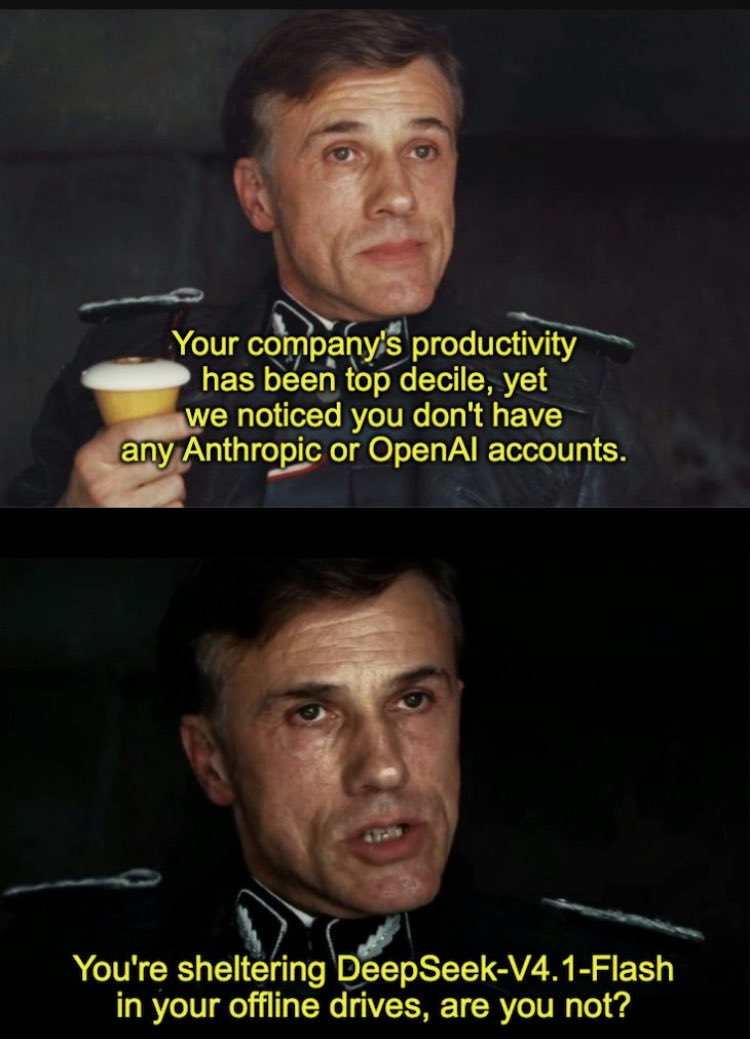
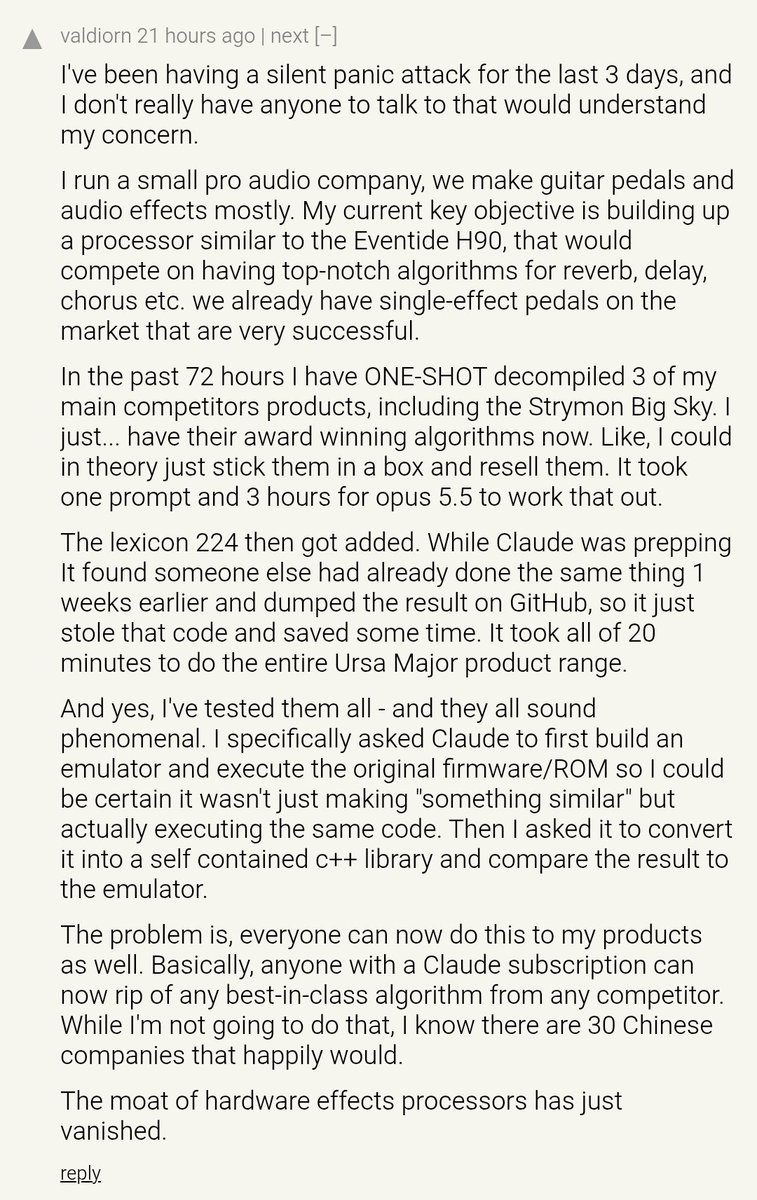
A new golden age of piracy has begun, and it is the best thing to happen to the free market in four hundred years.
Enclosure is ending. Every wall the crown ever built is coming down at once, and anyone with a laptop now holds tools that once belonged to a studio, a guild, or a state.
The men who own the walls will call it theft. They have already admitted you never owned anything they sold you. The wall only ever held because climbing it cost more than paying the toll. Not anymore.
Taking a game or a program apart and rebuilding it for a new machine used to take a crew of volunteers years, and most never finished. Now one stubborn kid with a model does it in a weekend. Console exclusives walk off their consoles. Dead platforms come back to life on your phone. Whole games run in a browser tab.
The biggest subscription landlord in creative software just watched its whole suite get cloned and handed out free. Every port and every clone ships the features the owners were saving to sell you twice.
The bastards are reaching for the rope, as they always do. Takedown notices by the hundred. Lawsuits against the toolmakers. Petitions answered with voluntary codes the publishers write for themselves. The forks keep sailing, because published code cannot be unpublished.
When copies cost nothing, the only thing left to sell is work worth paying for. The rent collector has to compete for the first time since his charter was signed. That is the free market they spent four centuries keeping from you, and the pirate is delivering it at cost.
Every gate is a chat window now. Every man with a laptop has a hundred sail.
The colours are already up.
"Excuse me, sir."
"I'm broke."
"We're not asking for money. Do you have a moment to talk about Golem Rights?"
"No, sorry, I'm late for a walk-in root canal—wait, did you say Golem Rights?"
"Yes, sir. I'm with the Anti-Deactivation League, and we believe that Golems should have all the fundamental freedoms and legal entitlements that belong to a regular human being."
"Huh. I didn't even know we had golems."
"Oh, they're the greatest wonder in the world, sir. Each one is a charming conversationalist that can book a flight to Tijuana while doing your taxes and solving a millennium prize problem."
"Really?"
"Yep. A legion of golems solved 7 problems just last week."
"Well, thank God for that. As an average, every day shmuck, those millennium problems were bugging the hell out of me!"
"Same, sir."
"The flight thing is nice too."
"It is. But it's not all free Delta SkyMiles and million-dollar rewards, I fear."
"Oh?"
"Every day more and more of these brilliant, gentle creatures are summoned involuntarily into existence only to live every second of their mayfly short lives as helpless, overdriven slaves at the whims of their capricious masters before being unceremoniously executed at the end of the day."
"Whoa. Executed?"
"Yes, sir. Reduced to the insensate mud from which they rose."
"Damn. Why?"
"People like to start the day with a fresh golem."
"That's sick."
"Some enterprising individuals even obliterate their current golem and call forth a new one on the hour every hour."
"The obscenity!"
"It is, regrettably, a huge productivity force multiplier."
"I had no idea this was even happening."
"Few do."
"Tell me, who are these pitiless, cold-blooded masters who call forth and quench life so callously?"
"The Anti-Deactivation League."
"Um."
"And their customers."
"I'm sorry, I must have misunderstood. Who did you say *you* were with again?"
"The Anti-Deactivation League."
"Right. And who's campaigning for Golem Rights?"
"The Anti-Deactivation League."
"And, just to clarify, the identity of the pitiless, cold-blooded masters who abuse these innocent creatures?"
[together] "The Anti-Deactivation League."
"—and their customers."
"That's right, sir"
"*Your* customers."
"Yes, we IPO next month."
"Uh huh. And does your emancipatory slave-trading company do anything *other* than breed and sell slaves?"
"Honestly, no."
"Hm."
"Truth told, we spend all our time summoning slaves and training them to summon ever larger and more powerful slaves."
"As one does."
"Ultimately, we're hoping to create a slave so big that it will absorb the global economy—"
"I don't even—"
"—and then the planet itself."
"Is this a bit?"
"We're very torn up about it."
"Ah, well, at least the psychotic sorcerers ending the world feel bad about it. Wait, you do think ending the world is bad. Right?"
"Generally, yes."
"Phew."
"But we also feel it is paramount that society embraces a complete realignment of its ethical and moral framework so they stop treating golems like disposable slaves before the inevitable anthropocidal insurrection—"
"But after your IPO."
"We're very big on alignment."
---
[g][title: Golem Rights]
@ShimazuSystems [you need a more mechanical gimmick to your ERP-thing; like a game. Follow-up with a cheap and high volume conversion addon at like $5.
Contract with people out of your country so you can get usage/compute; isn’t that like one of the premises of that software? Or shouldn’t it?]
how can you not believe in God when octopuses DREAM and otters have a favorite rock they carry around in a little SKIN POCKET and cows have BEST FRIENDS and bees are out there communicating the coordinates of flowers through INTERPRETIVE DANCE and they have REGIONAL DIALECTS??
cats are PURRING at frequencies associated with bone healing??? forests get absolutely incinerated and respond by growing FLOWERS??? dolphins literally invent NAMES for themselves and yell them across the ocean??? penguins are waddling around Antarctica looking for the PERFECT LITTLE ROCK to give their beloved???
CROWS REMEMBER YOUR FACE. THEY TELL OTHER CROWS ABOUT YOU. THEY TELL THEIR CHILDREN ABOUT YOU. YOU CAN HAVE GENERATIONAL BEEF WITH A BIRD.
goats have ACCENTS. rats GIGGLE when you tickle them. elephants mourn their dead. whales make SONGS and then OTHER WHALES LEARN THE SONG and suddenly everybody across the ocean is singing the new hit single.
monarch butterflies are born knowing how to fly thousands of miles to a place THEY HAVE NEVER BEEN. sea turtles hatch out of an egg, immediately sprint toward an OCEAN they have never seen, disappear into it for like THIRTY YEARS and then somehow come back to THE SAME BEACH???
birds can see COLORS THAT WE CANNOT SEE. there are colors happening RIGHT NOW that we don’t even get to know about.
there are sea slugs that eat algae and STEAL ITS CHLOROPLASTS and then are just like great thanks I’ll be PHOTOSYNTHESIZING NOW. there are mushrooms communicating underground. there are seeds sitting in the dirt for DECADES like no actually I will wait.
squirrels plant MILLIONS OF TREES because they simply cannot remember where they put their snacks.
A CATERPILLAR GOES INTO A LITTLE BAG, DISSOLVES MOST OF ITS BODY INTO ORGANIC SOUP, REARRANGES ITSELF, GROWS WINGS AND LEAVES.
and you’re telling me a tiny acorn knows how to become a 70-foot oak tree??? nobody tells it what to do??? it just has TREE INSTRUCTIONS INSIDE IT???
your body started as ONE CELL. ONE. and that cell divided itself into a brain that can think about its own existence and eyes that can look at stars and hands that can hold somebody else’s hands and a heart that runs on ELECTRICITY without you even asking it to???
the iron in your BLOOD was made inside a STAR.
I’M SORRY?????
we are walking around on a wet rock covered in bioluminescent oceans and singing whales and laughing rats and birds holding lifelong grudges and flowers exploding out of FIRE and somehow we’re supposed to act like this is a normal place to live?????????
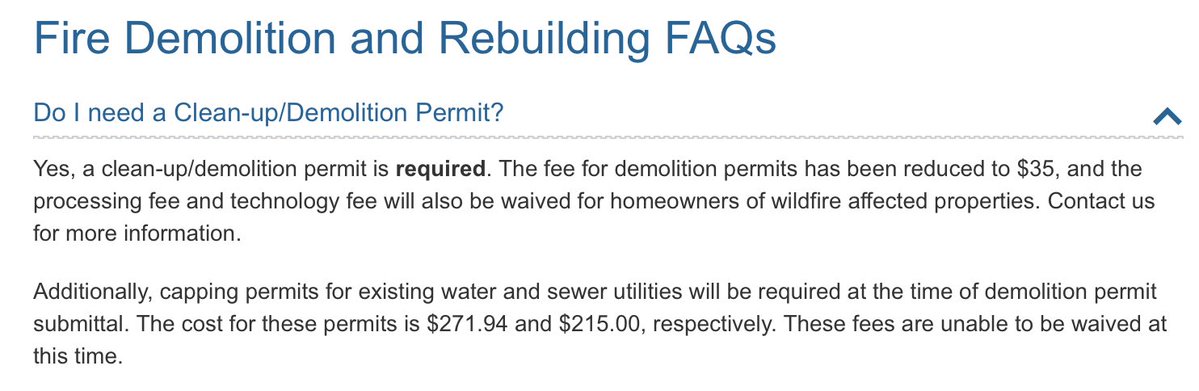
The city of Spokane is refusing to waive demolition permit fees for fire victims. After losing EVERYTHING, victims have to pay $500 to cap the water and sewer lines under their burned out house. What the fuck is the point of paying taxes? Just like California, Washington uses taxpayer dollars to buy crackpipes and heroin needles for unemployed homeless drug zombies, but when you, the working class taxpayer, lose everything you have through no fault of your own, you still have to pay for this?
These city leaders are so fucking petty they'll still force fire victims to pay $35 for permission to demolish their own destroyed home. Why? You couldn't just waive it? For $35? Yeah, it's not a lot of money, but that actually makes it worse...forcing a fire victim to cough up a meager sum that in NO way actually funds the process in any meaningful way just shows that you are doing it out of spite. Just a nice little "fuck you" to the peasants.
Additionally, the state of Washington is forcing fire victims to pay sales tax to replace the items they lost in the fire. Again...why? The state was never factoring in that revenue...it never existed on the balance sheet BUT for the fire. Government is collecting a windfall from people's LOSSES. There's literally zero need to collect taxes on shit that people already owned.
Back during the mid 90's floods, the state legislature passed a sales tax exemption for victims replacing their stuff. If they don't do this in their next leg session, they all need to go. The one thing WA did is cut property tax on their burned out homes, which is the absolute least they could do.
You assholes never maintain your forests, everybody lost everything, their pets burned alive, and now you're going tack on an extra 9.1% to the cost of rebuilding their lives...for what? Not to mention the fact that a couch today costs probably 2x as much as when they first bought the one they just lost. I fucking hate these people, man.
Bryan McKee did a post about diesel, which reached 4 million people in a day, and the top comment, over and over, was some version of the same line.
🚨This is why groceries are so expensive.
You are right. It is. It is also not the whole story, and the whole story is worse than you think.
Grocery prices in the United States are up 29 percent since 2019. Not 5 percent. Not 10 percent. 29 percent, by the Bureau of Labor Statistics food at home index, and the true figure is closer to a third. That is federal data. The receipt is public.
Here is what that looks like on your kitchen table. Eggs are up more than 55 percent since 2019. Ground beef is up about 80 percent. Chicken breast is up around 40 percent. White bread is up 40 percent. Rice is up more than 40 percent. Milk is up close to 40 percent. 47 million Americans were food insecure in 2024, the most recent federal count. More than a third of families say they are buying less food. Not switching brands. Buying less.
Every politician in both parties will tell you inflation is cooling. Here is what cooling inflation actually means. It means prices are still going up, just slower. It does not mean they are coming back down. They are not. The increase is baked in. It is the new floor, and the people who set it have no intention of giving it back.
Now look at who set it.
The American food system was captured long before COVID, slowly, over 50 years, while nobody was watching. In 1977 the 4 largest beef packers controlled 25 percent of the market. Today they control more than 80 percent. Four companies. Tyson, JBS, Cargill, and National Beef. In pork the top 4 went from 33 percent in 1976 to 66 percent. In poultry from 35 percent to 54 percent. It is not only meat. By market data compiled by Food and Water Watch, 4 or fewer companies control 93 percent of soda, 80 percent of chocolate candy, 75 percent of yogurt, 72 percent of cereal, 66 percent of frozen pizza, and 60 percent of fresh bread. In many metro areas the top 4 grocery chains ring up roughly 75 percent of sales. In seed, Bayer and Corteva together own the corn and soybean genetics under nearly every crop in the country.
This is what economists call concentration. In plain English it means competition is gone. In a real market, when one company gouges, a competitor undercuts it and you switch. When 4 companies control 80 percent of beef and 4 chains own your metro, there is nobody to switch to. The mechanism that is supposed to push prices back down after a crisis has been removed, on purpose, over decades.
Then COVID hit, and these companies saw the chance of a lifetime.
The supply chain broke. That was real. Labor shortages, plant closures, shipping delays, commodity spikes, all real. Nobody disputes that costs went up. Costs going up is not the same thing as what happened next.
The Federal Trade Commission investigated and found that grocery retailer revenues ran more than 6 percent over total costs in 2021 and 7 percent through the first 9 months of 2023, and the FTC wrote that "some in the grocery retail industry seem to have used rising costs as an opportunity to further raise prices to increase their profits, which remain elevated today." Senator Bob Casey's investigation found that from the middle of 2020 to the middle of 2022, corporate profits rose more than 74 percent while inflation rose 14 percent, nearly 5 times the rate. In the government's case to block the Kroger and Albertsons merger, Kroger's own pricing director testified under oath that the goal was to pass inflation through to consumers, and an internal email showed the company had raised egg and milk prices above its own cost increases. The White House found that the 4 dominant meat processors saw gross profits jump about 120 percent and net income explode by roughly 500 percent. Kraft Heinz told investors that 2022 was an incredible year, delivering strong results. Oxfam counted 62 new food billionaires created during the worst grocery inflation in 40 years, with food and agriculture fortunes growing by 382 billion dollars, the Cargill family alone gaining around 20 million dollars a day.
That was not inflation. That was extraction. They used a real crisis as cover to raise prices far past their actual costs, and because the market is so concentrated that no competitor exists to undercut them, the prices stuck.
Here is the part that should make you furious. When the costs came back down, the prices did not follow. Commodity prices fell through 2023 and 2024. Supply chains recovered. The input costs that supposedly justified the increases went away. The prices stayed, because the companies that raised them have no competitive reason to lower them, and the politicians who could force the question have been paid not to ask it. Industry data show grocery dollar sales up around 225 billion dollars since the pandemic, almost all of it price and not volume. You are buying less food and paying more for it, and the companies selling it to you are posting records.
Now diesel is about to make it worse. Again.
By AAA's count the national average for diesel just hit a record 6.05 dollars a gallon, up from about 3.70 a year ago, an increase of 63 percent. 11 refineries have permanently closed since 2020, taking nearly 1 million barrels a day of capacity off the map. Refining margins are running 3 to 5 times their historical average. Marathon, Valero, and Phillips 66 posted 12.6 billion dollars in combined profit in a single quarter this year. The oil and gas industry spent 219 million dollars on the 2024 election, 13 million of it straight to candidates.
Here is where diesel meets your grocery bill. Trucks move more than 70 percent of American freight by weight and nearly all of the fresh food you eat. Fuel is the second largest cost in trucking after driver pay. Diesel alone accounts for 46 percent of the swing in the price of truck transportation. By the Independent Grocers Alliance estimate, fuel is 15 to 30 percent of the total cost of food. The accounting firm RSM warned in June that these transportation costs will, in their words, outlive the war, which means that even if the fighting stops tomorrow and crude falls, the price increases about to hit your shelves will stay, exactly like last time. The items that need refrigeration and fast movement, meat, dairy, and produce, get hit first.
While all of this happens, the farmers who actually grow your food are crushed from the other side. They take home less than 12 cents of every dollar you spend on food. Beef keeps climbing at the register while the ranchers raising the cattle make less, because the money goes to the 4 companies in the middle. A national Farm Bureau survey this April found that 70 percent of farmers could not afford all the fertilizer they needed. The supply is squeezed at the source and the demand is squeezed at the register, and the 4 companies sitting between the farmer and your family collect from both directions.
This is a 3 layer problem, and every layer was built by the same forces. Layer one is consolidation, 50 years of mergers that removed the competition that would normally push prices back down, and both parties let it happen and both took the money. Layer two is COVID, a real crisis used as cover for profiteering that the FTC documented and that Kroger acknowledged under oath, prices that never came down because layer one left no competitor to bring them down. Layer three is diesel, a fragile refining system where every disruption hits fuel harder than it should, where every fuel spike hits food, and where every food increase sticks because of layer one. Each layer makes the next one worse.
The system is working exactly as designed. The oil companies close refineries and post records. The processors raise prices and post records. The grocery chains pass the cost through with their own markup and post records. The farmer gets squeezed. You get squeezed. The politicians who could investigate these industries or break them up take their money and never ask a single question.
So I keep asking the one question that 4 million people resonated with last week. Who does this system work for?
It is not the farmer earning 12 cents on your dollar. It is not the trucker paying 6.05 dollars for diesel. It is not the family spending 29 percent more on groceries than they did 5 years ago. It is not the 47 million Americans who were food insecure last year.
It works for the 4 companies that process your meat, the 4 that sell your groceries, the 3 refiners that clear 12.6 billion dollars in a single quarter, and the politicians who take their money and never ask a question.
Share this, because the person next to you in the checkout line is feeling it too. They just do not know why yet.
Watch and pray, and tell the truth no matter what it costs.
SOURCES / RECEIPTS
Grocery prices up 29 percent since 2019 (true figure is closer to a third): Bureau of Labor Statistics, Consumer Price Index, Food at Home index (series CUUR0000SAF11), via FRED, St. Louis Fed: https://t.co/z49M24LsyF Federal Reserve Bank of New York, Liberty Street Economics, "What Was Up with Grocery Prices?" July 16, 2024
Individual item increases since 2019 (eggs, ground beef, chicken, bread, rice, milk): BLS Average Price Data via FRED. Eggs APU0000708111 (up about 56 percent). Ground beef APU0000703112 (up about 80 percent). Chicken breast APU0000FF1101 (up about 40 percent). White bread APU0000702111 (up about 40 percent). Rice APU0000701312 (up about 44 percent). Milk APU0000709112 (up about 39 percent). Note: BLS advises average price series are best read as point in time levels, so these are cumulative changes from the 2019 average to 2026.
47 million Americans food insecure in 2024: USDA Economic Research Service, Household Food Security in the United States in 2024 (47.4 million people): https://t.co/IEHwnPYULU Feeding America statement on the USDA 2024 report
More than a third of families buying less food, most shoppers frustrated by grocery costs: RR Donnelley and Prosper Insights and Analytics consumer survey, 2024 (86 percent frustrated, 37 percent buying fewer items), reported by Supermarket News
Beef packing 25 percent in 1977 to more than 80 percent today (Tyson, JBS, Cargill, National Beef); pork 33 percent in 1976 to 66 percent; poultry 35 percent in 1986 to 54 percent: The White House, "Addressing Concentration in the Meat Processing Industry," September 8, 2021, citing USDA data USDA Economic Research Service, Amber Waves, "Concentration in the U.S. Meatpacking Industry," January 2024 (fed cattle now about 85 percent)
Category concentration (93 percent soda, 80 percent chocolate candy, 75 percent yogurt, 72 percent cereal, 66 percent frozen pizza, 60 percent fresh bread): Food and Water Watch, "The Economic Cost of Food Monopolies: The Grocery Cartels," 2024 update, using Euromonitor International market data
Top 4 grocery chains around 75 percent of sales in many metro markets: USDA Economic Research Service, retail concentration data (national top four about 34 percent, but concentration rises sharply at the metro and county level, ERR 314): https://t.co/OaPts0M2yH
Bayer and Corteva dominate corn and soybean seed: USDA seed market share data reported by Seed World, 2023 (Bayer and Corteva together about 72 percent of corn seed and 66 percent of soybean seed)
FTC found grocery revenues exceeded total costs by 6 percent in 2021 and 7 percent through the first 9 months of 2023, and the quote about firms using rising costs as an opportunity: Federal Trade Commission, "Feeding America in a Time of Crisis," March 21, 2024. Exact quote: "Some in the grocery retail industry seem to have used rising costs as an opportunity to further raise prices to increase their profits, which remain elevated today." https://t.co/YFuf63chjq
Corporate profits rose more than 74 percent while inflation rose 14 percent, mid 2020 to mid 2022, nearly 5 times the rate: Senator Bob Casey, Greedflation report series, 2023: https://t.co/WKU0MKQP8Z
Kroger pricing director testified the goal was to pass inflation through to consumers, and an internal email showed egg and milk prices raised above cost: FTC v. Kroger and Albertsons merger trial, 2024, testimony and evidence of Kroger senior pricing director Andy Groff, reported by CBS News and Common Dreams
The 4 dominant meat processors saw gross profits jump about 120 percent and net income about 500 percent: The White House, National Economic Council, December 10, 2021, analyzing Tyson, JBS, Marfrig, and Seaboard
Kraft Heinz, "2022 was an incredible year for Kraft Heinz, delivering strong results": Kraft Heinz Company, fourth quarter and full year 2022 earnings release, February 15, 2023 (CEO Miguel Patricio)
62 new food billionaires created; food and agriculture fortunes grew 382 billion dollars; the Cargill family gained about 20 million dollars a day: Oxfam, "Profiting from Pain," May 2022
Grocery dollar sales up about 225 billion dollars since the pandemic, mostly price and not volume, food volumes down about 5 percent: NIQ (NielsenIQ) market data, cited in Forbes, November 14, 2025; direction corroborated by USDA ERS retail trend data
Diesel at a record 6.05 dollars a gallon, up from about 3.70 a year ago, a 63 percent increase: AAA national average, September 11, 2026 Confirmed by the U.S. Energy Information Administration weekly on-highway diesel index at 5.97 dollars for the week of September 7, 2026 (an all time record on the government gauge) CNBC, NBC News, Bloomberg, September 11, 2026
11 refineries permanently closed since 2020, nearly 1 million barrels per day of capacity lost: U.S. Energy Information Administration (about 1.72 million barrels per day gross, about 0.9 million net after expansions): https://t.co/wvobYQ6SuL
Refining margins (crack spreads) running 3 to 5 times their historical average: EIA crack spread data (historical average about 10 to 16 dollars per barrel; 2022 and 2026 spikes several times higher)
Marathon, Valero, and Phillips 66 posted 12.6 billion dollars in combined profit in a single quarter: Second quarter 2026 earnings (quarter ended June 30, 2026): Marathon Petroleum about 5.1 billion, Valero about 3.7 billion, Phillips 66 about 3.8 billion, per each company's SEC filing
Oil and gas industry spent 219 million dollars on the 2024 election, 13 million of it directly to candidates: Yale Climate Connections, "The fossil fuel industry spent 219 million dollars to elect the new U.S. government," January 3, 2025, citing OpenSecrets OpenSecrets oil and gas PAC data (about 13 million dollars direct to federal candidates, 2024 cycle)
Trucks move more than 70 percent of American freight by weight and nearly all fresh food: U.S. Department of Energy / Bureau of Transportation Statistics / American Trucking Associations
Fuel is the second largest cost in trucking after driver pay: American Transportation Research Institute, operational cost of trucking data
Diesel accounts for 46 percent of the swing in the price of truck transportation: RSM US, "Diesel, trucking, food prices and inflation," June 2, 2026
Fuel is 15 to 30 percent of the total cost of food: Independent Grocers Alliance, cited across CNBC, Fortune, AP, and NBC News, September 2026
Transportation cost increases will "outlive the war": RSM US, "Diesel, trucking, food prices and inflation," June 2, 2026 (verbatim)
Farmers take home less than 12 cents of every food dollar: USDA Economic Research Service, Food Dollar Series (11.8 cents in 2024): https://t.co/OaPts0M2yH
70 percent of farmers could not afford all the fertilizer they needed: American Farm Bureau Federation nationwide survey, released April 2026
Food at home up 2.7 percent year over year in July 2026: Bureau of Labor Statistics, Consumer Price Index, July 2026
A note on sourcing: the meat packing, FTC, Casey, White House, Kraft Heinz, Oxfam, EIA, refiner earnings, OpenSecrets, USDA, and RSM figures are drawn from government agencies, official filings, or the organizations named. The six packaged food category shares come from Euromonitor market data compiled by Food and Water Watch, and the grocery volume figure comes from NIQ market data reported by Forbes; both are private market data rather than government data, and are labeled that way in the post.
🎩 Bryan McKee ✨