@StevenBartlett@foundmyfitness There are a lot of things in this study that should make you skeptical of the headline. For one (of many): the cases happened in 1991–2015 so the exposure likely happened years before that. The chemical used to golf courses in the 80s and 90s differ substantially from today.
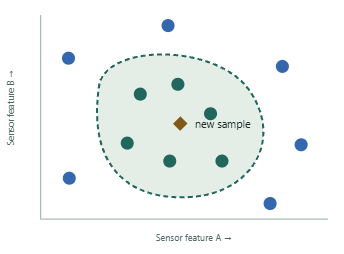
I tried using RBF-SVM ML models for odor detection. They didn't turn out that great. Other ML models performed better. But what is a RBF-SVM model anyway?
Imagine plotting recorded smells on a map. Similar patterns sit close together. An SVM learns the boundary that separates odor groups.
But what's the RBF part?
Instead of straight lines as the boundaries, it lets nearby patterns count more than ones further out. That lets you create curves.
The human nose has ~400 types of smell receptors. When you smell something, a unique combo of those receptors fire and your brain interprets that as a particular odor. Pretty similar to the way the letters of the alphabet can be mixed and matched to make any word.
At this point, I've look at so much raw odor sensor data, I can almost tell what's what from the streaming numbers on the screen. Kinda like that scene in The Matrix.
BREAKING: Scientists develop technology that allows people to digitally transmit smells across the world, potentially bringing scent to phone calls, video chats, & social media.
@Jonas_Vollmer These “predictions” are castles built in air. They stack assumption on top of assumption and don’t (and can’t) account for the dynamism of the complete system.
Agreed. Software is a type of language and SI is THE great translator. But language is really broader than that. Math is a type of language. Music. CAD. Architecture. It’s all about channeling ideas in your brain into things others can understand. Your point will apply to all of that.
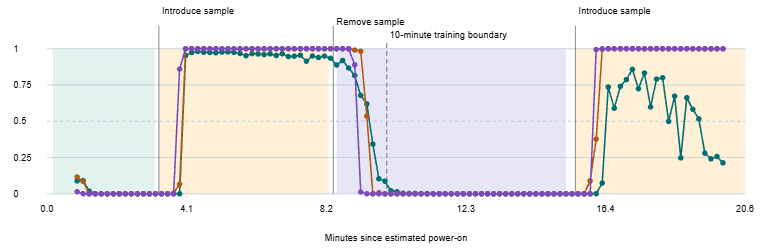
balanced accuracy (which I talked about in this post https://t.co/cvgZc47Rp6) still doesn't give you the whole picture. it misses:
- how quickly recognition happens
- if the algo recognizes a sample for a bit, but then messes up later on
- if the algo is 51% vs 100% confident in detection (100% should be rewarded more when it's right and penalized more when it's wrong)
- what % of the time it can make a prediction from available sensor readings
lots to consider. my fav visualization is a timeline like this. makes it way easier to see what's really cooking.
When judging whether an enose is guessing an odor correctly, ordinary accuracy isn't a good enough.
For example, if you have 8 samples of air and 2 samples of coffee and the algo blindly predicts air 100% of the time, its accuracy will be 80%.
A better approach is balanced accuracy.
- It accurately predicted air 8/8 times = 100%
- It accurately predicted coffee 0/2 times = 0%
You weigh those 2 equally so (100% + 0%)/2 = 50%
That's a much better reflection of what's going on (but still only a piece of the puzzle).