When I was a postdoc at MIT over 10 years ago, Jeffrey Goldstone, then in his 80s, would still come in every single day.
He rarely spoke with the high-energy theorists. Rather, at that time, he kept mainly to quantum information side of the CTP. Here's my one story with him 1/7
Wow. @physics_nate (currently on leave at OpenAI) has made significant progress on a very deep problem relevant to our understanding of the Standard Model (SM) of particle physics.
It’s technical, but briefly: the matter content of the SM (electrons, quarks, etc) are fermions and they are “chiral” (they have left-handed and right-handed components that behave differently). We’ve lacked a good way to describe / simulate such systems “non-perturbatively” (which is a controlled way of doing approximations).
The paper connects with foundational ideas laid out by Lüscher (who is wicked smaht) and uses GOT Astra + lean formalization in ways that are perhaps subtly different than in math because of the role of recorded assumptions vs. axioms.
https://t.co/HAek4J2A0X
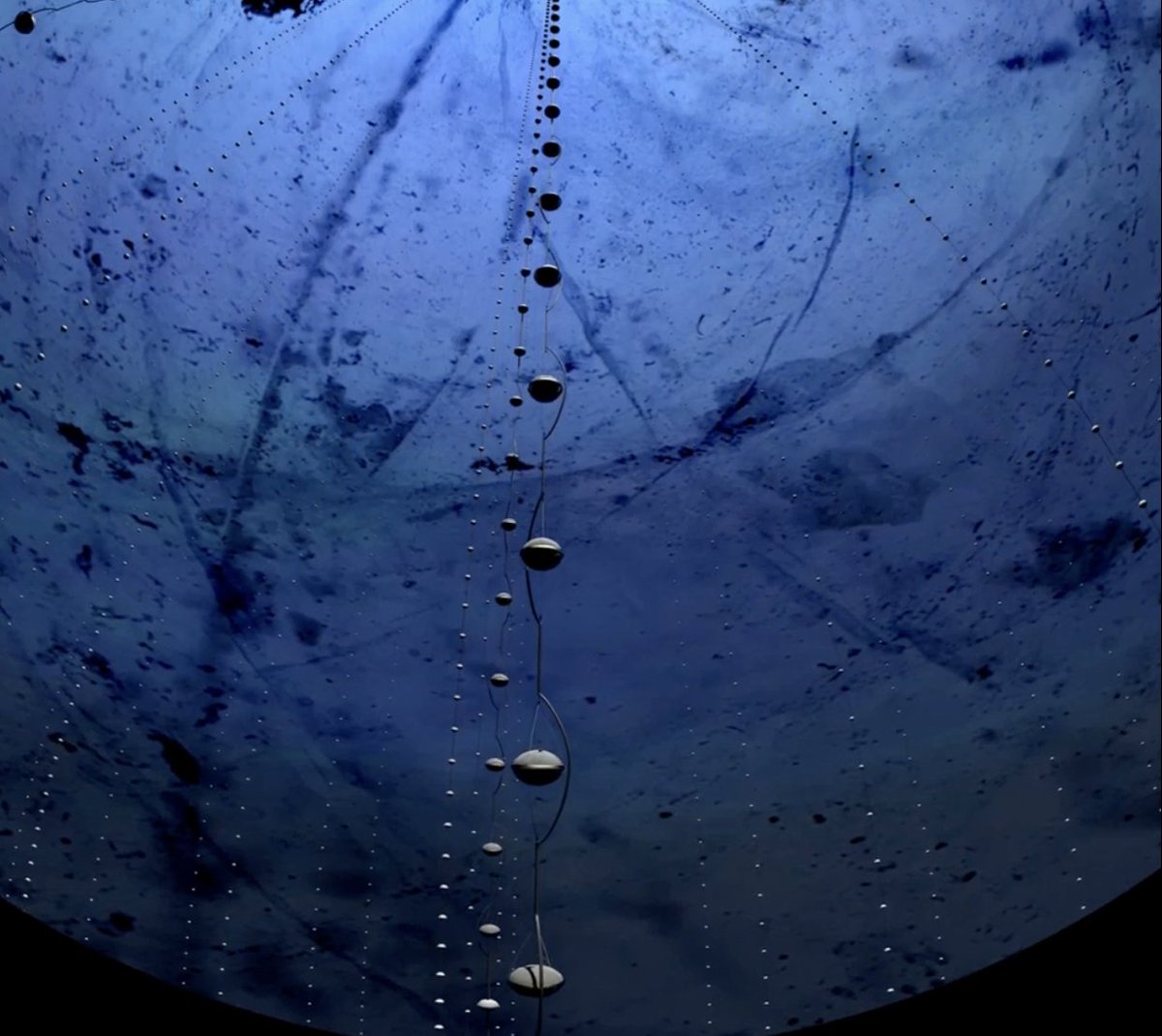
I am so happy today for Francis Halzen and for the IceCube collaboration. The Nobel Prize for Francis, for IceCube, and for high-energy neutrino astronomy is very special for me, both scientifically and personally.
Congratulations to Francis Halzen! He was so clear why
(1) neutrinos are the only way to do astronomy in dense environment with pointing
(2) neutrinos are likely to be generated by high-energy astrophysics as "beam dump" experiments
(3) big chunks of ice or water are the only way to go
and many people got convinced by the crazy idea. And he made it happen! A well-deserved honor. He is such a nice guy, too.
BREAKING NEWS
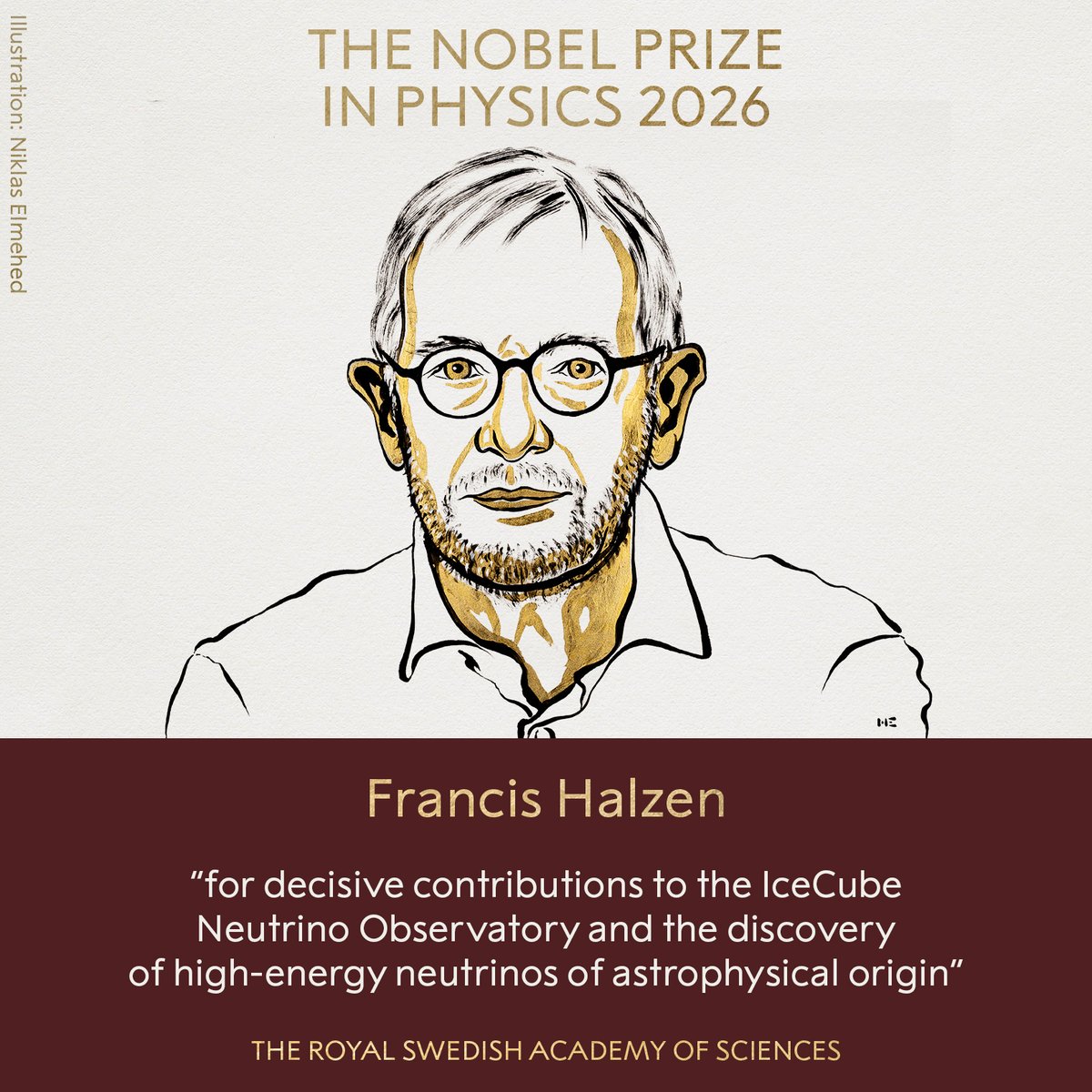
The Royal Swedish Academy of Sciences has decided to award the 2026 #NobelPrize in Physics to Francis Halzen “for decisive contributions to the IceCube Neutrino Observatory and the discovery of high-energy neutrinos of astrophysical origin.”
Working with @GuiLeiPimentel on new prescription to construct de Sitter gluon correlators. One of the new limitation these days are the limited working hours of our AI friends.
@KyleCranmer@AnthropicAI This paper has some suggestive calculations, if I recall the suspicion is that at 7 or 8 loops (in 4D) the UV divergence should appear — https://t.co/6UlLpSHadV
I am not a professional mathematician (do have a BSc though :))
Historically math was never just about proofs.
Newton treated infinite series and calculus problems before the foundations were made rigorous - centuries later!
His route to discovery was often "experimental."
Gauss did something similar. As a teenager, he counted primes in blocks, compared the results with logarithms, and noticed that their density looked like (1/\log x). He kept testing the idea whenever new prime tables appeared. A proof arrived only about a century later.
This was normal: calculate, draw figures, inspect tables, try examples, make a conjecture, and then search for an argument. A lot of the math (or maybe even all of it) developed in that period ended up directly relevant for physics.
The modern ideal of definitions first, perfect rigor throughout, and mathematics as an abstract axiomatic system became dominant mainly in the 20th centuries. Many of my colleagues think it destroyed math. It certainly led to a huge amount of math that has no known application outside the field—and may never have one.
The true most important “utility function” of a mathematician is not the number of problems they solve, or the number of counterexamples they find to some random conjectures, but the number of fertile ideas, definitions, and structures they create for other mathematicians. There is no other consumer to most ideas in modern math other than human mathematicians.
In this sense, math is not "done" *yet*.
A beautiful article on whether AI can "do mathematics" by the legendary Peter Sarnak, Prof. at Princeton and Ph.D. supervisor of at least two Fields Medallists. For anyone interested in such philosophical issues, it is a must read.
https://t.co/AIa6MNPNLV
Why is AI doing so much better in math than in physics? Is it because physics is more “hand wavy/intuitive”? (Not to say it’s doing bad in physics, it’s a very useful tool)
We put out a paper yesterday with Song and some of his amazing students. We point out some interesting observations about the structure of correlation functions for CC \phi^3 theory in dS: https://t.co/uWr3ONUNaR.
Today in "I got shafted because I wasn't as famous as the other guy": Demos Kazanas, the first to propose inflation to solve the homogeneity problem.
Inflation is usually credited to Alan Guth, with important follow-up work by Andre Linde, and Paul Steinhardt & Andy Albrecht.
Deeply saddened by the passing of Nobel laureate Tony Leggett. Once in a conference, the posters were inadvertently placed too low, yet he knelt down to listen to our presentations. His respect for every piece of knowledge will endure alongside his legendary contributions to phys