Italian culture, history, wines and landscapes
My family served the Savoy Dukes and Kings for centuries
Back from around the world I am rediscovering my roots
@GenoaCFC Grande Johan, fedele al Grifo (al contrario di altri che esaltano la grande famiglia rossoblu e poi prendono allegramente altre strade) Speriamo bene
@GenoaCFC AVETE VENDUTO LA SPINA DORSALE DELLA SQUADRA: DRAGUSIN("TANTO SIAMO PIU' FORTI"), MARTINEZ (TROVANDO UN PORTIERE ALL'ULTIMO MOMENTO), GUDMUNDSSON (SENZA SOSTITUTO), RETEGUI. AVETE CHIESTO IL RECORD DI ABBONATI (A PREZZI MAGGIORATI). SIETE UNA MASSA DI DEMENTI.
@GenoaCFC L’unica domanda a cui aspetto una risposta: NON VI VERGOGNATE A PRENDERE I TIFOSI DEL GENOA GIRO? QUANDO AVREMO UNA PROPRIETÀ E DIRIGENTI DEGNI DI QUESTO CLUB? GRAZIE
«...SIX ITALIANS EQUIPPED WITH MATERIALS OF NEGLIGIBLE COST HAVE SHAKEN THE MILITARY BALANCE IN THE MEDITERRANEAN TO THE ADVANTAGE OF THE AXIS»
(Winston Churchill)
On the night between 18 and 19 December 1941, six Naval operators of the #ItalianNavy completed the Enterprise of Alexandria, against the #BritishMediterraneanFleet, #scuttling two #battleships, one #destroyer and one tanker.
The operation began with the boarding of the Siluri a Lenta Corsa (SLC) assault vehicles, later universally known as "Maiali" (Pigs), on the submarine #Sciré.
The submarine sailed through the British defences and minefields to finally emerge in a perfect position 1.3 nautical miles for 356° from the Alessandria lighthouse.
The six men of the assault group, in pairs on each "pig", thus began their covert transit towards the targets.
On pig 221 the lieutenant Luigi Durand De la Penne with the Chief Diver Emilio Bianchi, on pig 222 Captain of the Naval Arms Vincenzo Martellotta with the Chief Diver Mario Marino and on pig 223 the Captain of the Naval Engineers Antonio Marceglia with the Chief Diver Spartaco Schergat .
De la Penne: "How's life, Bianchi?"
Bianchi: "Very well, commander"
De la Penne: "Are you afraid?"
Bianchi: "Yes, commander"
De la Penne: "Me too, Well, let's go!"
Durand de la Penne and Bianchi aimed for the battleship Valiant.
In the last stretch of the underwater race de la Penne was forced to drag his vehicle to the bottom having lost the support of Bianchi who was struck by an illness due to a malfunction of the respirator.
He managed to place the explosive charge under the ship but was captured. Shortly afterwards Bianchi was also captured and the two were locked in the ship's chain well.
The two did not reveal the location of the bomb but half an hour before the explosion, de la Penne was taken to the ship's commander to inform him of the risk faced by the crew; nevertheless he had the Italian officer brought back to where he was.
The explosion was punctual and tore the hull of the battleship but the two Italians managed to leave the room and go on deck from where they were evacuated together with the rest of the crew.
Martellotta and Mario Marino were forced to sail on the surface due to an illness of the crew chief and managed to position the charge for the tanker Sagona without managing to escape capture by the Egyptians.
The explosions took place around six the next morning.
Four ships were seriously damaged in the undertaking: in addition to the three mentioned, the destroyer HMS Jervis, moored alongside the Sagona, was in fact the victim of the charges laid by the Italian attackers.
Marceglia and Schergat finally managed to complete the attack on the Queen Elizabeth without incident. After placing the explosive charge they reached land and managed to get away from Alexandria but they too were recognized and captured the following day.
The final damage assessment was as follows: sinking of two British battleships #HMSQueenElizabeth (33,550 tons) and #HMSValiant (27,500 tons) and damage to the tanker Sagona (7750 tons) and the destroyer #Jervis (1690 tons).
The 1st Battle Squadron of the Mediterranean Fleet, the traditional flagship of the Royal Navy, has no longer existed since December 1941.
The value of our heroes was also appreciated by those who suffered their action.
Three years later, the six protagonists of the enterprise were decorated in Taranto with the gold medal for military valor in a completely singular way: it was Commodore Sir Charles Morgan, former commander of HMS Valiant at the time, who pinned the medal on their chest. of the operation.
MOUNTAIN FORTRESSES: BARD
The #Bard#Fortress is one of the most famous and impressive buildings in the entire #AostaValley, halfway between a castle and a fortress.
It is in fact one of the first examples of an early nineteenth-century barrier fortress, located on a rocky promontory 384 meters above sea level, on the left of the Dora Baltea.
In 1242 Amedeo IV of Savoy conquered the fort, which then came under Savoy dominion. In 1661 it became the garrison of the forces of the Duchy of #Savoy in the Aosta Valley.
Precisely from here, in 1704, during the War of the Spanish Succession, the army of Vittorio Amedeo II of Savoy opposed the #French troops.
The best-known episode, however, is that of 14 May 1800, when 40,000 men of #Napoleon 's Armée de Réserve crossed the Alps via the Great St. Bernard to surprise the Austro-Piedmontese army.
Once they arrived in Bard, they were stopped by the garrison of Piedmontese-Austrian troops who were garrisoning the fortress: the siege lasted about two weeks, until Napoleon, exasperated by the resistance of the Italian and Austrian soldiers, had the castle of Bard razed to the ground.
At the end of the 19th century the Bard fort fell into disuse and was first used as a military prison and then as a powder magazine, until it was acquired by the Valle d'Aosta Region in 1990.
After a major restoration, the castle was opened to the public in 2006 and today it is a highly appreciated cultural center in the region.
PIEDMONT MOUNTAIN #FORTRESSES: EXILLES
The #Exilles Fort is one of the oldest monuments in the Susa Valley.
Its origins are still uncertain but around 1155 it already existed when the counts of Albon exercised strategic, military and mercantile control over the Montgenèvre road, and Exilles represented the extreme eastern border of the principality.
In 1339, it already presented a complex structure: it is a rare example of a "street castle", with a defensive construction divided into several walled circuits to defend the internal core and an external barrier, effective control of the important road axis that led from #Piedmont to to #Provence via Montgenèvre.
In the sixteenth century the castle was long disputed by opposing Catholic and Reformed factions who aspired to control the #Dauphiné on this side of the #Alps.
At the beginning of the seventeenth century the fort changed its structure from an old castle to a bastioned fortress, where between 1681 and 1687 it hosted the mysterious and famous character called the "Iron Mask".
See also my previous post on this topic:
#PIEDMONT AND #HISTORY: THE #IRONMASK 🤖
In the early years of the eighteenth century, the fortified fortress of Exilles, under the direction of Bertola and De Willencourt, underwent massive renovation and modernization works including the reversal of the defensive front towards #France.
Further transformations were implemented in the mid-eighteenth century: the Fort was rebuilt by operating a notable synthesis between defensive and logistical structures, with the formation of independent, self-sufficient and defensively progressive bodies.
The Treaty of #Utrecht of 1713 transferred the royal dignity from the King of France to the House of Savoy, thus making it necessary to overturn the defensive front.
The fort was built in its current form between 1818 and 1829 by the King of Piedmont who returned to possession of his territories after the Napoleonic wars.
ITALIAN MOTORING SHOOTING STAR: SERGIO CRESTO
I live in #Ospedaletti, on the western Ligurian Riviera (Italy), a few meters from what until 1972 was a world-famous motorbike and F1 circuit.
When driving my red #AlfaRomeo on these winding roads between houses and villas, I often think of an American-Italian chap who lived here and who died in 1986 at the age of thirty while taking part to the Tour de Corse, the French stage of the world rally championship.
His name was #SergioCresto, and he had made a rapid career as a navigator, arriving at the then #Lancia #Martini team as co-equipier for Finnish raising star #HenriToivonen.
On May 2nd, 1986, they both died inside their 500 HP Lancia Delta S4, which fell off the road and immediately caught fire.
The reason for this shocking accident was probably the accelerator pedal which remained stuck down.
When braking with the left you tend to have very close feet and the "gas-brake" movement occurs in a fraction of a second.
Even though they were in a not too complex section of the special, when Henri Toivonen went to apply the brakes, he was unable to do anything as it was in an "unnatural" position.
In short, a technical problem, the failure of the pedal support, would have made the machine powered by around 500 horsepower uncontrollable.
Sergio and Henri, we will never forget you.
8 DECEMBER 1943: BATTLE OF MONTELUNGO
The Battle of Montelungo was fought during the #SecondWorldWar, during the #Italian campaign.
It was the first episode after ITALY'S DECLARATION OF WAR on Germany that saw a new Italian military formation of the so-called co-belligerent Army in action alongside the allies.
The first attack by the Italians was harshly repelled by the German soldiers on 7 December 1943 as the US soldiers did not take San Pietro Infine and therefore did not provide adequate artillery support . Subsequently with better cooperation, the Italians conquered Monte Lungo with a second attack on 16 December. The Germans retreated orderly to the next fortified position of the Gustav Line.
The Allied Command, to test the operational capabilities of this new Italian unit, assigned it a difficult task: to attack and conquer #MonteLungo, in the province of Caserta.
To oppose the enemy advance, the Germans had blown up on 29 and 30 September various houses, the fortress, the town hall and the bridge over the Rava stream, the only pass between the consular Casilina and the center of Mignano.
On 3 December the Italians, supported by two infantry regiments and a battalion of US rangers, received the order to conquer Monte Lungo, considered very important both for the Germans who used it as a barrier to avoid the Allied advance in the plain and to control the railway and the Casilina, and the allies who considered it crucial to pass over and head towards Cassino and to wrest control over the historic road.
On December 8, as foreseen in the Allied plans, they attacked, advancing covered by thick fog, but this was unexpectedly swept away by a strong wind: the Group, taken by enfilade from lateral positions that the Americans had failed to conquer, suffered heavy losses and he was forced to retreat.
In the following days, orders were issued for a new attack, with a new battle plan: it implied the fall of the main peaks of the Monte Lungo group, from right to left starting from an altitude of 950, Cima Sammucro, San Pietro Infine and Monte Lungo.
Preceded by about three quarters of an hour of intense artillery fire, at 09:15 on 16 December the Italian infantrymen and Bersaglieri set off again to conquer the mountain.
Unlike the first time, they were now covered by the 142nd US regiment already stationed on Monte Maggiore.
The Germans, after having strenuously defended the mountain, position after position, were forced to retreat to avoid being isolated and at 12.30 the #Italian and #US flags were flying at the top of the mountain.
In the end the #Germans finally had to retreat, but they gained time to prepare the positions of what would have been the Gustav Line, considerably delaying the Allied advance.
After much insistence on the part of the Italian Supreme Military Command, which had already obtained the use of various naval units alongside the Allies, an Italian unit was sent to the front for an operation to break through the German lines.
This department, established on 27 September 1943 in Brindisi, having the consistency of a brigade, was called the 1st Motorized Group; made up of soldiers from all the regions of Italy with worn-out uniforms and equipped with light armament (including Brixia Mod. 35 mortars and Breda Mod. 37 machine guns) with the support of an artillery group, it had been equipped with all the trucks that Italian military logistics had managed to find, and had had no allied help in terms of materials.
The group was at the disposal of American General Geoffrey Keyes. Led by General Vincenzo Dapino, it was commissioned to participate in the breakthrough of the Volturno Line, and was made up of the 67th "Legnano" Infantry Regiment, the 51st Bersaglieri Battalion, additional officer cadets, the 11th Artillery Regiment, the 5th Anti-tank Battalion, a mixed company of engineers and a service unit.
The war flag was that of the Legnano division.
ITALIAN OPERA SINGING IS PART OF UNESCO CULTURAL HERITAGE LIST
Unesco, the UN culture agency, announced it was including the four-centuries-old art, mixing costume, drama and music, under its category of Intangible Cultural Heritage.
#Italian#opera developed in the late 1500s and early 1600s in #Florence, at the court of the #Medici family.
It typically involves intricate plots, elaborate staging and virtuoso singing.
Opera singing joins other famed Italian practices, such as pizza-making and the art of scaling the Alpine peaks.
#Unesco described Italian opera as "a physiologically controlled way of singing that enhances the carrying power of the voice in acoustic spaces such as amphitheatres and churches".
It added that the art promoted "collective cohesion and sociocultural memory", as well as being "a means of free expression and intergenerational dialogue".
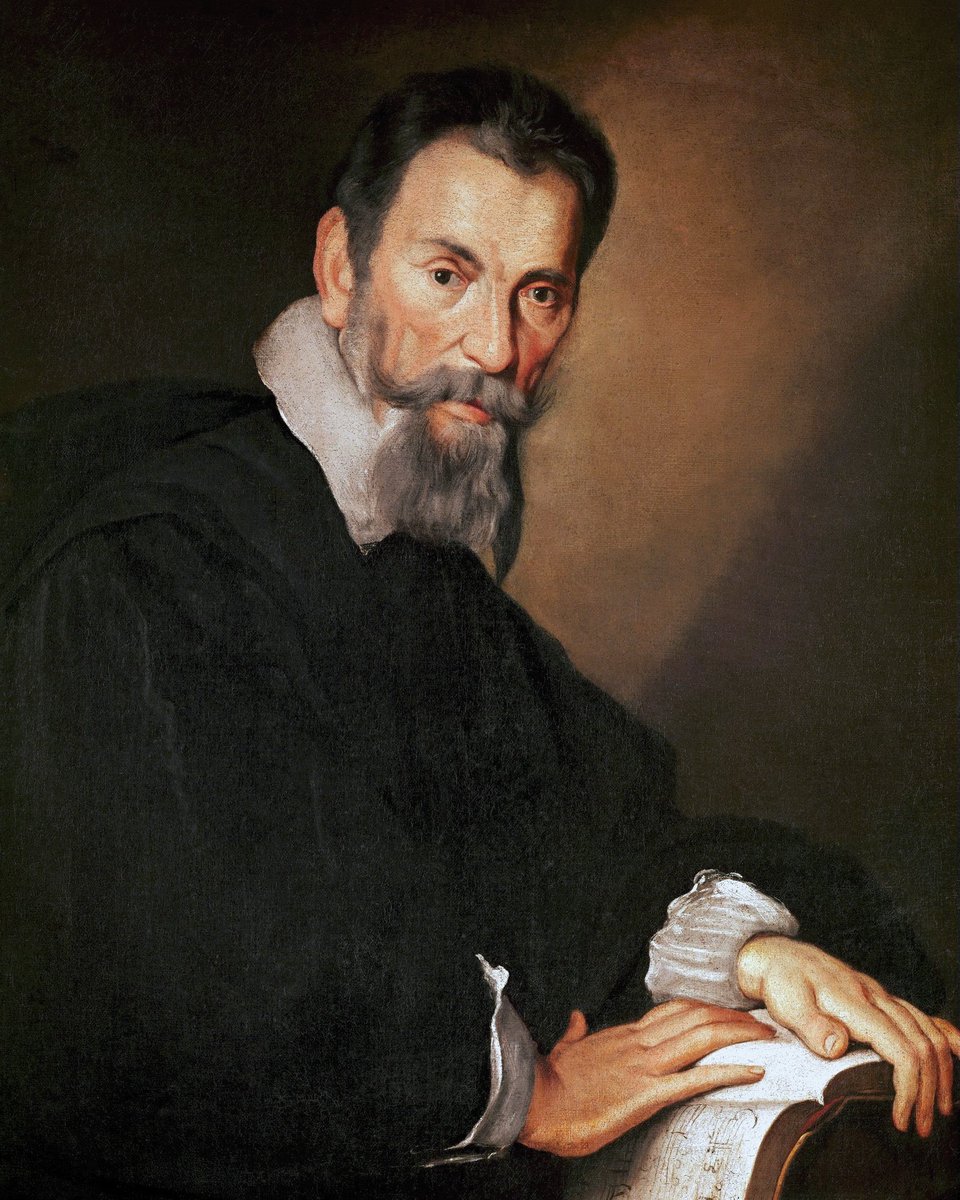
The first great composer of opera is considered to be Italy's Claudio Monteverdi, who lived from 1567 to 1643.
Today there are about 60 opera houses across Italy - a global record - while opera singers such as 20th-Century tenor Luciano Pavarotti have been venerated as major stars.
WHY #PIEDMONT? BECAUSE IT IS PACKED WITH #HISTORY, AND WE CONTRIBUTED TO IT!
My passion about Piedmontese #culture, #wine, #beer, #history, landscapes is due to the contribution my family gave to the fortunes of this part of Italy in the last 750 years.
In the 14th century my ancestors formed an armed unit, moved south from today #Switzerland to Piedmont to serve as contract soldiers for Amedeo VI, Earl of Savoy (also known as the “Green Earl”), the first member of this family to gain control of lands south of the Alps.
My ancestors eventually became members of Savoy “noblesse d’epée" (Nobles of the Sword), serving the Earls of Savoy, and later the Dukes of Savoy and then the Kings of Piedmont (following the Utrecht Treaty on 1715).
They are mentioned among the noble families of Piedmont in the first Duchy of Savoy roll call (January 12, 1550).
Thus, every time I pass the Maritime Alps and enter Piedmont from my native #Liguria, I do have the feeling of going through something I already lived through.
PIEDMONT MOUNTAIN FORTRESSES: FENESTRELLE
Throughout its #history, the #DuchyofSavoy first, and then the Kingdom of #Piedmont, have often been at loggerheads with their strong neighbour #France.
The unfortunate position of Fort Mutin, built by the French at the end of the 17th century and fallen into #Savoy hands in 1708, brought the need to guarantee the defense of the Val Chisone narrow passage back to the forefront.
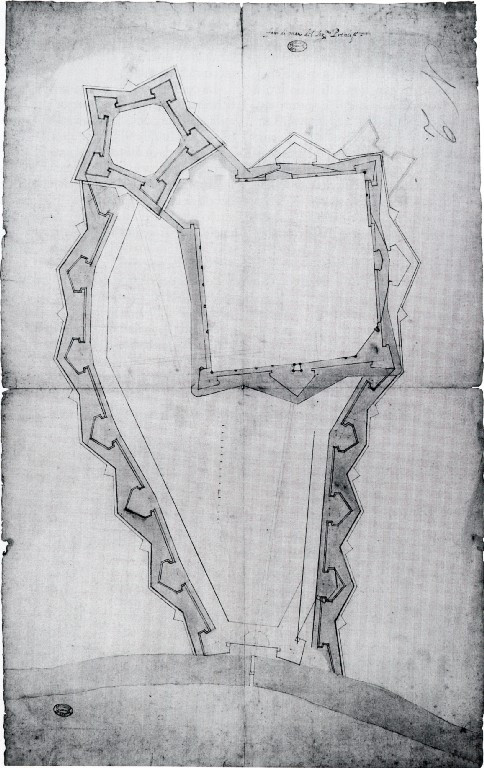
After some interventions, in 1715, to reorganize the French redoubt Tre Denti, the major works, designed by Ignazio Bertola, started from the Forte delle Valli.
The fort, whose eighteenth-century phase can be said to have ended only in 1786, is divided into three sections.
#Fort San Carlo, accessible from the Royal Gate, which houses the garrison buildings such as the officers' pavilion, the governor's palace, the church, the quarters, the warehouses and the powder magazines.
Along the western front a line of twenty-eight artillery positions forms two bastions, the S. Carlo and the Beato Amedeo.
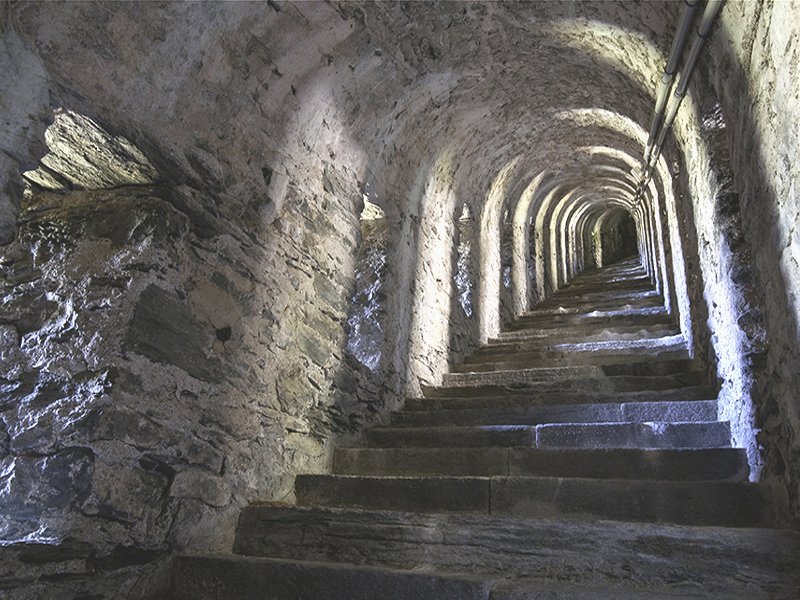
A "bomb-proof vault" staircase ensures protected communication with the upper forts, the Tre Denti and the Forte delle Valli, the latter divided into three redoubts: Belvedere, Sant'Antonio and dell'Elmo.
With the last major construction, the Carlo Alberto Redoubt, dating back to 1836-37 and intended to control the road to France to replace Fort Mutin, the fortified district took on its definitive form.
This impressive masterpiece of #military #architecture can be visited through guided tours.
PEASANTS' MEDIEVAL #REVOLTS: THE TUCHINI
The #Tuchini movement against the lords of Canavese broke out in 1386, a period in which the peasants of half of Europe revolted against arrogant lords.
In #Piedmont they have gone down in history as the Tuchini since one of the first acts of rebellion was "killing the dogs of the feudal lords" ("Tue Chiens" in French).
The war of the beggars against the powerful and against poverty, already lost from the beginning, had actually begun in Haute-Auvergne, had extended to the Velay and then to Languedoc, Provence and Lionnaise, leaving a long-lasting memory of such ferocity and anger.
Suffocated in France, the revolt had passed through the mountains of #Piedmont and #AostaValley, giving vent to all its destructive anger in the Canavese area, where nobles tyrannised the village communities and their poor people.
The first Piedmontese episode of rural revolt was that of the subjects of San Martino di Valperga between 1386 and 1391, which forced the Counts of #Savoy to send an army to stop the attacks on castles.
The clashes ended with the vengeful meeting in Ivrea where Amedeo VII of Savoy struck hard as "regular trials were instituted and many peasant leaders ended up executed" even if "new regulations on taxes were established, ransoms were prohibited and corvée were established", and the Canavese lords "were forced to treat their subordinates with greater humanity". Stick and carrot.
But the fire smoldered under the ashes, and the peasant rebellions exploded again in the Brosso valley.
Once again the Savoys suffocated the movement in blood: the Tuchini revolt ended only in 1447 with the "final pacification", consisting of a few concessions to the farmers and the military occupation of the valleys.
THE #SCOTTISH CLAN LOST IN #PIEDMONT
Legend has it that, after the battle of #Pavia in 1525, King Francis I of France surrendered to Emperor Charles V and some Scottish mercenaries, unable to return to their homeland, found refuge in the village of #Gurro , close to the #LakeMaggiore.
The choice fell on this place because the soldiers found living conditions in this village similar to those of the Scottish #Highlands.
In 1973, lieutenant colonel Gayre of Gayre and Nigg, baron of Lochoreshyre, after various historical research, declared the Gurresi to belong to the #Gayre Clan, asking that the inhabitants of Gurro could take advantage of the rights reserved for members of the Scottish Clans.
The sumptuous ceremony took place more than forty years ago and attracted numerous authorities and as many journalists and television broadcasters to Gurro, including the #BBC itself which produced a documentary on the event.
On the occasion of the recognition, the official kilt of the Gayre Clan (whose main color is green) and the original sporran (the leather and fur bag used as a holder to prevent the kilt from lifting) were given to Gurro.
As a sign of closeness to their Scottish origins, even today the population dresses in kilts on Sundays and on special occasions. Furthermore, on the second Sunday of July, on the occasion of the village festival, the inhabitants parade in tartan while playing the bagpipes.
There are many affinities between the village of Gurro and Scotland such as:
• the geological characteristics of the mountains and expanses of meadows suitable for cultivation and livestock farming;
• the parish registers of the town where you can read the names of their ancestors, such as Lenatt and Dromont;
• the local dialect which includes around 800 words of Gaelic origin;
• surnames such as Pattriti, Donaldi and Gibi which derive from the Scottish #Fitzpatrick, #MacDonald and #Gibb;
• on an architectural level, St. Andrew's cross-shaped beams typical of the ancient architecture of Scotland and which are not found in any other village in the valley were recognized in the houses of the village.
#BAROQUE#PIEDMONT: MILITARY AND CIVIL ENGINEERING, ASCANIO VITOZZI
Born in Orvieto in 1539, natural son of Ercole, lord of Montevitozzo.
He followed a career in arms as a young man, enlisting in the papal army and fighting in the Battle of #Lepanto in 1571, then in Tunis and Portugal, always following the Holy League.
Following the armed forces, he was promoted to #military #architect, designing modern fortifications, which brought him attention to the court of Emanuele Filiberto of Savoy, nicknamed the "Iron Head Duke".
Having arrived in the capital, Turin, then in turmoil of renewal, especially under the duchy of his successor, Carlo Emanuele I, known as "the Great", Vittozzi dedicated himself not only to defensive works, but also to civil architecture, designing squares, streets and buildings and becoming the advocate of the transition from #Mannerism to Piedmontese Baroque.
Vitozzi's most significant work is the sanctuary of #Vicoforte (from 1596), near #Mondovì, where the artist intervened on the project of E. Negro di Sanfort by inserting a cross in the initial elliptical plan, under the initial overview of my ancestor Antonio #Guidetti di Strambino, right arm of the Duke of Savoy .
The building development of #Turin remains linked to Vittozzi because he was given the task of designing the plan of the entire central district of Turin, from Piazza Castello, which he designed with the first porticoes, to Via Nuova (now Via Roma).
He is buried in the sacristy of the church of the Santissima Trinità, in Turin, in the central Via Garibaldi.
RIDLEY SCOTT'S #NAPOLEON BIGGEST INACCURACY: "ITALY SURRENDERED WITHOUT PUTTING UP A FIGHT"
(Italy as a unified nation did not exist at that time)
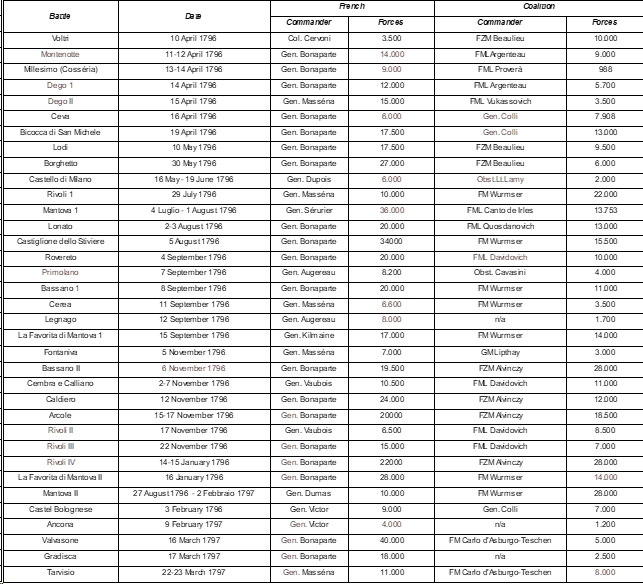
Upon Napoleon's First Italian Campaign (1796-97) 35 (thirty-five) battles were fought, with casualties ranging from a few hundred to several thousans.
Herebelow the list, with relevant dates, places, commanders and forces on the field.
Just to set the record straight...
Let us remember the Arc de Triomphe mentioning :
#Montenotte #Lodi #Castiglione #Arcole #Rivoli #Marengo
Next: Napoleon's Second Italian Campaign