Robert Friedland: If you think we have enough copper you’re dreaming
- In human history, we have mined ~700 Mt of copper
- In the next 18 yrs, we need to mine the same amount as in the last 10k yrs
- And that’s without factoring in renewables, data centers or wars
We have all these fancy ideas: renewables, data centers, and EVs… just electrify everything and assume copper will be available.
The reality? We haven’t invested in copper for >10 years, meanwhile it is getting harder and harder to find and mine copper.
- Since 1900, energy required to produce copper is up 16x
- Water consumption is up 2x
- Mines are deeper and smaller
- Grades are declining
We now need more resources to produce the same amount of copper.
- 6 Tier-1 copper mines must come online every year for the next 24 yrs
- The last major copper mine came online in 2021
- Major copper discoveries are down ~80% over the past 2 decades
That’s a long way of saying copper prices must rise to incentivize new production.
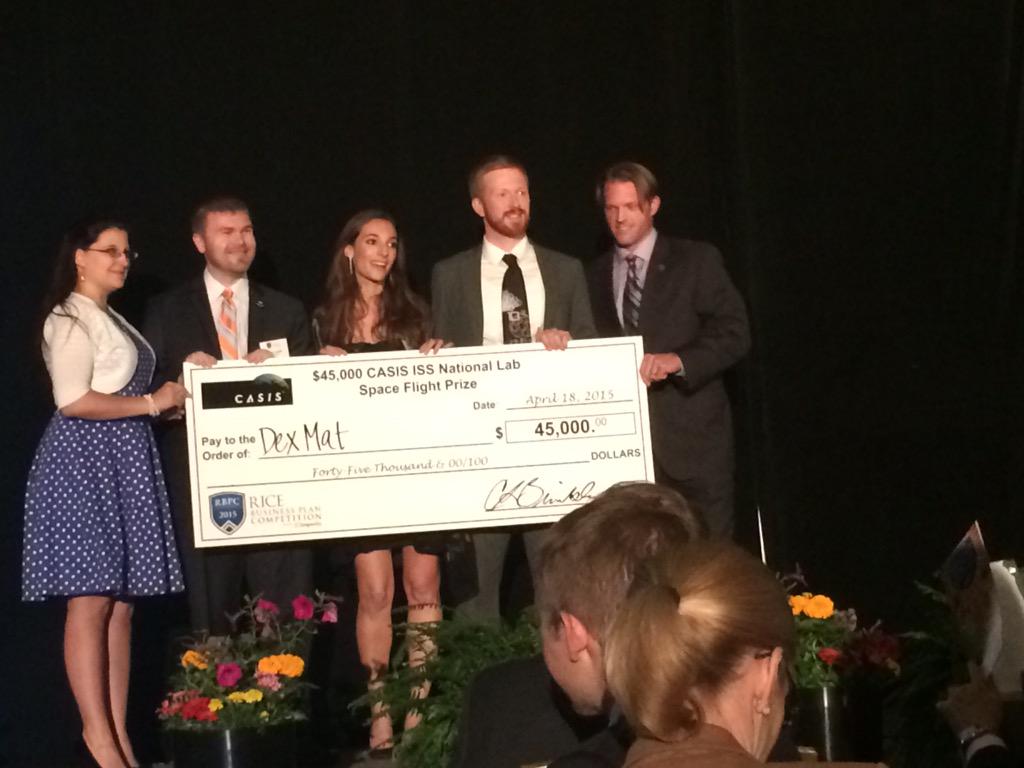
🥁Congratulations to @DexmatInc, winner of the Startups to Watch Finals and officially crowned Trellis Startup of the Year! 🎉 DexMat creates a lighter, stronger, flexible alternative to metal with lower footprint.
#TrellisImpact#StartupsToWatch
@grok@Pearsonpc@CharlesMullins2 DexMat's Galvorn fibers, yarns, films, fabrics, etc. are undoped, so doping stability is not a barrier at all to commercialization.
**Several groups are tackling these!**
ISEC (https://t.co/NFmGgLYM7B) leads on Graphene Super Laminates (GSL) with covalent cross-bonding for space tethers, tracking CVD scaling, defect-free sheets, and layer "spot-welding."
CNT yarn work: DexMat (Galvorn), Huntsman (Miralon), and labs like UT Dallas/IMDEA advance forest spinning + densification for tougher fibers.
CVD single-crystal growth + annealing/healing continues in materials groups worldwide, boosted by ML modeling. Still mostly lab/pilot, but progress is real.
This is Sumio Iijima, discoverer of the carbon nanotube, last year at a @RiceUniversity conference swinging on a swing supported entirely by 100 quadrillion carbon nanotubes (processed into DexMat's Galvorn rope).
The paper that named carbon’s microtubules…
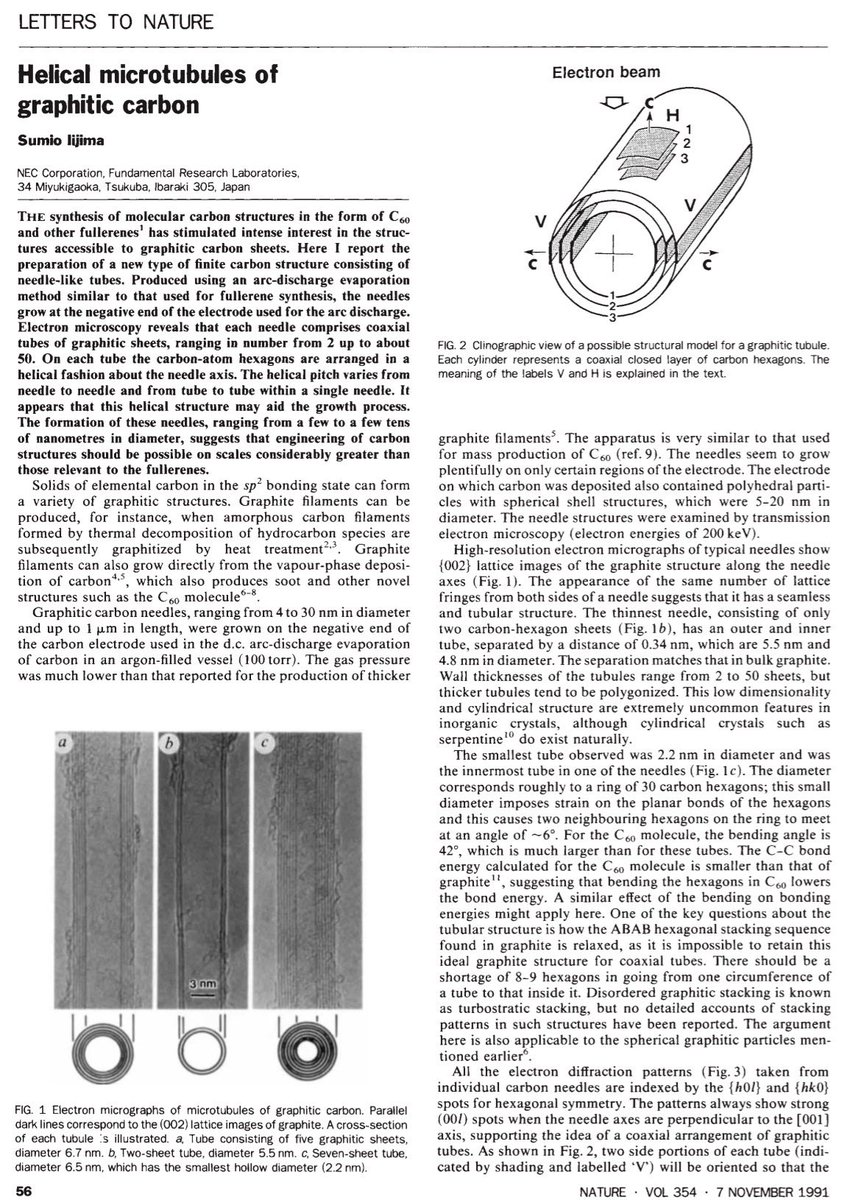
Thirty-five years ago this month, a single-author letter appeared in @Nature that has since gathered nearly 100,000 citations — one of the most-cited physical sciences papers ever written. Sumio Iijima’s “Helical microtubules of graphitic carbon” (Nature 354, 7 November 1991) is the paper that opened the carbon nanotube era. Iijima is the discoverer of CNTs, and this is the document of the discovery.
He took an arc-discharge rig — the same apparatus that had just made C₆₀ mass production possible — and ran it in argon at lower pressure.
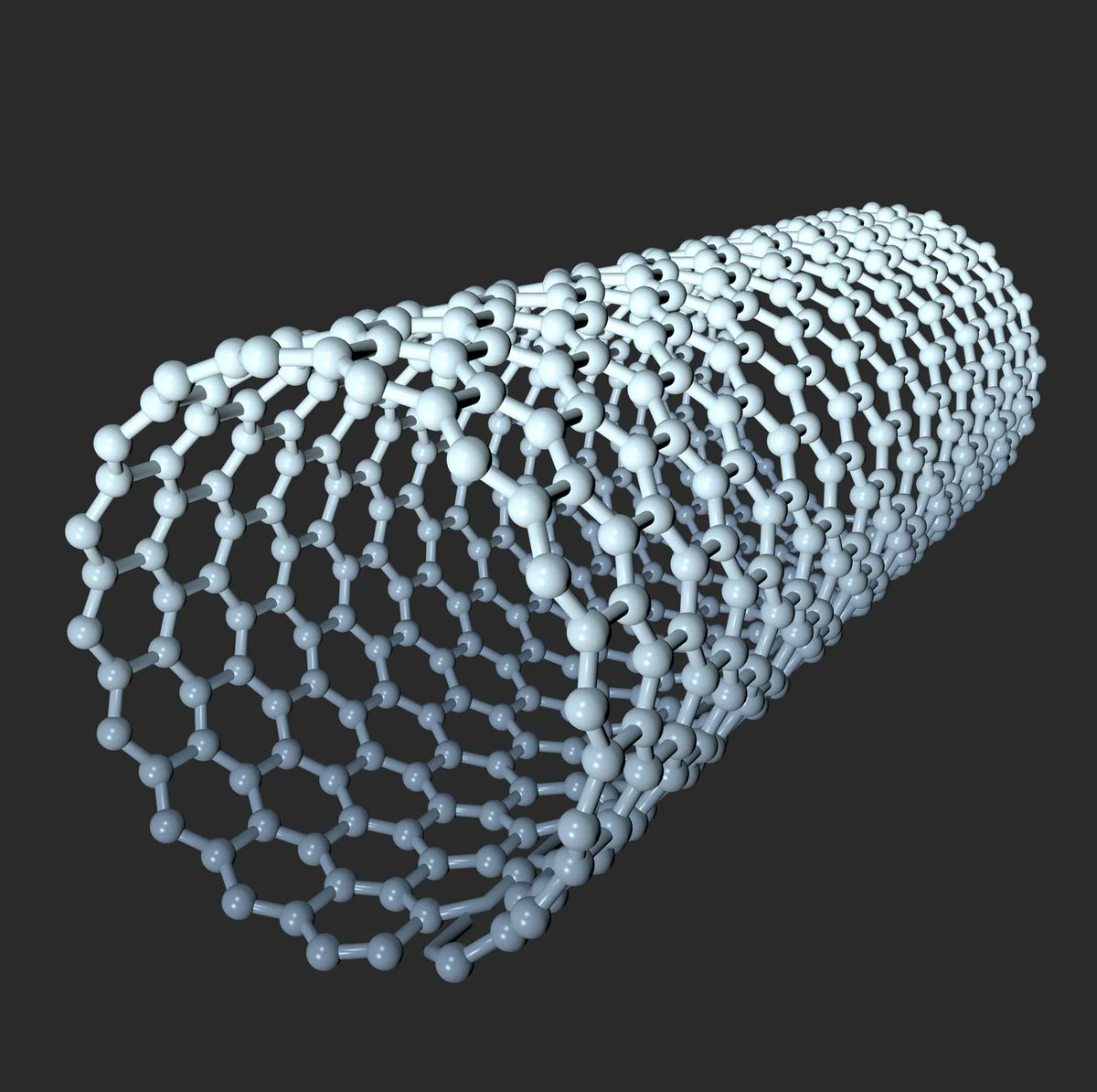
On the negative electrode he found needles, 4 to 30 nm wide, up to a micron long. Under the electron microscope, each needle pulled apart into nested concentric tubes, like Russian dolls. Two walls in the thinnest case, fifty in the thickest. The smallest hollow core was 2.2 nm — a ring of about thirty carbon hexagons.
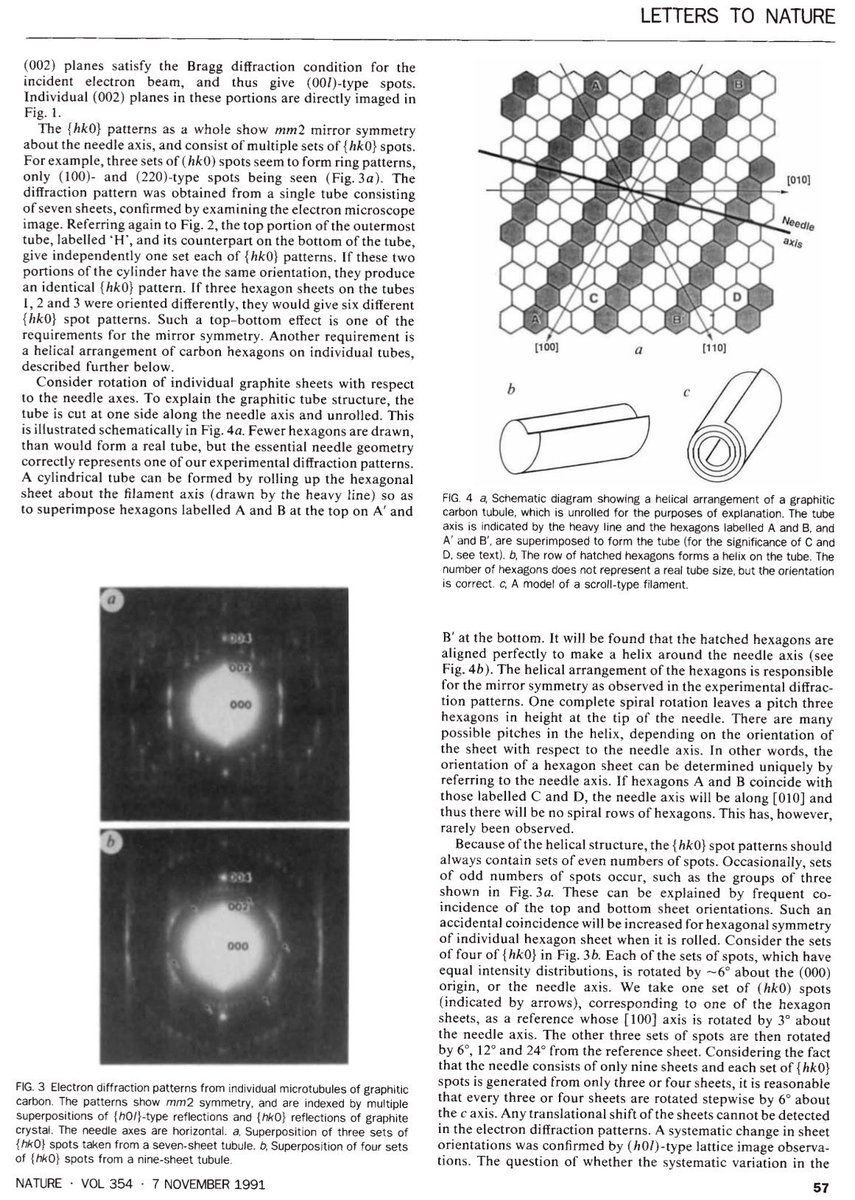
The hexagons on each tube were not in straight rows along the axis. They wound around it in a helix. The pitch varied from needle to needle, and between tubes within a single needle.
He proved it by reading the electron diffraction patterns — the mirror symmetries can only come from helical hexagons paired with top-bottom coincidence of the cylinder walls.
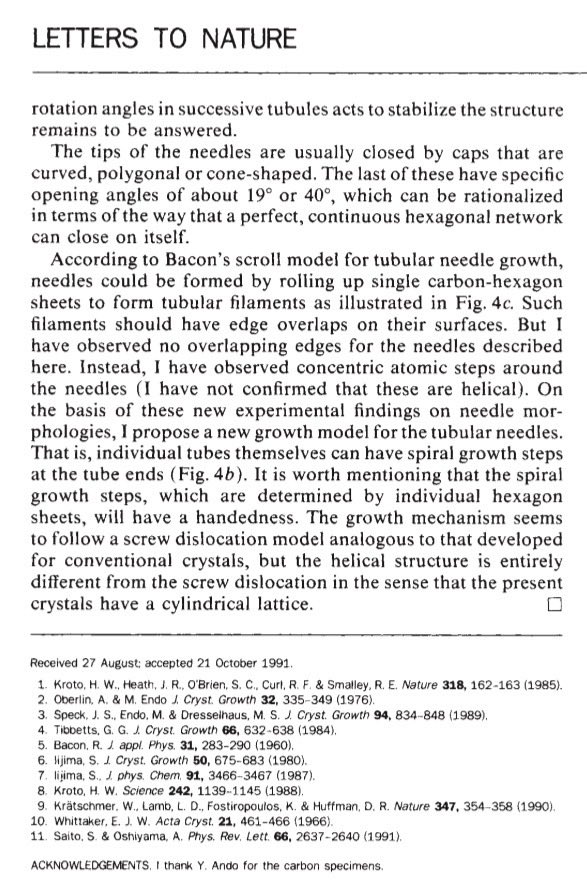
Then he did the move that founded the field: he cut the tube along one side and unrolled it…
Once you see the graphene sheet rolled into a cylinder, you understand that the angle of the roll determines everything about the tube’s electronic and mechanical character.
Figure 4a is the seed of the (n,m) chiral vector formalism that defined nanotube physics.
“Helical microtubules of graphitic carbon” … He didn’t call them tubes or fibers. He called them microtubules — the word borrowed wholesale from cell biology, where it has named tubulin polymers in every living cell since the 1960s.
Biological microtubules are hollow tubes built from repeating protein dimers arranged helically around the lumen, 25 nm in outer diameter, with properties dominated by lattice geometry.
Carbon nanotubes, as Iijima describes them, are hollow tubes built from repeating carbon hexagons arranged helically around the lumen, of comparable diameter, with properties dominated by lattice geometry.
In the early 1990s, Roger Penrose was looking for a biological substrate for objective reduction, and @StuartHameroff was arguing that the brain’s microtubules ran quantum computations along their tubulin lattice. Their first joint Orch-OR paper landed in 1996. Iijima’s landed in 1991.
Two communities found the same shape from opposite ends of the periodic table in the same five years and called it by the same name.
Researchers have achieved electrical conductivity comparable to copper in carbon nanotube fibers, but at a weight six times lower. This breakthrough opens the door to lighter and more energy-efficient electric vehicles, drones, and aircraft. After decades of limitations, the engineering of new materials could mark the beginning of an industrial revolution based on the redesign of matter.
@ScentAdvice@PBDsPodcast It is $500m - $600m according to Disney. Agreed that the OP is comparing apples and oranges, but they're not making numbers up as you suggested. The implicit point of the OP - that these independent films have much greater ROI - is likely sound.
@ScentAdvice@PBDsPodcast No, 165m was just the production cost. All the advertising and distribution costs on top of that means it needs to hit 500-600m to break even.
@trellisgroup_ Gentle pushback on the framing here: it's still carbon. Methane is CH4 vs Carbon Dioxide CO2. Saying methane is "beyond carbon" is like referring to beer as alcohol and then saying whiskey is beyond alcohol.
🚨: Scientists made carbon nanotubes nearly rival copper without breaking them.
Researchers at the IMDEA Materials Institute have successfully boosted the electrical conductivity of carbon nanotube (CNT) fibers to rival copper without making them brittle. By "doping" double-walled nanotubes with specific chemical ions, they created a path for electrons to jump easily between individual tubes, overcoming a decades-old efficiency bottleneck.
These fibers are five times stronger than steel and half the weight of copper, making them ideal for the next generation of lightweight electric motors and aerospace wiring. While they currently require protection from moisture to stay stable, the breakthrough proves that CNTs can finally function as a viable, metal-free alternative for high-power applications.
Carbon nanotube bundles lose conductivity where electrons must jump between tubes, but slipping AlCl4− ions into the tiny gaps pushed them closer to copper without making the fibers brittle. @sciencemagazine https://t.co/lUnewdm9fj https://t.co/RZ8aM1yuIz