Part - 1
Before the whole Suárez saga blew up, when he publicly turned a large part of Uruguay against Marcelo Bielsa, the record spoke for itself.
Before the fallout:
Wins: 11
Draws: 5
Losses: 3
Then Bielsa made the decision that ultimately caused all the drama. He refused to build the team around a declining Luis Suárez, choosing instead to move towards younger players. Suárez didn’t take it well and went on a public campaign criticising Bielsa, with several players either openly or quietly siding with one of the biggest names in Uruguayan football.
Since the fallout:
Wins: 5
Draws: 7
Losses: 5
People will point to those results and say Bielsa has suddenly become a bad manager. I don’t buy that for a second.
The reality is that once your dressing room becomes divided, results almost always suffer. It doesn’t matter how good the manager is. We’ve seen it happen throughout football history. Tactics can only take you so far when trust inside the squad starts to disappear.
What’s funny is that even during all this chaos, Uruguay’s performances haven’t actually been as bad as people make out. They dominated Saudi Arabia 27 shots to 7, outshot Cape Verde 17 to 12, and had a very even game against Spain. They were creating chances. The football was there. The finishing and individual performances weren’t.
Some of Uruguay’s biggest players simply haven’t produced. Federico Valverde, who should be leading this team, has been well below the standards expected of one of the world’s best midfielders. When your key players aren’t delivering in decisive moments, that isn’t automatically the manager’s fault.
Part - 2
The bigger issue is that people are questioning Marcelo Bielsa’s entire career because of one difficult spell.
This is the same manager who transformed Newell’s Old Boys into champions, took Athletic Bilbao to a Europa League and Copa del Rey final while beating Manchester United at Old Trafford with one of the best away performances English football has seen, completely changed the mentality of Chilean football, won promotion with Leeds United after sixteen years outside the Premier League and left a tactical legacy that still exists today.
Managers like Pep Guardiola, Mauricio Pochettino, Diego Simeone and countless others have openly spoken about Bielsa’s influence on the way they see football. Guardiola has repeatedly called him one of the greatest coaches in the world despite Bielsa having won far fewer trophies. That respect doesn’t come from sentiment it comes from understanding football.
People always use the “he doesn’t win enough” argument, but football isn’t judged purely by medals. Bielsa has consistently taken teams beyond what their squads should realistically achieve. Leeds weren’t expected to dominate the Championship the way they did or finish comfortably in the Premier League after promotion. Athletic Bilbao weren’t expected to outplay Europe’s biggest clubs. Chile weren’t expected to become one of the most aggressive and exciting national teams in the world.
Bielsa’s teams press harder than almost anyone, attack with bravery, create huge numbers of chances and ask every player to sacrifice themselves for the collective. His standards are incredibly demanding because he believes nobody is bigger than the team.
That is also why he has walked away from huge jobs and rejected enormous contracts throughout his career. If he feels players, owners or directors don’t share the same standards, he’ll leave rather than compromise his principles. He has never been interested in managing egos or building a team around superstar status.
Ironically, that’s exactly what happened with Suárez. Bielsa judged players on what they could contribute now, not what they’d achieved ten years ago. Whether you agree with that decision or not, it was consistent with everything Bielsa has stood for throughout his career.
If Bielsa has one weakness, it’s that he refuses to play politics. He expects absolute commitment, professionalism and humility from everyone. Modern football is full of massive personalities, and sometimes that creates conflict. But I’d rather have a manager who refuses to bend his principles than one who lets reputation dictate team selection.
People are free to criticise Bielsa’s decisions, but questioning whether he’s an elite coach because of one turbulent spell completely ignores over thirty years of evidence. Great managers aren’t judged solely by trophies. They’re judged by the football they create, the players they improve, the clubs they transform and the influence they leave on the game.
Marcelo Bielsa has done all four.
You either get it or you don’t, The End.
Hoy, justamente hoy, no existió La Bielseada.
- Fernando Muslera ? Cambio cantado. Quebrado mentalmente.
- Federico Valverde ? Se escondió toda la puta Copa del Mundo. Jugador clubista. En la Celeste ? Pecho frío y recontra cagón.
- Puso a todos los delanteros, rompió el mediocampo. Qué más se podía hacer ?
El error no fue hoy con Fernando Muslera. El HORROR fue haberlo citado nuevamente.
Toda la solidaridad con quienes se despertaron con sus cuentas en $0 por instrucción del Gobierno hacia la Tesorería General de la República, para embargar recursos por deudas CAE.
Acá una buena explicación a quienes preguntan por la condonación del CAE.
En el colegio te revisan la mochila
En la calle te piden el carnet
En la micro te piden la bip
En el super te piden el rut
Para arrendar te piden dicom
Al estadio camaras de vigilancia
Pero los weones no abren el secreto bancario x la privacidad de las personas
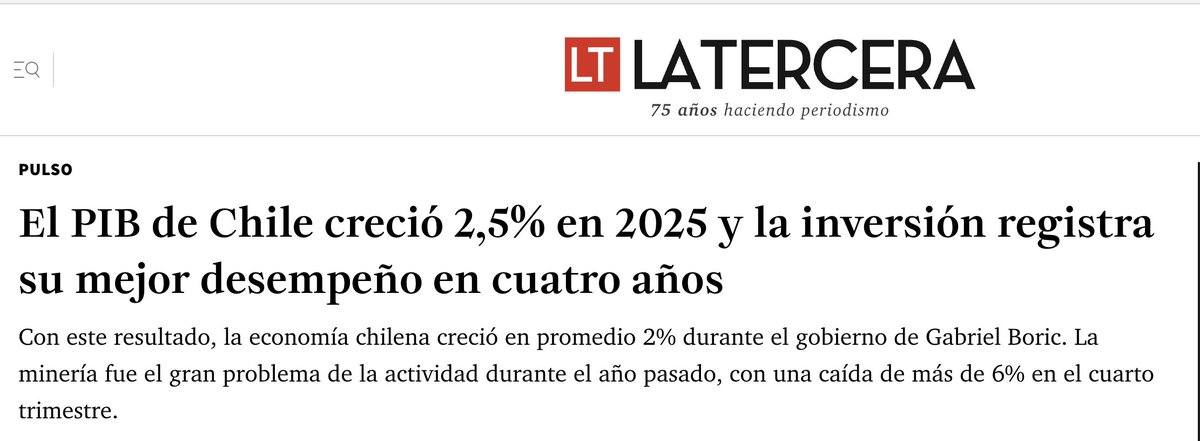
Último Informe de Cuentas Nacionales del Banco Central: en el país en ruinas el crecimiento anual fue de 2,5%, la inversión total creció 8,9% y la demanda interna aumentó 4,2%.
Se agradece la sinceridad de reconocer que la ley se votó sin leerla. Lo anterior es grave considerando que la ley es muy breve: sólo tiene 4 artículos que se contienen en dos páginas. En una lectura de 10 minutos te dabas cuenta de la locura que se estaba aprobando.
Voy a regalar una play 5 debido a mi apuesta dado que dije que el Real Madrid iba a quedar eliminado, tendré muchos defectos pero soy un hombre de palabra.
Si este tweet llega a 5000 RT y 5000 me gusta la sorteo ahora mismo. No creo que lleguen, no les gusta el dinero.