So the ballroom is a fiasco, the reflecting pool is a fiasco, the Iran war is a fiasco—the Trump administration is a fiasco.
Thank you for your attention to this matter.
After hearing what was said about Michelle Obama at the White House last night, I can’t stay silent.
She’s a Princeton- and Harvard-educated attorney, a former First Lady, and a global example of intelligence, grace, and elegance.
I’m speaking up because she taught us: *“When they go low, we go high.”* That means calling out disrespect while still choosing dignity.
I stand with Michelle Obama. And she represents the best of American values.
@Scaramucci The richest country in the world can’t afford healthcare for its tax paying citizens.
But Trump spent $80 billion to bomb Iran and now $300 billion more to build it back.
@Scaramucci Too bad the US spends trillions on bombing the crap out of countries on the other side of the planet rather than delivering decent houses, schools and hospitals for its people...
Sheryl Crow speaks out after Trump’s UFC 250 event: “To stay quiet means to turn a blind eye. And so I am saying this. What happened last night on the lawn of the White House was disgraceful and void of decency. Powerful, rich people filled the lawn to watch a violent sport that ended with a vile and racist comment. All while the average American cannot afford healthcare, gas, and cost of living. Do not be fooled. This administration is corrupt and does not give a damn about the American people. It only cares about making money hand over fist at the expense and in spite of our democracy. If we continue to support this kind of distraction from reality, we are no better than them. Let's be better, America.”
I’ve been thinking a lot about the extraordinary outbursts of the President of the United States against female journalists... well, actually against journalists in general and journalism. But it feels like he saves his most childlike behavior and irrational language for female reporters, calling them all kinds of names that kids in kindergarten are given times out for. It’s stunning to me to witness such behavior from any leader, any CEO, any person of influence or importance. I’ve never witnessed someone like this raging, this weekend with @meetthepress host @kwelkernbc, just last week in the Oval Office with @cnn’s @kaitlancollins, calling women stupid or piggy, telling them to “smile”, calling them darling, demeaning their credibility. Every good man should denounce this behavior. Every person should be able to stand up for their colleagues and say “No more.”
Imagine this man screaming like this at your daughter, your wife, your sister, your mother... would you stand for it? No, you wouldn’t! And neither should any of us. It’s unacceptable and undignified. Period. End of story.
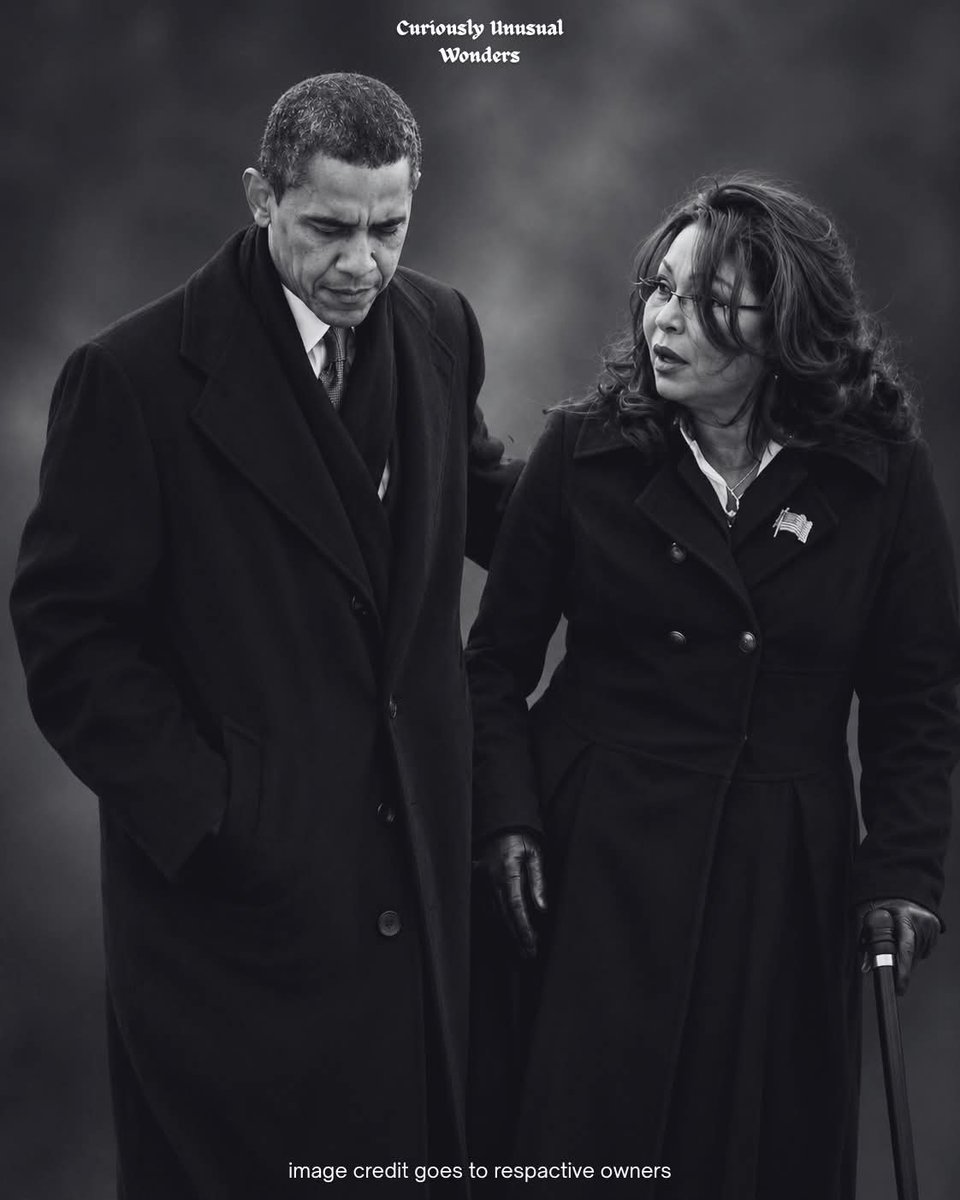
Before I paste the text that came with this photo, I just want to say this: Senator Tammy Duckworth has more courage, bravery, self-sacrifice and compassion in her pinkie finger than President Donald Trump has in his wildest dreams. Read on:
November 11, 2008.
Barack Obama had been president-elect for only seven days. The world was tracking every move he made. Reporters wanted statements. Cameras wanted moments. Washington expected spectacle.
Instead, Obama chose silence.
That Veterans Day, he traveled to the Bronze Soldiers Memorial near Soldier Field in Chicago and walked beside a woman who understood sacrifice more deeply than most Americans ever will.
Her name was Tammy Duckworth.
Four years earlier, she had lost both her legs in Iraq.
In November 2004, Captain Duckworth was co-piloting a Black Hawk helicopter north of Baghdad when a rocket-propelled grenade tore through the aircraft.
The explosion nearly killed her instantly.
Her right leg was destroyed. Her left leg was shattered beyond repair. Her arm suffered severe damage as the helicopter crashed to the ground.
She survived.
But survival came with months of surgeries, rehabilitation, and learning how to live inside a completely different body.
At Walter Reed Army Medical Center, during some of those darkest days, a junior senator from Illinois walked into her hospital room.
Barack Obama sat down and listened.
Not for headlines.
Not for cameras.
He listened as Duckworth explained how wounded veterans were being failed by the very system meant to support them.
Later, he asked her to testify before the Senate Veterans Affairs Committee.
She spoke honestly about delayed care, endless paperwork, and veterans abandoned after returning home from war.
Obama remembered every word.
In 2006, Tammy Duckworth became Director of the Illinois Department of Veterans Affairs. She fought relentlessly for veterans struggling with disability claims, PTSD, and broken bureaucracy.
Obama’s Senate office came to know her well.
She kept calling.
Kept pushing.
Kept fighting for people too exhausted to fight alone.
Then came Veterans Day 2008.
Obama could have attended any major ceremony in the country. Instead, he asked Duckworth to join him at a quiet memorial ceremony closed to the press.
No speeches.
No performances.
No political theater.
Just shared silence between two people who understood what service actually costs.
Tammy Duckworth never stopped serving.
She later became a congresswoman, then a United States senator, and the first sitting senator to give birth while in office.
But that quiet moment in Chicago still says the most.
Because real leadership is not about being seen.
It is about showing up for people when nobody is watching.
New statement from Scott Pelley:
There has never been anything in America like 60 Minutes.
The Sunday tradition is the most successful program of any kind in history. For more than a decade, its innovative growth on every major online platform has extended its reach to countless millions around the world. This spring, at the end of our 58thseason, 60 Minutes grew rapidly with an unheard-of 9% jump in viewers on CBS.
“60” has been the number-one program in America for decades because our beloved audience finds integrity, quality, and humanity in our stories. When stewardship of the program passed to my colleagues and me, our responsibility was to expand energetically into a new age of media technology while preserving the values our audience expects. Now, the new owner of our network is casting this legend aside, apparently to curry a moment of favor with the Trump administration.
The waste is heartbreaking.
Last month, 60 Minutes lost its DNA when our entire senior leadership and two of our best on-air correspondents were cruelly fired without cause. Good people were silenced because they stood up for our audience. They stood for fairness against the forces of political bias; they stood for professionalism against chaos.
For my part, new management has instructed me to inject falsehoods and bias into a politically sensitive story. I’ve been told to include assertions that are unverified. To date, in every case, I have managed to ignore these instructions or refuse them. Recently, politicians have been invited to choose correspondents for interviews on the broadcast. Giving politicians control over 60 Minutes interviews is not how this is done. Finally, incompetence and unprofessionalism in the new management have wreaked havoc. In a case involving one of my stories, the entire program came within 19 minutes of not getting on the air at all.
At 60 Minutes, we have fought harder than anyone knows to save the program that became an American icon. We owed that to our millions of viewers. I am deeply moved by the thousands of wishes we have received to “keep up the good fight.” Most of the men and women of CBS News are still in that fight. But now the collapse of values at the top has become untenable. The leadership of 60 Minutes is no longer recognizable. The principles I hold dear are gone, and so I must leave as well.
I depart after 37 years at CBS with one emotion—a heart brimming with gratitude for the men and women of CBS News who encouraged and enriched my work, very often at the risk of their own lives. I pray for a day when those people and their ideals are honored again—a day when sanity, competence, and courage return.
Scott Pelley
BREAKING: Pope Leo XIV makes historic apology for Holy See's own role in legitimizing slavery and for failing to condemn it for centuries. https://t.co/cQz8oU5Wkh
Aujourd’hui, j’étais à la banque, dans la file d’attente devant un distributeur.
Devant moi, un monsieur très âgé. Plus de quatre-vingts ans, sûrement.
Il tenait une enveloppe dans la main, un peu tremblante.
Quand ce fut son tour, je l’ai observé discrètement.
Il touchait l’écran, hésitait, revenait en arrière…
Je voyais bien qu’il ne comprenait pas.
L’écran, les boutons, les étapes… tout semblait trop rapide pour lui.
La file derrière commençait à s’impatienter.
Lui, il s’est retourné vers moi, avec un regard gêné mais digne,
et il m’a demandé, tout doucement :
« Vous pourriez m’aider… s’il vous plaît ? »
Je me suis avancée tout de suite.
Je lui ai expliqué calmement, étape par étape.
Sans jamais toucher son argent.
Par respect. Par pudeur. Par délicatesse.
Il voulait faire un dépôt.
Il a réussi, lentement, en se concentrant.
Quand l’opération s’est terminée, il avait l’air soulagé.
Comme un enfant fier d’avoir réussi.
Il m’a remerciée avec un sourire incroyable.
Et juste avant de partir, il a sorti un billet de 10 euros de sa poche
et a voulu me le donner.
J’ai refusé.
Il a insisté. Il m’a dit que c’était « pour le petit-déjeuner ».
Pour me remercier à sa manière.
J’ai décliné encore, doucement.
Et là, je suis repartie avec un nœud dans la gorge.
Parce que ce monsieur…
ce n’est pas un cas isolé.
Ils sont nombreux, nos parents, nos grands-parents,
perdus face à un monde devenu trop numérique, trop rapide, trop froid.
Perdus devant les écrans, les bornes, les applications, les mots de passe.
Ces gens ont construit le pays dans lequel on vit.
Ils ont travaillé toute leur vie.
Ils ont payé, cotisé, élevé des enfants, tenu des familles.
Et aujourd’hui, on les laisse seuls
face à des machines qui ne parlent pas,
dans des banques sans guichet,
dans des hôpitaux sans accueil,
dans des administrations sans humain.
On parle d’innovation, de progrès, de modernité…
Mais on oublie l’essentiel : l’humain.
S’arrêter cinq minutes pour aider quelqu’un,
ça ne coûte rien.
Mais pour eux, ça change tout.
Parfois je me demande :
est-ce qu’on avance vraiment…
ou est-ce qu’on devient juste plus rapides à oublier les autres ?
No nation, no society, and no international order can call itself just and humane if it measures its success solely by power or prosperity while neglecting those who live at the margins. Indeed, Christ’s love for the least and the forgotten compels us to reject every form of selfishness that leaves the poor and the vulnerable invisible.
Michael J. Fox & Tracy Pollan — Love That Doesn’t Flinch! He was 29. A global star. Back to the Future made him untouchable. Then the diagnosis came: Parkinson’s. The doctor said, “You might not work again in 10 years.”
Michael J. Fox went home and told his wife, Tracy Pollan. He expected panic. Tears. Pity.
Instead, she took his shaking hand and said, “We’re in this. All of it. Together.”
That was 1991. They’ve been proving it every day since.
The world knows the tremors. What they don’t see are the 3am moments. The nights his body won’t cooperate. Tracy sits beside him, rubs his back, and whispers, “You’re still you. You’re still my hero.”
And the incident that broke the internet?
2018. Michael was receiving the Muhammad Ali Humanitarian Award. His symptoms were acting up on stage. He gripped the podium, trying to steady himself. The room went quiet.
Tracy didn’t wait. She walked up, right there in front of thousands, wrapped her arms around him from behind, and held him steady. No fuss. No speech. Just presence.
He looked back at her and smiled. Then told the crowd: “She’s been holding me up for 30 years. Tonight you just got to see it.”
The clip hit 20M views in 48 hours. Not because it was sad. Because it was safe. It was love that doesn’t flinch when things get hard.
“I don’t fall apart because she won’t let me,” Michael said later. “Tracy doesn’t see Parkinson’s when she looks at me. She sees Mike.”
Tracy once told a reporter: “He asked me if I wanted out. I said, ‘I married you, not your diagnosis. You don’t get rid of me that easy.’”
33 years. Four kids. One foundation that’s raised over $2 billion for research. Bad days, good days, and days where love is the only medicine that works.
Parkinson’s tried to write their story. Tracy grabbed the pen back.
Because real love doesn’t cure the disease. It refuses to let the disease win.
After this Thursday’s show, the Ed Sullivan Theater will go dark, and we’ll lose one of the nation’s funniest and most courageous, truthful, and gentlemanly critics of Trump and his regime.
Farewell, and thank you, Stephen. https://t.co/0syXYZoCnD
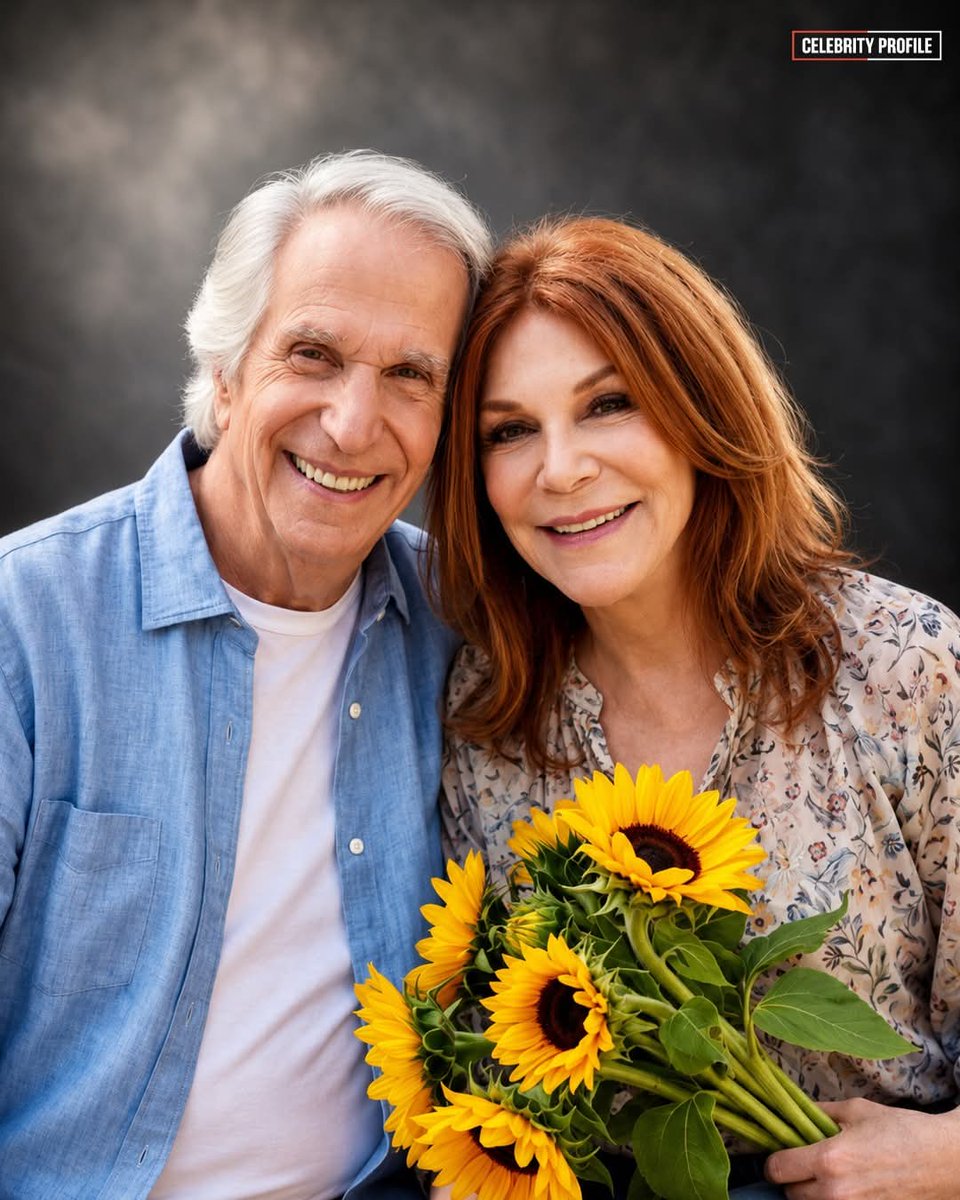
Beverly Hills, 1976. Henry Winkler walks into a clothing store. Needs a coat. Leaves with a life.
Stacey Weitzman is behind the counter that day — divorced, raising her young son Jed, simply doing her job. She smiles and asks if he needs help.
“You just did,” he thinks immediately.
They start talking. Ten minutes passes like ten seconds. Later, Henry would admit he didn’t want the conversation to end.
So he stayed.
The next day, he returned pretending he’d forgotten something. He pointed at jackets he clearly didn’t need while searching for another excuse to see her.
Stacey understood exactly what was happening.
At the time, Henry Winkler was already becoming one of the most recognizable faces in America. Happy Days had turned him into Fonzie, the leather-jacketed icon everyone adored.
But Henry wasn’t chasing attention.
He was chasing her.
And Stacey came with a little boy.
Some people might have called that baggage. Henry never did. From the beginning, he embraced both of them completely. Years later, Stacey reflected on it simply:
“He chose all of us on day one.”
In 1978, they married quietly in a small Manhattan ceremony without Hollywood spectacle or media attention. No grand performance. Just vows.
Then came daughter Zoe. Then son Max. Their house filled with noise, children, laundry, routines, and ordinary life.
That was exactly what Henry wanted.
“Fame is loud,” he later said. “Dinner with my kids is quiet. I picked quiet.”
Their marriage wasn’t built on dramatic gestures.
It was built on repetition.
Henry hid handwritten notes everywhere — inside books, purses, beside coffee cups. One note read: “You’re still the girl in the store. Now I just have 45 years of reasons why.”
Stacey saved every one in a shoebox.
At their thirtieth anniversary dinner, she read one aloud: “When I look at you, I see every day we’ve survived. And I’d survive them all again to get here.”
Nobody at the table could hold back tears.
Over the decades, they faced everything real families do — dyslexia struggles, illness, career highs and disappointments, children growing older, grandchildren arriving.
“We didn’t do perfect,” their daughter Zoe once said. “We did team.”
And every morning at 7 a.m., Henry still brings Stacey coffee.
Not out of routine.
Out of intention.
“It’s a proposal,” he says. “I’m asking her to marry me again today.”
No yachts.
No staged romance.
No Hollywood illusion.
Just two people continuing to choose each other long after the spotlight faded.
“People say we fell in love,” Henry once said. “No. We keep falling. On purpose. Every damn day.”
He walked into a store looking for a coat.
And nearly fifty years later, he still acts like he just found home.