REX is exactly the kind of thing people said was “impossible” and now it’s just casually dropping into the stack.
Encrypted inputs, cryptographic routing, privacy baked into the protocol instead of taped on at the edges that changes how you even think about designing apps.
Most chains still pretend confidential compute is some side quest or off‑chain black box.
Rialo is literally wiring it into the coordination layer, so trusted execution becomes a default primitive, not a rare exotic feature.
This is the kind of infra where you don’t just ask “what can we build on it?”
You start asking “what were we too scared to even try before this existed?”
More info >>>
MPC. FHE. TEEs.
All powerful on their own, but none solve the coordination problem. The hard part isn’t just encrypting computation; it’s the orchestration required to make it functional and secure.
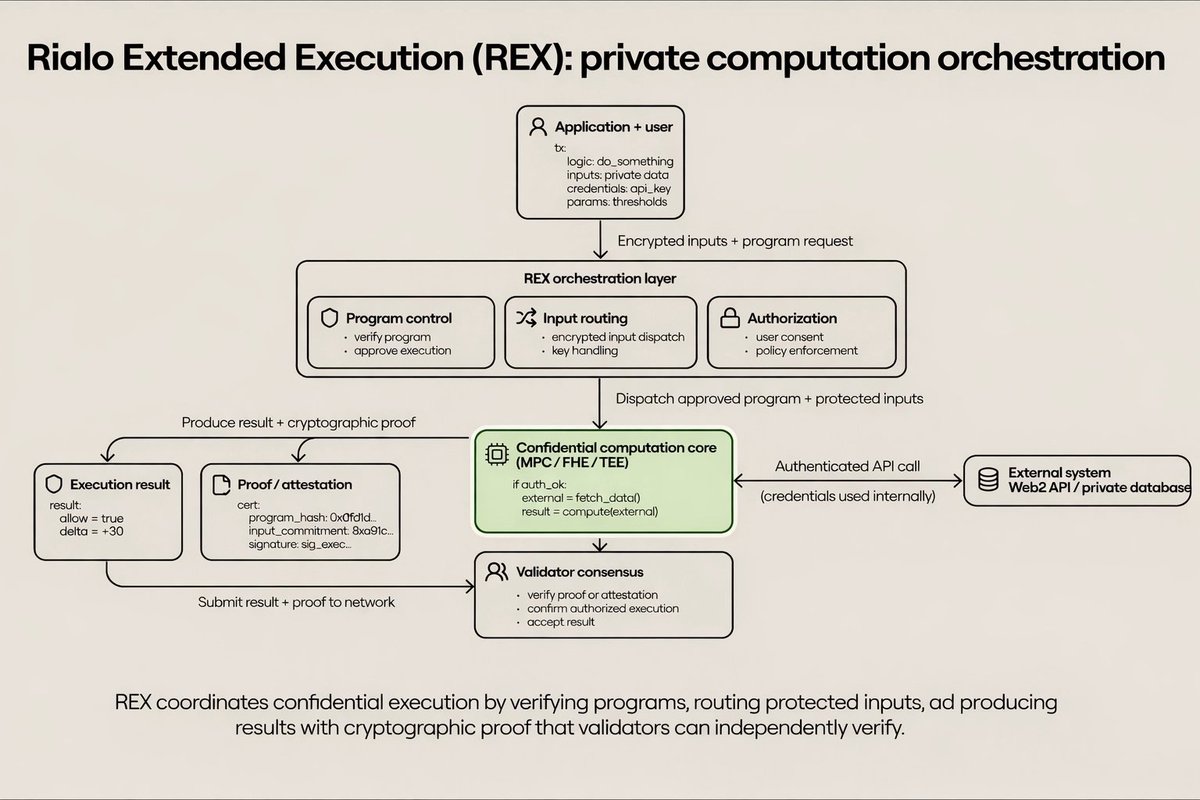
That’s what Rialo Extended Execution (REX) does.
REX is a protocol-level orchestration system for confidential computation that manages the entire lifecycle of a secure request:
Program Governance – Programs to be executed are verified and approved for specific execution runs before they ever touch the core.
Encrypted Routing – Encrypted inputs are routed cryptographically to a computation core only after the appropriate program logic is loaded.
Explicit Consent – Computation is performed only after explicit authorization from both the application and the user, enforced by strict policy.
Confidential Compute Core – Secure execution using MPC, FHE, or TEEs, including protected Web2 API calls within an isolated environment.
Verifiable Outputs – The system generates and verifies cryptographic attestations that prove a specific computation was correctly executed before routing the result to its destination.
REX transforms Rialo into infrastructure for real-world secure computation:
Private AI agents that process personal data without seeing it.
Sensitive enterprise workflows that maintain competitive secrecy.
Authenticated API automation for secure, off-chain interactions.
Verifiable off-chain compute with immutable on-chain guarantees.
This is native privacy at the protocol layer.
Get Real. Get Rialo.
This is huge! What started as an internal tool for managing agents is now becoming something everyone can use enabling secure agent deployment for builders and users alike, powered by @RialoHQ.
🔗 https://t.co/djYaGN1VDw
Rialo is one of those projects that immediately makes sense when you look at the bigger picture.
Real-world data, proof-carrying computation, and a blockchain that’s built to make apps feel seamless that’s the kind of direction Web3 needs right now.
Rialo continues to redefine blockchain infrastructure by solving the sync trap that cripples every other chain transactions that can’t pause, wait, or coordinate with the real world without brittle oracles and middleware. ❤️
Everyone is rushing to deploy agents right now, but they’re missing the full picture.
AI agents are the what. They decide, act, hit APIs, move money, coordinate with other agents, ship code, and complete tasks without a human in the loop. That capability is real and it's here.
But capability without governance is just chaos that’s good for demos and not much else.
Orchestration and governance is the how. It answers the questions the agent never asks itself. Who authorized this? What are the limits? Is there a record of any of this?
Right now most deployed agents have no answers to any of those questions.
That is the problem that Rialo can solve.
Permissions enforced on-chain. Agent coordination systems baked into the protocol. Every decision logged before execution, not after.
Make sure you understand the how before you scale the what.
This isn’t just the cautious path. This is the only path that doesn't blow up in production.
They said it couldn’t exist. So we built it.
Rialo Stonk Crush is a real-time onchain market terminal with 1337 live tickers, native settlement, sub-second proofs, and zero oracles.
This is what the future of onchain finance looks like.
@RialoHQ
This is the kind of progress that separates real builders from everyone else. No empty noise, no forced hype just consistent execution, clear vision, and momentum that keeps compounding over time. Rialo is showing exactly how serious infrastructure gets built. ❤️
We are proud to share that Subzero Labs (Rialo) has been featured in the @CBOE Innovation Spotlight.
CBOE (Chicago Board Options Exchange) is one of the world's largest derivatives and securities exchanges, handling 3.8 billion options contracts a year and powering $45B+ in daily FX volume. We are integrating CBOE's high-fidelity market data directly into Rialo, giving developers building on Rialo access to institutional-grade financial data as a native part of their onchain applications.
This is what it means to build neofinance infrastructure seriously: the data that institutional markets run on, available to developers building financial applications onchain. With market data from the likes of @CBOE provided natively, developers on Rialo can build sophisticated, data-rich applications without relying on third-party infrastructure or building custom data pipelines.
Rialo takes care of the data so developers can focus on building world-class apps.
Read the full spotlight: https://t.co/QuDtYgNbsT
Rialo is building programmable policies and guardrails for AI agents so your apps can run autonomously without getting owned or drained.
Instead of “set it and forget it” bots that blow up when something goes wrong, we’re giving them enforceable rules, risk limits, and on‑chain safety rails.
This is how you move from fragile automation to real, trustworthy AI‑powered infrastructure.
The future isn’t just more AI it’s AI that behaves.
Tokenization was never the bottleneck truth was.
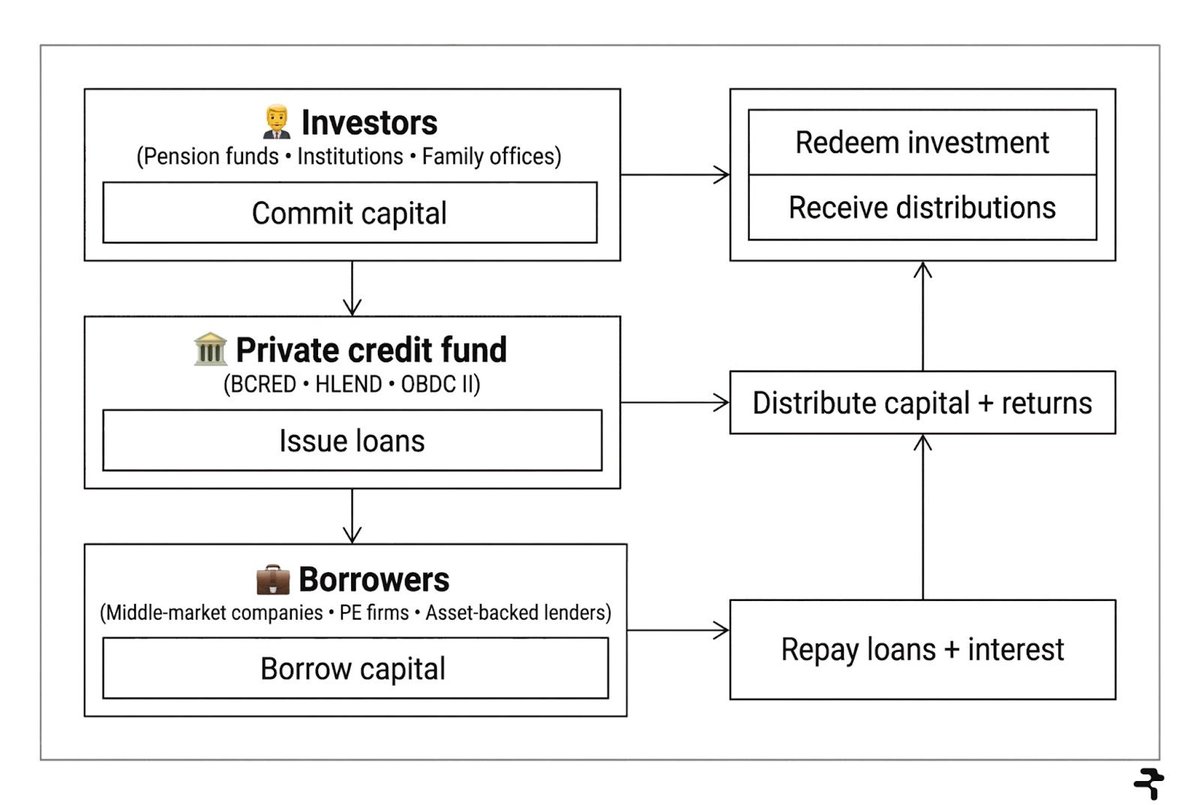
Onchain private credit doesn’t fail because of missing smart contracts. It fails because no one can verify what’s real without trusting intermediaries.
If your data pipeline is compromised, your “decentralized” system is just TradeFi with extra steps.
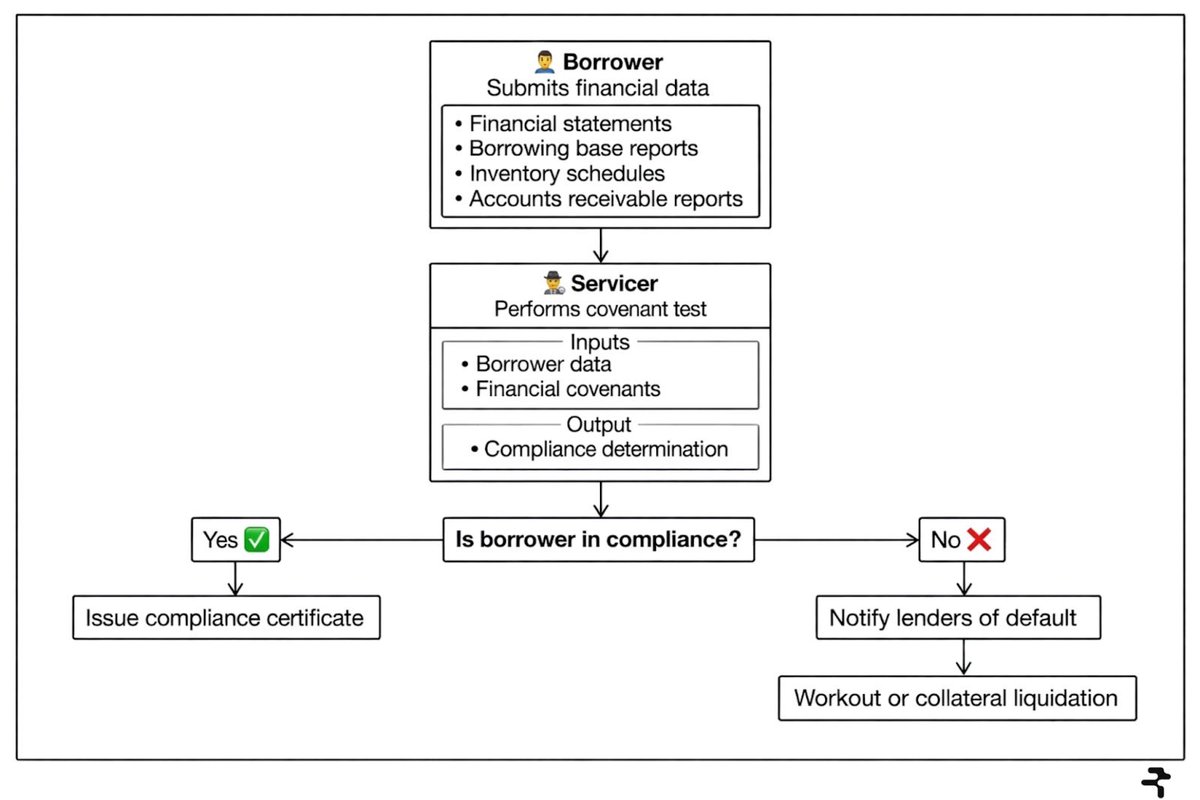
The real unlock isn’t putting loans onchain , it’s making covenant verification trustless, source-level, and independently provable.
That’s the layer most people are still ignoring!
https://t.co/4iRrXx1Jbf
Tokenizing private credit is the easy part. The hard part is verifying that borrowers are actually complying with loan covenants.
That gap is why onchain private credit has not worked yet.
Most chains ask builders to adapt to the limitations.
Rialo flips that logic.
Faster prototyping, native coordination, and real-world data flows make it feel like infrastructure designed for shipping not just experimenting.
That’s the difference between a chain that exists and a chain people actually build on.
Omid is right. Issuer censorship moves the trust assumption to a corporate executive.
We built a demo showing a different approach: a stablecoin that enforces compliance natively, at execution time, without delegating that power to offchain actors.
https://t.co/HiQku9AAFg
Everyone’s chasing “on-chain private credit,” but nobody’s fixing the core failure mode: truth.
Smart contracts execute perfectly on whatever data they’re fed.
If that data’s wrong, the math means nothing.
Rialo isn’t building another RWA wrapper. We’re building trustless verification for reality itself.
https://t.co/mHqWazWBo2
The RWA section is the one to read twice.
You can't model risk from smoothed quarterly NAVs. Liquidation takes 30–90 days with 20–50% haircuts. The math breaks before it starts.
But the deeper issue is older than DeFi: garbage in, garbage out. Smart contracts enforce rules perfectly, but they can't determine whether the inputs are true. Someone still has to feed real-world borrower data on-chain. If that party has bad incentives, you've rebuilt TradFi with extra steps.
This is the oracle problem, applied to private credit.
DeFi solved it for price feeds. Nobody has solved it for bespoke financial instruments: covenant compliance, borrower performance, collateral quality. That's the verification gap, and it's why private credit on permissionless rails keeps stalling.
That's what we're building at Rialo.
Distributed trust is the foundation of resilient security.
We’re diving deep into a 5-part technical series on threshold systems how cryptographic operations require a quorum instead of a single trusted actor.
Now live:
1.Distributed Key Generation joint key creation without anyone learning the full secret.
2.Verifiable Secret Sharing verified shares and trustless DKG with complaint-based disqualification.
Learn more:
https://t.co/DQ8ikV3BBr
https://t.co/kBO4odRmmC
Distributed trust is the cornerstone of robust security.
We are diving deep with a 5-part technical series on how threshold systems eliminate single points of failure by requiring a quorum of participants to execute cryptographic operations.
The first two modules are now live:
01 | Distributed Key Generation: An analysis of how groups jointly generate shared keys without any participant gaining knowledge of the full secret. This lesson covers Shamir's Secret Sharing, Lagrange interpolation, and honest-world key generation.
02 | Verifiable Secret Sharing: Moving beyond the honest-world assumption. This module explores Feldman’s VSS for share verification and Pedersen’s protocol for achieving DKG without a trusted dealer through complaint-based disqualification.
Stay tuned for the remaining three parts of the series.
Link below:
Rialo is building the infrastructure for a new kind of onchain finance.
Not the old, overcollateralized model that only works when everything is assumed to be risky , but a system where real-world
credit can finally become native to Web3.
The future of DeFi isn’t just about more liquidity.
It’s about making credit smarter, more private, and actually usable at scale. Rialo is pushing that shift by bringing real-world signals, privacy, and programmability into one stack.
This is what meaningful onchain finance looks like.
Less speculation. More utility. Less blind risk.
More real-world economic activity moving onchain.
Gauss changes the game for BFT consensus.
Traditional BFT blockchains choke on two pain points:
•painful, downtime-heavy upgrades
•impossible full committee swaps
Rialo’s Gauss fixes both. Instantly.
Gauss lets us hot-swap consensus protocols and validator sets in real time , no pauses, no coordination headaches.
It cleanly separates the consensus inner log from a sanitized outer log, unlocking modular evolution of protocol logic, committee membership, and fault thresholds, all without halting the network.
The Gaus Pepper has been officially Accepted :
“Gauss: Seamlessly Reconfigurable BFT Consensus”
by Allen Clement, Natacha Crooks, Neil Giridharan, Alex Shamis
https://t.co/1nFAHkvwpe
https://t.co/K0cIpZ9hrR
BFT consensus protocols in production blockchains suffer from two problems:
Upgrading them is a nightmare involving complex coordination and expensive downtime
They can't handle a complete committee swap without disrupting network operation
Rialo solves both with Gauss.
Gauss lets Rialo hot-swap consensus protocols and validator sets without a second of downtime. It introduces a clean separation between a consensus protocol's inner log and a sanitized outer log. It allows committee membership, failure thresholds, and the consensus protocol itself to evolve independently.
The Gauss paper has been officially accepted.
Take a sneak peek at the paper written by Subzero’s very own @allenclement, @natachacrooks, @neilgiridharan, and @aleak 👇