DEAD HANGING IS ESSENTIAL MAINTENANCE AND THE MOST POTENT PHYSIOLOGICAL STIMULUS
We discussed recently the strong hormonal effects that dead or active hanging has on the body. But it has beyond that a plethora of positive effects.
For most of human history, overhead reaching and hanging were daily requirements, not optional mobility drills. Modern life eliminated that movement pattern entirely. You sit in chairs. You hunch over screens. Your arms stay at your sides or in front of your body. Your shoulders never reach full extension. Your spine stays compressed.
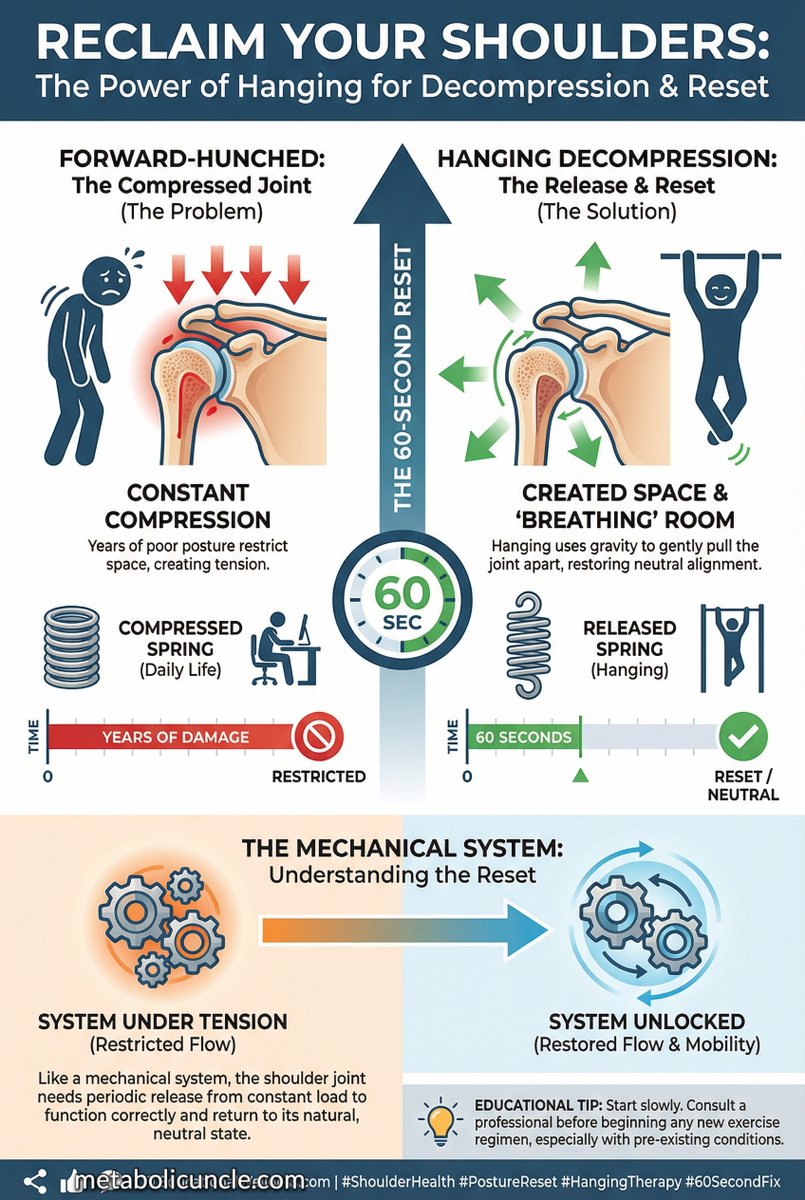
Dead hanging for one minute daily reverses years of that damage. Not through some complicated mechanism. Through simple mechanical traction and positional exposure.
Start with shoulder mechanics. When you hang with arms fully extended overhead, you create a joint position that modern life never demands. The shoulder capsule opens. The pectoral muscles stretch. The upper back activates to stabilize the scapula. This isn't stretching in the traditional sense. It's positional decompression.
Gravity pulls the humerus away from the socket. This creates space inside the joint. Compression decreases. Synovial fluid redistributes. The joint resets to neutral. People report shoulder pain disappearing within weeks because the daily decompression prevents the chronic inflammation that comes from constant compression.
Most shoulder problems stem from poor positioning, not injury. Forward head posture pulls the shoulders into internal rotation. Chest tightness reinforces that position. The upper back weakens. The rotator cuff muscles work overtime trying to stabilize an unstable joint. Hanging reverses all of that through passive mechanical loading.
Spinal decompression happens simultaneously. Every vertebra separates slightly under gravitational pull. The intervertebral discs expand. Fluid moves back into the disc space. This rehydration effect matters because disc compression from sitting and standing squeezes fluid out over time. The discs flatten. The spine loses its natural curves. Back pain develops.
Hanging creates the opposite mechanical environment. Your spine elongates. The natural curves restore. The discs rehydrate. This happens passively. You're not doing anything except holding the bar. Gravity handles the traction.
Studies on spinal decompression show that even brief periods of axial unloading produce measurable increases in disc height. The effect compounds with daily exposure. One minute seems trivial, but that daily stimulus prevents the chronic compression that causes most back problems.
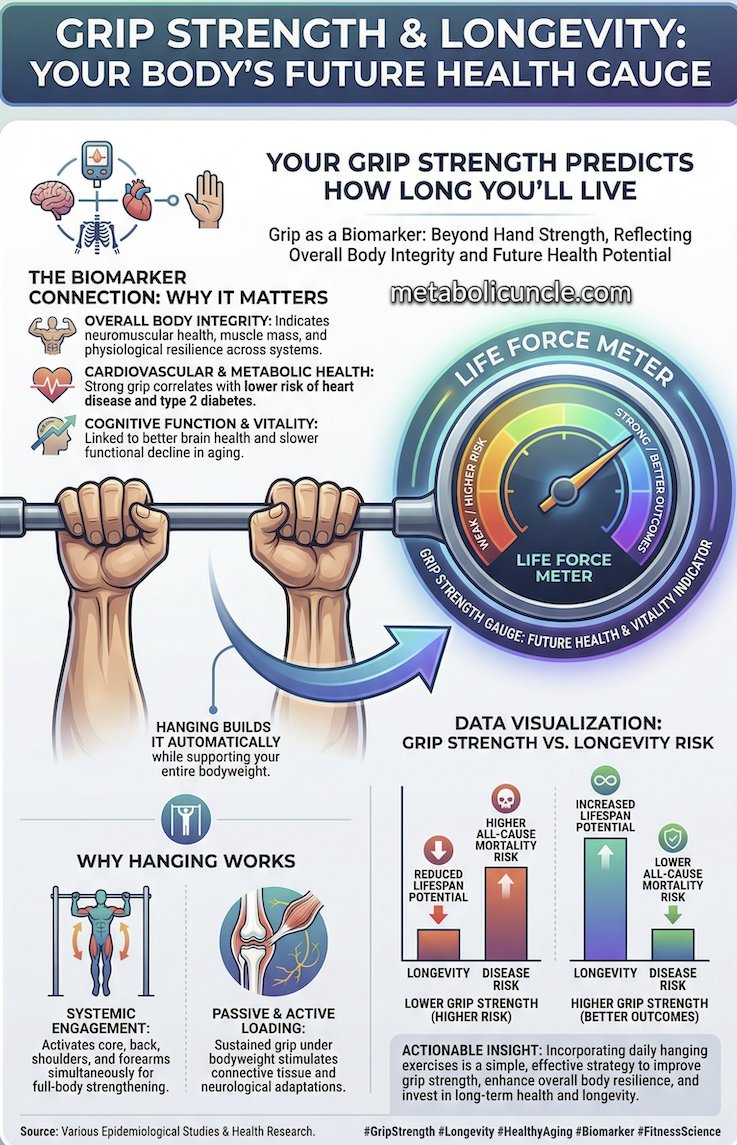
Grip strength improves rapidly. Your hands, forearms, and finger flexors have to support your entire bodyweight. This creates significant demand on the grip musculature. Most people can't hang for 30 seconds initially because their grip is that weak.
Grip strength correlates with overall health outcomes. Research shows stronger grip predicts lower mortality risk, better cardiovascular health, and maintained function with aging. The mechanism isn't fully clear, but grip strength seems to serve as a proxy for overall neuromuscular integrity.
Daily hanging builds grip strength without dedicated grip training. The adaptation happens fast. Within two weeks, hanging time doubles or triples. This carries over to every lifting movement. Your grip stops being the limiting factor in deadlifts, rows, and carries.
The lat and upper back activation during hanging isn't passive. Your latissimus dorsi, rhomboids, lower trapezius, and serratus anterior all fire to prevent your shoulders from shrugging into your ears. This constant low-level activation teaches proper scapular positioning.
Most people have no idea how to engage their lats correctly. They pull with their arms instead of their back. Hanging forces correct muscle recruitment patterns because gravity creates the perfect loading vector. Your lats have to work to maintain shoulder depression. Your scapular stabilizers have to keep the shoulder blade positioned correctly on the ribcage.
This motor learning transfers to pulling movements. People who hang daily often see their pull-up numbers improve without training pull-ups specifically. The daily hanging is teaching the correct movement pattern and building the stability needed for more complex pulling exercises.
Full body flexibility improves beyond just the shoulders and spine. Hanging stretches the lats, the core musculature, and even the hip flexors if you let your lower body relax completely. This full-body lengthening position is something most people never experience.
Your body adapts to the positions you inhabit most frequently. Constant sitting creates chronic flexion. Your hip flexors shorten. Your hamstrings tighten. Your thoracic spine rounds. Hanging creates the opposite pattern. Full extension. Complete lengthening. Your body starts remembering what proper alignment feels like.
Over time, overhead range of motion improves. Reaching up becomes easier. Movements that felt restricted become smooth. This happens because you're exposing your tissues to a lengthened position daily. The nervous system adapts. The muscles adapt. The connective tissue remodels.
Breathing capacity increases when your ribcage opens. Compressed posture pulls your ribs down and restricts lung expansion. Your diaphragm can't descend fully. Your intercostal muscles can't lift the ribs properly. Breathing becomes shallow.
Hanging lifts the ribcage and creates space for full lung expansion. Your chest opens. Your ribs separate. Your diaphragm can move through its full range. People notice they can breathe more deeply after starting daily hanging. More oxygen reaches the muscles and brain. Performance improves across everything you do.
Mental resilience builds when you push through the discomfort. Hanging for a full minute burns. Your grip fatigues. Your shoulders ache. Your mind tells you to let go. Completing the full minute anyway trains your nervous system to stay calm under physical stress.
This isn't dramatic. It's basic stress inoculation. You're teaching your body that discomfort isn't danger. You're building tolerance for sustained effort. This transfers to training, to stressful situations, to any challenge requiring you to push through difficulty.
Implementation is straightforward. Find a pull-up bar (rings are vene better). Grab it with both hands slightly wider than shoulder width. Let your body hang with arms fully extended. Don't pull up. Just hang.
If you can't hold for a full minute initially, accumulate time in shorter intervals. Hang for 15 seconds. Rest. Hang again. Repeat until you've completed one minute total. As your grip strengthens, you'll hold longer uninterrupted periods.
Consistency matters more than duration. One minute daily beats five minutes weekly. Your body adapts to frequent exposure. The daily stimulus creates lasting changes in mobility, strength, and posture.
Technical points for effective hanging. Keep your shoulders pulled down away from your ears. This engages your lats properly and prevents shoulder shrugging. Breathe normally throughout. Don't hold your breath. Let your lower body relax completely so your entire spine decompresses, not just your upper back.
Add variations as you adapt. Wider grip emphasizes lat stretch. Narrower grip focuses on shoulder mobility. Active hangs where you pull your shoulder blades down and together, then relax and repeat, add strength training to the mobility work.
The mechanism is simple. Gravitational traction. Positional exposure. Daily stimulus. Your body responds predictably when you give it the right inputs. Hanging provides inputs that modern life eliminated. Your shoulders decompress. Your spine lengthens. Your grip strengthens. Your posture improves.
One minute daily. That's the entire protocol. No equipment beyond a bar. No complicated programming. Just consistent exposure to a movement pattern your body was used to perform but modern life removed.
@DiegoRoyet29 Kevin y Mel Gibson, Pero veo las películas de Keanu Reeves, Tom Cruise, Denzel, Hanks las viejas y una sola interpretación en Gladiador la única que me gustó de ese carajo no más.