“Five minutes after birth, they decide your name, religion, nationality and sect. And you spend the rest of your life defending what you did not choose.”
— Arthur Schopenhauer
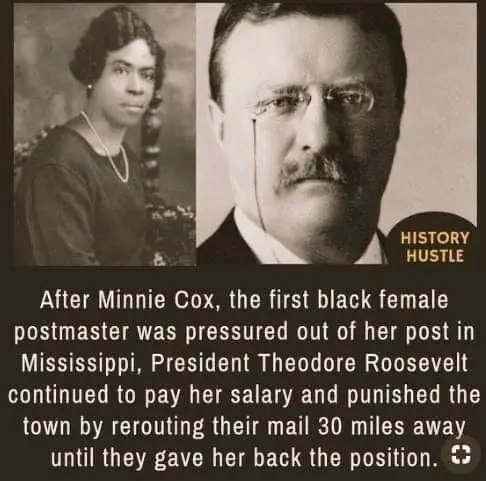
After Minnie Cox, the first black female postmaster was forced out of her post in Mississippi because she was black, President Theodore Roosevelt continued to pay her salary and punished the town by rerouting their mail 30 miles away until they gave her back the position.
The smartest people don't just listen.
They observe.
Words can be rehearsed.
Body language rarely is.
Watch the tone. Watch the eyes. Watch the expressions. Watch the patterns.
The Spearhead Reacts to U.S. Christian Nationalist's Call for Recolonization of Africa
Recently, American preacher Dale Partridge explicitly called for a return to European Christian colonization in Africa, invoking archaic, race-based theological constructs like the "Hamite" categorization to justify a permanent "civilizational station of subordination" for African nations.
In the latest Spearhead report, we peel back the mask on this narrative. We examine why these calls are not merely fringe opinions but a dangerous continuation of historical exploitation—the same logic used to rationalize the partitioning of Africa while "gospel merchants" stripped the continent of its resources.
History has shown us that the "fruit" of such colonization is devastation. We must remain alert; narratives like these are designed to sow the seeds for a second wave of encroachment.
An African Lady has revealed a deep secret behind the anti immigration movement in southAfrica and the possible consequences on poor sputhafricans in no distant time !
What do you think about this ?
Let's have this conversation respectfully .
"One of the gravest defects of religion is the fact that it can be used to keep the poor contented with their lot, which is very convenient for the rich."
— Bertrand Russell
To hide this level of violence under the guise of bringing civilization is the ultimate historical gaslighting. This isn't just a historical photograph; it is a crime scene.
"Olaudah Equiano (1745 – 1797) was an 18th-century African writer and anti-slàvery campaigner. From an early age, Olaudah Equiano experienced the h0rrors of slàvery first hand. However, eventually, one of his Masters gave him his freedom. This enabled him to become a B.ritish citizen and he began writing about his experiences. His autobiography ‘The Interesting Narrative of the Life of Olaudah Equiano‘ played a pivotal role in turning public opinion in Britain against sàvery.
Olaudah Equiano writes that he was born in West Africa ( Nigeria) in the year 1745 – a member of the Igbo tribe. Aged 11, he was kidn@pped, along with sisters, by native slave-holders; after being s0ld to Eur0pean slàve traders, he was then packed into a slave ship and transferred across the Atlantic to Barbados. Equiano eventually ended up in the British colony of Virginia. As a slavè, he was given different names, including Gustavus Vassa.
Equiano later wrote about the mistrèatment of slàves on the Virginia plantations. His vivid descriptions of the various punishments and hùmiliations that slàves had to endure were the first published account of an autobiography of a slàve. Speaking of the Virginia overseers.
Equiano was able to give a first-hand testament about life as a slàve. This information was useful for those who were hoping to change the law and outlaw slàvery. His friends encouraged him to write down a book about his experiences. First published in 1789, the account was eagerly received by many people in B.ritain. It sold well and went through many editions. Many people who read about the sùffering of slaves were more inclined to support the abolitionist cause. The book received good reviews, and many were surprised and moved by the quality of writing and his ability to depict life as a slavè.
The book made Equiano a prominent figure in literary circles. In 1788, Equiano was able to personally petition the king for the end of slàvery. The book also helped to demystify many of the current miscònceptions about African people – this personal account and personality of Equiano was very influential in displaying the obvious humànity of Black Africans.
Although there is some controversy about the exact birthplace of Equiano – some historians believe he may have been born in North America rather than Africa, there is no doubt that Equiano played a pivotal figure in the anti-slàvery movement. His writing and speeches helped show people that there was a strong sense of shared humanity."
The Royal Drummers of Burundi, in vibrant red and green, march in unison with enormous ceremonial drums (karyenda) held overhead, requiring strength, endurance, and precision, preserving a tradition across generations.
Historically performed for royalty, these powerful rhythms are a recognizable Burundian tradition.