Já que o assunto é bet, vou contar uma história de um menino que trabalhou comigo. Ele era viciado nessas roletas. Um dia recebeu um bom salário e estava feliz demais. Fomos embora juntos no meu carro, eu ia deixá-lo em casa, no João Pinheiro. No caminho, ele começou a jogar.
Em questão de minutos, o cara mudou completamente. Os olhos encheram de lágrimas. Perguntei o que tinha acontecido e ele falou: “Perdi R$ 1.800”. Eu nem acreditei que tinha sido tão rápido. Na tentativa de recuperar, colocou mais R$ 100 e perdeu. Falei para parar, mas ele estava naquela ânsia de recuperar o dinheiro. Colocou mais R$ 300 e, dessa vez, ganhou R$ 1.400. Parou e ficou feliz novamente.
Aí eu falei: “Porra, mas fazendo as contas você ainda está uns R$ 500 no prejuízo”. Ele simplesmente não ligou. Naquele momento eu entendi que talvez nem fosse mais sobre dinheiro. Ele precisava sentir que tinha ganhado. Podia perder R$ 1.000 e depois ganhar R$ 100 que a felicidade voltava.
Algum tempo depois, chegou ao trabalho comemorando: tinha ganhado R$ 30 mil. Comprou até um Palio. Só que uns seis meses depois, a mulher deixou ele. O vício já tinha chegado ao ponto de ele não dar mais atenção à própria família.
É por isso que muita gente olha para bet e pensa apenas: “É só não apostar”. Para quem está viciado, não é tão simples assim. A roleta não está vendendo só a possibilidade de ganhar dinheiro. Ela está vendendo a emoção de ganhar, a esperança de recuperar o que perdeu e aquela sensação de que, na próxima, vai dar certo.
E quando a pessoa percebe, não está mais jogando para ganhar dinheiro. Está jogando para tentar recuperar a sensação que o próprio jogo tirou dela.
@ultimasinter Bah que tristeza ver o Inter assim, escapamos por pouco ano passado e esse time é pior ainda, não tem dinheiro, não jogador bom, não tem liderança, não tem técnico, só tem torcida apaixonada!
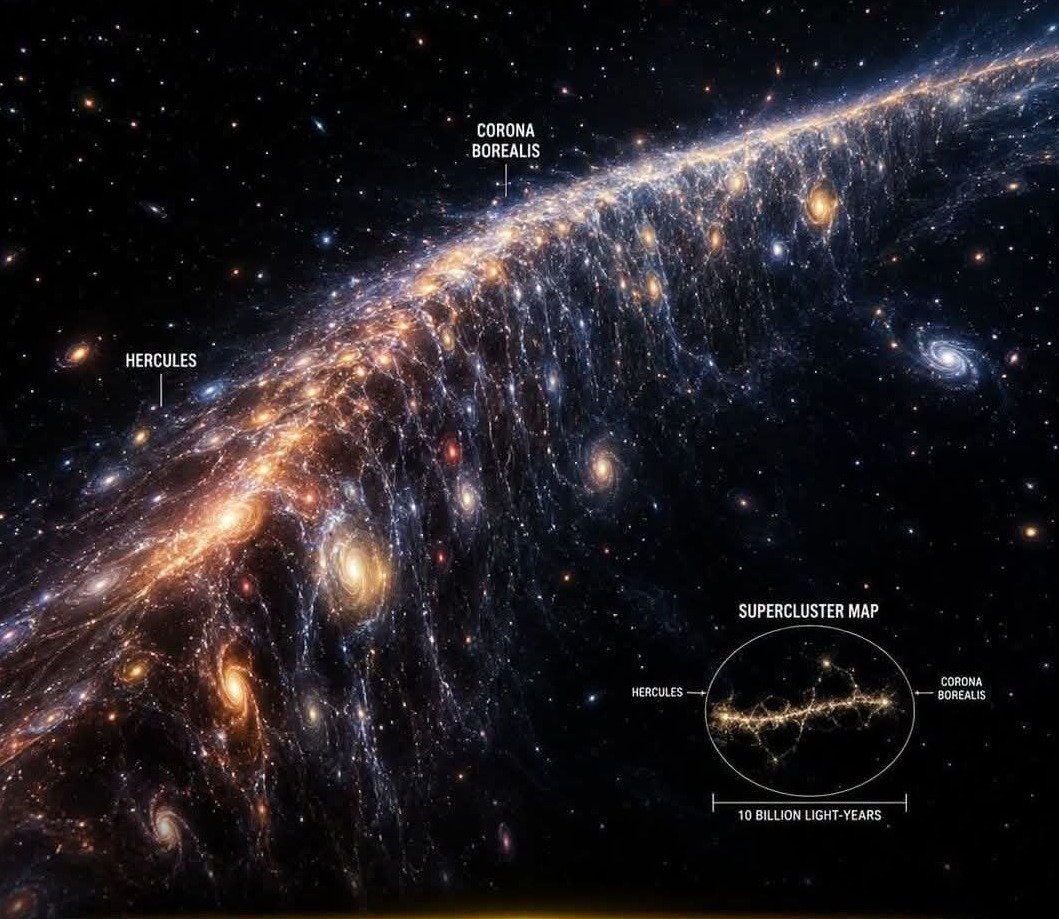
🌌 THE LARGEST STRUCTURE IN THE KNOWN UNIVERSE?
Picture something so vast that a beam of light—racing at nearly 300,000 kilometers every second—would still take billions of years to cross from one end to the other.
That something is the Hercules–Corona Borealis Great Wall, currently one of the largest known structures in the observable universe.
Don’t picture a solid barrier. This “wall” is a colossal filament of the cosmic web: a sprawling concentration of galaxies, galaxy clusters, and dark matter stretched across an estimated 10 billion light-years.
Astronomers first spotted it in 2013 while mapping gamma-ray bursts—the most violent explosions in the cosmos. An unexpected clustering of these distant beacons revealed a gigantic overdensity of matter spanning roughly one-tenth the diameter of the entire observable universe.
For scale: our Milky Way is about 100,000 light-years across. The Hercules–Corona Borealis Great Wall is roughly 100,000 times larger.
Its sheer size poses a serious challenge to the cosmological principle, which assumes that on the largest scales the universe should look roughly the same in every direction. Most models predicted that coherent structures shouldn’t grow much beyond about 1.2 billion light-years. This one appears to smash that limit.
Researchers continue to debate whether it is a single, truly connected structure or a statistical alignment of smaller clusters. Either way, it ranks among the most mind-bending discoveries in modern cosmology.
The universe is not a random scattering of stars and galaxies. It is woven into patterns so immense they defy everyday imagination—and somewhere inside this gargantuan wall of galaxies floats our own tiny Milky Way, a humble reminder of just how small our place in the cosmos really is.
JWST spots signs of a never-before-seen molecule on Pluto and Titan
Astronomers using the James Webb Space Telescope have found hints of a mysterious substance that has never been seen anywhere in the universe, and it appears on two very different worlds.
When light bounces off a planet or moon, each chemical it contains absorbs certain wavelengths, leaving dark gaps called absorption lines. These act like fingerprints, telling scientists what a distant world is made of. It's the same method Webb uses to study planets around other stars. In a new study, researchers spotted an unexplained gap at the same wavelength on both Pluto and Saturn's giant moon Titan. No known molecule matches it.
The finding is puzzling because the two worlds have little in common. Titan is larger than Mercury and has liquid rivers on its surface, while Pluto is a frozen dwarf planet far more distant from the Sun. Yet both seem to share this surface material, which appears more plentiful on Pluto and is spread unevenly across Titan.
Scientists suspect it could be a form of benzene or icy compounds like acetylene, but they can't confirm it yet. NASA's Dragonfly mission, due to reach Titan in 2034, may finally solve the mystery. The results haven't been peer-reviewed.
@roderix1966 Uma vez quando era adolescente, meu pais estavam viajando, eu acordei olhei a geladeira e tinha só uma torta de bolacha e vokca, nem leite nem pão, só isso, comi fui pro trabalho e deu aquelaaaa dor de barriga! Tempos de adolescente kkkk