Try #RoMo! A huge, carefully curated motion dataset shipped with the #MotionToolbox: a suite of dev and visualization tools for motion generation that just makes life so much easier!
🚀 RoMo @ #CVPR2026!
Built during my internship at @Roblox, RoMo is a large-scale dataset and semantic taxonomy for human motion generation:
🤸 ~820K sequences / 1,237 hours
📊 54 categories, 2,065 subcategories
🧰 Open-source Motion Toolbox
📍 Poster #202 · June 6 👇
🚨 RoMo @ #CVPR2026!
A large-scale, richly organized dataset + 3-level semantic taxonomy for text-to-motion:
🤸 ~820K sequences / 1,237 hrs
🧹 ~14 yrs of web video → only the top ~1%
📊 fine-grained per-category eval + open Motion Toolbox
📍 Poster #202 · Sat Jun 6 ExHall F 👇
🎉 The #CVPR HuMoGen Workshop is happening TOMORROW morning!
We’ll be featuring an exciting lineup of invited talks in generative modeling of 3D and 2D human motion. You won’t want to miss it!
https://t.co/lDN8TdFllk
Can we build a standalone, modular, and reusable naturalness reward for training motor controllers?
#SMP is a step toward that vision. Once SMP has been trained on a motion dataset, the priors can be reused to train new controllers to perform diverse tasks while adhering to the behaviors in the dataset, without original dataset or retraining.
🔥 Excited to share our latest work, SMP: Score-Matching Motion Priors, accepted to @siggraph
Webpage: https://t.co/Pz4yFAg1wo
Code: https://t.co/rZPp5b5GPD
Paper: https://t.co/K0z1oQkdFZ
Video: https://t.co/gPkyQCqNWz
Getting SDS to work for motion imitation has been tricky. But we finally got it to work!
With SMP, you can train a diffusion prior on a dataset, freeze it, and reuse it over and over again as a style reward to train new controllers.
Try it out: https://t.co/7enUVUkc3h
The Movement Lab has a new website ✨
A look at what we've been working on: humanoid robots, physics-based animation, and robot learning.
https://t.co/x7yXa4SzNa
The Movement Lab has a new website ✨
A look at what we've been working on: humanoid robots, physics-based animation, and robot learning.
https://t.co/x7yXa4SzNa
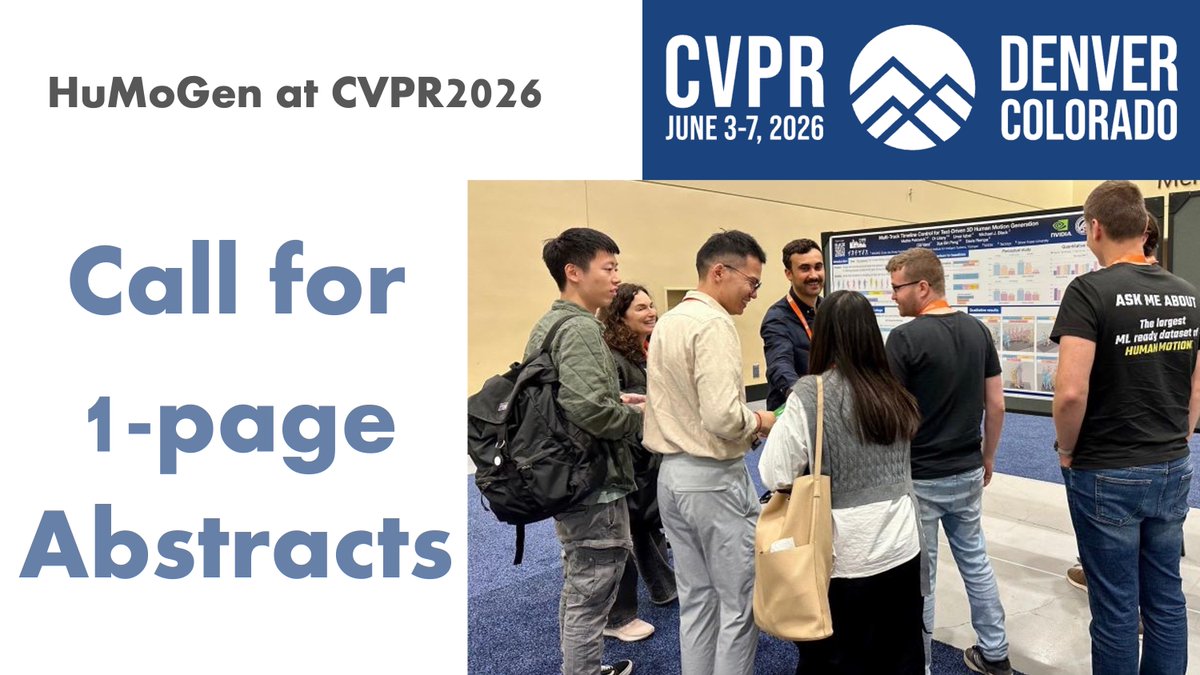
✨ Get the exposure your paper deserves!
Present at the best motion workshop in town 🏆
📩 Submit a one-page abstract to [email protected] with title, venue, authors, summary, teaser figure & webpage (optional).
Accepted abstracts will be presented in our poster session🚀
Excited about your MOTION paper being accepted to CVPR? Looking to extend its impact to more movers and shakers in the Human Motion Generation community? 🕺 Submit a one-page abstract to the HuMoGen Workshop at #CVPR2026 and reach an even broader audience! ✏️✨ @CVPR#HuMoGen >>
Creative work often starts before we can describe what we're looking for. What role can generative models play at this stage?
🌱Our new work, Inspiration Seeds, reveals hidden visual connections between images, creating a purely visual exploration space.
🔗https://t.co/gE9MRvbKcV
@ChenTessler@CedricKuperman Is driving games with RL controllers a realistic vision?
It is much riskier compared to today's motion graphs. What will be the real benefit?
Our students are paying for AI tools out of their own pockets. We surveyed the lab, and the numbers are real!
It makes them faster. We benefit. Feels wrong not to cover it. We're figuring out how to fund it.
Curious what other labs do.
Why pay full compute for pixels you're not even looking at?
In our new work, Foveated Diffusion, we introduce a new concept for efficient image and video generation, motivated by how the human visual system works.
(See full thread below)
High-resolution image and video generation is hitting a wall because attention in DiTs scales quadratically with token count. But does every pixel need to be in full resolution?
Introducing Foveated Diffusion: a new approach for efficient diffusion-based generation that allocates compute where it matters most.
1/7🧵