I keep saying we're destroying education by obsessing about testing in the AI era. Assign the same big, significant tasks you always assigned. Add some tests to make sure students understood what happened. But stop throwing the baby out with the bathwater. This post is right on.
What’s next in human-computer interaction?
Michigan AI Lab researchers and their coauthors shared their ideas at #UIST2026!
Take a look at what they’re working on: 💻〽️
https://t.co/X2qZRY9iB7
1. Cognitive limits: Novice learners don't effortlessly accelerate just because software sequences tasks. Without explicit human explanation and modeling, kids hit walls. Even Ventilla later admitted telling teachers to "get out of the way" failed.
Better AI and tighter time-boxing make Alpha a sharper execution of the playbook not a different theory of learning.
Every decade or so, Silicon Valley tries to optimize the human teacher out of instruction. Until an algorithm can diagnose confusion in a child's eyes and face in real time, history's warning still stands.
I liked how @sianbeilock describes how she uses AI. Meshes with my practices, too!
Opinion | Leaders Should Disclose How They Use AI. I’ll Go First. https://t.co/hZsRayzC0z
@labcomputer1 Such a complicated topic! Do students understand recursion in terms of loops? Or are there other ways of understanding iteration? https://t.co/U4hJnNKTdP
Carl explains the risk of GenAI. While you might be able to complete your current task with GenAI, understanding is about relating new ideas to old ideas. If you offloaded the old ideas to GenAI, you don't have them to relate to new ones.
@ShriramKMurthi@cvieiram@KathiFisler No, I do not think that you think students should be offloading. My note was not meant as a rebuke to you. I am all in favor of alternative pathways to alternative endpoints, like I say here. https://t.co/nG3SvWYPW5
@ShriramKMurthi@cvieiram@KathiFisler Sorry, no, the metaphor doesn't extend that far. I was connecting to Camilo's point that off-loading to GenAI does not lead to developing skills, and the metaphor is that using a car does not lead to physical fitness. No ordering effect implied.
I find #5 to be an incredible important systematic change. In a survey conducted a few years ago of APCSA teachers it was discovered that at some schools, students were required to take 2 or even 3 cs courses before APCSA, which is meant to be a CS1 course. Huge access barrier!
@cvieiram@ShriramKMurthi@KathiFisler Depends on which students we’re talking about. Non-CS majors debug successfully without algorithmic basics. https://t.co/iT8WI1LNTS
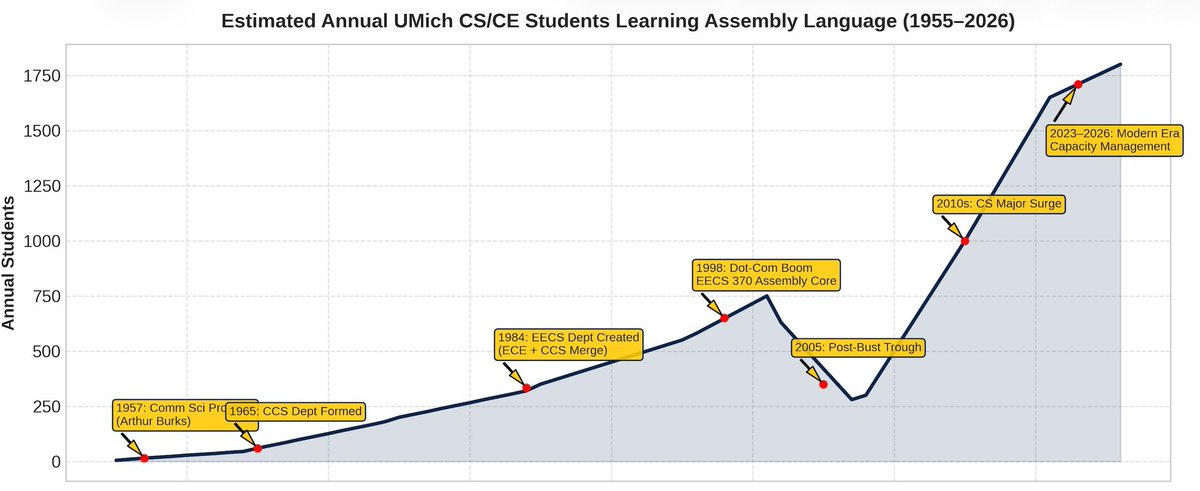
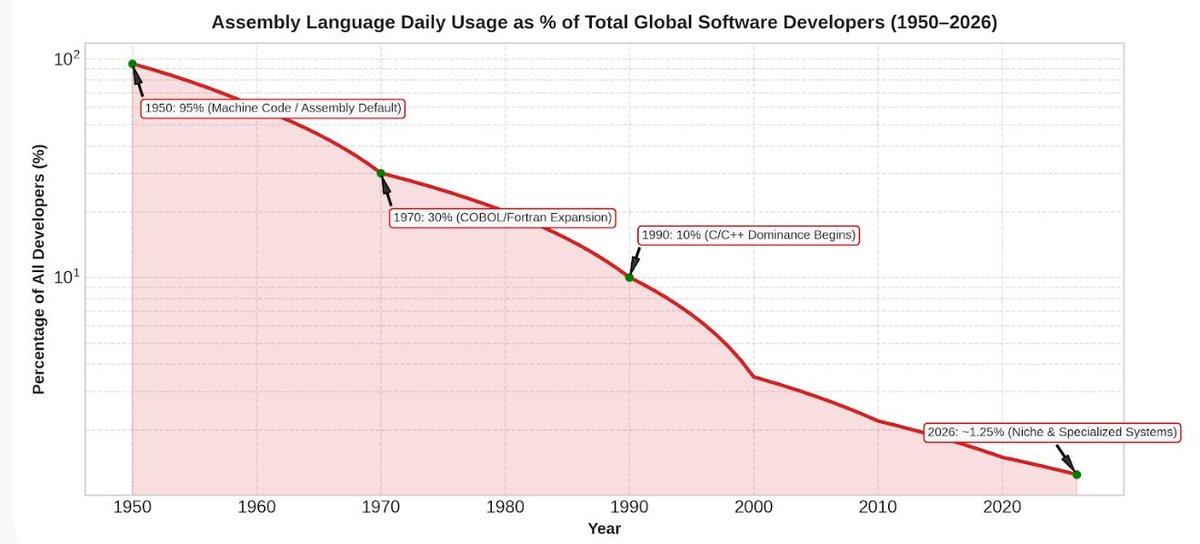
@amichlin You're arguing that it was "popular" and "still value in learning it." There's evidence for that, too, just because it's part of what we teach everyone and the numbers of CS majors has been increasing (until recently). Here are those numbers at UMich.
@amichlin I think you and @ShriramKMurthi are arguing two different things. The paper is right -- early programming languages allowed people to write programs without assembly. That is measurably true.
@cvieiram The article by @ShriramKMurthi and @KathiFisler explicitly address this point. How would you know if your compiler is generating buggy code? An LLM is a flaky compiler.