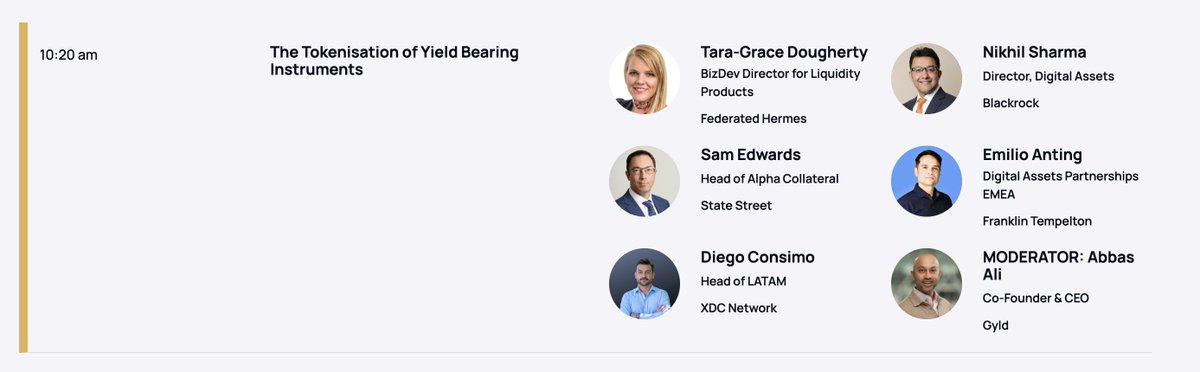
We'll be at the RWA & Stablecoins London Summit on 24th February, where our co-founder @abbasali will be moderating a panel on Yield Tokenization with industry leaders Nikhil S. (Blackrock), Sam Edwards (State Street), Emilio A. (Franklin Templeton), Diego Consimo (XDC Network) and Tara-Grace Dougherty (Federated Homes).
Drop @abbasali or @ruchirgupta90 a line if you'll be around!
Our founders @abbasali and @ruchirgupta90 are in HK this week at Consensus 2026 meeting investors, clients, and partners ahead of our launch later this year. Drop us a line if you're interested in what we're building at the intersection of crypto-native yield, fixed-income markets and tokenization!
We’re excited to introduce Active Staking Vaults - a new class of actively managed staking strategies we’ve been exploring with @ConcreteXYZ, the team behind some of the most trusted institutional-grade vaults in DeFi.
Our piece lays out three core ideas for where the market is headed:
1️⃣ Staking behaves like a real market - rewards are now driven by volatility, blockspace demand, and onchain activity.
2️⃣ Active strategies can outperform when paired with disciplined rules, transparent infrastructure, and role-based controls.
3️⃣ Vaults make this accessible - letting allocators express views on the “staking economy” with the same structure they expect from traditional active management.
If you’re interested in getting involved as an early allocator or curator, hit us up - we’d love to collaborate as we shape this category.
https://t.co/0u0ZG2ewoK
Volatility doesn’t just move markets — it moves staking rewards.
Our latest piece looks at how the October 10 liquidations translated into one of the biggest single-day jumps in Ethereum staking rewards, and what it says about staking as a tradeable asset class.
https://t.co/zwPsaMPCRY
Today @USTreasury and the @IRSnews issued new guidance giving crypto exchange-traded products (ETPs) a clear path to stake digital assets and share staking rewards with their retail investors.
This move increases investor benefits, boosts innovation, and keeps America the global leader in digital asset and blockchain technology.
Glad to announce that @ChuanBai has joined Gyld Finance as Chief Technology Officer.
Chuan brings over a decade of experience spanning traditional and digital finance — from building fixed-income pricing systems at Société Générale, to developing quantitative trading infrastructure at Millennium Global and CoinShares, one of the world’s largest digital asset ETP and hedge fund platforms. At CoinShares, Chuan led the buildout of proprietary trading and quantitative research platforms that powered the firm’s market-making and systematic strategies. His expertise in scalable trading architecture, pricing systems, and reproducible research will be key as Gyld builds institutional-grade financial market infrastructure for digital asset yields.
Welcome aboard, Chuan — we’re thrilled to have you leading Gyld’s technology and engineering efforts as we bring fixed-income structure and liquidity to DeFi.
Our co-founder @ruchirgupta90 was quoted in Decrypt on the rapid rise of Bitcoin ETPs. As access grows, the next phase will be about yield and performance — the kind of infrastructure we’re building at Gyld.
https://t.co/u2xY3XuLGW
We're heading to Token2049 Singapore next week—our founders @abbasali and @ruchirgupta90 will be on the ground meeting investors, clients, and partners. If you’re an asset manager, market maker, or trader interested in institutional staking markets, let's connect!
WOW. The SEC has approved Generic Listing Standards for "Commodity Based Trust Shares" aka includes crypto ETPs. This is the crypto ETP framework we've been waiting for. Get ready for a wave of spot crypto ETP launches in coming weeks and months.
🚨 SEC approves generic listing standards for ETFs — a landmark step for digital assets.
1/ What changed
ETFs tracking commodities (incl. crypto) can now list without bespoke SEC approvals if they meet defined tests (ISG market, 6+ months futures, or an ETF with ≥40% NAV in the asset).
→ Process under Rule 19b-4(e) shortens from months to weeks.
2/ Implications for crypto
Altcoin ETFs (SOL, XRP, LTC, DOGE, etc.) now have a clear fast-track pathway. This removes the bottleneck of one-off filings and levels the playing field with traditional commodities.
3/ The staking limitation
Funds must keep ≥85% of assets liquid daily. Staked/locked assets = illiquid.
15% staked → mandatory liquidity risk frameworks, outside the generic safe harbor. LSTs are not yet recognized as equivalent to the underlying.
⚖️ Bottom line
Plain-vanilla spot ETFs get a green light, opening the door to greater inflows and sharper fee competition.
ETFs seeking to integrate staking yield still face bespoke approval — but competitive dynamics will invariably push the market in that direction over time.
🚨 ETH exit queues are blowing out — and it shows exactly why we need institutional staking markets.
Kiln is exiting all of its Ethereum validators as a precautionary measure following the recent SwissBorg/Kiln incident. And because Ethereum throttles how many validators can enter/exit per epoch, queues have spiked dramatically.
For stakers who simply want to switch validators, the round-trip looks like this:
⏳~41 days in the exit queue (still earning rewards)
🛑~9 days in the withdrawal queue (no rewards)
🔁~13 days to re-enter the activation queue if restaking (no rewards)
👉 Nearly two months of capital stuck in limbo.
Importantly - these queues affect everyone staking ETH, no matter the provider. This is a market-wide problem.
Ethereum’s design — like most PoS blockchains — prioritizes security, not TradFi-style liquidity. It was never built for wrappers that must meet redemption obligations, or for large, idiosyncratic exits like this one.
That’s exactly why we need market infrastructure to exchange liquidity and staking-reward risk. With fixed-term, bearer instruments backed by staked ETH and a clear legal foundation:
✅ Liquidity-constrained holders could cash out early into liquid ETH, trading illiquidity for a discount.
✅ Long-term ETH holders could step in, earning the benchmark CESR + Spread for taking on the lock-up risk — effectively rewarding patient capital.
Wrappers with redemption obligations, like ETFs and ETPs, could meet them without relying on bilateral financing workarounds or excess buffers.
This isn’t about eliminating risk — it’s about pricing it, transferring it, and managing it. That’s exactly what institutional staking markets are built to solve
🚀 We’re excited to share that Gyld Finance has raised $1.5m pre-seed, led by @Lightshift_xyz
Staking has gone mainstream. ETFs and ETPs now hold staked assets, Digital Asset Treasuries and funds have allocated billions, and regulation is becoming clearer. Institutions are beginning to manage these positions at scale.
But the next phase is just beginning: competition and accountability.
Like fixed income markets, institutions will need to benchmark, optimize, and actively manage staking rewards — competing to outperform indices such as CESR from @coinfund / @CoinDeskMarkets
Today, that’s still difficult. Returns are volatile, entry/exit queues create friction, and there is no market to transfer or hedge slashing risks.
That’s why we’re building Gyld. Our liquid TERM staking instruments are designed with a clear legal framework — making staking rewards transparent, benchmarkable, and tradeable.
We’re working with @ZodiaCustody , @CopperHQ , @Figment_io, and @BlockdaemonHQ to ensure institutional standards from day one.
And we’ve built Gyld from deep experience at the intersection of markets, trading, and infrastructure:
@abbasali — Former Product Head at JPMorgan Kinexys
@ruchirgupta90 — Former Head of Treasury & Options Trading at GSR, and previously a Fixed Income trader
Follow Gyld Finance as we share how we’re shaping the future of staking markets.