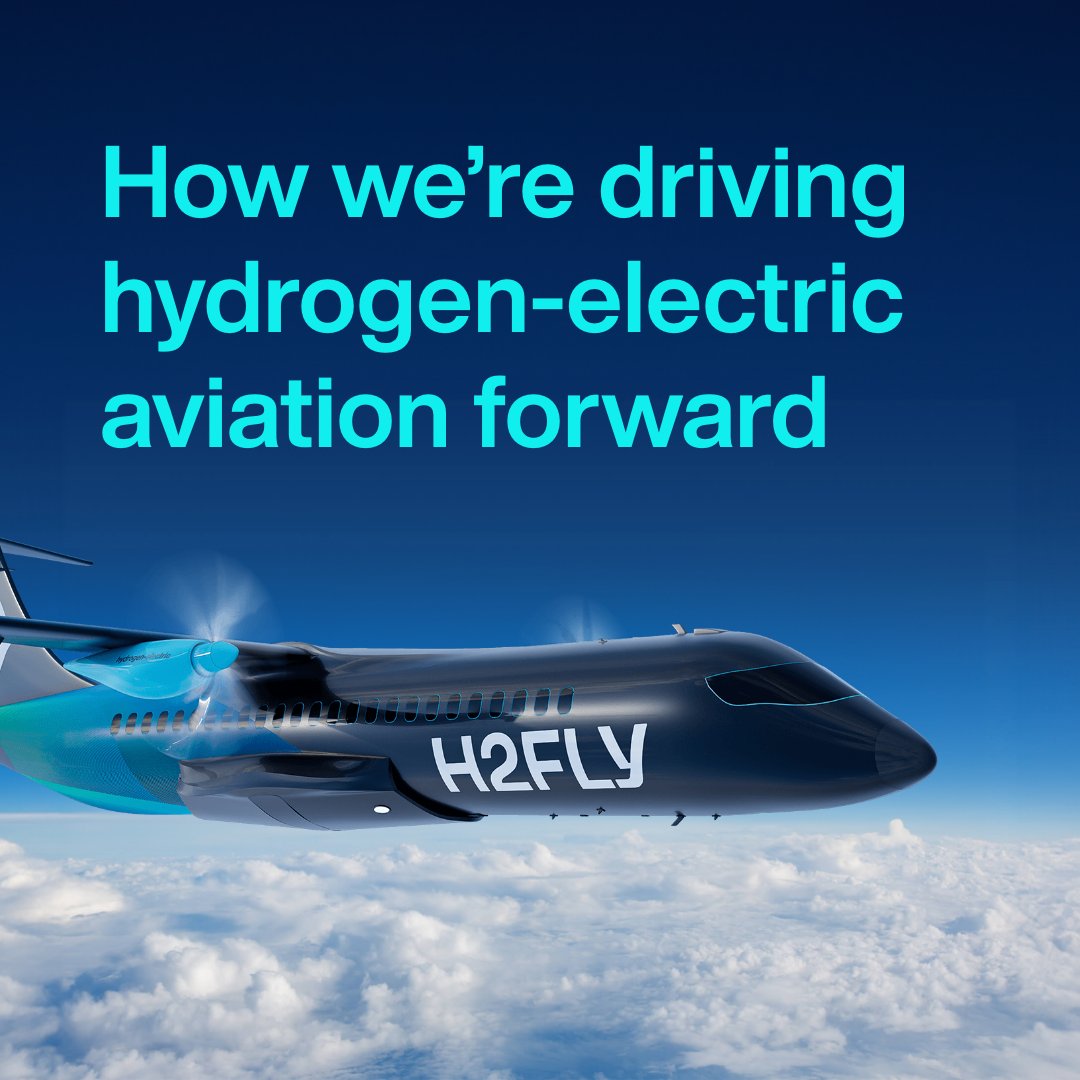
H2FLY has come a long way since its inception in 2015. Evolving from a research project, we've grown into a record-breaking leader in sustainable aviation. 🙌
Read the thread below for a year-by-year breakdown of our milestones so far.
Bringing hydrogen-electric flight to market is a step-by-step journey — and one that will start at a smaller scale.
Propulsion technology is only part of the equation. Hydrogen aviation needs a complete ecosystem: ground infrastructure, refueling concepts, operational integration, and certification frameworks. Building that ecosystem — alongside our propulsion systems — is the direction H2FLY is moving.
Our CEO Ralph Müller shared his perspective on the road ahead with Aerospace Global News: https://t.co/AP3JNeEXU5
Hydrogen-electric aviation isn't one-size-fits-all, the right system architecture depends on the specific aircraft and mission.
Our CEO Ralph Müller will be speaking at the AERO Hydrogen & Battery Summit 2026 on April 21 presenting H2FLY's methodology for working through that complexity.
Session details: https://t.co/VulY2UJBac
Women remain significantly underrepresented across aerospace, accounting for only around 6% of commercial pilots and about 14% of aerospace engineers.
We’re proud of the our team from H2FLY who were part of this important conversation in @Aero_GlobalNews on International Women’s Day.
The article highlights the women shaping the future of aviation and the importance of building teams where diverse voices can contribute, grow, and lead.
Read the full article to see what our experts Debjani Ghosh and Maria Sol Rau said about the barriers and the solutions needed to make the sector more equitable: https://t.co/v3lLbrDVtY
Some advice stays with you.
A conversation that inspires you. A perspective that changes how you approach your work. A reminder to keep going, especially when it feels challenging.
This International Women's Day, we asked some of the women at H2FLY what advice they would pass on to others navigating their careers or those just starting out.
Their words remind us of the importance of courage and persistence to break new ground, and believe in your abilities. We celebrate the women driving progress in aviation and those creating workplaces where everyone can contribute, grow, and succeed.
Resilient climate innovation is built on engineering discipline.
In a recent conversation with Alison Coleman from @Forbes, H2FLY CEO Ralph Müller shared why 2026 could mark an important moment for climate tech, particularly in aviation.
While parts of the sector are adjusting to new market realities, the fundamentals of long-term progress remain the same: systematic development, technical rigor and consistent execution.
At H2FLY, our work follows that principle, from bench testing to flight demonstrations across multiple aircraft platforms, guided by a clear roadmap and defined engineering milestones.
Read more here: https://t.co/fXUYvUNcUD
With our industry committed to net zero emissions, 2026 is shaping up to be a truly pivotal year for progress.
To meet these targets, the world must accelerate innovation, investment and collaboration, especially in hydrogen-electric flight.
H2FLY is ready for this challenge. Over the past year, we've advanced from research to real-world demonstrations, and in 2026 we'll continue to advance our next-generation fuel cell system, push ahead with new test flights and launch and expand our partnerships programs across the hydrogen ecosystem.
Together with our team, we're determined to set the pace for the future of hydrogen-powered flight.
2026 is set to be a landmark year. As we advance the next generation of our hydrogen-electric propulsion systems and expand our testing activities, we continue pushing the boundaries of what's possible.
To support this next phase, we're growing our team. We're looking for people who are passionate about being at the forefront of innovation and want to help shape the future of flight.
Become part of the journey, discover our upcoming opportunities here:
https://t.co/9vFeUYlKGh
Even as the year wraps up the team at H2FLY has been pushing hard in the test hall, keeping test benches running to stay exactly where we need to be on our roadmap.
Our in-house developed components, like valves, turbomachinery and electrical systems are all going through their pace to prove they’re ready for the next step.
Every run, every data point and every iteration is about one thing.
Getting closer to delivering the next generation of our H2F‑175 system in 2026.
There's no better way to wrap up the year than bringing the incredible H2FLY team together to celebrate our wins and the teamwork that made them possible.
This year's party gave everyone a chance to reflect and enjoy each other's company after months of hard work. It was great to see colleagues connecting across teams, sharing stories from a year spent driving progress both in the lab and out in the field.
From the milestones we've reached to the innovative projects on the horizon for 2026, we shared a heartfelt thank-you to every team member for their dedication this year.
Achieving zero-emission flight with hydrogen-powered technologies requires a steady supply of clean electricity to produce sustainable hydrogen.
Electricity demand in Europe is expected to surge by 2050 as industries, transport sectors, and AI data centres ramp up electrification in their decarbonization efforts.
Meeting this growing demand while producing green hydrogen for aviation, and simultaneously phasing out fossil fuels, calls for a rapid and large-scale deployment of renewables such as wind, solar, and beyond.
Without urgent policy action to accelerate renewable energy deployment, streamline permitting, improve grid infrastructure, and provide clear investment incentives, electricity prices could increase, risking economic competitiveness and energy security across Europe.
Policymakers must prioritize expanding renewable energy capacity, modernizing grids, and fast-tracking hydrogen infrastructure development.
Ensuring abundant, affordable, and clean electricity is essential for producing green hydrogen that makes zero-emission flight truly sustainable and competitive, securing Europe’s climate ambitions and energy future.
Source: Europe’s flightpath to economic competitiveness, Fathom Financial Consulting
Europe is home to less than 6% of the world’s population but accounts for nearly 27% of global air traffic, highlighting its critical role in connecting people and economies.
Aviation is a powerful economic engine for Europe, contributing approximately 5% to the continent’s gross domestic product (GDP) and supporting around 4% of all jobs. Its impact spans from manufacturing and exporting aircraft to enabling tourism in regions reliant on air travel.
The stakes are high. Large parts of Europe depend on aviation not only being viable but sustainable. Lagging behind in decarbonization would risk lost competitiveness, weaker economies, and missed chances for growth.
We believe Europe can seize a leading role in the future of clean aviation by advancing hydrogen-powered zero-emission flight technologies. By driving innovation in hydrogen fuel cells and sustainable propulsion, H2FLY aims to help Europe unlock new markets, create high-value jobs, and maintain its global leadership in aviation.
Europe won't just adapt to the future of aviation, it will shape it, powered by hydrogen.
Source: Europe’s flightpath to economic competitiveness, Fathom Report
Hydrogen-electric flight is moving closer to commercial reality.
We are transitioning from research pioneer to commercial supplier, supporting aircraft manufacturers as they develop the next generation of zero-emission aircraft.
To meet this moment, we are:
• Scaling for production, implementing new structures and design-for-manufacturing practices to prepare for system supply at an industrial scale.
• Developing the next generation of hydrogen-electric energy systems, designed to scale across multiple aircraft types and power classes.
• Enabling certification progress, collaborating with regulators and partners to help shape the compliance framework for hydrogen-electric propulsion
Read the full feature: https://t.co/TSxKIGBQlW
Our CEO Ralph Müller, recently spoke with Thierry Dubois at @AviationWeek, highlighting our progress on the next generation of our proprietary H2F-175 fuel cell system family.
Designed to scale across multiple aircraft types, from UAVs and eVTOLs to regional aircraft, the H2F-175 will offer flexible power classes, higher energy density, and improved efficiency, delivering better integration with aircraft platforms.
Early test rig evaluations are meeting performance expectations, further strengthening confidence as we advance toward our next phase of flight testing in 2026.
Read more here: https://t.co/s4wbnVE9cu
We’re preparing for the next phase of hydrogen-electric flight — moving closer to bringing quiet, zero-emission aviation to early commercial applications.
In 2026 and 2027, we plan to resume flight demonstrations and assess how our hydrogen-electric powertrain performs across different aircraft types. These upcoming tests will help validate the performance and reliability of our next-generation propulsion systems, paving the way toward commercial readiness by 2030.
Our mission remains clear: to lead the shift to a new era of flight — and to enable the aviation industry to move confidently toward zero-emission operations.
Read more here: https://t.co/s6EqC4uqA1
Once again, hy-fcell 2025 proved to be a defining event for the hydrogen industry.
We were proud to spotlight the role of hydrogen fuel cell technology in aviation— showcasing our latest work and sharing what’s ahead.
Huge thanks to everyone who joined guided tours, stopped by our booth, and took part in our panel discussion alongside @STR_Airport, @Airbus, and @Avinor.
Progress happens when industry leaders move forward, together. ✈️
Heading to hy-fcell Stuttgart? So are we!
The H2FLY team will be at Hall 4, Stand 4E43 throughout the event, ready to share our latest developments in hydrogen-electric propulsion systems for aircraft.
We’ll also be taking part in a panel discussion on 7th October, 2:00–3:00 pm. Where our CTO, Josef Kallo, will join John-Ragnar Aarset (Avinor), Isabell Gradert (Airbus), and Ulrich Heppe (Stuttgart Airport) to explore the path toward sustainable aviation.
Collaboration is key to driving meaningful progress, and we look forward to continuing the conversation with many of you in person. See you there!
Partnerships 🤝
Collaborating with leading companies, research institutions, and regulatory bodies allows us to pool knowledge, overcome shared challenges such as infrastructure, and accelerate the development of hydrogen-powered flight.
Together, we are shaping a cleaner, quieter, and more sustainable future for aviation.
The momentum behind advancing hydrogen-electric aviation is truly exciting.
At H2FLY, we are contributing by focusing on four crucial areas we believe can make the most difference. Here's how👇
Technology 📈
By advancing our fuel cell systems and liquid hydrogen tank systems, we are creating pathways for hydrogen as a sustainable aviation solution.