H36= collab electronic music, multi-media artists & creative twins Canyonlands1 & Baccasooz, also on asteroid as separate entities. here and @cosmos_prophet
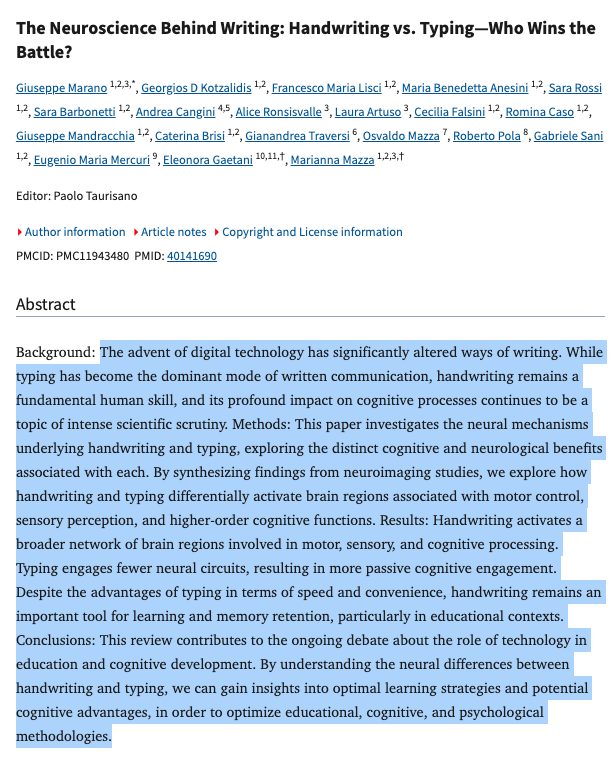
Your brain physically rewrites itself every time you pick up a pen.
Neuroscientists at Norwegian University scanned students' brains while they handwrote letters versus typing the same letters on a keyboard.
The results shattered decades of assumptions about how we process information.
Handwriting activated massive networks in the sensorimotor cortex, the visual processing centers, and the hippocampus simultaneously. Complex neural symphonies lit up across multiple brain regions, creating rich interconnected pathways between motor control, visual recognition, and memory formation.
Typing the same letters? The brain activity looked like someone had dimmed the lights across entire cognitive districts. The neural networks that flourished during handwriting simply went dark.
The difference?
When you form letters by hand, your brain constructs elaborate spatial maps of each character. The motor cortex learns the precise pressure, angle, and trajectory needed to create an 'A' versus a 'B.' Your visual system tracks the ink flowing from pen to paper in real time. Your parietal lobe integrates hand position with eye movement. Your hippocampus encodes not just what you wrote, but how the writing felt, where you paused, which words required more pressure.
Typing activates almost none of that circuitry. You press a key, a letter appears. The motor movement is binary. The visual feedback is uniform. The spatial relationship between thought and symbol gets mediated by a machine that standardizes every character into identical fonts and spacing.
Your brain treats these as fundamentally different cognitive tasks.
The evolutionary context makes this obvious once you see it. Human hands developed for manipulation, creation, and fine motor control over millions of years. We painted on cave walls, carved bone tools, and shaped clay vessels long before we invented written language. When writing emerged 5,000 years ago, it built on top of existing neural infrastructure that already connected hand movement with symbolic thinking.
Keyboards appeared 150 years ago. Touchscreen typing maybe 20 years ago. From an evolutionary timeline perspective, we started using them approximately yesterday. Our brains are still running ancient software that expects physical engagement with symbols.
That software produces dramatically different learning outcomes.
Students who take handwritten notes consistently outperform students who type the same information on memory tests, comprehension assessments, and creative applications of the material. The difference persists even when researchers account for typing speed, note length, and time spent studying.
The act of forming letters by hand forces deeper processing at the moment of information encounter. You cannot handwrite as fast as someone speaks, so your brain must actively filter, summarize, and prioritize information in real time. The motor effort required to form each word creates additional memory traces that typing does not generate.
Children who learn to write letters by hand develop reading skills faster than children who learn letters primarily through typing or screen interaction. The sensorimotor experience of creating letterforms helps their brains recognize those same letterforms when they encounter them in text.
Adults who handwrite shopping lists, daily schedules, or meeting notes remember the information better than adults who type identical lists into phones or computers. The spatial memory of where you wrote something on a page provides retrieval cues that digital text does not offer.
These findings collide directly with how education and work environments have evolved over the past two decades. Schools replaced handwriting instruction with typing classes. Offices converted from paper systems to fully digital workflows. Students take notes on laptops. Professionals draft documents on screens.
We optimized for speed and efficiency while accidentally severing the neural pathways that evolution spent millions of years developing.
The implications reach beyond memory and learning into fundamental questions about human cognition. If the physical act of forming symbols changes how your brain processes ideas, what happens to thinking itself when you remove the physical component?
Digital text is infinitely searchable, instantly editable, and perfectly shareable. But it may be creating brains that process information more superficially, store memories less durably, and connect ideas more weakly than brains that regularly engage in handwriting.
The neuroscience suggests we traded cognitive depth for technological convenience without realizing what we were giving up.
Some of the most innovative thinkers across history were obsessive handwriters. Darwin kept detailed handwritten journals. Einstein worked through complex theories in handwritten notebooks. Virginia Woolf wrote her novels by hand before transcribing them. Steve Jobs famously took handwritten notes during Apple meetings even as he was building the most advanced computers on Earth.
Perhaps they intuited something about the relationship between hand, brain, and insight that we measured in brain scanners but somehow forgot in practice.
Your pen is literally a cognitive enhancement device that activates neural networks digital keyboards cannot reach.
Finally got around to uploading an old album to https://t.co/ixwdY4bXyl
Was a such a smooth experience, I think @GrimfelOfficial has created something special here.
Heres one of the tracks from it
https://t.co/Tuur79Ovdp
Here, have a bunch of really weird and difficult to explain ancient anomalies.
Scattered around the megalithic site of Saqsaywaman in the highlands of Cusco, Peru.
All filmed, Edited & Narrated by me
If this work matters to you support it with a like/comment/repost
@garagefli@NewComerTruth@laurendeboneill@Cosmos_Prophet Cheers, I am developing it into a miniseries with a main character— I’m trying to stop it being too much like dr who which is difficult. Yes lots of music also in development. Everthing part done forever as per.
@garagefli@NewComerTruth@laurendeboneill@Cosmos_Prophet Excellent, got loads of work done to that mix and the other one. Thank you for those. Love that sample of the guy talking about making music. Great mixes/mixing and tunes.
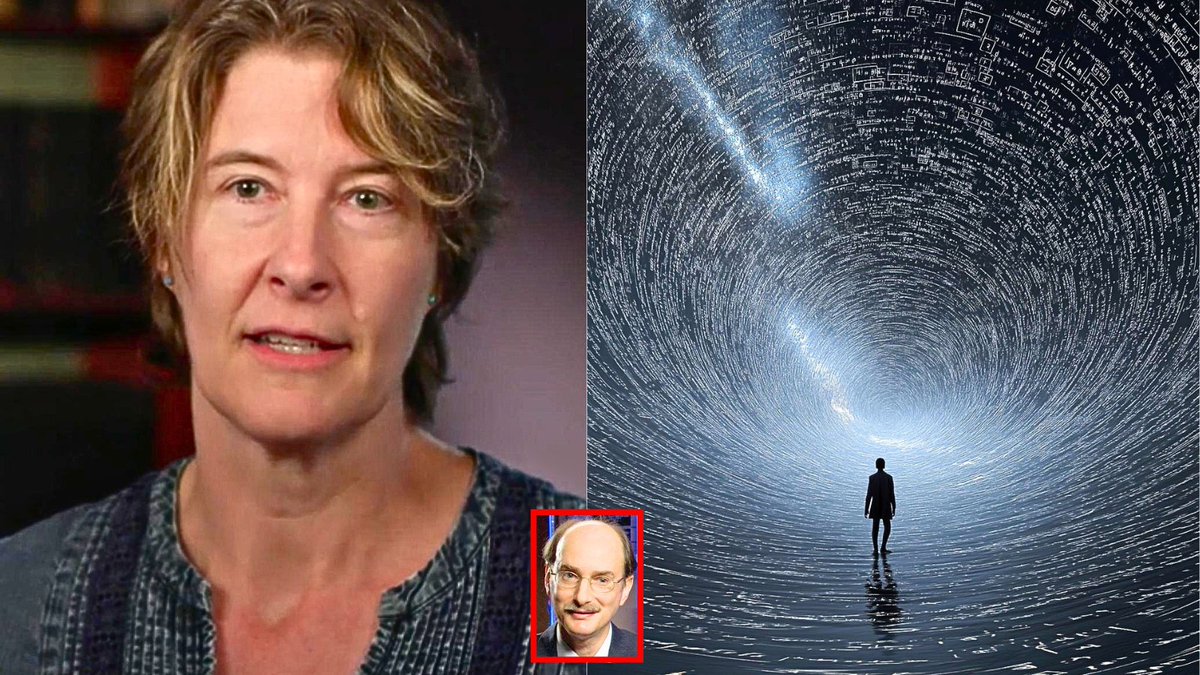
She is a Cognitive neuroscientist who claims that consciousness can ‘jump’ into the future, suggesting that time is not strictly linear and that gut feelings may sometimes be information ‘leaking’ from the future.
Julia Mossbridge has collected many stories of such experiences and also had them herself since childhood.
One story is about a four‑year‑old girl in 1989 who suddenly felt she would never see her father alive again when he left on a trip, and later that night he died in a car crash.
Mossbridge says her own dreams sometimes matched real events that happened later, and keeping a dream journal helped her see that some details were too specific to be a simple coincidence.
Because of this, Mossbridge started to question the usual picture of time as a straight line: past, present, future in one direction only. She suggests the future might already exist in some form, and that people can sometimes “remember” future events the way they remember past ones.
She gues that there is both experimental evidence for precognition and support from physics ideas like “retrocausality,” where something in the future can influence the past. For her, the difficulty is not understanding the concept, but getting people to accept it, because it conflicts with their belief that time must be linear.
In 1968, with no CGI available, the effects team had to get inventive to create the floating pen in 2001: A Space Odyssey (1968).
The solution: attaching a pen to a rotating sheet of glass.