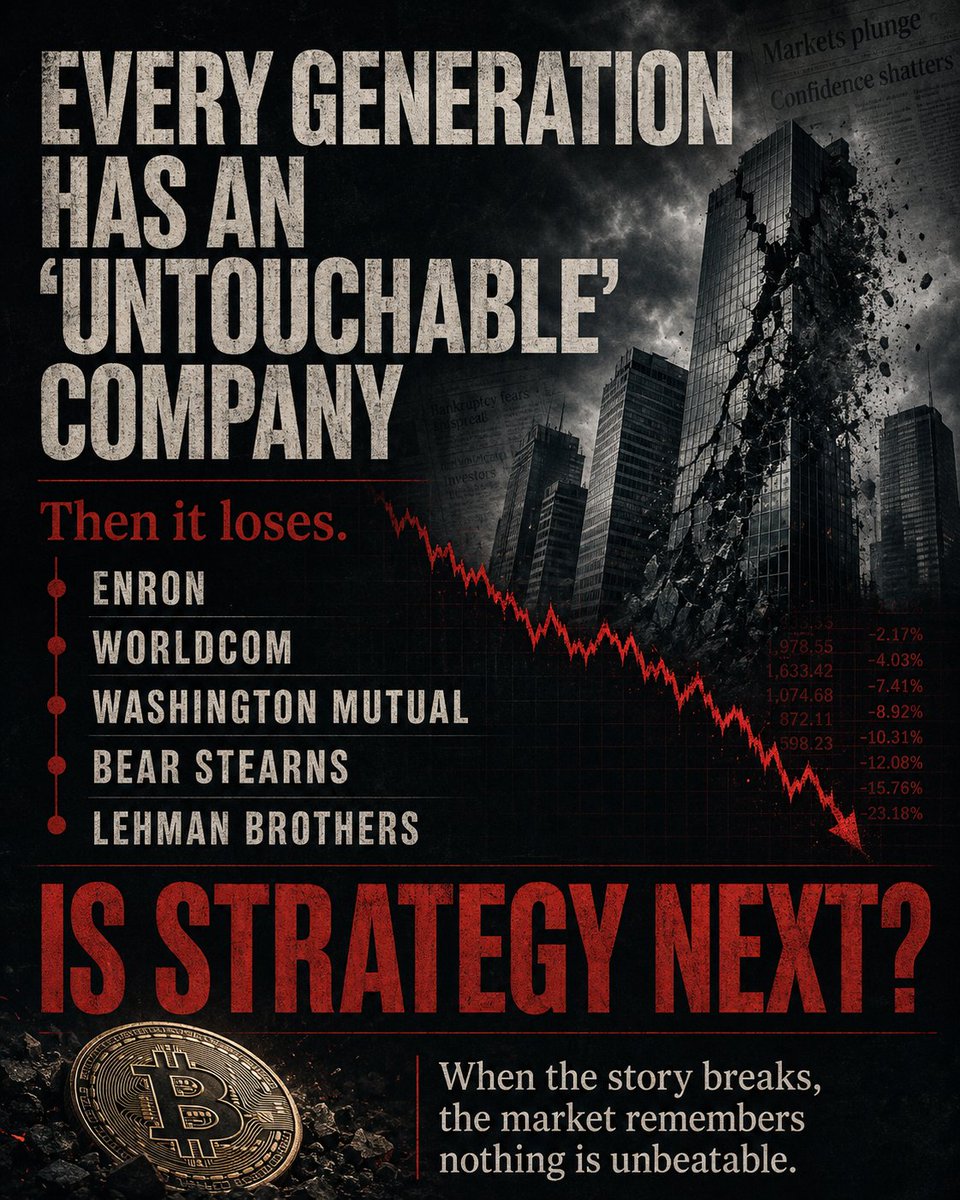
Every Generation Has an Untouchable Company. Then It Dies.
Every generation of investors gets one.
The company that is supposedly too big, too smart, too important, too innovative, or too well-positioned to ever really fail.
And every fucking time, people convince themselves this one is different.
Until it isn't.
Enron wasn't some penny stock operating out of a strip mall. It was one of the most celebrated corporations in America. Wall Street loved it. Analysts loved it. Executives were treated like fucking geniuses.
Then the stock went from more than $80 to less than $1 and the company filed for bankruptcy.
WorldCom was one of the largest telecommunications companies on Earth. It had infrastructure, customers, revenue, global reach, and the kind of scale people assumed made it nearly untouchable.
Bankrupt.
Washington Mutual had more than $300 billion in assets.
People trusted it with their fucking life savings.
Then one day it became the largest bank failure in American history.
Bear Stearns had been around since 1923.
Gone.
Lehman Brothers survived the Civil War, two world wars, the Great Depression, and damn near 160 years of financial history.
It couldn't survive 2008.
AIG was so interconnected with the global financial system that the government essentially decided allowing it to collapse could take everyone else down with it.
Fannie Mae and Freddie Mac were considered pillars of American housing finance.
Both ended up in government conservatorship.
The point isn't that these companies were all the same.
They weren't.
Some involved fraud. Some involved leverage. Some involved liquidity problems. Some made catastrophic bets. Some simply constructed businesses that worked beautifully until the environment supporting those businesses changed.
But they all shared one thing.
The market created a story explaining why normal rules didn't apply to them.
And that's where MSTR comes in.
I'm not saying Strategy is Enron.
There is no need to make that accusation.
The danger with MSTR is sitting directly in front of everyone.
Strategy has effectively transformed itself into a gigantic Bitcoin capital-markets machine.
Issue securities.
Raise capital.
Buy Bitcoin.
Bitcoin rises.
MSTR rises.
The ability to raise capital improves.
Issue more securities.
Buy more Bitcoin.
Repeat.
When the flywheel is spinning clockwise, it's fucking brilliant.
Michael Saylor looks like a genius because the structure itself reinforces the trade.
But Wall Street has seen this movie before.
The question you should always ask about a financial flywheel isn't:
"How powerful is it when everything works?"
The question is:
"What happens when it starts spinning backwards?"
Because Bitcoin doesn't need to go to zero for MSTR to have a serious problem.
It doesn't even necessarily need another 80% collapse.
You need some combination of prolonged Bitcoin weakness, compression of MSTR's premium, weaker demand for new securities, higher financing costs, continuing preferred dividend obligations, and investors becoming less willing to fund the machine.
Then the virtuous cycle starts becoming a vicious one.
And we're already seeing something that should make people pay attention.
Strategy spent years selling investors the idea of accumulating Bitcoin indefinitely.
In 2026, Strategy disclosed that it had sold Bitcoin and used proceeds to fund preferred-stock distributions and replenish the cash reserve used for those obligations.
Read that again.
The Bitcoin accumulation machine has now demonstrated that under certain conditions it will sell Bitcoin to service the capital structure built around buying Bitcoin.
That doesn't mean bankruptcy is tomorrow.
It means the machine has another direction.
And that's the part the cult doesn't want to talk about.
Because once you build a company around permanent access to capital markets, access to capital markets becomes part of the business model.
Eventually the question stops being:
"How much Bitcoin does Strategy own?"
And becomes:
"How much money does Strategy need to keep this entire capital structure functioning?"
Those are very different questions.
This is how these stories always work.
At first, leverage looks like genius.
Concentration looks like conviction.
Complexity looks like innovation.
Rising asset prices validate every decision management made.
Critics look stupid.
The stock keeps climbing.
The believers become louder.
And eventually people stop analyzing the company entirely.
They start defending the mythology.
"Bitcoin always comes back."
Maybe.
"Saylor will just raise more money."
Maybe.
"There will always be demand for MSTR securities."
Maybe.
And there it is.
Three sentences containing the most dangerous word in finance:
always.
There is no always.
There was no always for Enron.
There was no always for WorldCom.
There was no always for Washington Mutual.
There was no always for Bear Stearns.
There was no always for Lehman Brothers.
And there sure as fuck isn't an always for MicroStrategy.
I don't know exactly what breaks MSTR.
Maybe it's Bitcoin.
Maybe it's the premium.
Maybe it's the preferred structure.
Maybe capital markets simply stop giving Saylor increasingly favorable financing.
Maybe nothing dramatic happens and the thing slowly unwinds over years.
But I'm willing to make the prediction:
MSTR will eventually become the case study people use to explain how an apparently unstoppable financial machine became fragile because everyone assumed the machine would never stop.
And when it happens, everyone will pretend they saw it coming.
They always fucking do.
Because Wall Street's four most expensive words aren't:
"This time is different."
They're:
"It can't fucking fail."
The pump proved one thing. Saylor's flywheel is now broken. The experiment has failed. The next downturn will be even worse for MSTR than this last one.
With a MASSIVE +25% week for $BTC, the problems with $MSTR remain unchanged.
Due to $MSTR trading more in line with $BTC instead of “amplified Bitcoin,” mNAV remained pegged at 1.
What does 1 mNAV mean exactly?
It means no common share ATM for Bitcoin purchases, USD Reserve increases, and no $STRC repurchases.
Thus, when liquidity conditions should have improved for @Strategy, it is clear they painted themselves into a corner.
With Bitcoin’s stellar week, the flywheel was not restarted.
If these conditions continue, Strategy will be forced to sell more Bitcoin in the effort to reach par with $STRC.
Once all the premium is squeezed, “amplification” goes by the wayside.
Here is the part the MSTR cult does not want to talk about.
Bitcoin ATH on October 6, 2025:
$126,198
MSTR that same day:
$365.21
Fast forward to this rally.
Bitcoin hit roughly $79,463.
MSTR hit roughly $121.86.
Do the fucking math.
Bitcoin is still about 37% below its high.
MSTR is still about 67% below its high.
Bitcoin has recovered to roughly 63% of its peak value.
MSTR has recovered to barely 33%.
Wasn't MSTR supposed to be the leveraged Bitcoin play?
Wasn't Saylor's financial engineering supposed to create MORE Bitcoin exposure per dollar and MORE upside than simply owning Bitcoin?
Instead, the market has spent the last two years systematically stripping the premium out of the stock.
MSTR's NAV multiple went from roughly 3.5x to 3.9x at peak insanity to around 1.1x today.
That is the story.
The Bitcoin didn't stop being Bitcoin.
The market stopped believing Saylor deserved a massive premium for wrapping Bitcoin inside a corporation loaded with common stock issuance, preferred stock, debt, dividends and increasingly complicated financial engineering.
And here's the funniest part.
Strategy was buying Bitcoin near the top at over $123,000.
Months later it was selling Bitcoin around $59,000 to $61,000 to help fund obligations and reserves.
Buy high. Sell low.
Apparently we're calling that financial engineering now.
MSTR hasn't disproven Bitcoin.
Bitcoin has exposed MSTR.
If you wanted Bitcoin exposure, you could have just bought the fucking Bitcoin.