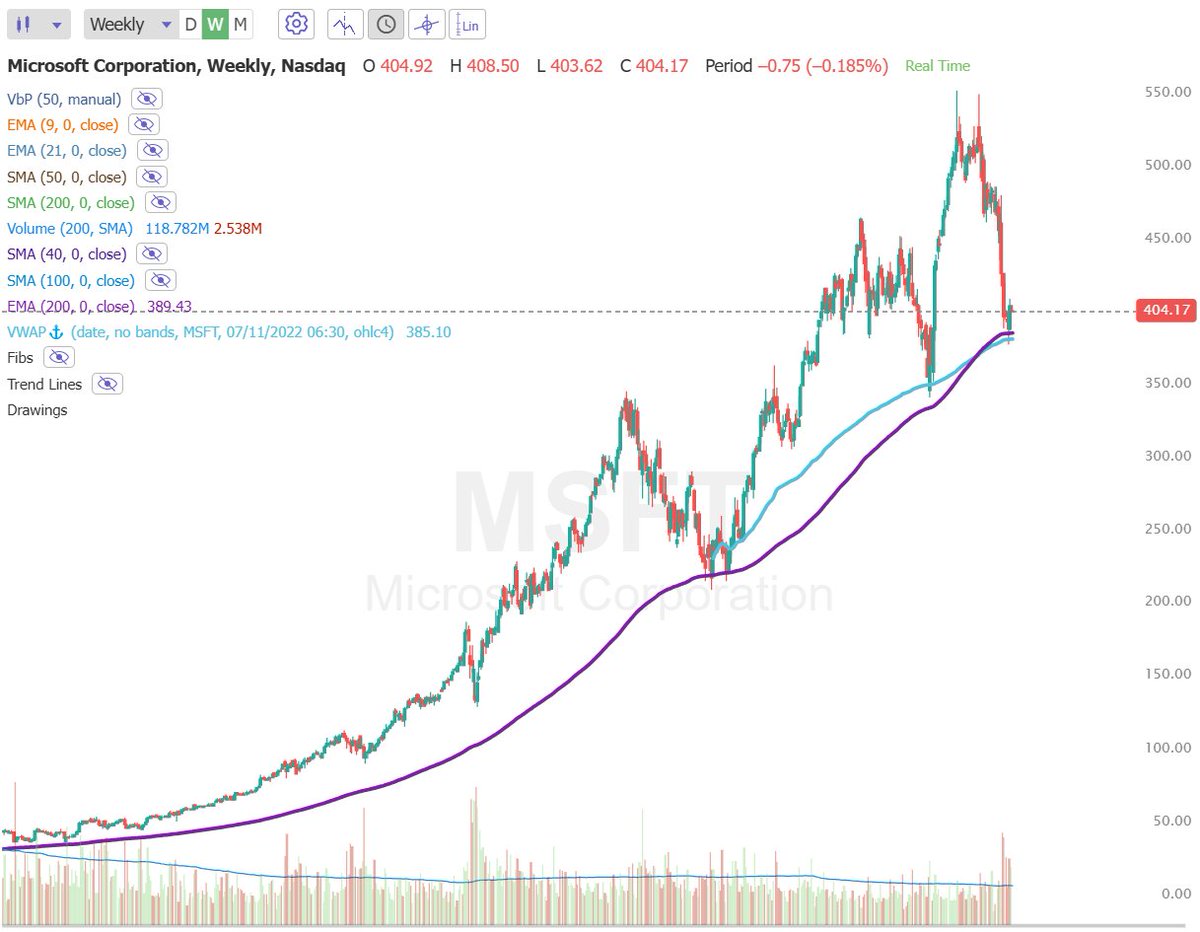
It’s been over a decade since $MSFT broke its 200-week EMA which now aligns with the anchored VWAP from the Oct 2022 bear-market bottom around the $385–$390 range.
Big level the stock needs to defend.
Don't be confused by $MSFT ~30% drawdown.
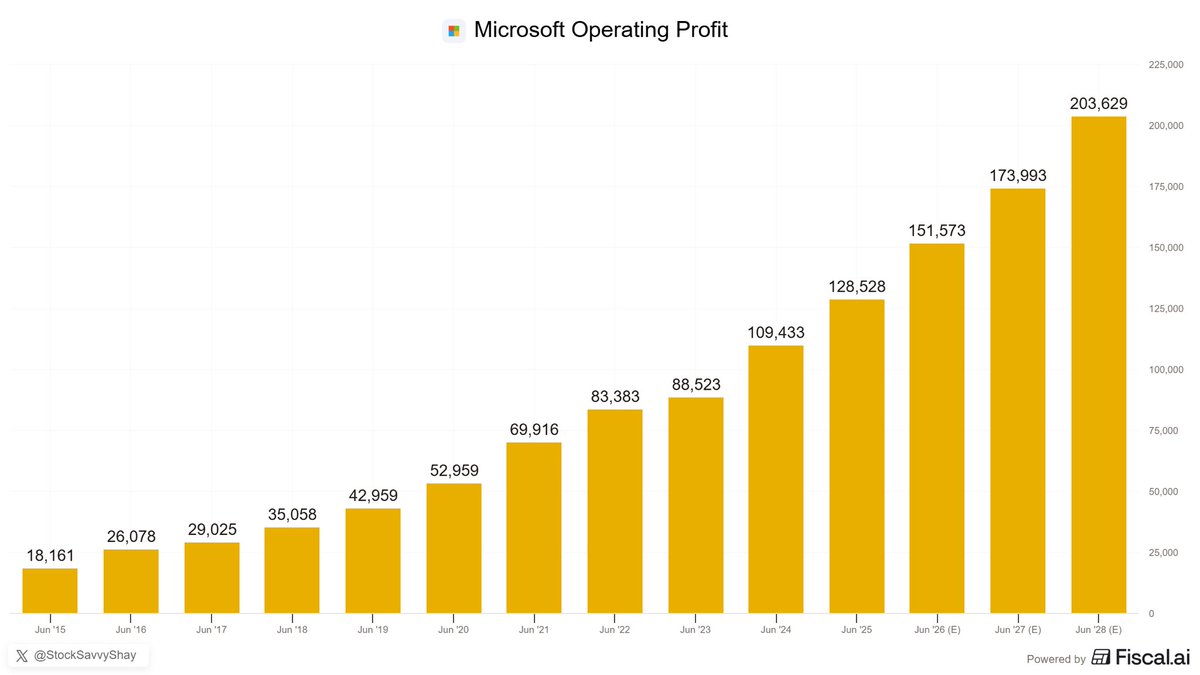
The business is firing on all cylinders and is on track to generate ~$17B in operating profit per month by 2028.
That's over 10x the operating profit from a decade ago at a near decade-low multiple.
Why Cybersecurity Is the Key to Unlocking the Power of AI Agents 🧐
As AI evolves into autonomous agents capable of decision-making and action, data will explode to levels no one could have imagined. These AI agents will analyze, optimize, and transform workflows across industries, but with this explosion of capabilities comes an equally massive increase in risks. What must you do with this data? Secure it. That’s why cybersecurity is critical, and why it should be a cornerstone of every portfolio in this new era.
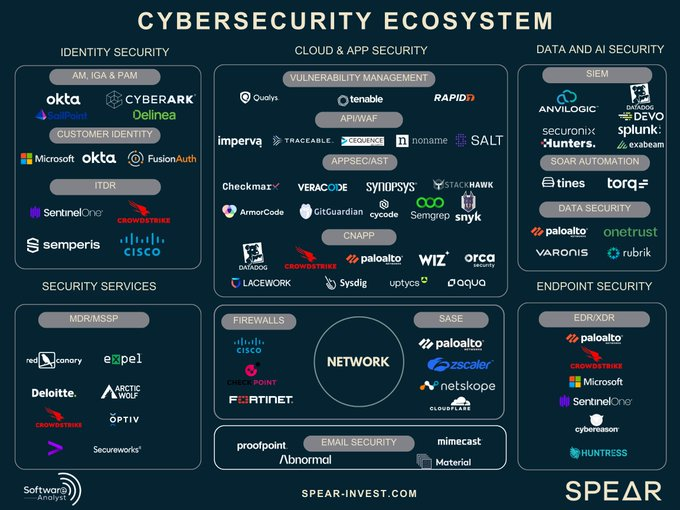
AI agents are more than tools -- they're active participants in business processes, generating and interacting with unprecedented amounts of sensitive data. Protecting this data is essential, and cybersecurity will serve as the foundation for ensuring AI agents can operate securely and effectively. From endpoints to cloud networks, these companies are shaping a future where AI agents deliver their transformative potential without compromising enterprise security.
Let’s start at the edge -- the devices connecting us to the digital world. $CRWD reigns supreme in endpoint protection, defending an ever-expanding attack surface as workloads sprawl across decentralized systems. CrowdStrike’s Falcon platform is a game-changer, leveraging AI to detect and neutralize threats before they materialize -- serving as the critical first line of defense in an enterprise’s cybersecurity arsenal.
Yet, endpoints are only the beginning. The real test lies in safeguarding the connections between them, which is where $ZS excels. Its Zero Trust Exchange functions like an invincible air traffic control system, ensuring data moves seamlessly and securely between users, devices, and applications. In a world generating unprecedented data volumes in real time, Zscaler’s capability to inspect and secure every packet isn’t just a luxury -- it’s a necessity.
Dive deeper into the arteries of AI-powered enterprises, and you’ll find the networks -- the lifeblood of digital communication. $NET, often underestimated, is a silent hero here. Its unparalleled speed and scalability not only accelerate data delivery but also shield networks from crippling DDoS attacks. In the AI age, where milliseconds matter, Cloudflare ensures that data highways remain unobstructed -- allowing AI-driven systems to perform at their peak without compromise.
As AI fuels exponential growth in connections, the next frontier lies in managing identities. $OKTA, the gatekeeper of identity and access management, steps in to verify and enforce permissions with surgical precision. In this zero-trust paradigm, no user -- human or machine -- gains access without rigorous authentication. It’s a critical safeguard in an environment where AI systems multiply and interact in unprecedented ways.
Securing identities is essential, but hardening networks is non-negotiable. This is where $FTNT dominates. Its hardware and software solutions operate at the network edge, delivering unparalleled protection against external assaults and internal weaknesses. Fortinet doesn’t just secure data -- it ensures that AI-driven workflows maintain their integrity, even in the face of evolving threats.
Now, look within those networks. Privilege management -- who can do what and when -- is the linchpin of security. $CYBR specializes here, ensuring only trusted entities can access critical systems. In an AI-dominated world, where automation and scale redefine operations, CyberArk’s solutions mitigate insider threats and lateral attacks -- keeping enterprise lifeblood flowing securely.
Above all, the cloud looms large as the backbone of the AI enterprise. $PANW leads the charge with multi-cloud protection that’s as comprehensive as it is intelligent. Its AI-powered threat intelligence adapts in real time, ensuring migrating workloads remain secure no matter where they land. Yet the cloud’s promise of flexibility and scalability would be incomplete without $RBRK, the guardian of data resilience. In an era of rampant ransomware -- Rubrik’s ability to secure data at rest and enable rapid recovery is a lifeline for enterprises navigating the chaos of AI proliferation.
Bad actors are weaponizing the same AI technologies to launch more devastating, targeted attacks, igniting a high-stakes arms race. The July 19th outage vividly demonstrated how severe the consequences of failure can be -- another stark reminder that cybersecurity is a strategic imperative. Data volumes will soar, intelligence will dominate decision-making, and protection will be the dividing line between survival and irrelevance. These companies are writing the blueprint to ensure that AI delivers on its transformative promise without succumbing to its vulnerabilities. Cybersecurity is the stickiest component of any IT budget -- where a CTO will always prioritize the highest quality over the best deal.
As the market gears up for the second stage of AI, exposure to cybersecurity will be non-negotiable. It is the bedrock upon which Stage 2 of AI will be built -- ensuring enterprises remain secure while scaling to meet the demands of this transformative era.
Everything you need to know about $MU's earnings today 🧐
Introduction
Micron is a prominent player in the semiconductor sector, specializing in memory and storage solutions that power a wide array of electronic devices and systems. From smartphones and PCs to data centers and automotive applications -- Micron's products are integral to the modern digital economy.
Micron's competitive advantage lies in its comprehensive portfolio of DRAM, NAND, and NOR memory products, alongside its innovation in next-generation memory technologies like 3D XPoint. The company's ability to scale production, reduce costs, and innovate rapidly is critical in an industry characterized by cyclical demand and intense competition. Micron’s ongoing advancements in memory and storage solutions ensure its relevance in a market driven by data-intensive applications.'
Product Offerings
• DRAM (Dynamic Random-Access Memory): Their DRAM products are crucial for high-speed data processing in computers, servers, and mobile devices. They are key to enhancing system performance in a world where speed and efficiency are paramount.
• NAND Flash: These storage solutions are used in a variety of devices such as smartphones, SSDs (solid-state drives), and tablets. Micron’s NAND technology helps in delivering fast, reliable storage that supports the quick retrieval and saving of data.
• 3D XPoint: Developed in collaboration with Intel, this technology is designed to fill the gap between DRAM and NAND, offering higher speed and endurance than NAND, and a more cost-effective solution than DRAM. It represents a significant advancement in memory technology -- opening new possibilities for big data and real-time analytics applications.
• Automotive Memory Solutions: As vehicles become more digital and connected, the demand for advanced memory solutions in the automotive sector has increased. Micron offers specialized memory products that meet the rigorous standards required for automotive applications -- supporting advancements in ADAS and autonomous driving technologies.
Earnings Preview
Today's report comes at a crucial time as Micron navigates strategic and market challenges, particularly its dependence on $NVDA next-generation Blackwell chips for its high-bandwidth memory products. Despite initiating mass production of its HBM3E earlier this year, Nvidia’s delays could impact demand, echoing through Micron's revenue streams.
Micron’s last quarter showed a 28% gross margin due to improved pricing and product mix, despite a substantial 24% shortfall in operational cash flow -- this was largely due to heavy infrastructure investments aimed at expanding its customer base in the memory sector. My focus will likely center on Micron’s relationship with Nvidia, especially any insights into how Nvidia’s delays are affecting order flows. Given Nvidia’s significance as one of Micron’s largest AI customers, any indication of sustained or increased orders will be vital to mitigate concerns about potential slowdowns.
Earning Estimates
• Sales $7.63B -- up 91% YoY
• EPS $0.76 -- up 159% YoY
• EBITDA $3.3B -- up 44% YoY
• FCF $381M -- up 5% YoY
I'll be releasing my analysis on Micron's earnings tonight -- sign up below to access the full content 👇
$GOOGL, $MSFT, and $AMZN confirmed this week that cloud computing is reaccelerating, indicating an increased need for cybersecurity -- let's delve into my top 10 names within this space and explore the competitive moats of each holding, from the largest to the smallest 👇
Prices for the top 10 names on my growth portfolio watchlist that would give me the greenlight to initiate a position 👇
1. $NVDA ~$495
2. $AMD ~$120
3. $ARM ~$48
4. $AXON ~$180
5. $ISRG ~$265
6. $IOT ~$20
7. $HUBS ~$420
8. $GTLB ~$495
9. $SNPS ~$370
10. $KLAC ~$385
$WMT has just announced a 3-for-1 stock split, setting a trend I expect to see continue throughout 2024 -- here are my predictions on who’ll be next 👇🏼
• $NVDA 6-1 stock split
• $MELI 15-1 stock split
• $MDB 5-1 stock split
• $NFLX 10-1 stock split
• $CRWD 5-1 stock split
• $PANW 5-1 stock split
• $CMG 20-1 stock split
• $NOW 10-1 stock split
• $ISRG 4-1 stock split