I've been invited to the advisory board of "History of Intellectual Culture", the "International Yearbook of Knowledge and Society" @degruyter_pub. Many thanks to the editors @CharlotteLerg @ostling_j and @DrJanaWeiss for this honor!
https://t.co/gfDWFCYqaE
#histknow#migknow
CfP: History of knowledge articles
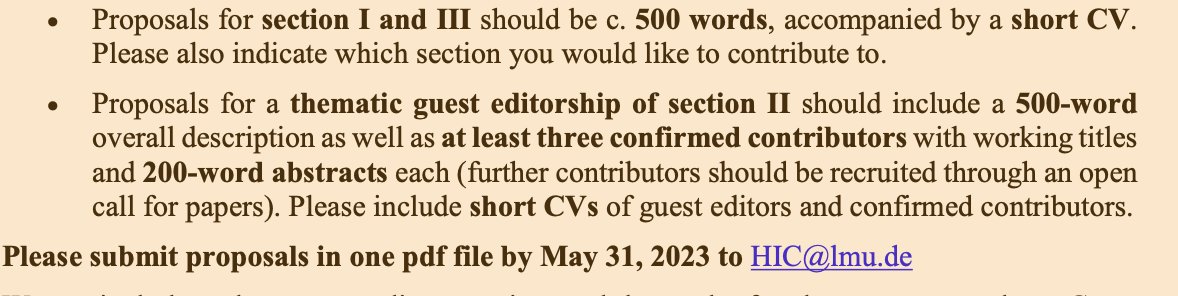
The international yearbook “History of Intellectual Culture” (@dg_history) is seeking new contributions for publication in 2024. Deadline for proposals: 31 May.
https://t.co/yXsx2uiBK7
ATTENTION 🛎️ready for round 3? Looking for a #publication option? #peerreviewed#OpenAccess 👉 Our new #CfP is out!! More details also here: https://t.co/tQw36DUw6T
Upcoming conference: History of Knowledge, Porto, 22–24 November
Finally, a big international conference that brings together historians of knowledge, including @DupreSven, @HistoryElaine and many more. Spread the word!
https://t.co/gKD6KSpDrx
What is the history of knowledge? And how is it related to the history of education and the history of ideas and sciences? These questions are discussed in a new scholarly conversation.
https://t.co/uEArXxExG3
In a rich overview in “History of Education”, @Dr_JWestberg discusses the development of the field in the Nordic countries. He stresses that “the history of knowledge certainly has the scope to shed light on the history of education”.
https://t.co/glaEUjc4Nu
#AcademicTwitter, you were my inspiration! Read my essay and other excellent papers on participatory culture in @HICyearbook's inaugural issue: https://t.co/PXLzRXr5DY
Allow us to introduce ourselves..
Join the LUCK Colloquium tomorrow to find out more about HIC and hear from two of our vol 1 contributors!!
Like our publications - it's online and accessable for anyone interested.
On 13 December, 13.15–15.00, we will organize this semester’s last history of knowledge seminar. It will be in the form of an online launch of the new yearbook “History of Intellectual Culture”.
@CharlotteLerg @DrJanaWeiss@em_steinhauer@ostling_j
https://t.co/n3YrHmNVDI
We don’t know what historians of the future will say about the #Covid19#corona years, but we can think about what sources they will use and that raises a lot of questions about historical knowledge formation in and for the #public. Check out our #HICconversation
Is positive discourse analysis a method for the history of knowledge? Maria Bach @mvsbach tackles this question in our recurring section 3, “engaging the field” #method#knowledge
https://t.co/AgHYqknndx
Arguably, there is no better way to share the link to Sakina Shakil Gröppmaier’s piece on critical-ness in the academic sphere than right here on twitter! @sakinaSG_#digitalpublicsphere#participation
https://t.co/Si808ijZaD
From Sweden to Argentina: our next author, Ana Carolina Arias, explores how the 1921 National Folklore Survey utilized teachers to collect folklore traditions - #participate without a guideline on how and what they were supposed to collect.
https://t.co/Bcg0COT4C7
Måns Ahlstedt Åberg links knowledge circulation and #eugenics by analyzing how the Swedish Institute of Race Biology cooperated with the general public in the 1930s.
https://t.co/siw5DjDBkp
On the pitfalls of using #participatory knowledge for politico-social engineering at the #FrankfurtSchool check out Emily Steinhauer's piece @em_steinhauer
https://t.co/ejSbR8zTCn
Head over to @deGruyter to check out Lisa Gitelman’s @namleti piece on “The Evolution of the MLA Style” @MLAnews https://t.co/zOVqEIxsv5
Watch this space for more on our Vol. 1 as we introduce individual articles over the next few weeks – and remember it’s all #openaccess