“No ransom was paid. No concession was made. I salute every officer and operative whose courage, discipline, and professionalism made this possible.
“To those who seek to spread fear through terror, know that the Nigerian state will pursue you relentlessly. We will protect our people, defend our communities, and never relent until peace and security prevail across our country.”
— President @officialABAT
FMINO PRESS RELEASE
RETURN TO FUEL SUBSIDY WILL REVERSE NIGERIA’S ECONOMIC GAINS — INFORMATION MINISTER
The Honourable Minister of Information and National Orientation, Mohammed Idris, has cautioned against calls to restore the petrol subsidy, saying a return to the old regime would undermine Nigeria’s improving fiscal position, weaken investor confidence, and reverse gains from the economic reforms of the President Bola Ahmed Tinubu Administration.
In an Op-Ed published on Monday, August 24, 2026, in some national dailies, titled “Restoring Fuel Subsidy Will Reverse Nigeria’s Economic Gains,” the Minister outlined the fiscal benefits of subsidy removal, the economic risks averted, and the difficult trade-offs that would confront the country should petrol subsidy be reintroduced.
"Restoring subsidy would almost instantly return Nigeria to the economic conditions of 2022, recreating the same fiscal pressures, distortions, scarcity and incentives for arbitrage that made the old system unsustainable," Idris said.
Idris said proponents of subsidy restoration must confront its real opportunity costs.
“Do we restore petrol subsidy, or sustain student loans and consumer credit for young Nigerians? Do we restore subsidy, or preserve higher allocations to states and local governments? Do we restore subsidy, or continue funding roads, rail, power and security? Do we restore subsidy, or strengthen the fiscal capacity required to expand healthcare, education and social protection for vulnerable Nigerians?” he asked.
The Minister recalled that in 2022, amid declining oil production and weak revenues, Nigeria spent about $10 billion on fuel subsidies, while the World Bank warned that the subsidy was consuming resources that could otherwise have supported education, healthcare, infrastructure and social protection.
Citing the Federal Government’s recently presented “Nigeria’s Reform Scorecard: The Benefits, Costs and Harms Prevented,” Idris said the Honourable Minister of Finance and Coordinating Minister of the Economy, Dr Taiwo Oyedele, disclosed that subsidy savings mobilised ₦15.8 trillion in resources for the Federation between June 2023 and December 2025.
He explained that approximately ₦5.43 trillion accrued to the Federal Government, ₦6.52 trillion to states and ₦3.88 trillion to local governments, clarifying that the ₦15.8 trillion was not a separate pool of cash but resources released within the Federation’s wider fiscal system.
According to Idris, the increased fiscal space has strengthened the capacity of states and local governments to meet salary and pension obligations and invest in essential services, while supporting major federal investments in infrastructure, security, agriculture and human capital.
He said the Reform Scorecard recorded approximately ₦6.47 trillion in additional expenditure on strategic infrastructure, alongside more than ₦400 billion committed to major social investment initiatives, including NELFUND, MOFI Real Estate Investment Fund, MREIF and CREDICORP. In contrast, social transfers have reached more than 10 million Nigerian households.
Idris added that Nigeria was already carrying an electricity subsidy estimated at ₦3.14 trillion between June 2023 and December 2025, warning that reintroducing petrol subsidy would impose an additional burden on public finances.
He noted that the Organised Private Sector and the wider economic community had also cautioned against reversing the reform.
“Nigeria cannot build tomorrow’s economy by returning to yesterday’s unsustainable subsidy regime. We have moved beyond that model,” he said.
He urged Nigerians to view the reforms in the context of the country's long-term economic stability and the need to build a stronger and more productive economy.
Rabiu Ibrahim, mnipr
Special Assistant (Media) to the Honourable Minister of Information and National Orientation
Monday, August 24, 2026
FMINO PRESS RELEASE
FG’S TETFUND INVESTMENT IN TERTIARY EDUCATION WILL UNLOCK NORTH CENTRAL’S ECONOMIC POTENTIAL — INFORMATION MINISTER
The Honourable Minister of Information and National Orientation, Mohammed Idris, has said the Federal Government’s investment in tertiary education through the Tertiary Education Trust Fund (TETFund) will help unlock the North Central region’s vast agricultural, mineral, energy and economic potential.
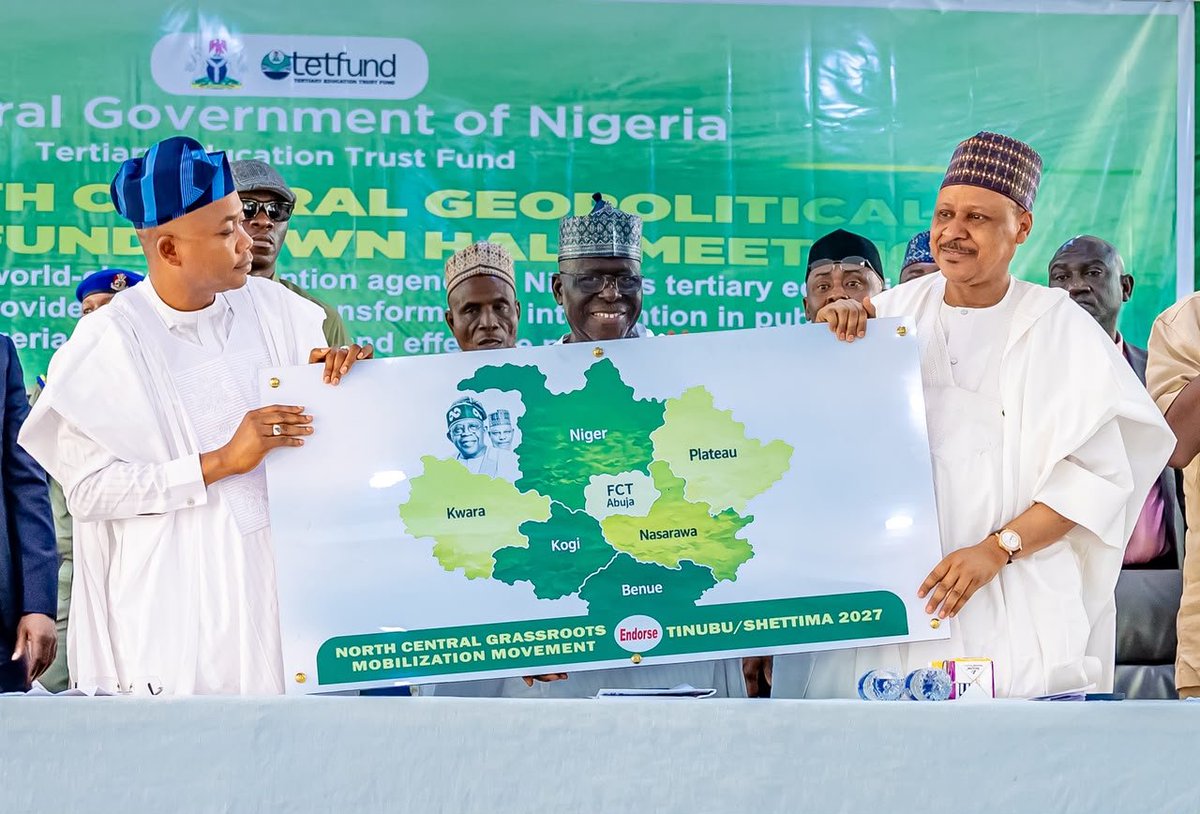
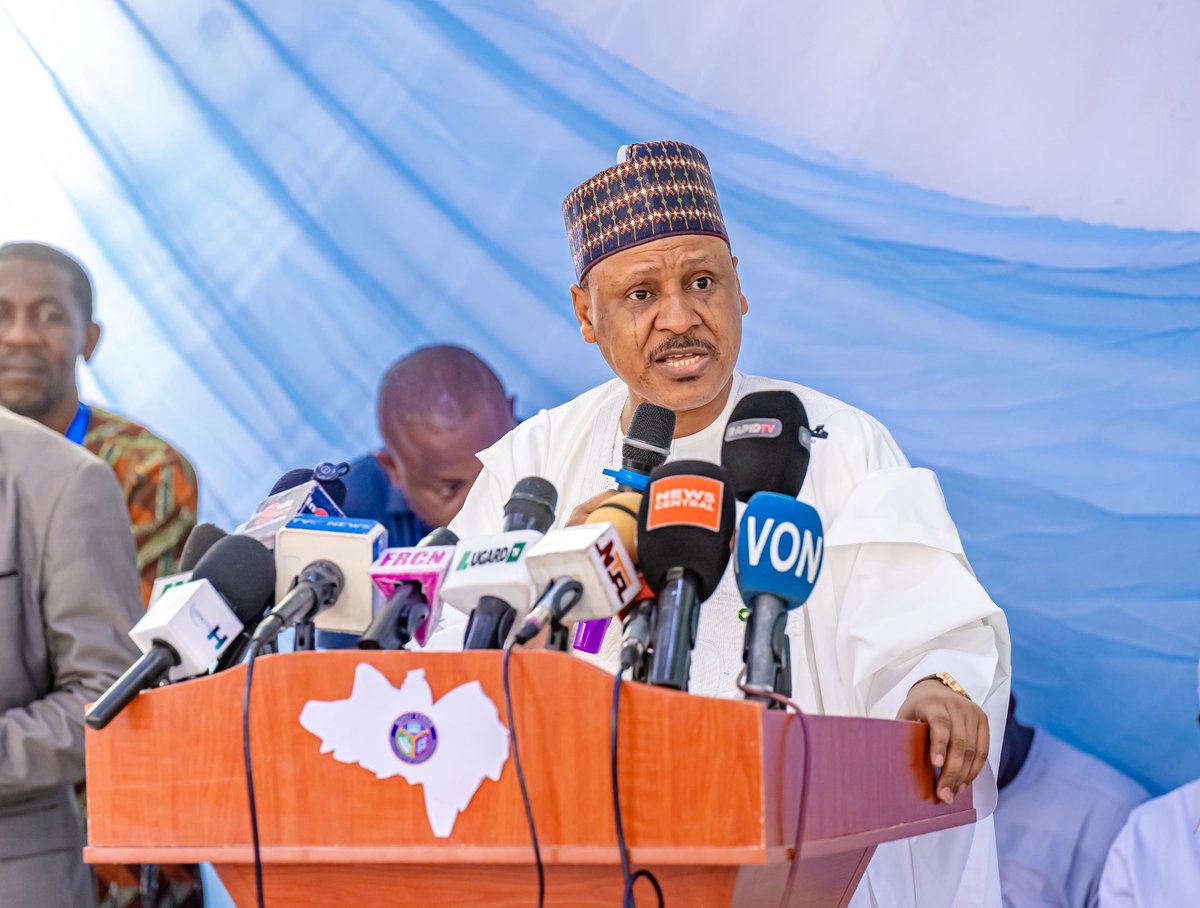
Idris stated this on Thursday in Lokoja, Kogi State, at the 2026 TETFund North Central Zonal Town Hall Meeting.
The Minister said the region’s universities, polytechnics and colleges of education must be closely connected to its development needs and produce graduates with skills relevant to agriculture, mining, manufacturing, technology and other sectors.
“Our universities, polytechnics and colleges of education must therefore be closely connected to these opportunities, producing the scientists, engineers, agricultural experts, technicians and entrepreneurs required to unlock the vast potential of the North Central,” he said.
He said the Federal Government’s commitment was reflected in the 2026 TETFund intervention, with approximately ₦2.53 billion allocated to each public university, ₦1.87 billion to each polytechnic and ₦2.06 billion to each college of education.
“These are not simply budgetary figures. They represent laboratories that can be equipped, lecture halls that can be built, libraries that can be modernised, research that can be supported and students who can learn in better environments,” Idris said.
The Minister stressed the need for stronger links between tertiary institutions and industry, saying institutions must focus not only on producing graduates but also on research, innovation and job creation.
He also highlighted the role of the Nigerian Education Loan Fund (NELFUND), technical and vocational education, digital skills and entrepreneurship programmes in expanding opportunities for young Nigerians.
“Education is therefore not only an economic investment; it is an investment in national security and social stability,” he said.
He urged TETFund to maintain transparency, monitoring and accountability in the use of intervention funds and called on stakeholders to ensure that recommendations from the town hall lead to measurable action.
The Executive Governor of Kogi State, Ahmed Usman Ododo, said tertiary institutions must move beyond producing graduates to becoming centres for research and practical solutions to the country’s challenges. “We need research that solves problems in agriculture, mining, healthcare, manufacturing, artificial intelligence, renewable energy, and security. Our research must move beyond theory to solutions that improve the lives of our people,” the Governor said.
He added that tertiary institutions should help turn the region’s natural resources and human capital into food security, industrial growth, employment and sustainable development.
In attendance was the Secretary to the Government of the Federation (SGF) ably represented by Prof Babatunde Bernard; the former Executive Governor of Kogi State, His Excellency, Captain Idris Wada; the Chairman, Board of Trustees, Tertiary Education Trust Fund (TETFund), Rt. Hon. Aminu Bello Masari, among other dignitaries.
Rabiu Ibrahim, mnipr
Special Assistant (Media) to the Honourable Minister of Information and National Orientation
Thursday, 20 August, 2026
Nigeria cannot build tomorrow’s economy by returning to yesterday’s unsustainable subsidy regime. We have moved beyond that model.
President @officialABAT and his administration will continue working to translate the bold fiscal reforms into improved living standards, stronger public services, and greater economic opportunities for the Nigerian people.
https://t.co/F7SAcihiQ6
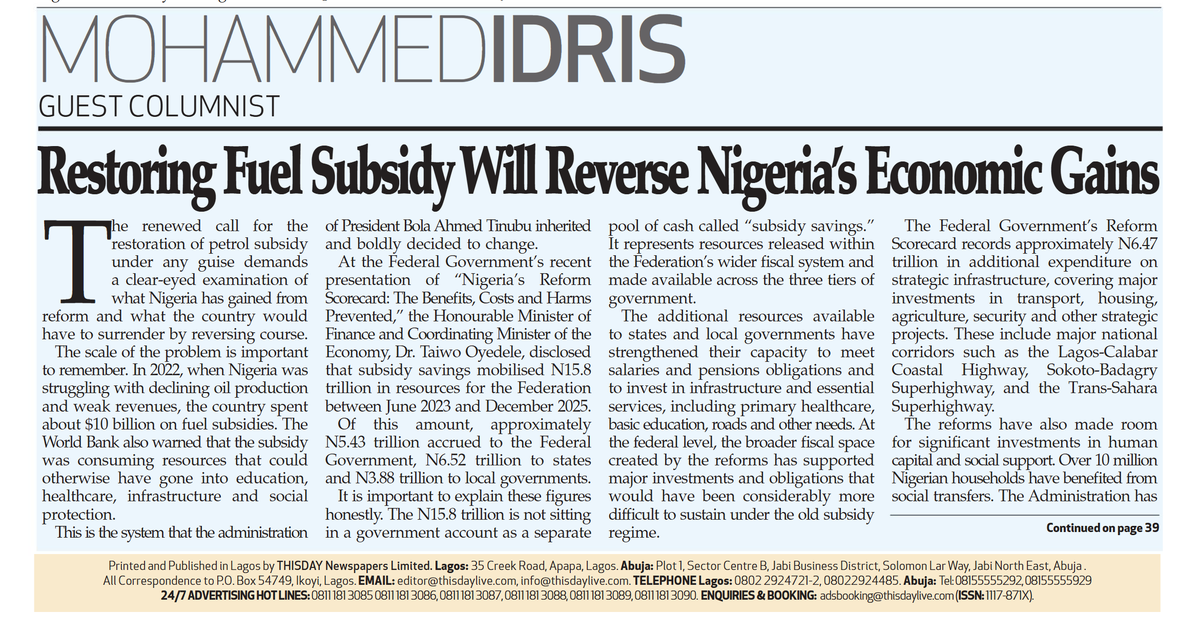
Restoring Fuel Subsidy Will Reverse Nigeria's Economic Gains
The renewed call for the restoration of petrol subsidy under any guise demands a clear-eyed examination of what Nigeria has gained from reform and what the country would have to surrender by reversing course.
STATEHOUSE PRESS RELEASE
PRESIDENT TINUBU RENEWS THE TENURE OF DG NTA @NTANewsNow, MD NAN @NgNewsAgency
President Bola Ahmed Tinubu has renewed the tenure of the Director-General of the Nigerian Television Authority (NTA) and the Managing Director of the News Agency of Nigeria (NAN) for another three-year term.
President Tinubu first appointed Abdulhamid Salihu Dembos of the NTA and Ali Mohammed Ali of the NAN on October 20, 2023. Their second term will begin on October 20, 2026.
Salihu Dembos, from Yola, Adamawa State, is a former National President of the Radio, Television, Theatre and Art Workers Union (RATTAWU). He previously served as the executive director of marketing at the NTA after his retirement in 2017.
He joined the NTA as an announcer at the Kaduna Station after his National Youth Service in 1989. He rose through the ranks and, at various times, served as General Manager at NTA Lokoja and NTA Kano. He retired as the acting Zonal Director, NTA Kaduna Network Centre, in 2017.
Ali Mohammed Ali is a veteran journalist and media manager with over 30 years of experience. He has a keen interest in media evolution and content development in a digital world, meeting the needs of a diverse population with alternative news feeds.
With a first degree in English from Bayero University, Kano, Ali also holds a graduate degree in International Affairs from Ahmadu Bello University, Zaria, and a Post Graduate Diploma in Mass Communications from Bayero University, Kano.
President Tinubu has urged the two chief executives to justify his confidence in them by continuing to demonstrate commitment to their organisation’s mandates and the promotion of the government’s Renewed Hope Agenda.
Bayo Onanuga
Special Adviser to the President
(Information & Strategy)
August 23, 2026
Citizens have a right to know what resources have been freed up by President @officialABAT’s bold fiscal reforms, what these resources mean for the Federation, and how the benefits of reform are being translated into tangible improvements in their lives.
My remarks at the ‘Nigeria’s Reform Scorecard’ presentation in Abuja:
We were in Lokoja yesterday for the 2026 Tertiary Education Trust Fund @TETFundNg North Central Zonal Town Hall Meeting. In attendance were the Governor of Kogi State, Ahmed Usman Ododo; former Governor, Captain Idris Wada; Chairman of the Board of Trustees of TETFund, Rt. Hon. Aminu Bello Masari, and other dignitaries.
The Federal Government’s investment in tertiary education through TETFund is unlocking vast agricultural, mineral, energy and economic potential in the North Central zone, and across the entire country.
For 2026, TETFund has allocated approximately ₦2.53 billion to each public university, ₦1.87 billion to each Polytechnic and ₦2.06 billion to each College of Education.
These are not simply budgetary figures. They represent laboratories that can be equipped, lecture halls that can be built, libraries that can be modernised, research that can be supported and students who can learn in better environments.
TETFund is also complementing other impactful interventions like the Nigerian Education Loan Fund @NELFUND, all aimed at expanding access and opportunities for young Nigerians. Because education is not only an economic investment; it is also an investment in national security and social stability.
Citizens have a right to know what resources have been freed up by President @officialABAT’s bold fiscal reforms, what these resources mean for the Federation, and how the benefits of reform are being translated into tangible improvements in their lives.
My remarks at the ‘Nigeria’s Reform Scorecard’ presentation in Abuja:
The Minister of Information (@FMINONigeria), Mohammed Idris @HMMohammedIdris, says Nigeria’s tertiary institutions must become engines of research, innovation and skills development. Speaking at the 2026 @TETFundNg North-Central Town Hall in Lokoja, he urged universities, polytechnics and colleges of education to align training with opportunities in agriculture, mining, energy, manufacturing and technology.
Idris said TETFund’s 2026 intervention provides about ₦2.53bn to each public university, ₦1.87bn to each polytechnic and ₦2.06bn to each College of Education. He said the funds should improve laboratories, lecture halls, libraries and research, while stressing that institutions must also produce graduates with skills relevant to employers and industry.
He also highlighted NELFUND, vocational training, digital skills and entrepreneurship as key parts of the Federal Government’s education agenda. Idris urged stronger partnerships between schools and the private sector, greater accountability in TETFund spending, and training that prepares young Nigerians for artificial intelligence, automation and emerging technologies.
#TETFund #Education #NorthCentral #MohammedIdris #Nigeria #RenewedHope
(L–R) Director-General, Debt Management Office (DMO), Patience Oniha; Statistician-General of the Federation, Prince Semiu Adeyemi Adeniran; Permanent Secretary, Federal Ministry of Budget and Economic Planning, Dr. Deborah Bako Odoh; Executive Chairman, Nigeria Revenue Service (NRS), Dr. Zacch Adedeji; Minister of State Budget and Economic Planning, Dr. Doris Nkiruka Uzoka-Anite; Minister of Budget and Economic Planning, Abubakar Atiku Bagudu; Minister of Finance and Coordinating Minister of the Economy, Taiwo Oyedele; Honourable Minister of Information and National Orientation, Mohammed Idris, fnipr; Permanent Secretary, Federal Ministry of Finance, Mr. Raymond Omenka Omachi, FCA; Permanent Secretary, Policy Support and Special Duties, Federal Ministry of Finance, Mohammed Sanusi Danjuma, FCNA; Accountant-General of the Federation, Mr. Shamseldeen Babatunde Ogunjimi; Director-General, Budget Office of the Federation, Mr. Tanimu Yakubu; and Director-General, National Orientation Agency (NOA), Mallam Lanre Issa-Onilu, during the presentation of Nigeria’s Reform Scorecard: The Benefits, Costs & Harm Prevented, hosted by the Federal Ministry of Finance on August 19, 2026, in Abuja.
@FinMinNigeria | @taiwoyedele
#TheScorecard #RenewedHopeAgenda
I attended the 8th edition of the Blueprint Newspapers Limited Public Lecture, Impact Series and Awards of Excellence, today in Abuja.
Themed “Security Challenges and Integrity of Nigeria’s 2027 Elections”, the event was chaired by the former Governor of Zamfara State and Senator representing Zamfara West Senatorial District, Senator Abdul’Aziz Yari Abubakar.
In my remarks, I reaffirmed the Federal Government’s commitment to strengthening the security and information environment necessary for peaceful, credible and transparent elections in 2027.
The security and welfare of Nigerians remain fundamental responsibilities of President Bola Ahmed Tinubu’s administration, and we will continue to mobilise the resources, personnel and technology required to confront terrorism, banditry, kidnapping and other threats to the safety of Nigerians.
We are also working very hard to tackle growing threat posed by misinformation and disinformation, particularly with the rapid development of Artificial Intelligence. Democracy cannot thrive where citizens are deliberately misled.
This is why the Federal Ministry of Information and National Orientation @FMINONigeria, in partnership with @UNESCO and other stakeholders, has established the International Media and Information Literacy Institute (IMILI) @IMILinstitute in Abuja to strengthen media and information literacy in Nigeria and Africa.
FMINO PRESS RELEASE
IBB AT 85: INFORMATION MINISTER CELEBRATES FORMER MILITARY PRESIDENT, PRAISES HIS ENDURING COMMITMENT TO A UNITED NIGERIA
The Honourable Minister of Information and National Orientation, Mohammed Idris, has congratulated former Military President, General Ibrahim Badamasi Babangida, GCFR, on his 85th birthday, describing him as an elder statesman whose life and service occupy an important place in Nigeria’s contemporary history.
In a statement issued on Monday, the Minister said General Babangida’s journey through military service, national leadership and statesmanship represents a significant chapter in Nigeria’s political and institutional evolution.
Idris noted that, decades after leaving office, the former Military President has remained engaged with issues of national importance, particularly those concerning Nigeria’s unity, stability and development.
He said General Babangida’s experiences in leadership and public service constitute a valuable reservoir from which succeeding generations can draw lessons about the complexities and responsibilities of nation-building.
The Minister also acknowledged the former Military President’s enduring faith in Nigeria and his continued interventions in support of national cohesion and peaceful coexistence.
“General Babangida remains an important voice in our national journey, and at 85, we celebrate his service, his statesmanship and his enduring commitment to a united Nigeria,” Idris said.
He wished the former Military President many more years of good health, peace and fulfilment, while praying that he continues to enjoy the affection of his family and the goodwill of Nigerians.
Rabiu Ibrahim, mnipr
Special Assistant (Media) to the Honourable Minister of Information and National Orientation
August 17, 2026