In a world filled with expectations, it's time to rise above and carve your own path. Embrace the freedom to be unapologetically yourself, to share your truth, and to ignite a revolution of self-acceptance and empowerment. 💪🔥
The impact of a trigger results in a response. This could be emotional, cognitive, behavioural or physical. This is essentially how the person feels as a result of these triggers, and also the ways they have been dealing with it.
We don't connect over perfection, we connect over what's real. Our struggles and our slip ups are what bring us together. Our stories connect us to each other, they allow us to realise we aren't alone. Our stories of survival can eventually become someone's beacon of hope.
It's OK to say 'No'. It's ok to place a boundary around what makes you feel comfortable, safe and supported. Make your 'Yes' as powerful as your 'No'. Holding your boundary is a badass move.
The best thing you can do for someone is to take the time to ensure they feel seen and heard. Not sure how to do that?
Care. Just care.
#heartonmysleeve
The hardest part of sharing your story and opening up is usually the decision to do so, but it's at our edge where we begin to see the world and ourselves in a new way. It may feel scary, but it has to feel better then carrying a story that was never meant to be yours alone.
Never let the fear of not knowing what to say or do get in the way of being there for someone. When it all falls away, take it back to the basics and just, care.
#heartonmysleeve
Let's talk triggers.
Triggers are situations, events, circumstances or happenings that generate an emotional reaction, or negatively impact a person’s mental health.
Trigger -> Impact -> Story -> Need.
Think of the moments where you felt truly seen and heard.
What brought about that sense of safety?
How can you offer that to someone else and who is it going to be today?
#heartonmysleeve
Most people are looking to feel heard more than they are looking for the right advice. The way we care for others is to care about them.
The most important part is to show someone respect as a fellow human.
When everything falls away, and you don’t know what to say... just care.
"We focus a lot about asking someone if they are ok, but we also need to know it’s ok to say "I’m not ok". I make the @heartonmysleeve pledge “to have a real conversation when I'm not ok���, today and every day. Because life isn’t all glitter and sparkle" @onemorethanthree
We don't need to rush in and give a response or ask a question straight away. Give it space.
The heavier something is, the bigger the space it needs to land.
So if someone says, "I've just been diagnosed with cancer".Pause.
No need to rush in and take it away. Let it land.
Much of the work we do at HOMS is to create Mentally Healthy Workplaces. While it's not an employer's responsibility to make your mental health better, it's imperative that the work environment and culture doesn't make an employee's mental health worse.
What's your thoughts?
Sometimes we may have a ‘vulnerability hangover’, worried that we shared too much, or that someone’s perception of us has changed. That’s a very normal response. It’s ok to let someone know you’re feeling a bit exposed and asked for reassurance.
We are not responsible for someone’s entire life, but we can be accountable for how we show up in an interaction.
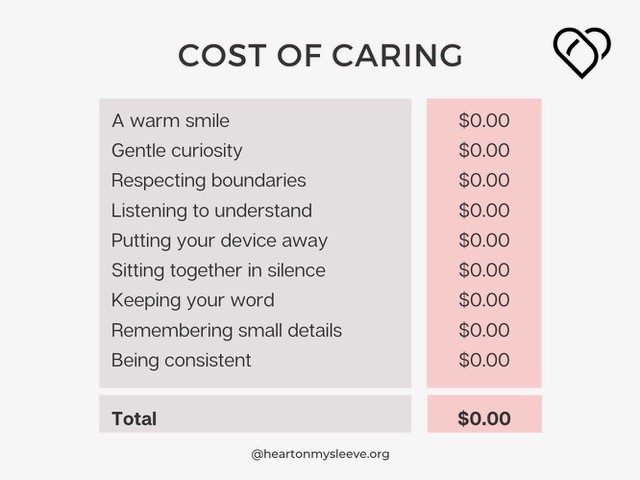
It truly costs nothing to care.
#Heartonmysleeve
"Since being 16 and falling pregnant and being only 17 when I gave birth I've been bullied. Nearly giving up on the world. Words and actions hurt! But I'm still standing and trying to put a happy face every day. @Kmariee69
Thank you for sharing your story.
Connection with other people is scientifically shown to be one of the greatest coping tools for our mental health. When we have a real conversation with someone: It is the ultimate 2-for 1 coping strategy. ‘A problem shared is a problem halved.’
"Wearing our hearts on our sleeve is brave, it’s difficult and it’s honest in such a world that wants so badly to falsify claims that mental health struggles are a form of suffering - where sharing thoughts and feelings is considered a weakness, rather than a powerful force.."
Sentence Stems that will support an open conversation..
1. Hey Mike, I noticed you were a bit distracted at lunch, what’s been going on for you?
2. You know what I would love right now? To hear what’s happening in your world.
What others would you add?