Sicily has a four-legged early warning system for Mount Etna. It has a beard, it eats gorse, and it is beating several million euros of monitoring equipment by half a day.
The shepherds have known this for as long as anyone has kept goats on that mountain. The herd tells you. No drama about it, no bleating, no rearing up and pointing at the summit. They simply decline to go up the hill that morning, and if the goats will not go up, neither do you. Oldest volcano warning system in Europe. Costs nothing. Runs on scrub.
For most of history the scientific response to this has been a polite nod and a change of subject.
Then in 2011 a German turned up with a box of trackers.
Martin Wikelski of the Max Planck Institute of Animal Behaviour has an unfashionable habit of asking local people what they already know before deciding they are simple. He collared goats living year-round on the slopes and started logging where they went, and when, and how fast.
On 4 January 2012 the data went peculiar. The animals turned down the high pastures they use every day of their lives, all of them, and headed for the trees. The seismometers were quiet. The gas monitors were quiet. In a control room in Catania, a great deal of very expensive equipment was reporting a perfectly ordinary Wednesday.
That evening Etna started throwing lava and ash into the sky.
Six hours.
The same signature has now turned up before eight major eruptions, and at the extreme the goats move fourteen hours ahead of the mountain. Ahead of the tremor. Ahead of the gas. Ahead of everything the volcanologists are paid to watch.
Nobody knows how they do it. The best guess is sulphur dioxide and hydrogen sulphide venting beforehand at concentrations no human nose could ever find, which would mean the animals are smelling the future and declining to comment. Wikelski's own summary is that they know in advance, we have no idea how, but they do.
The institute says there is not yet enough data for a formal warning system. More eruptions, more animals, more species. Which is the correct scientific answer and a very funny one, since the shepherds reached sufficient confidence somewhere around the Bronze Age and have been acting on it every day since.
Rome had geese who saved the city by making a racket when the Gauls came over the wall, and honoured them for it every year afterwards.
Etna has their spiritual successors, doing the same job by refusing to walk uphill.
We have a word in English for a man who behaves like a goat. It means he eats anything, wrecks anything, and understands nothing.
The goat currently outperforms a seismograph.
Trees have been quietly running the most successful carbon capture startup on Earth for millions of years — no funding rounds, no PowerPoints, no “pivots.”
One mature tree still gulps ~48 lbs of CO₂ a year while throwing better shade than your group chat.
People living in urban areas are less likely to use medication for depression and anxiety if they have easy access to well-maintained woodlands, new study finds:
https://t.co/HsHEyz2VyL
Caledonian #pinewoods are among our oldest and richest habitats. They are characterised by wild #Scotspines, descended from Scotland’s once-vast ancient forests. We’re on a mission to identify and map these important refuge areas 👉 https://t.co/gXkg4ebiCv
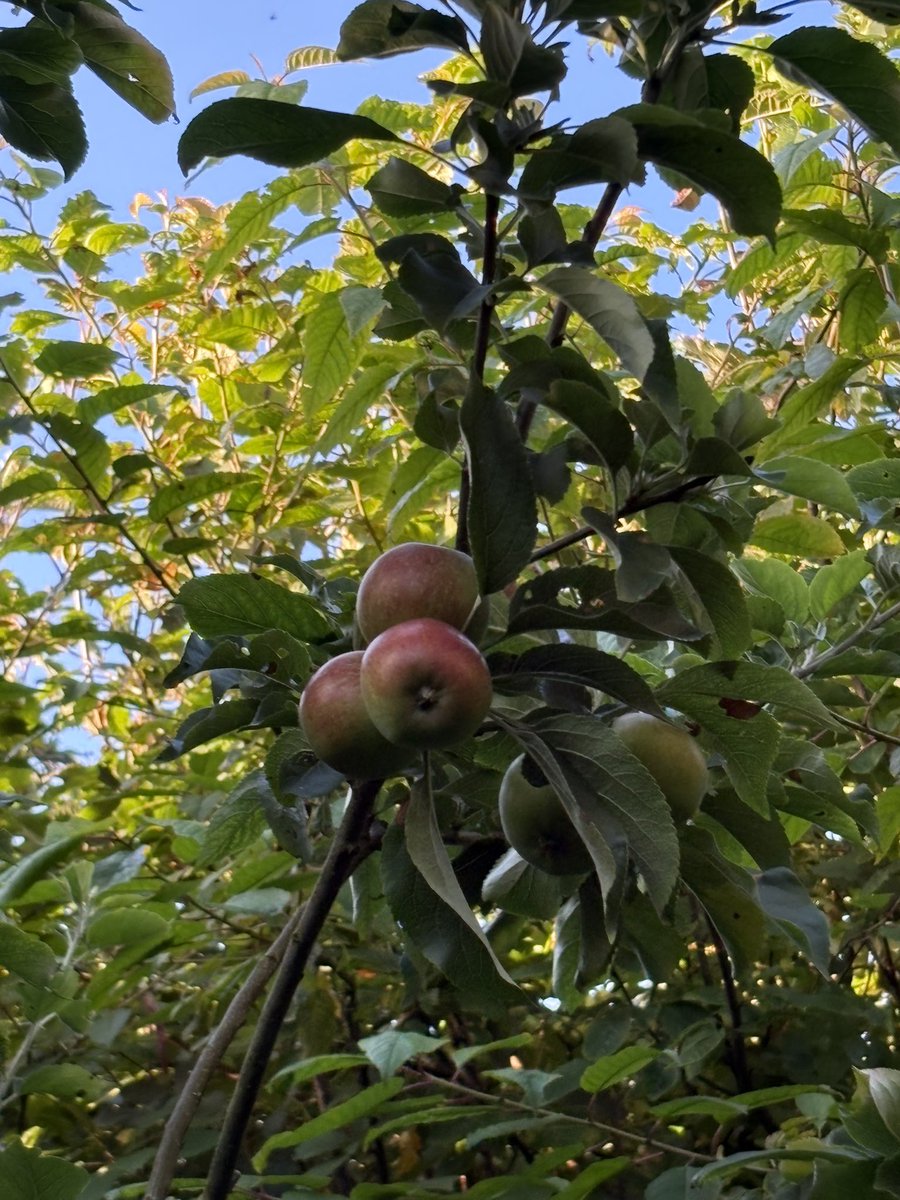
Best year ever for outside apples here at 60 north. The trees in the garden seem to have doubled in size too. Is it the extra CO2 ? longer summer? Who knows, though someone on here will . Lovely roses have survived the scaffolders. #appletrees
Trees don’t doomscroll, argue, or incite racial hatred.
They just quietly suck up ~48 lbs of CO₂ a year and cool the planet.
Be more tree.
Or better—plant one. 🌳
#TreeVolution
Foraging is a great way to connect with nature – and blackberries are ready to pick right now! As you forage, look out for bumblebees, butterflies, and hedgerow wildflowers such red campion, herb robert and dog rose.
More ways to connect with nature:
https://t.co/Cj8pEPRzms
The worst bit is that the Scottish public are funding this debacle. Twice . Firstly through Scottish Legal Aid funded by the @scotgov and through the Ethnic Minorities Law Centre funded by the Scottish councils and Scot government.
https://t.co/JaYBFUjsFu
Trees don’t need meetings, budgets, or vibes.
They just quietly help you breathe, cool the planet, and throw shade at excuses.
Plant more. Argue less. 🌳
Trees are nature’s free AC.
Shade + evaporation can drop local temps by several degrees—saving lives when heatwaves hit.
Yet heatwaves still kill ~150,000 people every year worldwide.
Plant more trees. Cool the cities. Save lives.
This is one of the most beautiful paintings of Christ ever made, and for over a century people have walked past the one detail that holds its entire meaning...
It is called The Light of the World, painted by the English Pre-Raphaelite artist William Holman Hunt. Christ stands at night in an overgrown garden, holding a lantern, his hand raised to knock at a wooden door.
It illustrates a line from the Book of Revelation:
"Behold, I stand at the door, and knock."
The door is choked with ivy and weeds. It has clearly not been opened in a very long time.
Now look at the door itself, and you will see what holds the key to understanding the entire artwork… there is no handle. No latch, no knob, nothing on the outside at all.
Hunt left it off on purpose: this door can only be opened from within.
The door is the human soul, and the point is that Christ can stand there and knock forever, but he cannot let himself in. The handle is on the other side. It has to be you who opens it. The ivy has grown thick over the frame because this particular door has stayed shut for years, and yet his lantern is still burning, and he is still standing there, still knocking, waiting for a door that may never open.
Fifty years after he painted it, Hunt felt he had to spell the meaning out: the shut door, he said, was “the obstinately shut mind.”
The light has not gone out and whether that door ever opens was always, only, up to you...
Orangutans might just be some of the best parents in the animal kingdom. 🦧❤️
In the animal world, few species invest in raising their offspring with such endurance and completeness as orangutans. Many researchers and nature observers agree that orangutan mothers rank among the most outstanding parents, surpassed only by humans in the length and devotion of their care.
Orangutan infants stay with their mothers for 7 to 9 years, learning every skill needed to survive in the rainforest. The mother teaches them what to eat, where to find food, how to build sleeping nests, and how to move through the trees. Remarkably, she usually gives birth to another baby only every 7 to 9 years, allowing each offspring years of undivided love, protection, and attention. For orangutans, raising a child is not merely a few years of caregiving—it is a long process of teaching the young how to survive on their own.
Scientific figures further support this view. Infants nurse continuously for at least 6.5 to 8 years, and in some cases up to 9 years, remaining dependent on their mother for a total of 7 to 10 years before becoming fully independent. This is the longest period of maternal dependence among non-human mammals. The average interbirth interval of 7–9 years is also a record among land mammals. A female typically produces only 2 to 4 offspring in her lifetime.
Even more striking, the orangutan mother shoulders every responsibility alone. The species is largely solitary, and fathers play almost no role in rearing the young. The mother carries, protects, nurses, shares her nest, and teaches all survival skills by herself. In the early years, the infant remains in nearly constant bodily contact with her. This form of complete single motherhood is rare among other great apes such as chimpanzees or gorillas, which live in groups and benefit from indirect support from other members.
The rainforests of Southeast Asia present a challenging environment with irregular food sources and many dangers. Young orangutans learn primarily by observing and imitating their mothers: recognizing seasonal ripe fruits, processing difficult foods (including the use of simple tools), building a new nest high in the trees each night, navigating safely through the canopy, and avoiding predators. Mothers are highly tolerant when their offspring beg for food or cling to them. Research also shows that individual orangutan mothers have distinct parenting styles that they consistently maintain across successive offspring.
The results of this “few offspring – intensive care – thorough teaching” strategy are impressive. Survival rates to weaning reach approximately 91 percent—higher than those of most other large mammals and even exceeding those in many historical human societies.
For these reasons, orangutans deserve to be regarded as among the finest parents in the animal kingdom. This assessment rests on clear biological evidence: a record-breaking duration of care, undivided attention devoted to each child, and the dual role of the mother as both sole caregiver and the only teacher who prepares her young for survival.
Un très grand bravo à cette jeune femme…. Jade, 25 ans, habitante près de Toul, en Meurthe-et-Moselle se rend régulièrement dans les forêts avec environ 60 litres d’eau pour remplir des récipients (bassines, coupelles, plats, etc.) qu’elle a installés à des endroits stratégiques, repérés grâce aux traces d’animaux. Elle constate souvent qu’ils sont vides à son retour, et elle a même entendu des animaux venir boire juste après son départ. Face à l’ampleur de la tâche, elle a lancé un appel aux volontaires pour se répartir les secteurs et multiplier les points d’eau.
Cette initiative s’inscrit dans un contexte plus large : la Ligue pour la Protection des Oiseaux (LPO) appelle elle aussi à multiplier les abreuvoirs pour la faune (oiseaux, hérissons, petits mammifères, reptiles, insectes…) tant que les points d’eau naturels restent à sec. Les recommandations sont simples et responsables : récipients peu profonds, placés à l’ombre dans des zones dégagées, et idéalement géolocalisés pour pouvoir les récupérer une fois la sécheresse terminée. https://t.co/yrWzoBA1aw
You haven't gone fare enough @andyburnham Yes the ban on the disposable bbqs is a positive move but you need to ban Sky Lanterns. These pesky toys are nothing but floating incendiary devices that do untold damage in tinder dry conditions #banskylanterns@ChrisHewis
California is putting solar panels over some of its aqueducts – a solutions that can save water while generating clean energy. The first of its kind in the US.
We have so many solutions. Implement them. #ActOnClimate#climate#energy#renewables
You've never seen ancient engineering like this before.
This is Pont du Gard, in France, built 2,000 years ago — without any cement.
Here is a look into the breathtaking world of Roman aqueducts...🧵