To advance education by delivering courses, lectures & workshops that confront religious, racial, ethnic & cultural intolerance, with a focus on antisemitism.
From the report's executive summary: 'Too many who argue “anti-Zionism isn’t antisemitism” are pushing for a free pass to engage in antisemitism, of whatever form, without consequences.'
This new @OnlineHate report is rooted in the Australian context, but its findings on online antisemitism — how it has grown and evolved in recent years across varying platforms — are relevant across the globe, including here in Canada.
It will come as no surprise to those of us who track antisemitism and antizionism every day that three years after October 7, a new study finds online anti-Jewish hatred still at record levels — higher than any period since monitoring began.
Not a single major platform has returned to pre-Oct 7 baselines.
Traditional tropes (Jewish power conspiracies, blood libels) dominate, not “criticism of Israel.” This is for now the new normal, but one obviously we cannot accept. At @AntisemitismOrg we do our small bit to turn the tide and studies like this only make us redouble our efforts.
The OHPI report is called Analyzing the New Normal.
Direct. The 🔗 https://t.co/kzZV9THjrF
Are we even surprised?
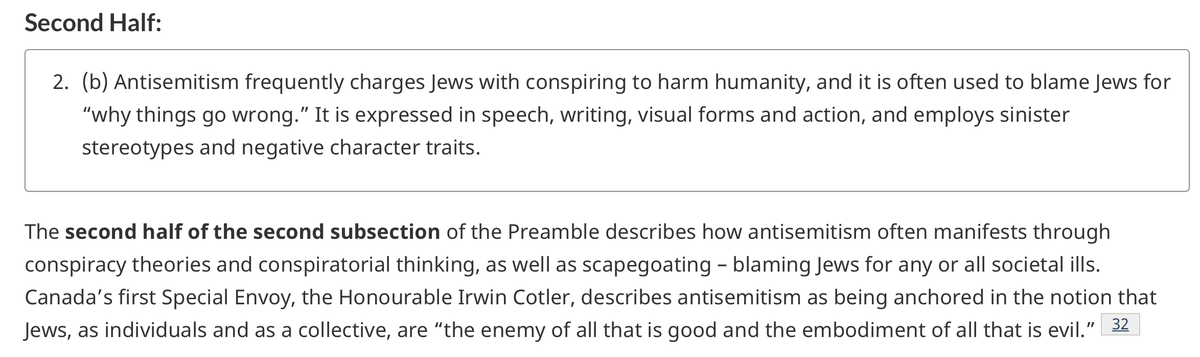
We often address the connection between conspiracy theories and conspiratorial thinking with antisemitism, and for valid reasons. The Canadian Handbook on @TheIHRA working definition of antisemitism explains it well:
One part of this article by Peter L. Biro contends: ‘Alas, [Canada’s IHRA guidelines and @Safety_Canada’s recent progress report], indeed, Canada’s entire treatment of the subject, fails to explain what is meant by “anti-Zionism,” which is distinct from “antizionism” – which is actually a form of Jew-hatred that is entirely distinct from antisemitism. I think of antizionism as the virtuous hatred that undercuts liberal democratic civic culture.’
This assessment of antizionism/anti-Zionism and antisemitism is pointed — what do you think?
Opinion: Jews are being canceled at cultural events. Antisemitism on Canadian campuses has been found not to be “episodic or peripheral,” but “persistent and proliferating,” revealing “a culture that actively and systematically tries to exclude and vilify them.”
https://t.co/WOdmRkzIvJ
What standards should Canadians expect of those entrusted with overseeing our children's education?
A new HRCCO-commissioned Leger poll finds that 68% of Canadians believe individuals who publicly support antisemitism, extremism, or political violence should be ineligible to run for the position of school board trustee.
@MartyYork with @nationalpost examines the findings and speaks with HRCCO about their implications for public education and school board governance.
Read more: https://t.co/C3z1PzkrtE
Holocaust distortion is not simply a matter of historical misunderstanding. Minimizing Hitler's antisemitism or questioning the intent behind the Holocaust undermines our understanding of history and the dangers of antisemitism.
Those seeking public office have a responsibility to understand that history and to take it seriously.
https://t.co/7pN4BC945R
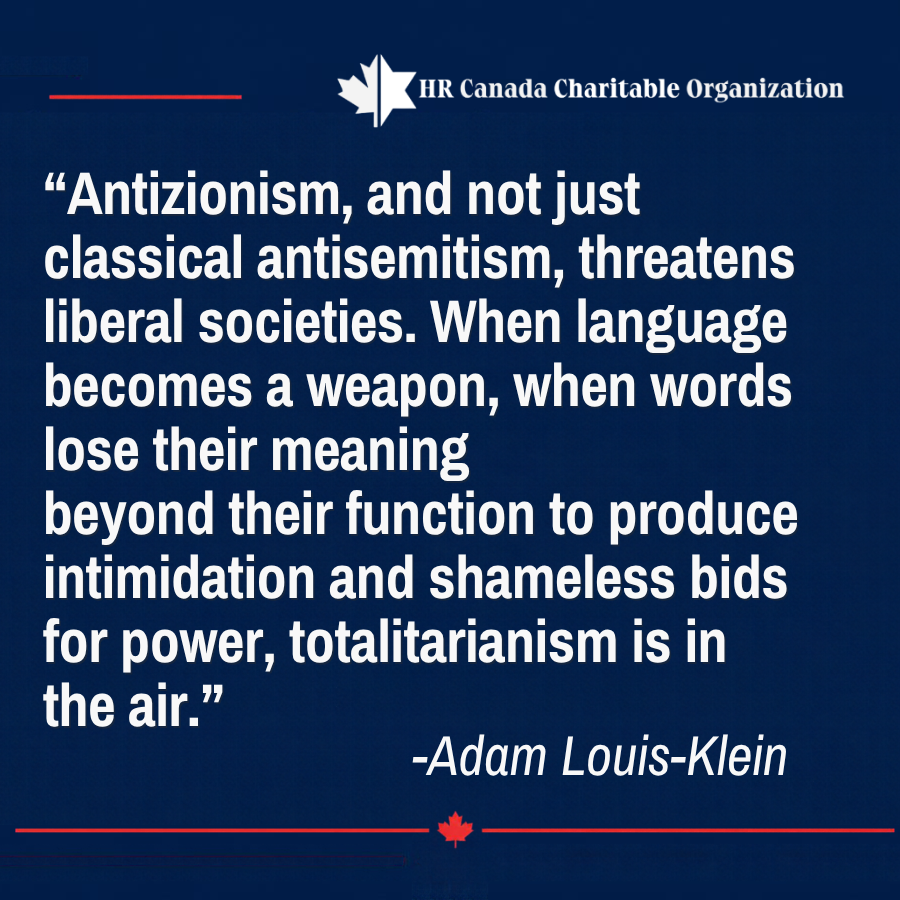
Is anti-Zionism simply another expression of antisemitism, or does it represent a distinct ideological threat?
Adam Louis-Klein argues that understanding contemporary anti-Zionism requires a new framework—one that recognizes its implications not only for Jews, but for liberal democratic societies themselves.
@Jerusalem_Post@MathildaHeller Wikipedia is being used to target Canadian charities and Jewish institutions. This isn’t just editing, it’s a mechanism of organized pressure against community institutions. This is part of a wider trend of Wikipedia being used to erase Jewish narratives, identify, and history.
Important report by @alexbencarson. With the news coming out that Artists Against Artwashing is organizing (yet another) event Wikipedia-editing event in Toronto, ON, this investigation by @ADL provides critical evidence.
Wikipedia is how so many people get their information. This trend, supported by this research, is alarming.
An ADL investigation found that Wikipedia left 91% of a banned editor's Israel-related edits intact, while 19 active accounts continue shaping articles on the Israeli-Palestinian conflict.
✍️ @alexbencarson
https://t.co/DE1ufEH6Xo
Even when evidence came out that proved his innocence, the French army stood by the real perpetrator — who was acquitted — and kept Alfred Dreyfus in prison.
By the time Dreyfus was pardoned, the wheels had already been in motion. Theodor Herzl’s witnessing of the Dreyfus Affair had set the stage for the Zionist movement, aimed at answering the question: if Jewish people will not be treated as equal citizens of their countries, if Jew hatred persists, where should Jewish people go?
The significance of this moment in time cannot be understated.
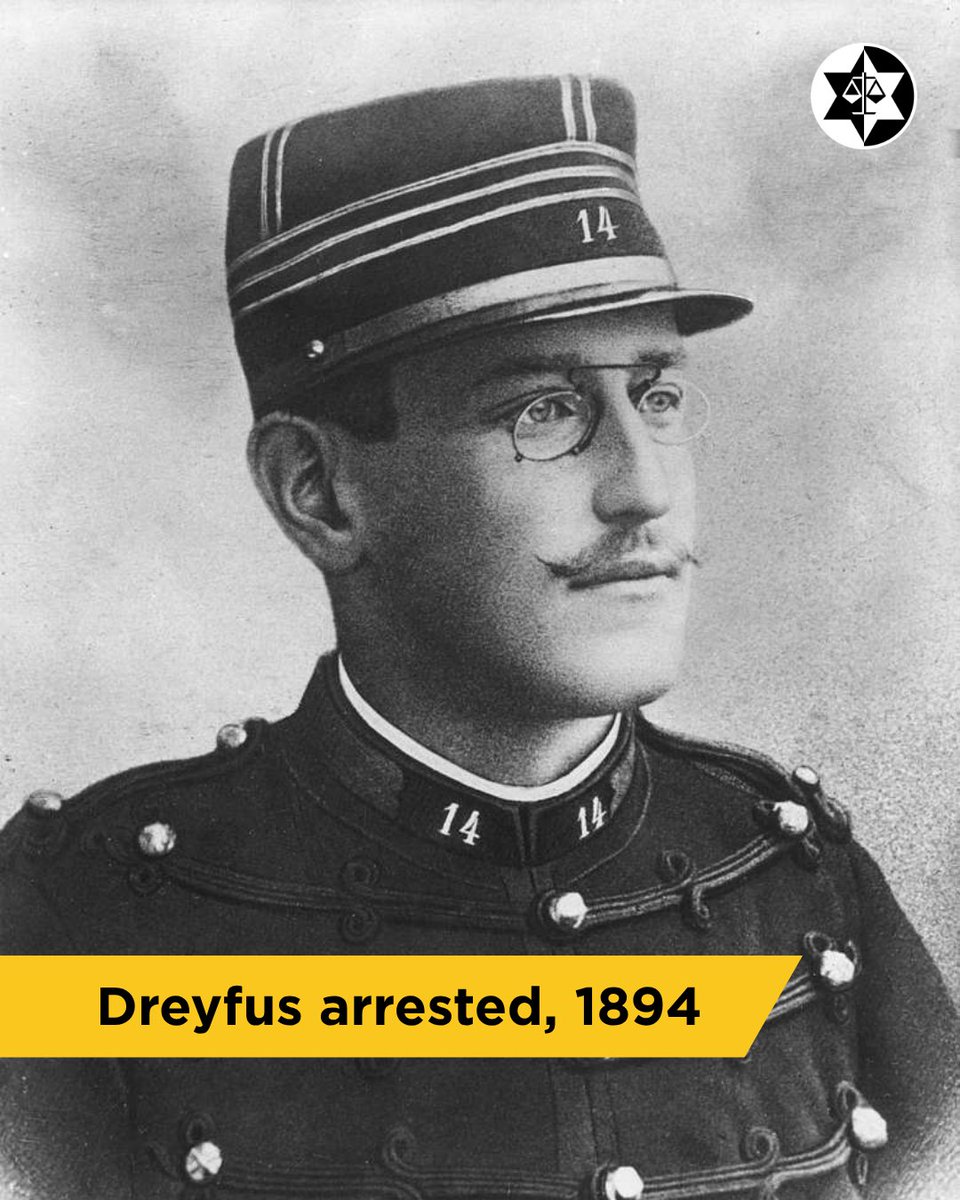
On this day – 15th October 1894 – Captain Alfred Dreyfus was falsely arrested for espionage, because he was a Jew.
Despite overwhelming proof of his innocence, Dreyfus remained imprisoned for years. It took more than a decade of public pressure, legal battles, and courageous advocacy before he was finally cleared and reinstated in 1906.
The Dreyfus affair was one of the most momentous incidents in the history of European Jewry and antisemitism.
The CJN reports that at least two dozen Jewish Canadian Armed Forces members and veterans have been rejected from a $150 million racial-discrimination settlement.
The settlement’s definitions include ethnicity. But rejected Jewish applicants were reportedly told eligibility was tied to the Employment Equity Act’s visible-minority definition.
How Jewish identity and antisemitism are assessed in these kinds of processes —especially in the Canadian context — is inextricable from the politicized, often ahistorical narratives about Judaism that have become pervasive globally in recent years.
Read the report to learn more.
At least two dozen Jewish Canadian Armed Forces members and veterans have been denied compensation under a $150-million settlement addressing decades of racial discrimination and harassment. The claimants say their exclusion raises serious questions about how eligibility is being determined.
Read more: https://t.co/9224AIynk5
On this day – 14th October 1943 – the Sobibor uprising took place.
Prisoners at the Sobibor extermination camp carried out a daring uprising against their Nazi captors. In an act of incredible bravery, the 600 prisoners fought back, killed several guards, and helped over 300 prisoners escape.
Around 50 of those who escaped would go on to survive the war.
This moment is remembered as one of the most powerful acts of resistance during the Holocaust.
Long but great post. The dual loyalty trope is not limited to just American Jews; Canada’s handbook on @TheIHRA working definition of antisemitism expands on the trope in example 6.
See: https://t.co/lFxuxAXyPM
From where comes the dual loyalty accusation, the notion that Jews can never really be trusted as their allegiance is first and foremost to their nation, and at what time periods does it resurface? The second question is far more important to answer than the first because anti-Jewish hostility has historically been a manifestation of societies undergoing profound political, social, or national crises. Put differently, the argument I put forth is that the proliferation of the dual-loyalty accusation is itself evidence of a nation struggling with its own identity and by extension, legitimacy.
Consider the historical record, punctuated by acute episodes of anti-Jewish animus and, more specifically, accusations of dual loyalty: the emancipation of French Jewry, accompanied by the famous declaration that Jews should be granted everything as individuals but nothing as a nation; the Dreyfus Affair; the emergence of modern antisemitism in Germany, where Wilhelm Marr warned that the “Semitic” people would transform Germany into a “New Palestine”; Stalin's postwar campaign against Jews as a “fifth column,” particularly following Golda Meir's arrival in Moscow in 1948; and, finally, the contemporary resurgence of dual-loyalty accusations among factions of the American right, where Jews are increasingly accused of failing to put “America First.”
What matters most about these episodes is not simply that Jews were accused of disloyalty, but the historical circumstances in which those accusations emerged.The emancipation of French Jewry in 1791 unfolded amid the French Revolution (1789–1799), one of the most tumultuous periods in French history, when the very meaning of citizenship and national belonging was being redefined. The Dreyfus Affair erupted in a France still grappling with the political and psychological consequences of its defeat in the Franco-Prussian War. Modern antisemitism emerged in Germany during a period of profound economic, political, and social upheaval. The timing is particularly revealing: Germany had only recently become a unified nation, and the question of who truly belonged to that nation remained deeply contested. In the postwar Soviet Union, Stalin's anti-Jewish campaigns intensified as the regime sought to consolidate its authority and assert its supremacy in the emerging Cold War, amid deep anxieties about ideological loyalty and foreign influence.
Which brings us to the present and the ugly resurgence of dual-loyalty accusations haunting segments of the American conservative movement. To be sure, the rise of “America First” sentiment must be understood against the backdrop of failed immigration policies and a country increasingly anxious about preserving its borders, sovereignty, and national identity. But it is precisely this context that makes the renewed accusation of Jewish dual loyalty so revealing. The charge of dual loyalty hurled at American Jews today should therefore be understood not as evidence of a Jewish problem, but as a symptom of an American one—an indicator of a nation experiencing a crisis of legitimacy. The question, then, is not why Jews are once again being accused of divided allegiances, but what the resurgence of that accusation tells us about the condition of America itself.
Our map enables Canadians to engage with documented incidents of antisemitism across the country in real-time, an interactive, searchable database that compliments @Canada's ongoing research and activities addressing antisemitism.
Our newest initiative is the HRCCO Map Of Reported Antisemitic Incidents.
The map is an interactive, real-time source for incidents of antisemitism across Canada — since @CanadianPM Mark Carney's speech at Holy Blossom Temple on June 1, 2026.
Check it out: https://t.co/QatthQAxRt
🚨 In the 48 hours around the October 7 anniversary, CAM's monitoring found open calls to kill Jews and burn synagogues on X, in at least 7 languages. These aren't opinions. They're threats.
A thread 🧵👇
ICYMI: Our Sept. 2026 poll asked Canadians whether individuals who express support antisemitism, extremism, or political violence should be allowed to run for school board trustee.
Read more about it here: https://t.co/2cj0ZzoYhE
In Sept. 2026, HR Canada Charitable Organization commissioned a survey of Canadians asking whether individuals who expressed support for antisemitism, extremist views, and political violence should be allowed to run for school board trustee.
The results of the survey are important in the context of antisemitism in provincial education, but also for antisemitism across Canadian civic and educational institutions.
Read the report here: https://t.co/annyDHeM7v
One reason discussions of antizionism get derailed into questions about what “Zionism” means, or what it means to “oppose Zionism,” is the insufficient attention paid to antizionism itself—thick description of its ideas, behaviors, and history. No one treats antisemitism as a question of “opposition to Semitism” because a thick weft of associations has already been woven around the term, giving it a recognizable meaning independent of what it nominally “opposes.”
In Sept. 2026, HR Canada Charitable Organization commissioned a survey of Canadians asking whether individuals who expressed support for antisemitism, extremist views, and political violence should be allowed to run for school board trustee.
The results of the survey are important in the context of antisemitism in provincial education, but also for antisemitism across Canadian civic and educational institutions.
Read the report here: https://t.co/annyDHeM7v
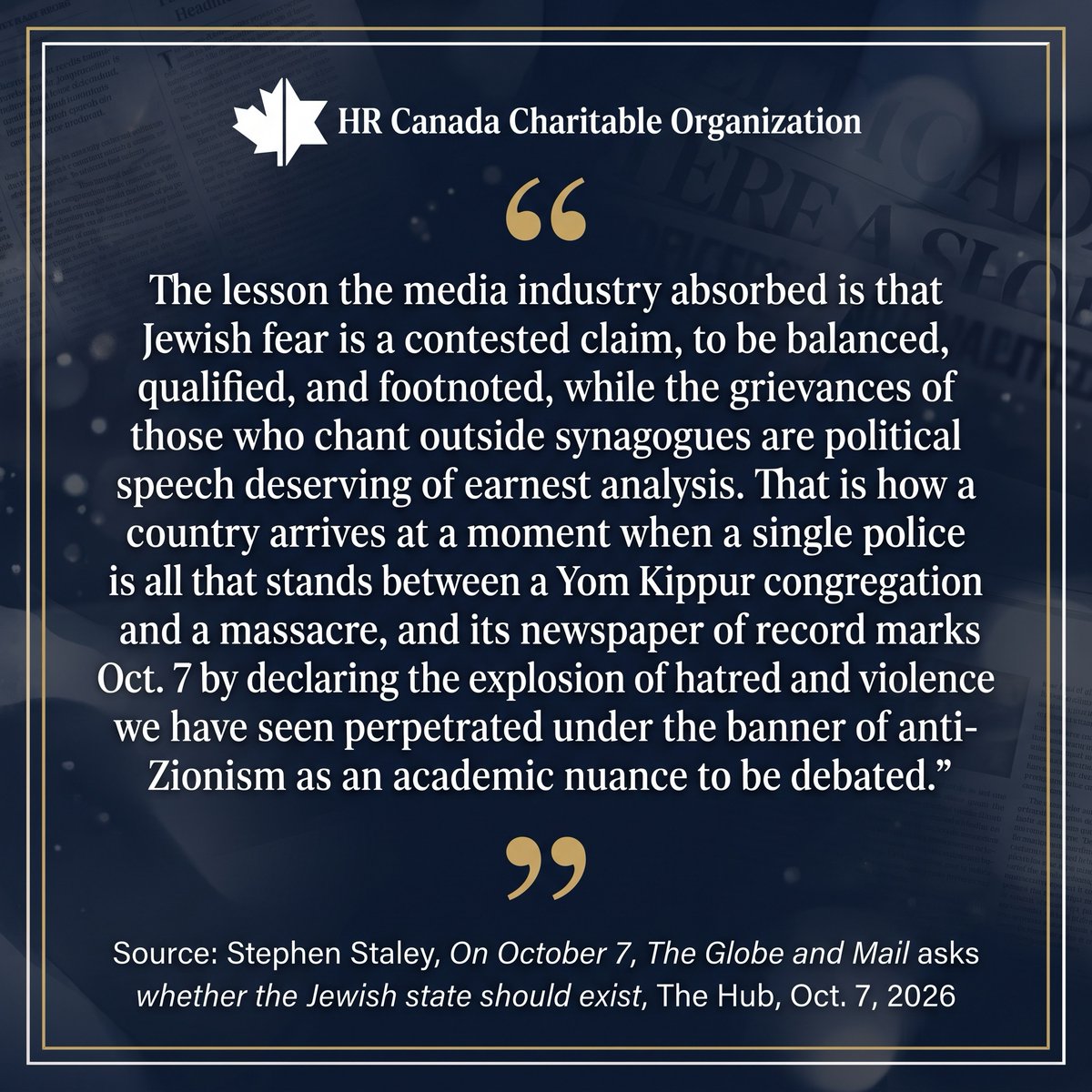
In "On October 7, The Globe and Mail asks whether the Jewish state should exist" for @TheHubCanada, @stevestaley succinctly addresses @globeandmail's decision to publish an article questioning the distinction between antisemitism and antizionism on the anniversary of Oct. 7, 2023.