Advancing industrial relations reform to save Australia's prosperity.
Authorised by Frank Parry, H.R. Nicholls Society, Suite 6.1, 2 Collins St, Melbourne 3000
Work From Home Bill = Wrong, Fraught, Horrendous
New H.R. Nicholls Society modelling shows the Bill could cost around 1,800 young Victorians their first job every year.
Working from home has benefits. But turning it into a legislated right risks making employers think twice about hiring graduates and young workers in the first place.
Under Albanese, Australia's workplace relations system is broken.
From the Pilbara to the steps of Spring Street, strikes and industrial chaos have become the new normal. Businesses, workers and the economy are paying the price for a system that no longer works.
Militant unions are once again putting Australia's prosperity at risk.
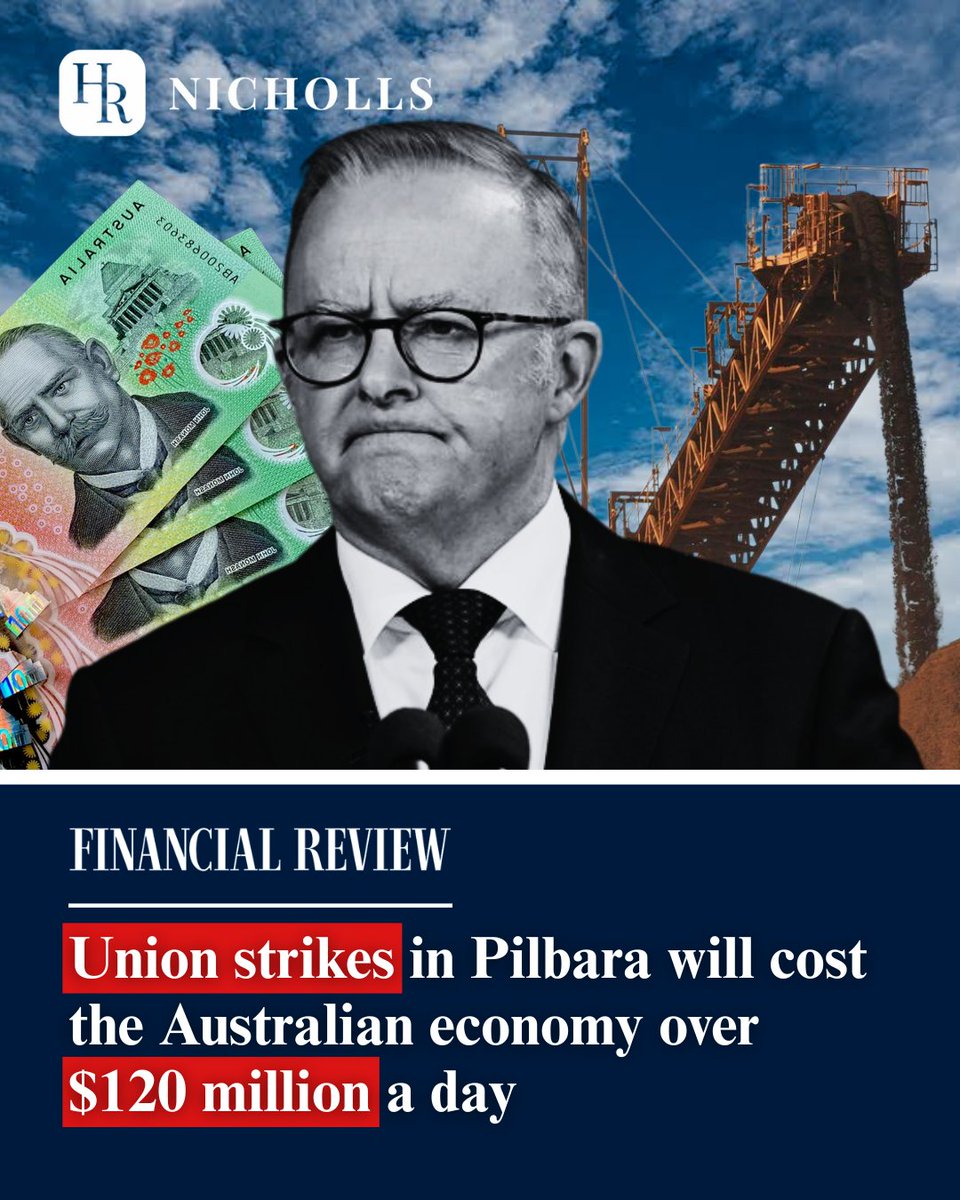
Their latest strike in the Pilbara could cost more than $120 million every single day in lost revenue and strip millions a day in royalties from the Western Australian Government.
Every day strike drag on is another day Australia's economy pays the price for union militancy.
Australia needs an economy that rewards hard work, not one that can be held hostage by militant union bosses.
Australia is heading in the wrong direction.
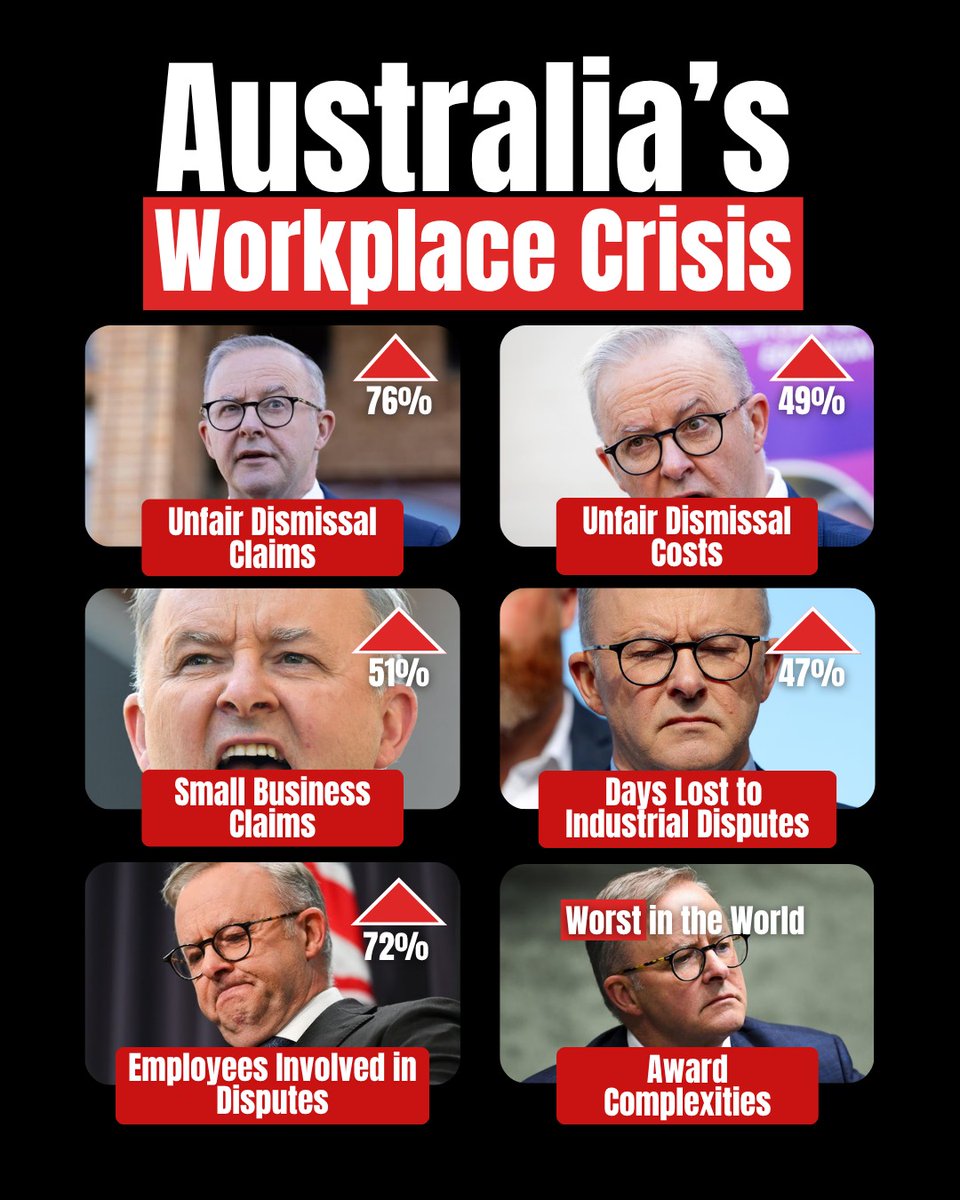
Unfair dismissal claims are surging. Costs are climbing. Industrial disputes are dragging more workers off the job. Small businesses are being buried under claims and award complexity.
Labor has handed more power to unions, more red tape to employers and a bigger bill to Australian businesses.
The system is broken, and Labor is making it worse.
No union should ever have "extraordinary influence" over a government.
Yet that's exactly what the IBAC report found. It found the Andrews Labor Government made an "undisclosed deal" with the UFU that placed its Secretary, Peter Marshall, in a position where he was able to exert "extraordinary influence" over negotiations.
It's a warning to every Australian who believes governments should serve the public, not powerful unions and vested interests.
Victoria's proposed Work from Home laws are a solution looking for a problem.
Flexible work is best achieved through agreement between employers and employees, not more government regulation.
Instead of delivering flexibility, this Bill will create more legal risk, more red tape and more uncertainty for businesses already under pressure.
It's time to bin the Bill, Ben.
For Labor’s 50th National Conference this week in Adelaide, the Australian Manufacturing Workers Union (AMWU) has published demands through its “blueprint for action” that it describes as “a working-class instruction to the government”.
The cost?
Nowhere in the 30 pages of the AMWU’s “blueprint for action” is a single demand costed.
So HR Nicholls has done a line-by-line analysis.
The results are staggering.
The recurring bill runs from $120 billion to $160 billion a year gross, and $80 billion to $125 billion even after the blueprint’s own wealth, inheritance and resources taxes are generously scored. That is before the one-off items: wiping the remaining $65 billion plus of HELP debt at a stroke, then buying the energy grid, the aged care sector and assorted “critical supply chains” which at fair value commits Australia to a capital program that could cost as much as $450 billion. All of it borrowed.
This amounts to quadrupling the entire federal deficit permanently.
The treasurer would be prudent to remind the union of his own debt ceiling at $1.2 trillion which the AMWU’s plan would breach before its second birthday.
Business has spent this last term learning that what Labor writes down at these conferences, it eventually does.
Read the full article by HR Nicholls Executive Director James Mathias in the AFR today:
https://t.co/8YuMcUq6a7
Union militancy is on the march.
The Transport Workers’ Union has spent eight long years patiently lining up the expiry of more than two hundred (200) enterprise agreements next week.
Union members are prepared to “shut down Australian transport”: to ground the planes, to choke the highways and the distribution centres, in what they proudly call the largest co-ordinated industrial campaign in the sector’s history.
In Western Australia, BHP is scrambling to recruit a replacement workforce just to keep the nation's single biggest export hub at Port Hedland alive where one day's stoppage burns more than $100 million.
None of this is accidental.
Three waves of legislation since the Albanese Government was elected in 2022, and more than 61 substantial workplace amendments, have handed the unions a loaded weapon to hold the Australian economy for ransom.
When the disruption comes, the public debate will be flooded with slogans which lack the rigorous, evidence-based rebuttal to who actually bears the cost, what the laws really do, and what genuine reform looks like.
That is our work, and decades ago even the unions' own analysts conceded we were winning the intellectual argument. We intend to keep winning it.
Hear our Executive Director James Mathias making the argument against union militancy in Western Australia, and read our latest report “The Go Away Money Economy: How Australia Turned Unfair Dismissal into a Settlement Industry”: https://t.co/wkuiFJkZED
The HR Nicholls Society is proud to release our latest report, a deep‑dive into the General Retail Industry Award revealing 1,424 possible pay rates across classifications (full‑time, part‑time, casual), employment types, apprenticeships and age‑based rates. One of 122 awards, it exposes a system of complexity that is drowning small businesses and evidences a deeper institutional failure that is harming productivity and producing confusion, litigation and administrative overload. Read the full report on the official HR Nicholls website https://t.co/YmmIShtrat #WorkplaceReform #HRNicholls #Woolworths
"The Government must deploy a high-powered taskforce of Ministers, senior officials, Victoria Police, and top contractors to enforce order and justice."
Read our latest media release here: https://t.co/0icOJzv3CW
Watch the full story: https://t.co/jNsQkNCDKC
Despite the CFMEU being put into administration, the rot in the construction industry has not stopped - and a notorious underworld figure is allegedly at the heart of it. #60Mins
A reckoning in workplace relations is inevitable, and the 💰 140 million financial hit Woolworths suffered in December from a near-three-week strike underscores just how harsh it could be: https://t.co/0dC21GS28e
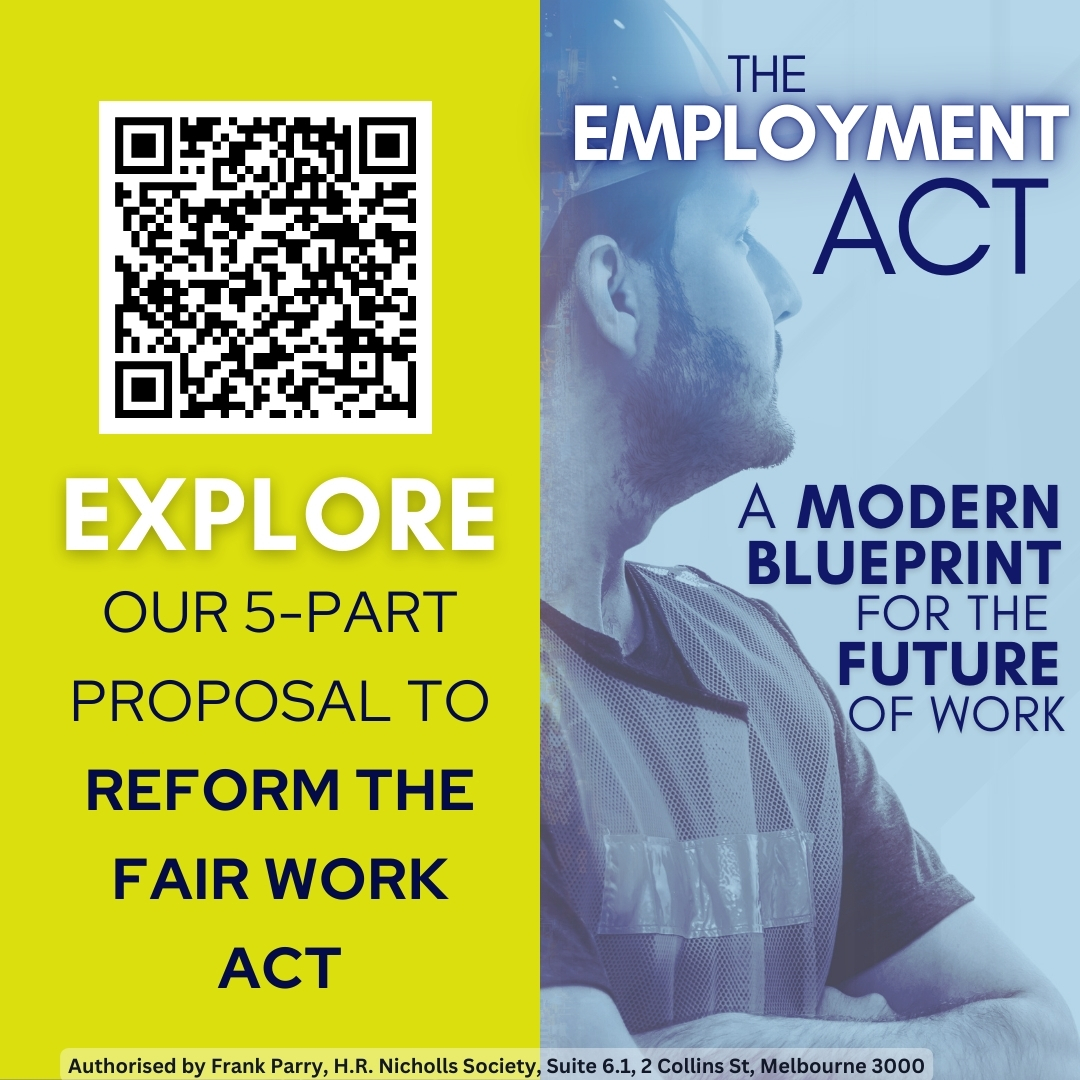
The H.R. Nicholls Society today publicly releases its most extensive reform paper to date, The Employment Act: A Modern Blueprint for Workplace Reform, which calls for urgent changes to Australia's broken workplace relations system.
Click here for more: https://t.co/15K2JxTNlt