Three different strategies for leading change in organisations: data-based, high engagement & generative:
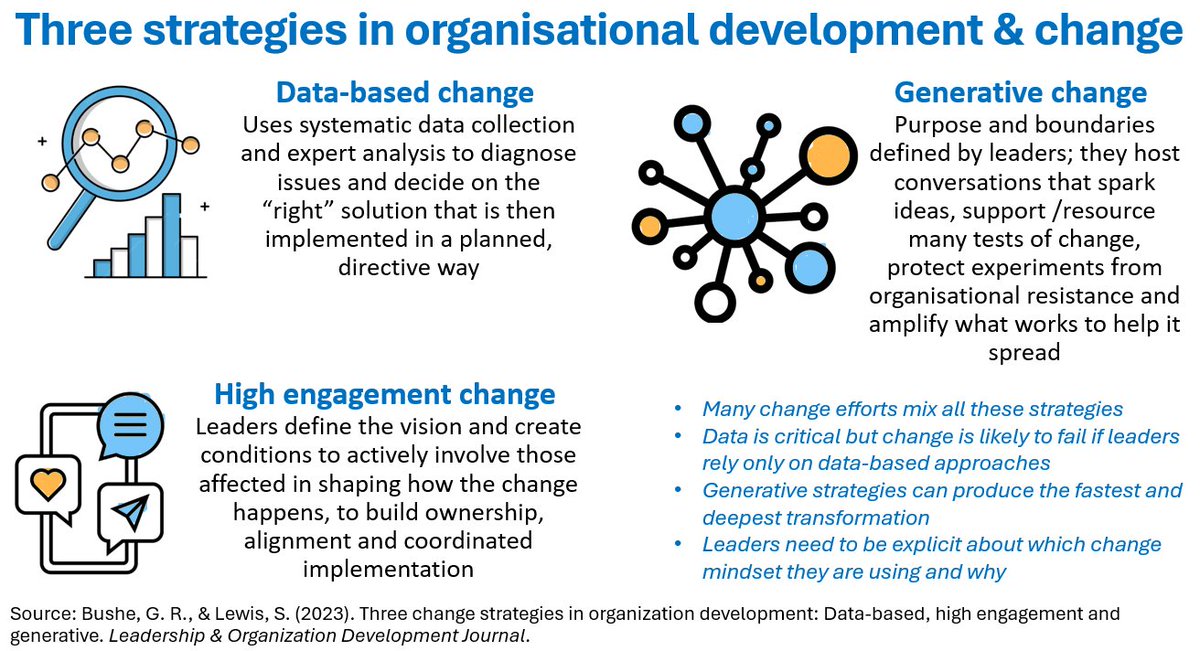
1) Data-based change: Leaders or experts diagnose the problem using data to decide the “right” solution & roll it out. Fits best when there’s one clear answer, stable situation & you need tight coordination & control (eg, standardised process redesign or compliance project). Implementation is directive in nature.
2)High engagement change: Leaders already know the direction, but actively involve many people in shaping how to get there. Builds ownership, taps local knowledge, & increases likelihood that a major change (eg., a big IT rollout or operating model shift) is accepted & implemented well.
3) Generative change: Leaders frame a clear purpose (e.g. “‘safe, compassionate care with less stress for people who use services & colleagues”), set boundaries, then invite people across the system to launch many small experiments or tests of change & “learn as we go.” Works best when there are many interconnected, competing factors, the situation is unpredictable & there is no single knowable “right” solution.
From a paper by Gervase Bushe & Sarah Lewis.
Most change efforts mix these strategies, often unconsciously. Data is critical to effective change but data-based change that neglects human participation is highly likely to fail.
High engagement change & generative change use many of the same large-group change methods but are fundamentally different. High engagement change uses group events for leaders to listen & create proposals for to choose from or to produce sub-decisions & action ("You said, we did"). By contrast, generative change events are used to stimulate & launch numerous change activities with the intent of lots of people engaged in trying things out & to “learning as we go.” High engagement starts with a leader-led vision (what things will be like once the change is complete). Generative change starts with purpose (what the organisation is trying to do every day). The authors say that vision-led change risks shutting off potential innovations that may emerge when we start with purpose.
Generative change can produce deeper & faster transformation than the other strategies but requires leaders to cede some direct control in favour of self-organisation & emergence.
Read more: https://t.co/F25YFfWxki
Joan, a Service User, talks positively about the benefits of 5 Moments for Medication Safety and its importance for patients, families, and carers to use with the support from health professionals. #MedSafetyWeek
The ‘5 Moments for Medication Safety’ are the key moments where action by patients and their carers can greatly reduce the risk of avoidable medication related harm. Joan reminds us of the 5 Moments-Starting, Taking, Adding, Reviewing and Stopping.
Easily remembered by the acronym “STARS”
https://t.co/zeWZpMBjT1
Marking #WorldQualityWeek, we're delighted to launch our 2024–2025 Annual Quality Report. This year's theme, “Quality: Think Differently,” is a timely invitation as we mark one year since #HSCQI transitioned to #RQIA, challenging us to look at how we support #HSC to build capability and foster a culture of continuous #improvement. #Quality is everyone’s responsibility. Let’s work together to think differently, embrace improvement, and make care safer for all. Download the report at https://t.co/iVzgpdoYYx #WorldQualityDay #WQW25 #ThinkDifferently #PatientSafety @RQIANews@NIProjectECHO@healthdpt
As part of World Quality Week 2025, we’re delighted to share reflections from colleagues who attended the IHI Quality and Safety Forum in Utrecht earlier this year.
The forum explored new thinking, evidence, and practice in quality, safety, and person-centred care.
#WQW25
5 Moments for Medication Safety - Moment 2.
Taking a Medication, Pharmacist Aine believes the toolkit encourages a patient to properly take their medication as prescribed. #medsafetyweek
It will encourage patients to review when they should take this medication and how much should they take each time and what to do if there any side effects.
Read more - https://t.co/zeWZpMBRIz
💊 The Health Minister has welcomed the launch of the "5 Moments for Medication Safety" toolkit
👉 It helps with:
✅ Starting a new medicine
✅ Taking a medication
✅ Adding in medication,
✅ Reviewing a long-term medication
✅ Stopping a medicine
🔗 https://t.co/Iy3k1mCGU7
💊 The Chief Pharmaceutical Officer has welcomed the launch of the "5 Moments for Medication Safety" toolkit
Professor @cathyharrison00 said "medication safety needs to be a priority for everyone".
🔗 https://t.co/Iy3k1mCGU7
5 Moments for Medication Safety.
Moment 3- Adding a Medication, Service.
User Margaret talks about how the toolkit has helped her understand the implications of adding new medications.
It will also encourage her to consider other medication she may be taking, and what she they should do if she suspects an interaction. #medsafetyweek
Health and Social Care (HSC) organisations have launched this year’s HSC mental health and emotional wellbeing campaign urging people to look after their mental health to help deal with life’s daily challenges.
Find out more at https://t.co/zWqkfmaov1
#LookAfterYourMentalHealth
📋A public consultation on the learning disability service model has been launched
👥The Department will host a series of regional events for the consultation
➡️Info: https://t.co/roPvZH6Ve9
✅Consultation: https://t.co/pLNlz92h1N
Connect ➡️ Collaboration ➡️ Change, An early morning start with one of our #acutewards attending #safetybrief tailoring dietary needs &
nutritional priorities key to the individual setting, aiming to meet nutritional recommendations @HSCQI@mckee_joanne@BDA_Dietitians@theRCN
Great #QI work with catering and nursing teams Optimising hospital nutrition for the most nutritionally vulnerable to minimise sarcopenia and reconditioning for system wide benefits @NHSCTrust@tennysonCAHPO@jenniferwelshbt@millarwilson
🚨New Funding Call from PEDRI🚨
~' From Standards to Impact' ~ with awards up to £15,000 to support Public Involvement and Engagement Practitioners working in UK-based research orgs and infrastructure programmes:👇
https://t.co/DfKu8k4HH4
Build a community for change with services users, patients, families and colleagues working together towards a shared purpose.
Remember change is often best navigated from the ‘outside in’.
For more on this topic visit: https://t.co/lzoIF16CYH
#Changematters
NI’s Chief Pharmaceutical Officer Professor @cathyharrison00 has been designated a Fellow of the Royal Pharmaceutical Society for distinction in the profession of pharmacy.
The Health Minister praised Prof Harrison for her "outstanding leadership".
🔗https://t.co/XspJZDJ1tZ
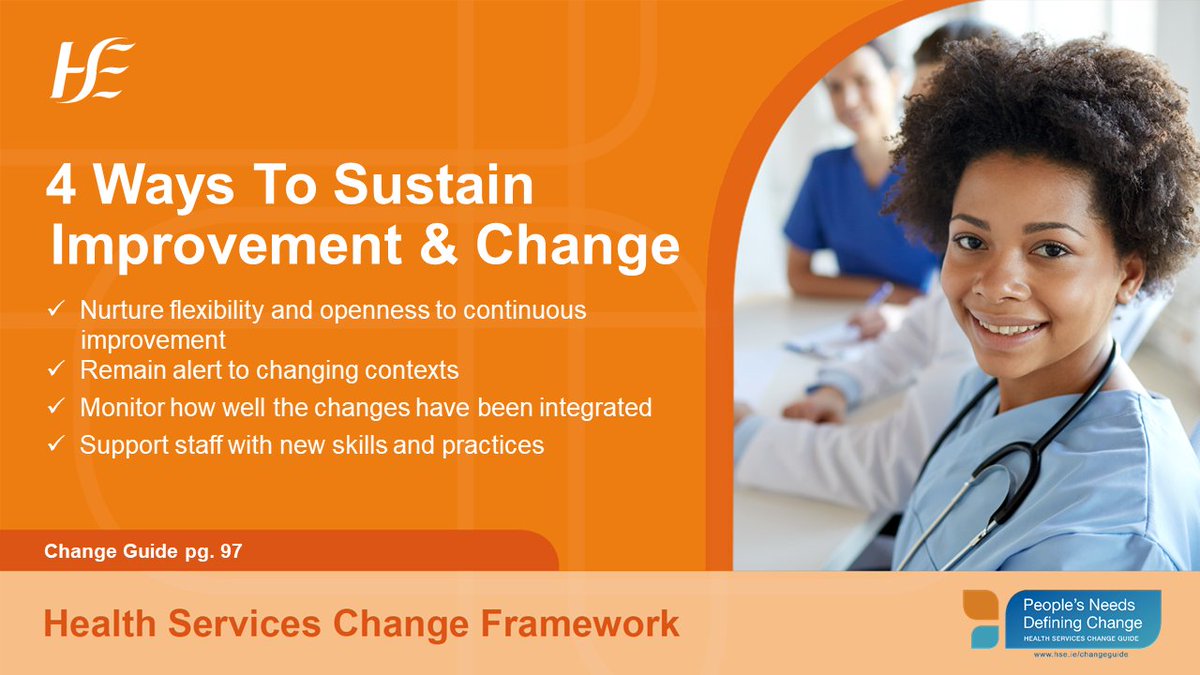
Sustaining improvement and change requires an openness to continuous learning. Being able to adapt to changing needs and remaining flexible requires leadership and team supports.
Keep a keen eye on the ever-changing context that surrounds you. Monitor how well changes in ways of working are being integrated into the normal patterns of day to day work.
For more visit: https://t.co/ULxZGAHZ1Q
#changematters
At the #Quality2025@bmj_company@TheIHI conference in #Utrecht, change experts Helen Bevan and Göran Henriks have begun their day-long workshop entitled ‘Beyond incremental improvement: what do we need to deliver deep, systemic change in healthcare?’.
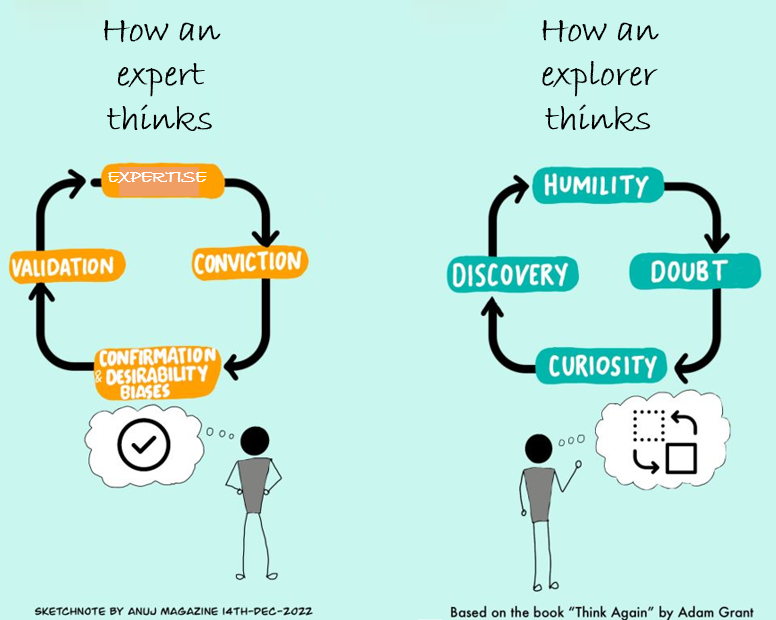
The pair are presenting a case that change requires an inquiry mindset and focusing on shared purpose and inquiry together. Leadership in building collective inquiry will help navigate complex change. System thinking and inquiry competence and building capacity and capability in these areas is pivotal.
Organisation Development and Design GM Marie O’Haire will speak at the workshop later today.
#changematters
Celebrating #ICTD2025, NI Health Minister @mikenesbittni is encouraging all to ‘Be Part of Research’ by signing-up or getting involved in health research. Thank-you Minister, for your continued support to Health and Social Care research.
@NIHRtakepart@healthdpt@publichealthni