Endless Human Bloodletting and Failure of Intelligence
I am deeply saddened and troubled by reports that at least nine people were killed in the Zuwagal community, Mangu Local Government Area of Plateau State, in yet another assault on innocent Nigerians. These deaths have occurred amid a deeply concerning pattern of recurring attacks, displacement and the destruction of communities throughout the country.
Data from the past two weeks are alarming. OpenWatch's security incident records show 261 reported deaths across Nigeria between 2 and 15 November 2026, including 24 in Plateau during the first week and 15 during the second. Plateau also reported additional attacks on 16 November.
These victims are not merely numbers. They were fathers, mothers, children and breadwinners whose lives were abruptly ended, leaving families and entire communities to mourn.
Why are communities being threatened without receiving adequate protection? Why are intelligence reports failing to result in preventive action? How many more innocent Nigerians must lose their lives before decisive measures are implemented?
I call on the Government and security agencies to immediately reinforce security operations in vulnerable communities; thoroughly investigate these attacks and ensure that both the perpetrators and those who support them face justice; establish reliable early-warning and rapid-response systems; deliver humanitarian aid and rehabilitation services to displaced families; and release transparent, accurate casualty figures for all affected communities.
We must also confront the root causes of insecurity by strengthening accountable institutions, intelligence gathering, justice, education, economic opportunity and meaningful engagement with communities.
Every Nigerian life is valuable, regardless of ethnicity, religion or political affiliation. The right to life must never be subject to negotiation.
My deepest condolences go to the bereaved families and the people of Plateau State. May God comfort them and bless our country with peace.
Nigeria must do more than mourn those who have died. We must protect those who are still living. -PO
NIGERIANS, GO AND VERIFY (3)
Building the Future Through Education
Peter Obi
In the first two instalments of this series, I explained how we approached the task of building strong institutions and laying a solid foundation for the development of Anambra State. One of the most important institutions we invested in was education.
For me, education was not a political game or a convenient political promise. Even before I ventured into politics, I had always regarded it as the foundation of meaningful development and the most enduring investment any government can make in its people. I believe that the future of any society depends largely on the quality of its educational institutions, teachers, learning environment, and opportunities available to its young people.
This conviction informed our decision to invest across the entire educational spectrum, from primary schools to universities, technical institutions, and adult education.
Basic and Secondary Education
One of our first major decisions was to return mission and privately owned primary and secondary schools to their original proprietors while retaining government support. We also provided billions of naira to assist in rehabilitating the returned schools, restoring the partnership between government and religious institutions that had historically contributed to educational excellence.
This policy attracted international attention. Professor Paul Collier, the Oxford economist and World Bank consultant, led a World Bank-commissioned study of Anambra’s educational transformation. His team examined our decision to return schools to their original missionary owners while retaining government responsibility for funding teachers’ salaries and supporting infrastructure. The team described the partnership model as a revolution in public service delivery and recommended it as a model that could be replicated by other Nigerian states and developing countries. We believed then, as we do now, that government does not necessarily have to own every institution to discharge its responsibility effectively. What matters is ensuring that every child has access to quality education.
For those who claim that we built no schools, I invite them to verify our records. We constructed five-classroom blocks in virtually all of the 177 communities in Anambra State, one of the most extensive community-based school infrastructure programmes undertaken by any state government. The town union chairmen and community leaders of that period can attest to this.
We also renovated hundreds of dilapidated schools, including some where trees had literally grown through abandoned buildings. Comprehensive Secondary School, Onitsha, and Oraukwu Grammar School are examples.
Beyond infrastructure, we distributed approximately 40,000 computers to schools, including more than 22,500 HP laptops. We equipped secondary schools with Microsoft Academies and connected schools across the state to the internet. We supplied generators, established and stocked libraries, revived school sporting activities, and installed boreholes in over 300 schools, including all girls’ schools. We also provided funding to support sporting activities in all our secondary schools.
These technology investments attracted remarkable international recognition. Mr Fabrice Campoy, Managing Director of the Personal Systems Group at HP Inc., described our procurement and distribution of over 22,500 HP laptops as the biggest project of its kind in the Middle East and Africa. Similarly, Mr Ken Spann, then Country Manager and Head of Microsoft Nigeria, described the establishment of Microsoft Academies in more than 500 Anambra secondary schools as the most extensive deployment of its kind in Africa at the time.
NIGERIANS, GO AND VERIFY (1)
Introduction: Governance as a Public Trust
Peter Obi
When I took office as Governor of Anambra State, our beloved state was at a critical juncture. Leadership had become increasingly disconnected from the people, and many of the essential institutions needed to support a modern society were weak, ineffective, or absent altogether. We understood that governance could not continue according to established habits. It needed to be reconceived as a solemn public trust founded on transparency, prudence, accountability, and demonstrable results.
Our governing philosophy rested on four principles: character, competence, capacity, and compassion. We understood that leadership was not a platform for self-promotion, political slogans, or the pursuit of personal acclaim. Its purpose was to improve the circumstances of ordinary citizens. It meant converting public resources into concrete benefits and ensuring that government’s foremost responsibility was to serve the people. Achieving this demanded more than good intentions; it required a clear vision, careful planning, and disciplined execution.
Among our earliest findings was that the state lacked a unified development plan to direct its priorities and determine how resources should be allocated. We therefore promptly created the Ministry of Economic Planning to establish the institutional foundation for deliberate, coordinated, and sustainable development. After completing the necessary groundwork and consultations, we launched the Anambra Integrated Development Strategy (ANIDS).
At that time, the Millennium Development Goals (MDGs) were being pursued worldwide across eight clearly defined priorities: eliminating extreme poverty and hunger; achieving universal primary education; advancing gender equality and empowering women; reducing child mortality; improving maternal health; combating HIV/AIDS, malaria and other diseases; promoting environmental sustainability; and fostering a global partnership for development.
We adopted ANIDS as our overarching development philosophy and strategic framework for advancing these objectives, tailoring them to the distinctive circumstances, needs and development priorities of Anambra State. Instead of viewing the MDGs as remote international benchmarks, we worked to convert their aims into practical policies, programs and measurable results that would produce tangible improvements in the lives of our people.
We also undertook a deliberate effort to redefine the state’s identity, changing its public image from ‘Home for All’ to ‘The Light of the Nation’. This was not merely a change in slogan; it reflected our resolve to restore public confidence in government, renew civic pride and show that Anambra could serve as a model of purposeful leadership and development.
The ANIDS Blueprint: A Comprehensive Framework for Development
ANIDS served as the foundation for our commitment to broad-based and balanced development. We did not accept the idea that government could focus on a single sector while leaving others behind. We recognized that education, healthcare, infrastructure, security, agriculture and capable public institutions were mutually dependent. Advancement in one area could not be sustained without commensurate progress elsewhere. Accordingly, we pursued development across every sector, guided by defined priorities, disciplined planning and prudent stewardship of public resources.
Central to this vision was the restoration of the dignity of the Anambra person. We understood that dignity could not be restored through rhetoric alone. It was evident in the condition of roads and other infrastructure, the availability of healthcare, the quality of education, the performance of public institutions and the way government treated its workers, pensioners and traditional institutions.
LET MY RECORD SPEAK
I just arrived United States this evening to honour an important invitation and participate in a series of engagements beginning at 9am tomorrow morning in Washington DC.
Throughout my election campaigns, I have sought to emphasise policies, ideas, and practical solutions that can deliver the change Nigeria urgently requires and help our nation overcome its current challenges.
Nevertheless, because certain individuals have repeatedly scrutinised my past, even as they appear uneasy about their own records, I have chosen to allow the facts to speak for themselves. Starting today and running for ten days, I will present some of the accomplishments recorded during my tenure as Governor of Anambra State. This series will outline my interventions, achievements and the responsibilities entrusted to me. I have titled it my Record of Service.
In every position I have held, I have consistently given my utmost effort in fulfilling my responsibilities. Although no one can always attain every intended result, I have never been found lacking in dedication or effort. I have always given the task my full commitment.
As campaign activities gather momentum, I will also continue to keep you updated on my daily engagements and other significant developments.
In particular, in light of allegations that I abandoned Anambra State during the erosion crisis, among other assertions, I consider it necessary to present the facts to the public. I have never evaded any responsibility entrusted to me, and I will certainly not shirk my responsibility to help address Nigeria’s challenges.
I am confident that, ultimately, facts outlast allegations, while records carry greater weight than rhetoric.
Let my record speak for itself! -PO
@IdrisAOni1 That is why we need to purge Islam out of Yoruba land..
You can't have arab supremacist ideology on Yoruba ancestral land.
IFA already talked about separatist like Islam and we will handle it accordingly
Yesterday, I had the honor of visiting Benue State, traveling from Makurdi, the state capital, to Gboko, where I paid a courtesy call on the revered Tor Tiv. I am profoundly grateful to His Majesty for the gracious welcome and for the opportunity to discuss the development, peace, and welfare of our people.
I particularly commend the Catholic Bishop of Gboko, Most Rev. Father William Avenya, for his steadfast dedication to education. During my visit to the College of Nursing Sciences established under his leadership, an institution I have supported since its inception, I pledged an additional ₦10 million to help strengthen its operations. Supporting education and healthcare is an investment in our collective future.
We then proceeded to Yelwata, where we stood in solidarity with the people and families affected by the tragic massacre. The pain endured by these families, especially the children who lost their parents, is profoundly distressing. To address some of their immediate needs, I committed ₦5 million for the construction of a borehole to improve access to clean water, as well as ₦10 million to support the education of children orphaned by the massacre.
No child should be forced to let the tragedy that has affected their family determine the course of their future. Although no financial contribution can restore the lives lost or remove the suffering endured by their loved ones, we have a responsibility to do everything within our power to renew hope, preserve dignity, and create opportunities for those affected. Education must continue to serve as a bridge to a brighter future for these children.
The day concluded with a town hall meeting held as part of our continuing engagements across the country. I was joined by my elder brother and NDC Vice Presidential candidate, Senator Rabiu Musa Kwankwaso, as well as other candidates of the Nigeria Democratic Congress (NDC) in Benue State.
These engagements enable us to hear directly from our people, gain a clearer understanding of their concerns, and consider practical responses to the challenges facing our communities and nation. We are firmly of the view that leadership begins with listening and must ultimately be judged by the meaningful difference it makes in people's lives.
I remain firmly persuaded that leadership exists to serve. We must increase our investment in education, healthcare, security, and human development. Our goal must be to build a country in which every Nigerian, regardless of personal circumstances or place of birth, can live with dignity and realize their full potential.
I would like to express my appreciation to the Governor of Benue State, His Excellency, Rev. Fr. Hyacinth Alia. Before my visit, I sent him a message, and he personally returned my call to assure me that I would receive a warm welcome in the state. This exemplifies the true essence of statesmanship: placing humanity and mutual respect above political differences.
I extend my heartfelt gratitude to the people of Benue State for their warm reception and hospitality. May God continue to bless Benue State and the Federal Republic of Nigeria.
A New Nigeria Is POssible! -PO
A NEW DIMENSION OF TOXIC POLITICS IN NIGERIA
The new dimension of toxic politics that Nigeria has developed since 2025,
I arrived at the airport at 7 a.m. this morning to board my flight to Enugu. There, I saw the Nigeria Under-17 girls' team, which had just arrived and was preparing to board its vehicle into town.
With genuine joy and enthusiasm, I asked my Protocol Officer, Jackie Wayas, to find out whether I could greet and welcome the team. I was informed that officials of the Nigerian Football Federation (NFF) had refused and had requested that I not approach them because, if I did, they would all lose their jobs.
Regrettably, this is not the first time I have been subjected to such treatment. On March 25, 2025, I was in Uyo for the World Cup qualifier. The governor warmly received me and welcomed me at the VIP stand. Following the match, other government officials went to greet the players, but I was again prevented from doing so. I was told by the officials that they would lose their jobs if I proceeded.
It is deeply troubling to witness the extent of toxic politics into which our nation has descended since 2025. Each year appears to bring further deterioration. This reflects how deeply Nigeria has been affected.
The new Nigeria we aspire to build must have no room for hostility, intimidation, or discrimination, regardless of political affiliation. It must be a Nigeria in which unity, mutual respect, and our shared humanity take precedence over political differences.
A new Nigeria is POssible. -PO
GOOD DAY, MR PRESIDENT: NIGERIANS DESERVE ACCOUNTABILITY
Good day, Mr President.
I congratulate you on spending a night in one of Nigeria’s states outside Lagos and Abuja. I hope you enjoyed the warmth, hospitality, and delicious cuisine of Akwa Ibom, which I am sure is even better than those of the destinations where you have spent over 260 days outside Nigeria since coming into office.
I sincerely hope this visit will inspire you to travel to the remaining 33 states of the federation, spend time with the people and, more importantly, explain what your administration has done with the ₦15.8 trillion saved from the removal of fuel subsidy, the over $100 billion you have borrowed, the increased revenues accruing to the government from taxing Nigerians, and the additional government revenues which your administration celebrated last year as having surpassed its target.
Nigerians deserve to know how many that were pulled out of poverty within this period, how many out-of-school children were returned to school, and how many functional primary healthcare centres you have built. They also deserve to know how much electricity supply has improved, especially given your promise that if you do not fix power, Nigerians should not vote for you. They deserve an explanation of how you have secured the country, which still ranks among the most terrorised countries in the world.
Mr President, Nigerians deserve answers. They deserve to know what has been done with the resources entrusted to your government.
The New Nigeria we want to build will be based on accountability, transparency, and the physical, measurable impact of our public resources on the lives of citizens.
A new Nigeria is POssible. -PO
Do not Undermine Democracy
I have received with shock the news of an order by the Federal High Court in Abuja nullifying the emergence of the Chairman of the African Democratic Congress (ADC) and all the actions he has taken. This is unsettling and surprising.
I do not challenge the ruling of the court. The court of law is constituted to determine disputes according to the law. My concern is that three months before a general election, it is in the public interest to have certainty. It is not good to have too many uncertainties about candidates and parties a few weeks before a presidential election. This instability is obviously engineered by the ruling party, just as they have done against me in the Labour Party and continue to do so to close down civic space for a robust campaign. It is also from the same rulebook that manufactures violence against us in our campaigns.
One mark of democracy is that at all times, it is voters and not courts that choose leaders. I trust in the judiciary. As a public officer, I have shown deep respect for the judiciary. I appeal that we protect the integrity of democracy by not undermining the free and fair choice of candidates.
The sustenance of democracy in Nigeria, in the midst of encroaching military rule in West Africa, should strengthen our resolve to protect opposition politics and not stamp out opposition parties. It is because of the importance of opposition to the sustenance of democracy that I have always promised that, as President, I will take a special interest in ensuring opposition parties are stable and thriving, and that opposition candidates are not persecuted out of electoral contests.
This is a time to strengthen our democracy by allowing the opposition to thrive.
A new Nigeria is POssible. -PO
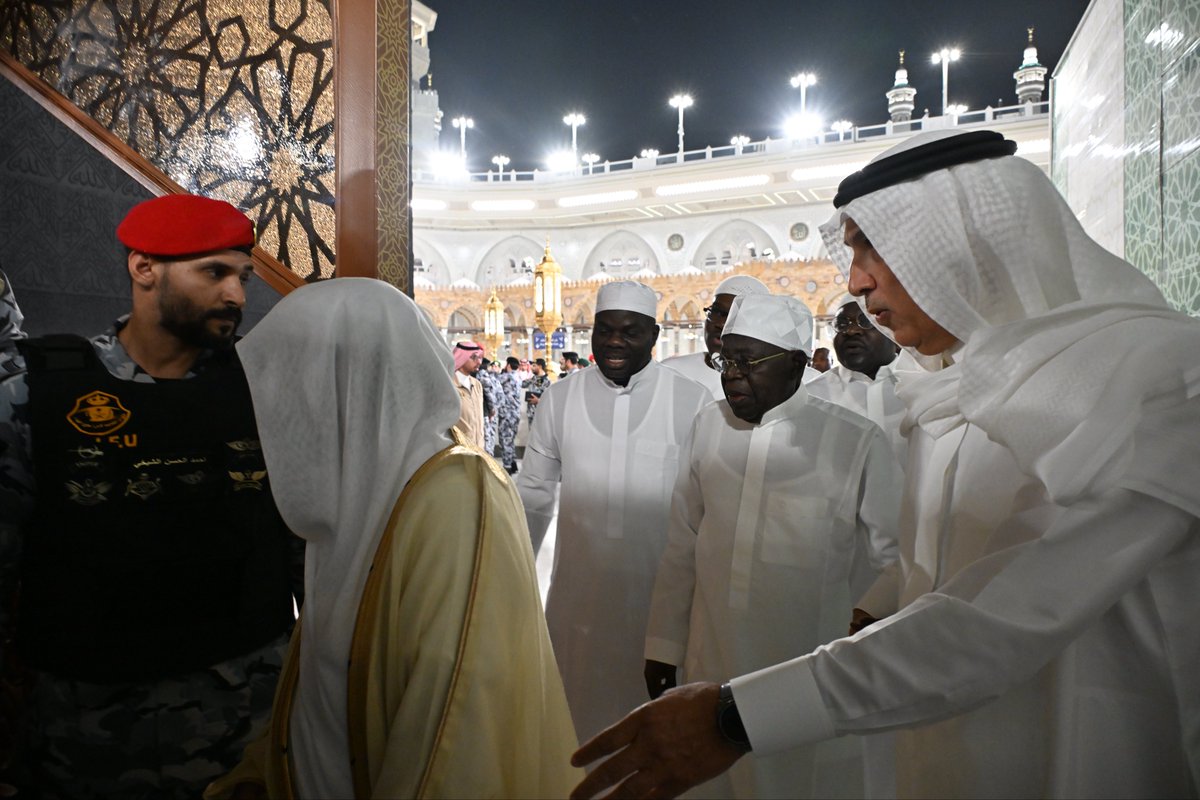
I have concluded my visit to the Kingdom of Saudi Arabia, where, together with members of my delegation, I had the rare honour of entering the Holy Kaaba to pray, and of performing Umrah.
I am deeply grateful to the Custodian of the Two Holy Mosques, King Salman bin Abdulaziz Al Saud @KingSalman, and to Crown Prince and Prime Minister Mohammed bin Salman for extending this privilege to us, and for their gracious hospitality and brotherly care.
It reflects the enduring bonds of faith and friendship between Nigeria and Saudi Arabia.
In those sacred moments, I prayed for peace, unity and prosperity for our dear nation and for all Nigerians.
Bola Ahmed Tinubu, GCFR
President of the Federal Republic of Nigeria
@spagov2@KSAmofaEN
I was very pleased to be able to pay Mr. Rilwan Olawale a visit over the weekend, after his release from DSS custody following a series of engagements in the course of last week aimed at securing his release.
It was heartwarming to see him reunited with those who care about him.
I thank everyone who expressed concern and solidarity and who stood by Rilwan through this ordeal.
I reiterate that we believe in a Nigeria where law enforcement agencies pursue their mandates legitimately while diligently respecting and protecting the legal and fundamental human rights of every Nigerian.
Welcome back, Mr. Olawale.
Ó TI YÁ.