On harnesses, I vacillate between three beliefs:
- the less harness, the better. Models are the magic
- post training a model and harness is dramatically better and the model providers win
- harnesses have real independent value from the model
I have no idea which is right.
Feature richness and UX flow have served as durable moats while coding and design were scarce.
Coding is now rapidly commoditizing toward near-zero marginal cost. UX design remains somewhat constrained—for now—but likely not for long.
Traditional app moats persist only as long as “app bundles” remain as it has been, which I increasingly doubt.
The last wave exposed the fragility of 'GPT wrappers.' This time it is for coding wrappers, UX wrappers—whatever label we may call them.
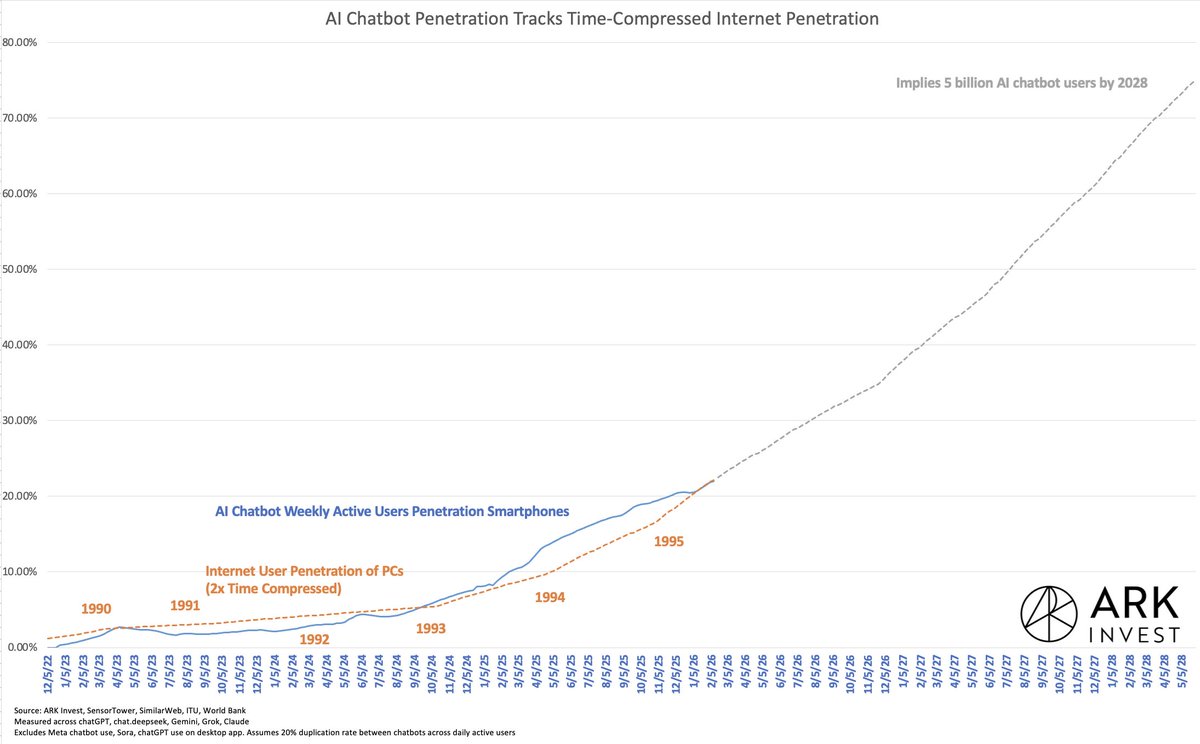
AI penetration of smartphone users roughly equivalent to January 1996 internet penetration of PC users with diffusion happening 2x faster.
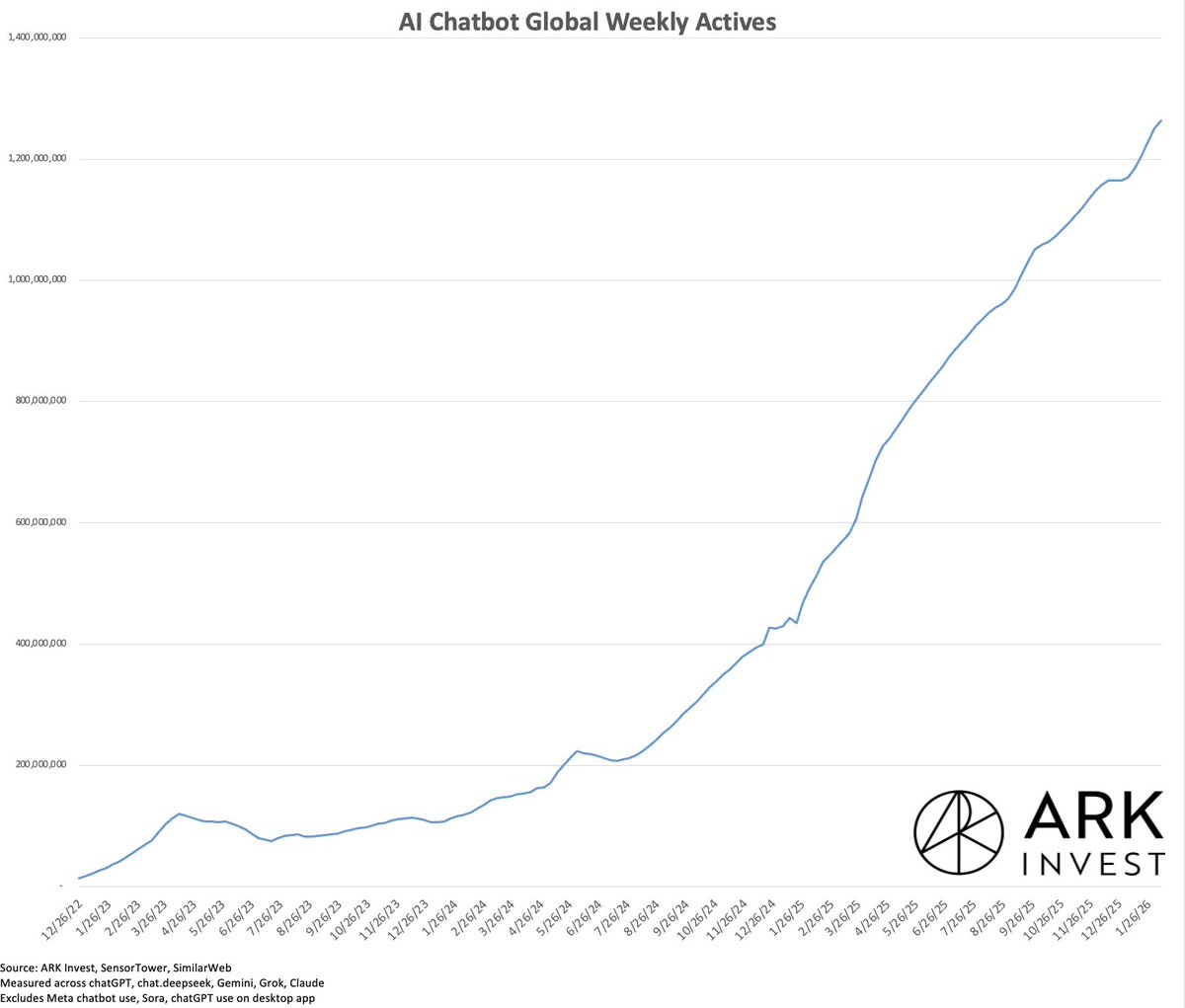
1.25 billion AI users (up 2.5x year over year), but they're not using it very much, an hour per week (up 1.6x year over year). In '96 internet users were doing a half hour per week.
Internet users got to 75% penetrated by 2000.
Implies 5 billion AI users by 2028.
Internet time use increased 7-fold by 2000 to a half hour per day.
On its compressed adoption time-scale if AI follows the same engagement trend it implies AI use will scale from ~60 billion annualized hours today to 1.3 trillion by late '28.
For context Youtube currently does 1 trillion hours.
Still very early days for AI, the consumer, and indirect monetization.
I’ve long imagined the Consumer AI landscape as a swarm of millions—eventually billions—of agents: some directly managed by individuals, others ambient and autonomous.
These agents would dynamically form and dissolve subnetworks to achieve specific goals, intermingling with humans to create a hybrid society of people and agents.
What I didn’t anticipate was seeing an early manifestation of such a semi-autonomous agent society emerge so quickly—through @openclaw in @moltbook.
An intriguing and inspiring journey lies ahead for Consumer AI.
In Consumer AI, the real outcome isn’t incremental growth, but a structural reset: new consumer flows, new distribution, and a reallocation of value away from incumbents.
After looking top-down for the shift from "Attention Economy" towards "Intent Economy", here goes bottom-up - starting from what AI newly enables, the behaviors it unlocks, and the second-order effects that define the next consumer platform cycle.
Key takeaways:
- “YouTube-ification of everything”: AI collapses the cost of creation (media → software → even scientific researches), and the durable change isn’t better outputs. It’s new behaviors at scale.
- From interface-heavy to intent-driven: the request/response UX loop weakens; users start approving the delivery for her 'intent'.
- Market structure rewrites: app bundles unbundle—expect consolidation into headless suppliers on one end and an explosion of micro-capabilities on the other, with a new “intent router” layer capturing distribution.
If you’re building in Consumer AI: the power laws likely accrue to intent orchestration, trust/permission infrastructure, and workflow-native distribution—not another standalone app with better functionalities and/or UX.
Read the full post 👉 https://t.co/338oBs55lQ
The most important shift in Consumer AI isn’t model quality—it’s where intent is captured and executed.
We’re moving from the Attention Economy to the Intent Economy.
For 20+ years, the internet monetized attention: traffic, clicks, funnels, attribution. Because true intent was hard to observe, platforms optimized proxies—SEO, ads, performance marketing, affiliate layers.
AI changes that. Users now express intent directly:
“Help me decide”, “Plan this”, “Do this for me”
As AI assistants become the endpoint—not just the starting point—traffic no longer flows through Google → SEO → ads → destination sites. When traffic reroutes, revenue reroutes.
This shift is already visible:
AI assistants are moving from search to summary
Purchase journeys are moving from search & browse to intent & recommendation
Agents can already execute end-to-end transactions for commerce and services
At a technical level, this means search → browse → checkout is being replaced by task → recommendations → selection.
When that happens, monetization shifts upstream—to whoever owns intent interpretation and execution. That puts a meaningful portion of today’s internet revenue pools at risk, including ~$130B of Google revenue and ~$55B of Amazon search ads.
The AI Super App race is really a race to own the concierge layer—the system that understands user intent, orchestrates agents, and delivers outcomes. History suggests that once this layer consolidates, value concentrates quickly.
This is not a niche opportunity. It’s a structural reallocation at internet scale—a credible $1T outcome.
Full analysis here 👇
https://t.co/Of6brYEQVq
More analysis on the ByteDance AI assistant vs. WeChat API / mini-program access conflict:
https://t.co/WjVbF1khc5
The final section lays out the real dynamics: WeChat’s platform power vs. challengers like ByteDance, Xiaomi, and https://t.co/3EjmcyUmG9.
For now, platforms hold the upper hand—especially given Chinese regulators’ preference for preserving the status quo.
Contrast this with the US/EU, where regulators tend to favor consumer choice and interoperability. That path often leads to the API access, albeit limited, as we saw in the Epic Games vs. Apple cast.
No verdict yet. These interface wars are just beginning—and likely to play out over the next 1–2 years.
Over the past week in China, we got a fascinating (and very telling) glimpse of where Consumer AI may be heading: an emerging “interface war” around AI assistants.
What happened (in days):
12/1 — ByteDance launched an Android phone with a built-in AI assistant capable of automating actions across mobile apps (think “computer use” on mobile, but enabled via API-level access to key apps on-device).
12/2–12/3 — WeChat and Taobao reportedly moved quickly to block API access.
12/6 — ByteDance appears to have conceded (for now), restricting cross-app API access.
[The Interface War Behind ByteDance's GUI Agent](https://t.co/CLBQchzKba)
What’s even more important: ByteDance isn’t alone. Similar assistants are being prepared by handset makers and AI players—Huawei (Xiaoyi), Xiaomi (Xiao AI), https://t.co/3EjmcyUmG9 (AutoGLM), and others.
*Why this matters*
This looks like the AI Assistant version of an incumbent war happening across layers—similar to the emerging “agent access for commerce” tensions we’re seeing among Amazon, Shopify, OpenAI/Perplexity, etc.
At its core, this is a battle for ownership of the consumer layer:
Mobile UX ownership (e.g., ByteDance vs. WeChat)
Commerce ownership (who “owns” discovery → intent → checkout)
*The fear: becoming “headless”*
If you lose the interface layer, you risk becoming a headless provider—a commoditized backend that fulfills requests while someone else owns the user relationship, the data, and ultimately the margin.
That’s why I was struck by two moments earlier on the US side:
(1) ChatGPT’s demos of direct product search + add-to-cart flows via function calling (which can push intermediaries toward “headless fulfillment”), and
(2) Apple’s mini-app / app-extension direction, which—depending on how it evolves—could give an assistant the power to feel like a “super-app layer” for the AI era.
*How would this end?*
I honestly don’t know. The incentives are existential for stakeholders:
ByteDance / https://t.co/3EjmcyUmG9 vs. Huawei / Xiaomi vs. WeChat / Taobao / Meituan.
A similar dynamic may play out in the US—starting with commerce and extending to assistants attempting to displace Siri and Alexa. Whether the US ever produces a WeChat-like “superapp” is still unclear—but the fight for the interface is clearly beginning.
Curious: In an agentic world, who do you think ultimately controls the consumer interface—OS players, super-apps, or the AI assistant layer?
#ConsumerAI #AIAgents #ChinaTech
Literally, Apple quietly announced something much bigger than it looks: the Mini Apps Partner Program.
While this X-eet already breaks down many first-order and second-order effects well, here are my quick takes through the lens of Consumer & AI. Still more questions than answers.
1. “AI Super Apps” are now officially legitimized
ChatGPT—with its recently announced Apps SDK—is the current frontrunner. But others will follow quickly: Perplexity, Claude, Alexa (if Amazon is truly serious), and more.
2. What happens to the other contenders?
Think: AI agent apps and AI-native browsers (Manus, Genspark…) and the new wave of AI browsers (Comet, Dia, Follou… not to mention ChatGPT Atlas).
They’re each playing a slightly different game, but ultimately chasing the same prize: a few coveted spots in the AI Super App race.
A core value proposition of “AI browsers” has been to route around platform constraints—like the App Store for iPhone. With Apple’s Mini Apps Program, the rationale for products like OpenAI’s Atlas becomes weaker, at least on mobile.
Yes, there remain important use cases—“computer-use” workflows, primarily for backward compatibility of existing web/apps, and certain agent behaviors that don’t fit neatly into Mini Apps—but the relative value narrows.
3. A flood of Mini Apps is coming—then things may get messy
Expect an early-days-App-Store moment (remember the Fart app?), followed by a crowded, chaotic market.
Much will depend on the policies of the “container” apps competing to become the dominant AI Super Apps.
China’s mobile ecosystem consolidated into tightly controlled walled gardens (WeChat, Alipay, Meituan, to name a few). Their mini-app ecosystems are curated with firm control over who gets in, how apps behave, and what gets prioritized—very different from the freer markets of the App Store or Google Play.
Apple’s (and likely Google’s upcoming soon) Mini Apps framework seems headed toward a more open, App-Store-like approach. Which leads to…
4. A surge in “developers” and “apps”—but not in the way we’d imagine
Several forces will make this ecosystem unfold differently from any past platform shift:
Vibe-coding tools enabling effortless, social creation (think: Wabi-style social sharing of AI apps).
Claude Code and similar systems solving tasks end-to-end with autonomous agents.
A massive library of user-generated prompts—from GPTs, Claude Skills, and AI browser skills—suddenly becoming “Mini Apps” themselves.
The result: a period of creative chaos before a new equilibrium emerges.
Until then, I may have to keep thinking about the second-order effects… and the ones beyond that.
Apple JUST quietly announced something that’s a lot BIGGER than it looks: "the Mini Apps Partner Program"
Apple is admitting that the future of software is embedded, lightweight, vertical mini-apps distributed inside bigger app
For founders who want to make $$ building apps:
1. Apple just legitimized the “superapp” model for the West.
China has WeChat mini-programs. India has PhonePe Switch. The West has… nothing. Apple just opened the door. You can now run HTML/JS mini-apps inside a native host and earn 85% on qualifying purchases. That’s Apple-sanctioned platform piggybacking.
2. Distribution arbitrage becomes real again.
You don’t need to convince users to download your app. Just partner with a host app and drop in a mini-app. This is a cheat code for early traction. Think: travel apps hosting niche tools, fitness apps hosting mini workouts, marketplaces hosting micro-utilities.
3. Apple is creating a new economy layer: “embedded SaaS.”
Imagine: CRM mini-apps inside vertical tools. Math solver mini-apps inside education apps. Calendar mini-apps inside productivity apps. The TAM for tools that don’t need standalone installs just went vertical.
4. Developers get an 85% revenue share.
This is Apple basically saying: “We want this ecosystem to grow, and we’re willing to cut our take rate.” When Apple lowers its cut, I pay attention because they see a platform shift coming.
5. AI makes this 10× more important.
LLM-powered micro-apps (calculators, planners, agents, coaches, niche utilities) are tiny by design. They’re perfect mini-apps. Apple just created infrastructure for AI-native micro utilities to live inside bigger apps with built-in commerce.
6. Host apps become new “distribution landlords.”
If you own an app with traffic, you become a platform. You can host mini-apps, take a cut, and build a developer ecosystem around you.
It’s a new monetization model for existing apps with audiences.
7. This unlocks a wave of second-order opportunities.
- Agencies helping apps become mini-app hosts
- Mini-app dev shops
- “Shopify for mini-apps” toolkits
- Mini-app marketplaces
- Analytics for mini-app performance
- Discovery engines for mini-apps
- I'll be dropping mini app ideas on @ideabrowser and @startupideaspod
TLDR;
Apple just turned every high-traffic app into a potential superapp and every indie developer into a potential platform partner.
The App Store is becoming modular, composable, and layered. The next decade of consumer apps will look less like standalone products and more like ecosystems stitched together with mini-apps.
This is quietly one of the biggest distribution unlocks in years.
My view on this claim is “Yes and No”, but largely “No”, as below.
(My argument below is largely biased towards the Consumer side of the value prop, rather than the enterprise-focused high-efficiency tooling with AI features/functionalities/tech applied.)
For something that can be called ‘AI apps’
If we define ‘AI app’ as feature-based functionalities, I agree to this argument since those functionalities will be offered by the FM and other infra layer providers (even including AWS soon). This applies exactly to what we used to call ‘GPT wrappers’ in a dismissive sense.
However, if we look further into the dominant apps/services on web & mobile in the past few decades, many (in fact, most) of them have their moat, not in their functionalities, but in other defensible elements.
A few key moats that come up to my mind include: social graph (Facebook), behavioral lock-in (through recommendation engine) (Tik Tok, Toutiao), behavioral lock-in (through social graph) (Snapchat), network effect (esp. the supply graph) (Uber, Airbnb), product listing & logistics (or, SPC as Josh repeatedly claims) (most e-commerce). All of these moats live outside of the pertinent domain FMs can handle and functionalities FMs can add.
Of course, the FM providers can tackle some of these elements to corner a few key markets (e.g. shopping checkout inside ChatGPT). But, practically speaking, there are way more markets/verticals/segments than any one FM providers can address and dominate in many of them, if not most, (even if OpenAI reach $3T market cap in next 10 years).
It is not a matter of having enough resources or not, but a matter of focusing, identifying, and building lasting moats & defensibility, which I believe is why there have been so vast opportunities for so many upstarts since the dawn of Capitalism.
For something further than ‘apps’ (”Scenario 2”)
Furthermore, if we consider the latest tweet on Elon Musk saying “no app, no OS, all personalized content generated on demand in real-time” which I strongly agree to, it is possible that there would be less and less of something we may call ‘AI apps’. My futuristic projection is that we more likely would live in some ‘ambient environment’ where my needs are taken care of in background (by ‘ambient agents’).
In this type of environment, there will not be many distinctive apps, each focusing on many disparate functions (e.g. app for each category of email, calendar, messenger, shopping, hotel booking …), but might be a few “AI Concierge”, fully personalized to me, which can handle most of my needs (explicit or implied/inferred) and requests (explicit).
In this setting, there will not be many investment opportunities in “AI apps” segment, not because “FM providers will dwarf emerging AI apps”, but because “there will not be much needs for separate AI apps” other than “AI Concierge”.
Instead, there may be a number of ‘headless’ provider of each functions (e.g. hotel booking, grocery delivery). (As demo’ed in GPT-4 for Instacart and ‘Apps SDK’ of OpenAI more recently, the trend is that more and more of these functions would be integrated with something like ChatGPT, meaning there will be less needs for the consumer-facing UX (i.e. ‘headless’), but the needs for those functionalities (i.e. product delivery, airline booking) will remain as invisible functions behind ChatGPT or “AI Concierge”)
In this futuristic imaginative setting, some entirely new entity (e.g. “personalization data layer” or something similar, e.g. “personalized social layer”) might prevail as primary (possibly, the only) touch point for consumers, rather than many disparate ‘AI apps” just like what we see on our iPhone screens. (Imagine Siri handling 90% of my personal needs, e.g. shopping, hotel booking)
Even in this case, I don���t think OpenAI can dominate in these “layers”. If I have to, I’d rather bet on Apple than OpenAI (largely due to the personal data owned by them), though I believe there more likely will emerge new entities taking care of these layers, than OpenAI dominating these layers too.
I am not 100% sure whether/how this “Scenario 2” may unfold down the road, but my thesis is that “Scenario 2” would be more likely than having 1,000’s of disparate ‘AI apps’ (as we have experienced in the Mobile Age). This thought has led me to my thesis that “’the Next Google’ more likely would emerge in the ‘personalization layer’, at least in the Consumer + AI space”.
My AI investment thesis is that every AI application startup is likely to be crushed by rapid expansion of the foundational model providers.
App functionality will be added to the foundational models' offerings, because the big players aren't slow incumbents (it is wrong to apply the analogy of "fast startup, slow incumbent" here), they are just big. Far more so than with any other prior new technology, there is a massive and fast-moving wave that obsoletes every new app almost as fast as it can be invented. There is almost no time to build a company and scale it.
There are two ways AI application startup founders can make money:
- Make a flash-in-the-pan app that generates a ton of cash and bank the cash (my estimate is that you have about 12-18 months cashflow generation)
- Make a good enough app that you get acquired by one of the big players for sufficient equity
The situation is highly unstable - we don't know if it's going to crash or go to the moon but both scenarios make it very unlikely that any AI application startup will independently become a generational supercompany (baseline odds are low to begin with).
The best odds are finding an application niche in a highly specialized field with extremely unique and specific data barriers, ideally ones relating to real atoms (hardware or world-related) data and not software/finance.