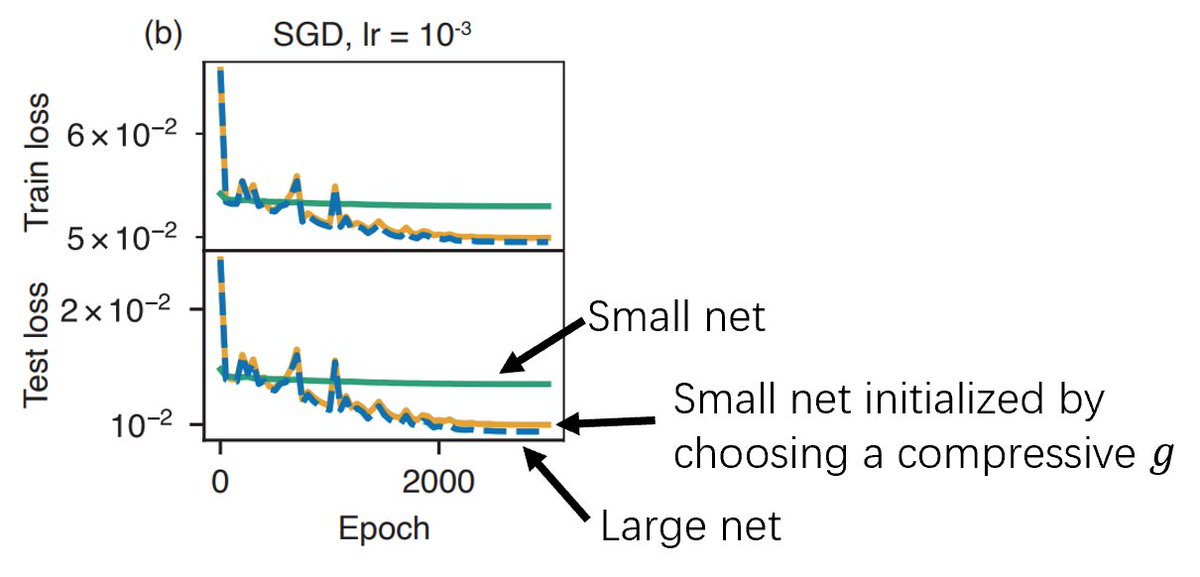
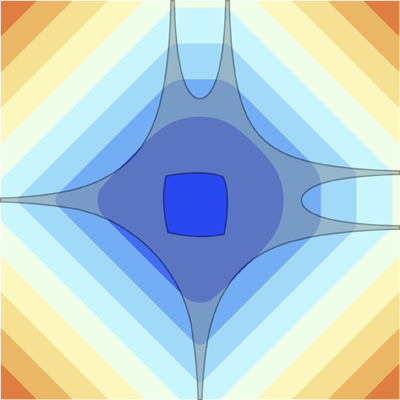
What determines the compressibility of a neural network? In our most recent work, we showed that (sufficiently smooth) deep MLPs can be compressed to a size that depends only on the input data dimension and, surprisingly, is independent of the model's width.
https://t.co/FLYgXbYLtS
7/7 Asymptotically, power-law scaling can be boosted all the way to stretched-exponential. Anywhere a permutation symmetry hides, compression follows. We also demo it on transformers.
💻 Code: https://t.co/CUHRrZsGG9
w/ Di Luo, Tomaso Poggio, Isaac Chuang, @LiuZiyin10 Ziyin
1/7 🧵 Can we make neural networks and datasets radically smaller without losing anything?
Our new ICLR 2026 paper says yes — provably. d variables can be losslessly compressed to O(polylog d), and this is optimal.
📄 Paper: https://t.co/1dbP2IY0zz
Excited to share our theory on the universal compressibility of neural nets (led by @HYWangphy)! This leads to a new dynamical lottery ticket hypothesis and implications for improving neural scaling laws. https://t.co/jpBwIyitlb
Check out our ICLR poster!
A new formulation of non-Hermitian band theory is applicable to any number of spatial dimensions, a development useful for the study of physical effects exclusive to open systems.
Read https://t.co/my7BHViyay
#openaccedd#PRXjustpublished#PRXcondmatt