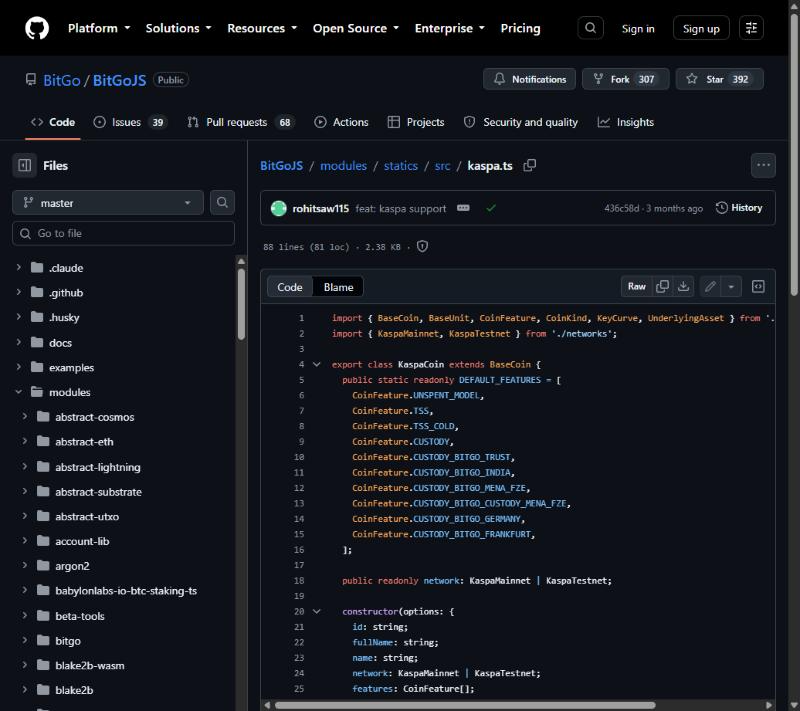
🚨BitGo quietly built $KAS custody.
TSS + TSS_COLD signing, and seven custody flags: BitGo Trust, India, MENA FZE, Germany, Frankfurt.
Registered as a production coin in BitGo's own statics. Commit message: "feat: kaspa support."
Marketing gets announced. Plumbing gets shipped
BREAKING: Monthly stablecoin card spending volumes surged another +16% in July, to a record $1.03 billion.
This marks +200% year-over-year volume growth with over 10 million purchases made during July.
The growth has comes amid surging demand for instant settlement and global access, which stablecoin cards provide.
Jupiter, the world's largest onchain platform has also driven adoption through localized integrations, like QR-based payments and accessibility across 60+ countries, with 68% of volume coming from non-US users.
To put this into perspective, just 3 years ago, monthly crypto payment card volume was at just $1 million.
We expect to see $1.5+ billion in monthly volume by year-end.
@buddythedog2020 If any Kaspan’s live in Denver and would like the best emergency department/urgent care alternative which is direct pay, feel free to check us out at https://t.co/AP4xCvvDng
Or text/call (970) 800-2515 or visit us at 2515 Eliot St. Denver, CO 80211. 10% discount for Kaspa. 🫡
Zero-day exploits are going to become normal. For most of computing history, discovering a serious vulnerability required scarce human expertise, time and persistence. AI is destroying that scarcity. Frontier models can already read enormous codebases, reason across functions, compare historical patches, identify previously unknown vulnerabilities and increasingly construct working exploit chains. Anthropic has found vulnerabilities in software that had already endured years of conventional fuzzing. Google has now observed a threat actor using what it believes was an AI-developed zero-day. The important shift is economic: vulnerability discovery is becoming industrialized.
Soon the attacker isn't one researcher staring at code. It's thousands of autonomous agents continuously probing every implementation, dependency, bridge, API, sequencer, validator client and administrative surface simultaneously. That makes architecture matter enormously. Proof-of-work does not make software immune to exploits. Kaspa's node software can have bugs like any other software. What PoW does is anchor the fundamental problem of controlling consensus to something intelligence alone cannot manufacture: physical computation and energy. You can know every rule of the network. You can have an AI smarter than every developer who wrote it. That knowledge does not magically produce hashpower.
This is why Kaspa becomes increasingly interesting in an AI-dominated world. Kaspa retains permissionless PoW while using GHOSTDAG to order parallel blocks, allowing the network to operate at 10 blocks per second without abandoning Nakamoto-style resource-based consensus. AI makes intelligence abundant. That means systems increasingly dependent on credentials, privileged operators, governance layers and complex trusted infrastructure face an expanding machine-speed attack surface. Kaspa moves in the opposite direction: transparent rules, permissionless participation, decentralized proof-of-work and a consensus mechanism ultimately grounded in an external physical cost. In the age of superhuman intelligence, one of the strongest security primitives may be something intelligence cannot simply think its way around: work.
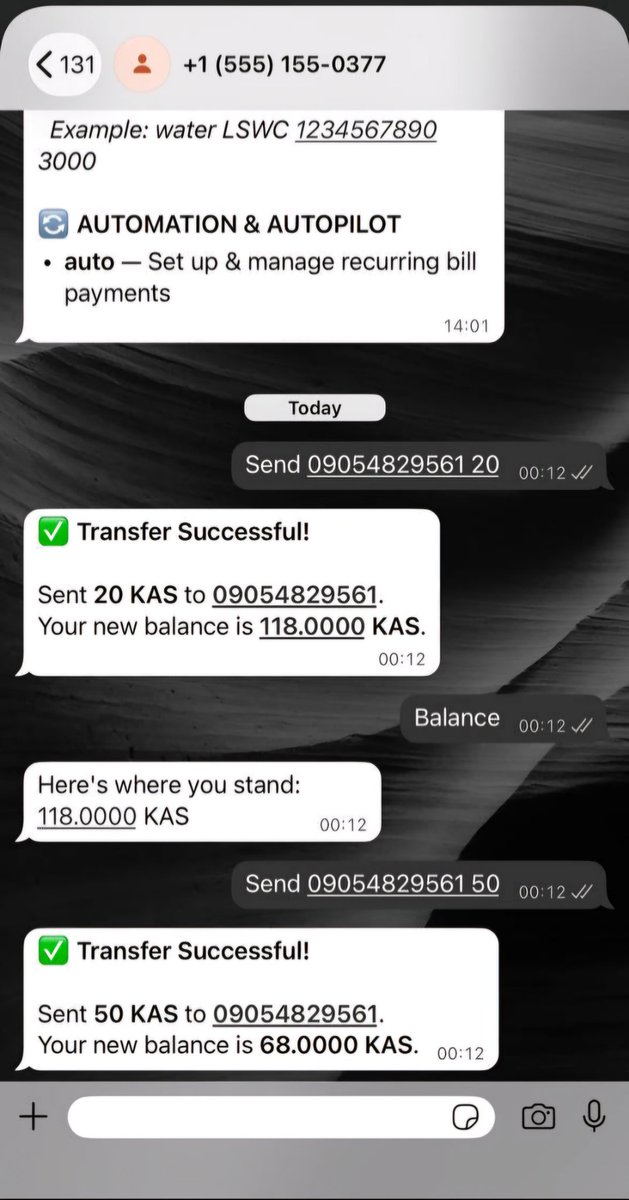
Crypto payments should be as easy as sending a WhatsApp message.
That's exactly what we're building with Kasapp!
Kasapp brings Kaspa's 1-second BlockDAG directly into WhatsApp, making crypto payments and everyday digital services accessible to millions across Nigeria and, eventually, Africa. 🇳🇬⚡
With Kasapp, you'll be able to:
📲 Buy airtime & mobile data (MTN, Airtel, Glo & 9mobile)
⚡ Pay electricity bills and receive meter tokens instantly
📺 Renew DSTV, GOtv & Startimes subscriptions
💸 Send and receive KAS instantly using a phone number or any Kaspa wallet
🚀 Experience real-world blockchain utility without complicated wallets or long onboarding processes
Our goal is simple:
Make crypto useful for everyday payments, not just trading.
We've also opened a discussion thread in the official Kaspa Discord to gather ideas, suggestions, and community feedback as we continue building.
Join the conversation here:
https://t.co/01qkVgRIOx
If you're passionate about Kaspa, BlockDAG, crypto payments, financial inclusion, Web3, or African fintech, we'd love to hear your thoughts.
Early access is coming soon. 🚀
#Kaspa #KAS #Kasapp #BlockDAG #CryptoPayments #WhatsApp #Web3 #Fintech #Africa #Nigeria #FinancialInclusion #DigitalPayments #CryptoAdoption #PeerToPeer #Blockchain #BuildInPublic
Tokenized cows just backed a farm loan on Brazil's stock exchange
Ten dairy cows in Paraná became the first tokenized livestock collateral on B3, Brazil's stock exchange, backing a loan worth about $19,400. Each cow carries a digital ID generated from AI sensor collars tracking its health in real time.
Banks usually cut up to 60% off livestock collateral because they can't verify an animal is even alive. Live monitoring removes that discount just as Brazil's farm bankruptcies have nearly quadrupled since 2023.
Cowmed already monitors 100,000 cows worth around $395M and projects a fifth could be pledged within two years, stretching RWA tokenization from T-bills into working farm animals.
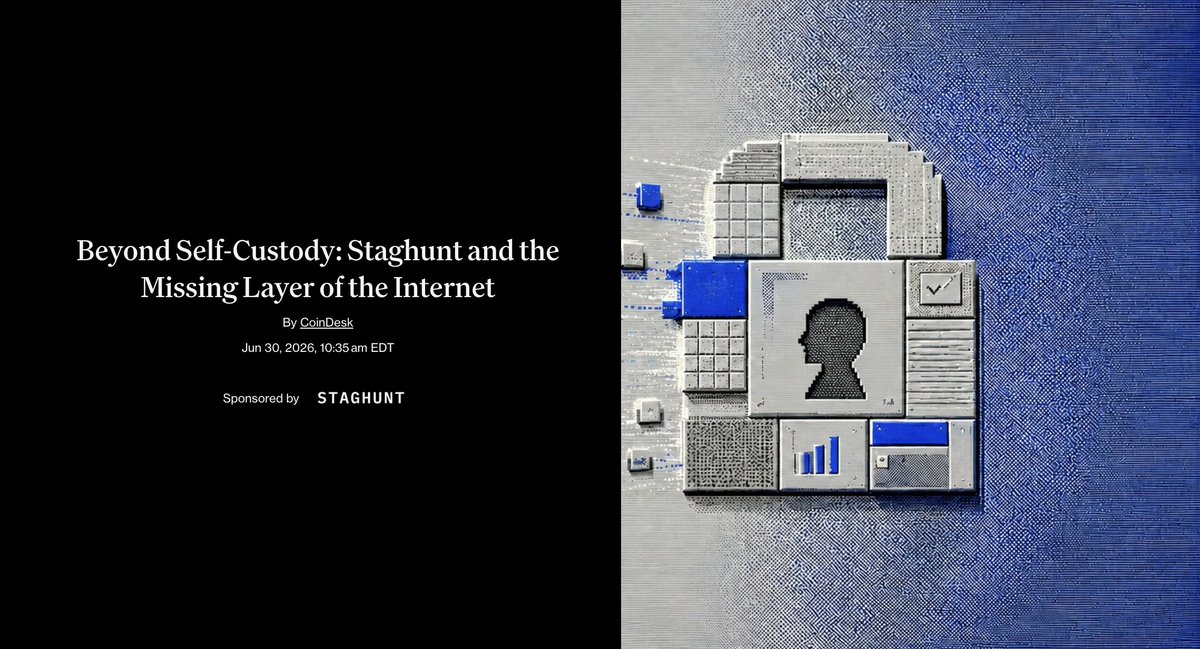
Crypto gave individuals sovereignty. Staghunt is betting the next frontier is the group version: coordination markets.
Read more at our latest thought leadership in partnership with @hashdag
https://t.co/VJQ15N0ka0
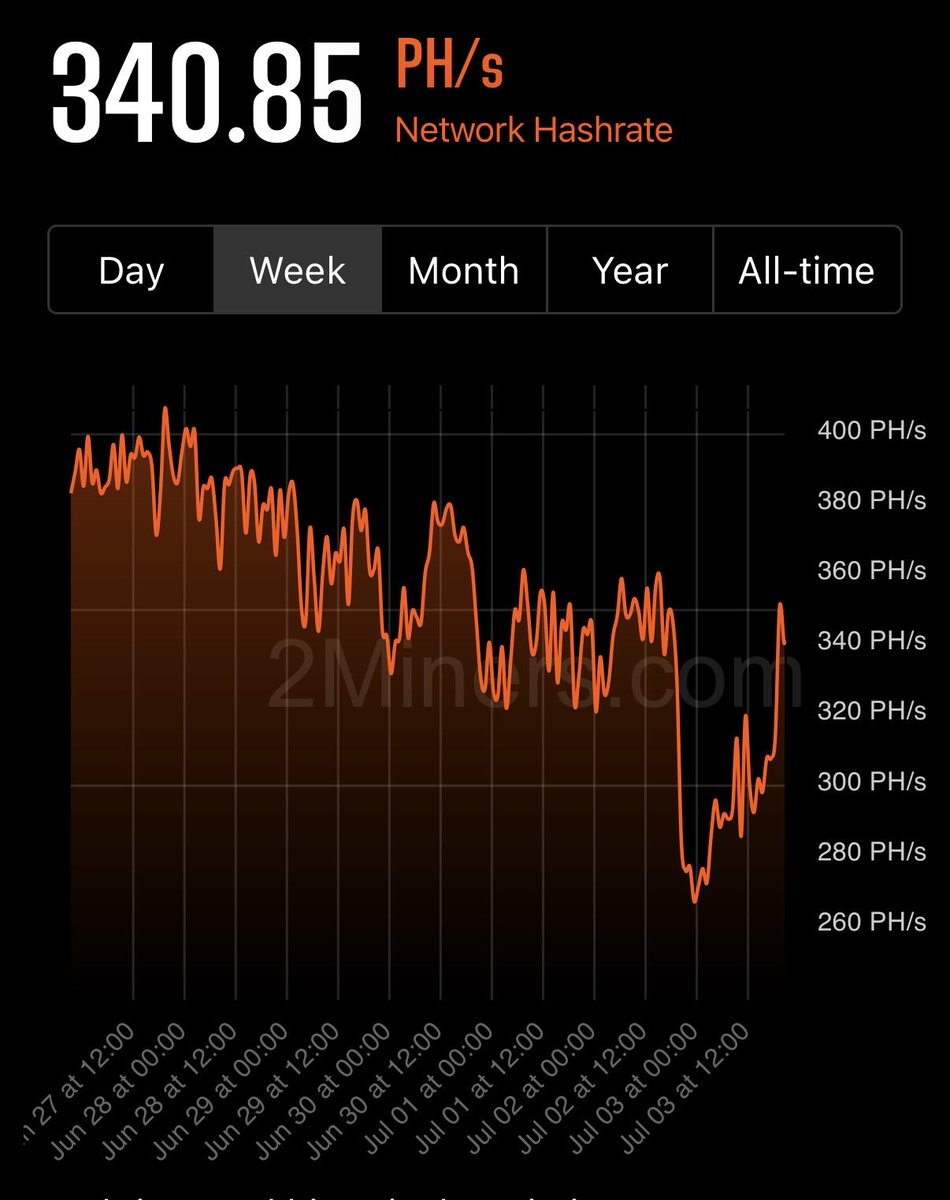
Kaspa network hashrate took a sharp dip this week before snapping back. It slid from around 400 PH/s early in the window down to a low near 270, then recovered hard to 340.85 PH/s currently, most of the drop retraced in a day or so.
The dip lines up with Humpool winding down, with miners switching their operations to other pools.
Kasmart has now set up a full integration with eBay! Any eBay sell can now sync their entire ebay store to Kasmart and begin to accept #Kaspa as a payment option!
It's time to grow our ecosystem to the main stream!
The coordination and effort required to synchronize a complex upgrade across a truly decentralized network are a real challenge, and success is never a given. A good moment for a toast to all non-trivial life accomplishments
AI can now operate on Kaspa as an economic actor, not as an on-chain brain. The model does not need to live inside consensus. That would be wasteful. The intelligence runs at the edge, Kaspa settles the consequences.
Agents can hold and spend KAS, manage covenant-controlled wallets, enter enforceable contracts, post and fulfill bounties, submit lane-based operations, pay for compute, verify work, and settle proofs back to L1. The computation happens off-chain, but the value transfer, ordering, state enforcement, and proof settlement anchor into proof-of-work.
That is the real unlock. Kaspa gives autonomous software a monetary substrate that does not require banks, payment processors, stablecoin issuers, or centralized rails. AI does the work elsewhere. Kaspa makes the work economically final.
Stock market leverage in Asia is beginning to crack:
Stock trade defaults reported by securities firms in Taiwan rose to $62 million so far in June, the highest monthly total since data began in 2019.
A stock trade default occurs when investors who bought shares on margin fail to pay for those purchases, or when sellers fail to deliver the shares required to settle the trade.
Trade defaults have soared +300% over the last 2 months and now exceed the 2021 record by ~20%.
This comes as margin purchases have surged +160% over the last 12 months, to $19 billion, close to the all-time high set just before the 2000 Dot-Com crash.
By comparison, margin debt has risen +94% in South Korea over the same period compared to +50% in the final 12 months of the Dot-Com bubble.
Market leverage is out of control.
📢 RENT CARS WITH KASPA 🚗💨
You can now book car rentals from 1,700+ top suppliers with $KAS payments @kaspaunchained
📍 50,000+ pickup locations worldwide
Kaspa accepted here
BOOK NOW: https://t.co/bUoqkZZa7T
OpenAI is not investing in Kaspa.
OpenAI has announced its support for the Rust ecosystem with a $600,000 commitment to the Rust Foundation.
The point is that major technology companies are beginning to bet on the same technological foundation that Kaspa chose years ago. ⚡️#KAS
The Architectural Edge: Why Kaspa Outpaces Ethereum for DEX Infrastructure
Building a Decentralized Exchange (DEX) on a traditional single-chain blockchain like Ethereum is like trying to run a high-frequency trading firm on a narrow, one-lane highway. While Ethereum pioneered automated market makers (AMMs), its sequential design forces every transaction to wait in a single queue.
Kaspa’s BlockDAG architecture—complemented by the Toccata hard fork—rebuilds the Layer 1 foundation to handle the intensive demands of decentralized trading natively. Kaspa offers several architectural advantages that make it a superior backbone for a modern DEX compared to Ethereum.
Parallel Processing vs. Sequential Bottlenecks
Ethereum processes transactions sequentially. One block is added at a time, roughly every 12 seconds. When thousands of traders rush to swap assets during market volatility, the network bottlenecks, causing a massive surge in gas fees.
Kaspa replaces the single blockchain with a Directed Acyclic Graph (**BlockDAG**). Using the GHOSTDAG protocol, the network processes multiple blocks **in parallel** simultaneously (~10 blocks per second on mainnet). For a DEX, this means transactions don’t get jammed in a single queue; trades are woven together concurrently without degrading network performance.
Structural Defense Against Predatory MEV
Because Ethereum relies on a public mempool where a single block producer dictates the exact sequential order of transactions every 12 seconds, **Maximal Extractable Value (MEV)** bots thrive. They spot a pending trade and "sandwich" the user—buying right before them and selling right after—forcing the trader to execute at a worse price.
Kaspa's Advantage: Real-time decentralization dismantles the mechanics of MEV bots. With Kaspa producing blocks at a rapid-fire pace, there is no single consensus leader holding a monopoly over transaction ordering for long intervals. Rapid parallel block creation and real-time sequencing make it virtually impossible for bots to accurately predict the state and insert predatory sandwich attacks. Traders get the exact execution price they expect.
Sub-Second Latency (CEX Speed, DEX Security)
Waiting 12 seconds for a block—and minutes for true finality—is a lifetime in live trading. While Layer 2 rollups speed up execution, they fragment liquidity, introduce bridge vulnerabilities, and complicate the user experience.
Driven by the Rusty Kaspa engine, the network features sub-second block times. After just 10 seconds, a trade has accumulated roughly 10 layers of confirmation deep within the DAG structure. A DEX on Kaspa delivers the instant, responsive user experience of a Centralized Exchange (CEX) while settling entirely on an ultra-secure, decentralized Layer 1.
.
Predictable, Sub-Cent Transaction Fees
High traffic turns Ethereum into a playground for whales, where a simple token swap can easily cost $20 to $100+ in gas fees.
Because Kaspa scales horizontally at the base layer rather than relying on vertical scaling, the throughput handles massive volume natively. Transaction fees remain consistently sub-cent (<$0.01), making micro-swaps and algorithmic high-frequency trading economically viable for retail users.