Our Housing affordability plan is highlighted here. Promoting our workers as experts in BC Real Estate. To work cooperatively with policy experts in gov't. Together creative solutions can be found. #bcpoli#VanRE https://t.co/NUtYNaHegV
We've said this for over a decade, and we're seeing the final empirical defenestration of the YIMBY polemic against elasticity of demand: their claim that luxury supply will be picked up by local owners which will free up lower priced stock via "trickle down" demand.
📢 HAPPENING NOW
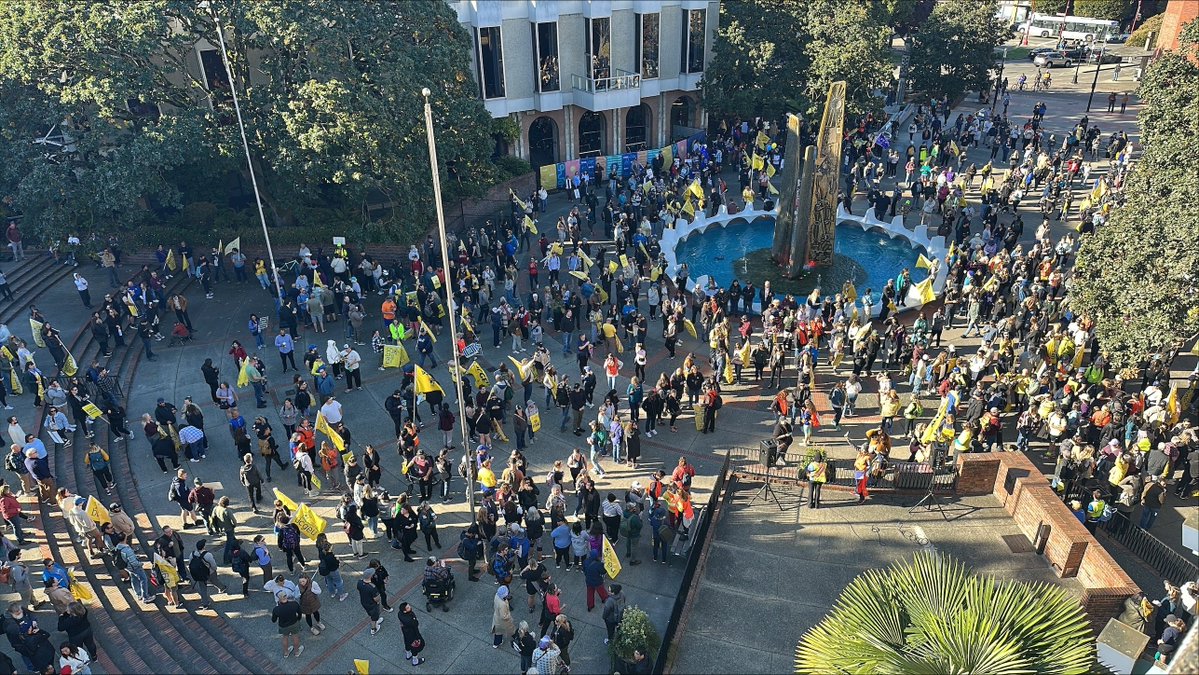
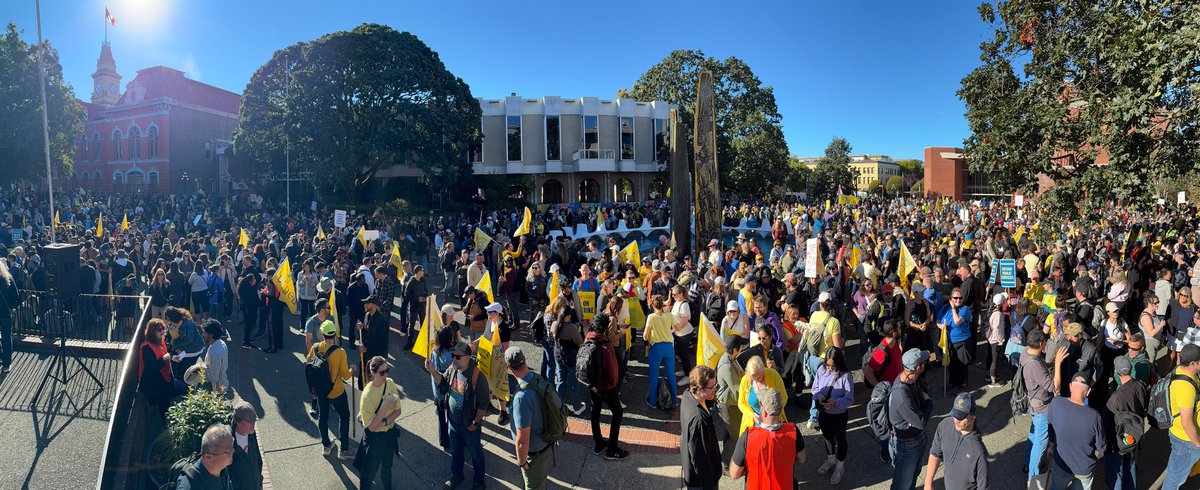
The march is starting in Victoria!
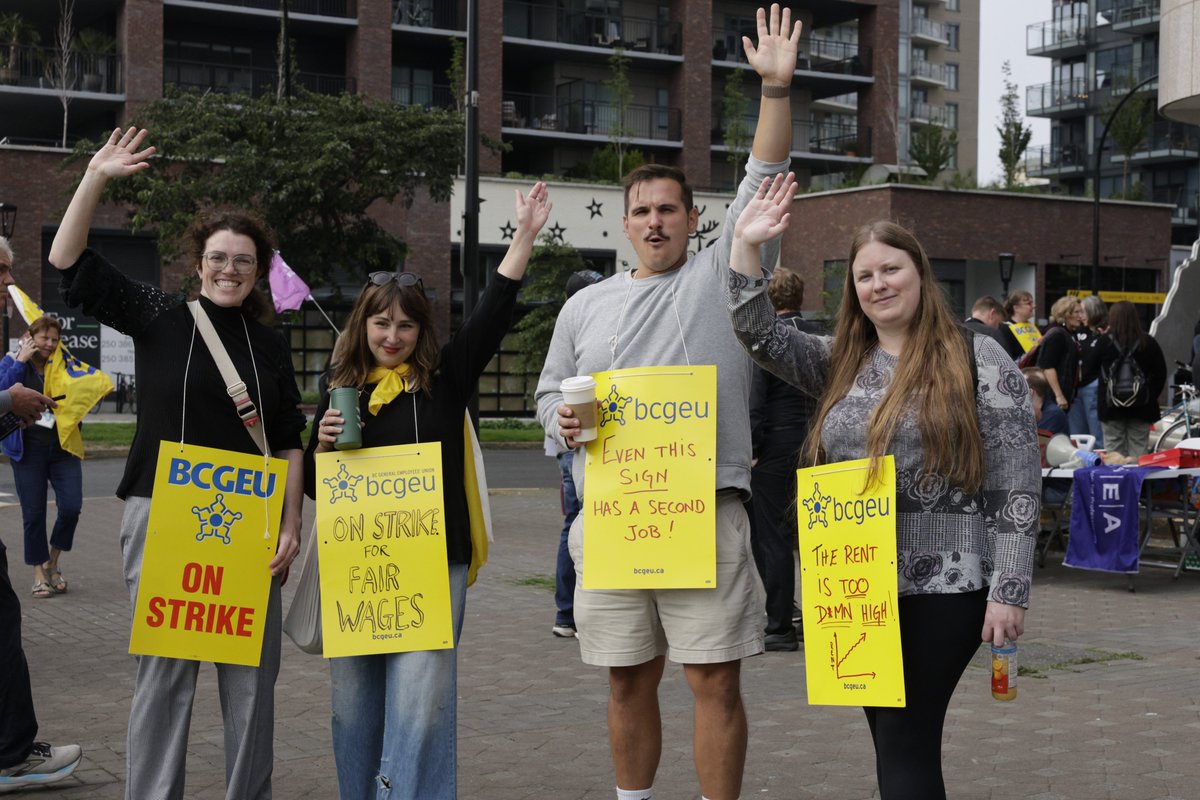
Thousands of public service workers and supporters are on the move with one clear message to government: Fund the Frontlines.
📅March kicks off at 11 AM from Centennial Square.
📍Rally begins at 12 PM at the B.C. Legislature.
☀️Morale is high — show your support by tagging @bcgeu and sharing your photos + videos from the march!
📽️ 4 weeks on strike.
⏱️ Thousands of hours on the line.
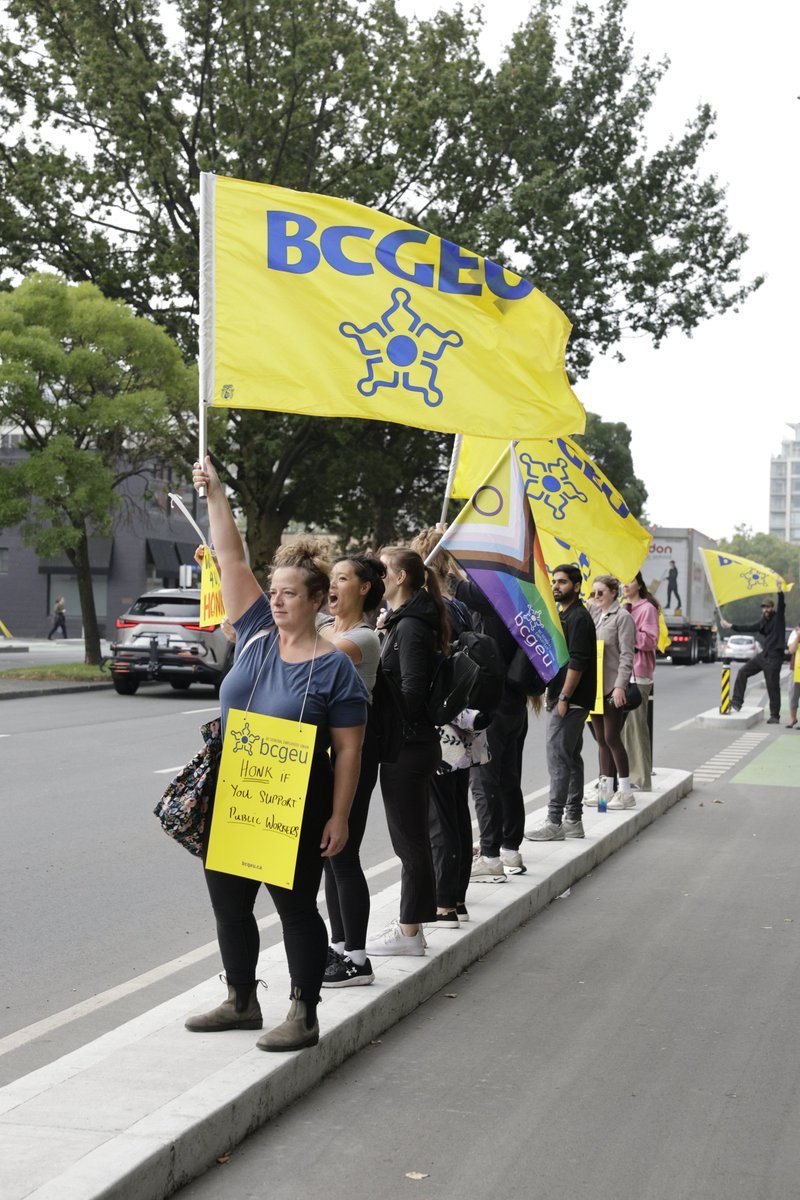
🟨 Countless yellow flags waving.
📣 Endless honks of support.
🤝 Workers + communities united across B.C.
Morale is high. We have the power and we’re not backing down until gov delivers a fair deal.
👉 Watch + add your voice: https://t.co/pmoQciFWVN
When people ask why @bcgeu civil servants are striking for fair wages, its worth noting the Tim Hortons manager in Courtnay, BC makes a higher wage than 2/5 of the civil service.
We need to lift everyone up to be able to afford to live in our communities.
Disappointing to seeing misinformation floating around in media peripheral to our strike. Heres the truth:
1. The gov does NOT have a deal with 64k healthcare workers. There are no deals agreed to
2. Public Service workers got LESS than inflation last round. Ratified at 53%.
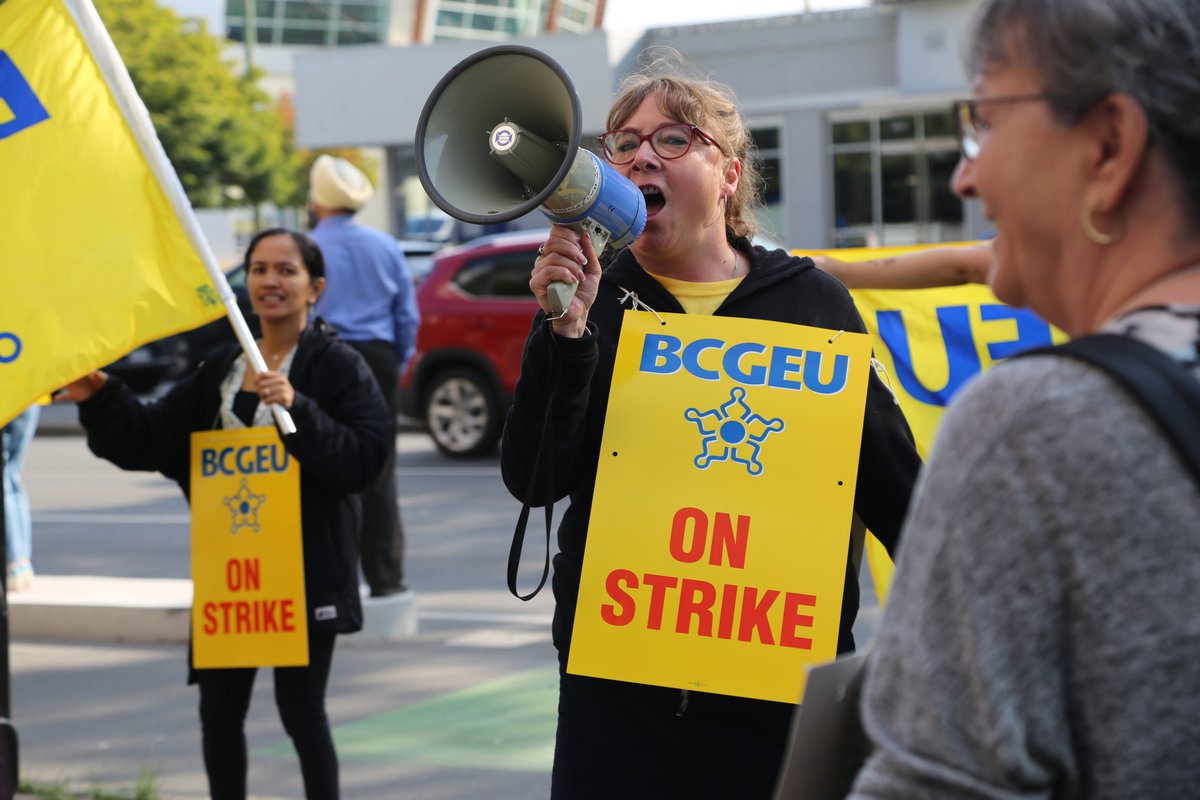
Today, public service workers across B.C. took to the picket lines to demand a fair deal.
From Prince George to Surrey to Victoria, 2,627 workers in key ministries walked off the job — making it clear that government’s low wage offer is not good enough. These workers keep B.C.’s economy moving by reviewing projects, permits, and environmental assessments. When they stop, projects stall and communities wait.
This action is backed by an overwhelming 92.7% strike vote mandate. Members are united and ready to fight for wages that reflect the rising cost of living.
📍 Strike locations:
• Prince George: 1011 4th Ave
• Surrey: 10470 152 Street
• Victoria: 3350 Douglas, 4000 Seymour, 1802 Douglas, 1810 Blanshard, 836 Yates, 675 Belleville.
✊🏽 Join the picket line. Bring your solidarity and your support.
💬 Share this post to spread the word.
Together, we’ll keep pressure on government!
BCGEU members working for the BC Public Service have voted 92.7% in overwhelming favour of taking job action and will issue 72-hour strike notice this afternoon. Job action could begin as early as Tuesday morning. For media inquiries, email [email protected]. https://t.co/EN2jS03Apk
Everything is cheaper when you don’t care about how workers are treated, wages that are paid, families that are fed, the environment, safety standards, the quality of work, human rights, whether money stays in our economy, or the national interests of your country. But the true cost always shows up.
Probably the greatest misconception about finance is the idea that it’s all about maths and numbers, rather than about contracts, power and politics
For example, I often come across people who talk about the ‘mathematical impossibility’ of paying back the interest on all debt. Who cares: it’s a human system that breaks all the time, and for thousands of years the ‘mathematics’ of it get overridden. Debt is a political tool that you can choose to resist or choose to weaponise. It’s not a mathematical object
At most, the numbers and maths are proxies for underlying emotions and power relations that both transcend and precede human numbers systems. They’ve been with us far before we started writing out abstract equations
what is hilarious about @Anthony__Koch vs @vancolour take on taxing land wealth is that theyre both right:
'free market' Smithian moral economy and Marxist crtiques of capital both developed from a common critique of the inefficienciss of aristocratic land wealth.
The Executive Summary:
Every election, we hear the same promises: more housing, more affordability. But for the next generation, homeownership is slipping further into fantasy.
I’ve been in the real estate business for over twenty years, and in that time, I’ve seen young homebuyers lose hope—and parents wonder why their children can’t afford what once seemed attainable. For decades, the benchmark for affordability was simple: a home should cost no more than four times a household’s income. Today, that number is closer to ten in Toronto and twelve in Vancouver—a level once considered unthinkable.
We’re told this is just “basic economics”—a supply problem easily fixed by building more homes. But this narrative oversimplifies the issue and masks a more fundamental transformation. Homes are not like widgets from a factory. They’re a basic human need and a financial asset that appreciates over time. When a good becomes both a necessity and a financial investment, the usual rules of supply and demand begin to break down.
Contrary to what many suggest, home prices in Canada didn’t explode because cities stopped building. In fact, many metropolitan areas have seen a steady pipeline of new housing. What’s changed is the role that housing plays in our financial system. We’ve moved from one economic reality to another—a full paradigm shift.
In the old housing paradigm, home prices were anchored by incomes. Households saved for a down payment, qualified for a mortgage based on what they earned, and bought homes to live in. That world was governed by an internal logic: prices couldn’t rise far beyond what people could reasonably afford.
But in the new paradigm, that anchor has been severed. Housing is no longer just about shelter—it’s a financial instrument. Prices are no longer constrained by income but driven by capital flows. Homes are bought not just by Canadian households but by investors—some domestic, some global—whose purchasing power is shaped not by salaries but by access to wealth, credit, and leverage.
This shift began in the 1990s when the federal government, grappling with a fiscal crisis, encouraged households to borrow against home equity to stimulate spending. What started as a strategy to support consumption and home renovations soon evolved into a means of financing the purchase of additional properties. Then came the 2008 financial crisis and, more recently, the COVID-19 pandemic—both marked by ultra-low interest rates. As yields on traditional investments dried up, real estate emerged as a safe and lucrative store of value.
Today, investors account for nearly one in three home purchases in Canada. As their presence has grown, so too has the disconnect between home prices and the real economy. A house is no longer just a place to live—it’s a wealth-generation tool, often wielded by those who already hold significant financial advantages.
This has created two serious challenges. First, it has pushed housing further out of reach for younger Canadians, many of whom no longer see a realistic path to ownership. Unlike earlier generations, they are not just up against peers with similar means—they are up against capital-rich investors whose buying power is unconstrained by income. Second, it has distorted the allocation of capital across the economy. Money that could be funding innovation, productivity, and job creation is instead being poured into the ownership of multiple properties.
Canada has built an economy where the best way to get rich isn’t to invent, create, or build anything—it’s to own houses and wait for prices to rise.
Recognizing this paradigm shift is the first step toward real reform. If we continue designing housing policy for a system that no longer exists, we’ll keep getting the same results: higher prices, deeper inequality, and a generation locked out.
If we want a resilient economy and a housing market in which the next generation has a real shot at owning a home, just as previous generations did, we must rethink what we reward. That means redirecting capital toward sectors that drive innovation, competitiveness, and good jobs instead of propping up a system that treats housing as a shortcut to easy wealth. 3/
NEW - @JM_Whiteside has introduced a bill to ban employer-mandated sick notes to take short-term sick leave. Says it will free up doctor time. This was a campaign promise from the BC NDP, and had been called on by doctors.
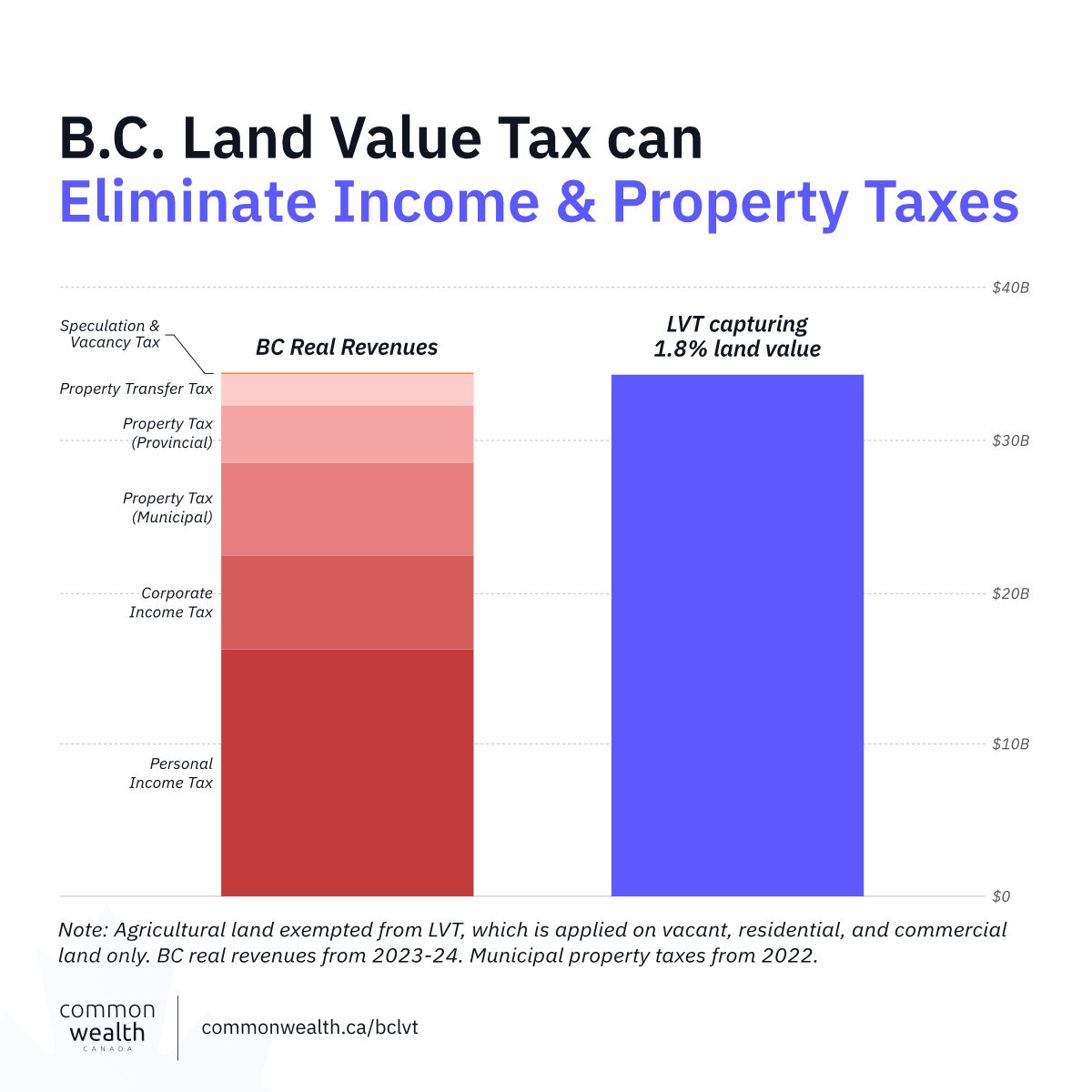
Imagine if our tax system didn't take from work, but rewarded it.
We could do that by eliminating income, property, and transfer taxes with land value tax, while improving the housing market.
BC's land assessment was designed to do just this. Here's how it could work.
1/🧵
NEW 🧵: Is human intelligence starting to decline?
Recent results from major international tests show that the average person’s capacity to process information, use reasoning and solve novel problems has been falling since around the mid 2010s.
What should we make of this?
@StephenPunwasi We wrote two papers on land value capture. Prior to BC elections in 2017 & 2018. Met key Govt officials: BCNDP, TransLink, Metro Vancouver, City Councils, Mayors, CCPA, & academia.
Link to Provincial Paper: https://t.co/5xnWfE7gpr
Link to Municipal Paper:
https://t.co/bF4PDImN3C
"I think both parties suck. But I think they do a really good job of making us not like each other…I wish people would understand that politicians do a good job of making us fight with each other." - Charles Barkley
Here’s a goal for government in 2025: if your programs are so complicated that they require applicants to hire a consultant to access them you’re doing it wrong. Scrap it & go back to drawing board. If you’re a small business, a municipality or just a regular person, it’s ridiculous you’d feel forced to hire a multinational accounting firm to access a government grant or an immigration consultant to find some loophole or an ESG consultant to comply with government reporting requirements. The list goes on. They have created an industry around government that is little more than a shakedown.
lots of things surprise me as I look into the Sikh religion. I don't think there are many religions where the devout (including founders) are proud to die in defence of OTHER religions.