SEC Commissioner @HesterPeirce gave a short but pointed speech yesterday at a Georgetown Law conference on privacy-enhancing technologies. In short, she said the quiet part out loud (thankfully):
regulators have spent too long treating privacy demands as suspicious, when in fact privacy-preserving financial technology protects people from bad actors at least as much as it shields them from shoulder-peering regulators.
Privacy and investor protection, she argues, are not in conflict.
The most interesting idea in the speech was that transfer agents currently must record the name and physical address of securities holders. She suggested giving transfer agents the flexibility to record instead that securities reside at a public blockchain address, which by design carries no personally identifiable information. That would eliminate a whole category of PII honeypots and reduce the data exposure risk that comes with holding tokenized securities today. And the idea certainly makes the MOAR REPORTING types shudder with disgust.
For self-custody wallets, the implication is significant. It would remove one of the structural barriers to holding tokenized securities outside a custodial intermediary. It could give them another meaningful feature.
For DeFi interfaces, the more directly relevant part of the speech was the invitation Peirce extended to builders: if you have technologies that can accomplish KYC and AML compliance objectives while minimizing PII collection and storage, she wants to hear from you through the Crypto Task Force. That is a real opening for the kind of portable, on-chain KYC attestation model that makes the most sense for non-custodial interfaces at scale, where collecting and warehousing underlying customer data is architecturally awkward and creates liability exposure the interface should not have.
It is one commissioner's speech, and that commissioner is leaving (😢), but it is notable that a sitting SEC commissioner is actively reframing privacy-preserving wallet and interface design as a feature worth accommodating rather than a compliance gap worth closing.
https://t.co/hQvex0P7W4
Nothing says "we let the AI write our policy memos" like citing an academic paper that argues the opposite of your position. @bankpolicy filed evidence against itself and called it advocacy. 🍿
Today, a coalition of 100+ signatories join DEF in sending a letter to Congress.
Software developer protections are a non-negotiable in digital asset market structure legislation. This critical issue unites us — crypto and tech builders, investors, and advocates.
I joined NYCBA to discuss the GENIUS Act, Treasury’s state similarity NPRM, and what issuers, boards, and market participants should watch next.
Key issues: oversight, reserves, liquidity, supervision, and the $10B threshold.
Listen here: https://t.co/H91fi8Ii03
Thanks to all who supported the effort! Stablecoin Standard Releases New Framework to Guide Global Adoption of DeFi Stablecoins https://t.co/oHOqx7yZpP
Judge Rakoff of the SDNY in US v. Heppner just warned everyone from vibe lawyering because anything they vibe lawyer can be discoverable, whereas actually consulting with a lawyer is generally protected from disclosure.
Bradley Heppner was charged with securities fraud, wire fraud, conspiracy, false statements to auditors, and falsifying corporate records, all tied to an alleged scheme to defraud investors to the tune of more than $150 million. After Heppner’s arrest, the FBI seized devices and documents, including about thirty one documents memorializing his exchanges with @AnthropicAI@claudeai . The question before the court was whether those @claudeai communications were shielded from Government review by attorney client privilege or the work product doctrine. The court treated the case as a question of first impression about public AI tools in criminal investigations, but said ordinary privilege rules still controlled and required disclosure here.
J. Rakoff held that they were not. Heppner’s Claude chats were discoverable because
Claude was not his lawyer,
the communications were not confidential,
they were not made to obtain legal advice from counsel, and
they were not prepared by or at the direction of counsel so as to qualify as work product.
The attorney client privilege did not apply because the Claude exchanges lacked at least two, and likely all three, of the doctrine’s basic elements.
First, they were not communications between client and attorney. Claude was not a lawyer, and the court rejected the idea that a public AI platform should be treated like ordinary neutral software in a way that would preserve privilege, emphasizing that recognized privileges rest on protected human relationships involving fiduciary duties and professional discipline.
Second, the court found the communications were not confidential. Anthropic’s privacy policy says Anthropic collected user inputs and outputs, could use them to train Claude, and could disclose data to third parties, including regulators and parties involved in claims or litigation. Heppner could not reasonably expect confidentiality.
Third, the court found that Heppner was not communicating with Claude to obtain legal advice in the legally relevant sense - i.e. in order to facilitate discussions with his actual lawyers. Because Heppner used Claude on his own, the key question was whether he sought legal advice from Claude itself, not whether he later intended to discuss the subject with lawyers. Claude expressly disclaimed that it was a lawyer (because obviously its not a lawyer) and said it could not provide formal legal advice (because, again, its obviously not a lawyer), which reinforced the court’s conclusion that the communications were not privileged when made.
Moreover, sharing the Claude materials with defense counsel did not change their status. Nonprivileged communications do not become privileged simply because they are later transferred to a lawyer - this is nothing new.
The work product claim failed for similar reasons. These documents were not prepared by counsel or at counsel’s direction. Defense counsel had admitted that Heppner created them on his own. The court also found that, although the documents may later have affected defense strategy, they did not reflect counsel’s strategy at the time they were created. That was enough for the court to conclude they were not protected work product.
In short, this case covered a novel area but predictably applied very old, ordinary rules when concluding that Heppner’s use of Claude satisfied neither attorney client privilege nor work product protection, so the Government was entitled to inspect the documents.
JUST IN: @OpenAI is rolling out a new suite of financial-services tools that connect ChatGPT with FactSet, Third Bridge, Excel, and Google Sheets, allowing professionals to build financial models, run analysis, and draft investment memos using AI.
1/ We need an Apollo program for human capital.
AI is rapidly eroding tasks, jobs, and early careers, but it also offers incredible new tools to accelerate mastery, discover your aptitudes, and simulate the lost apprenticeship phase.
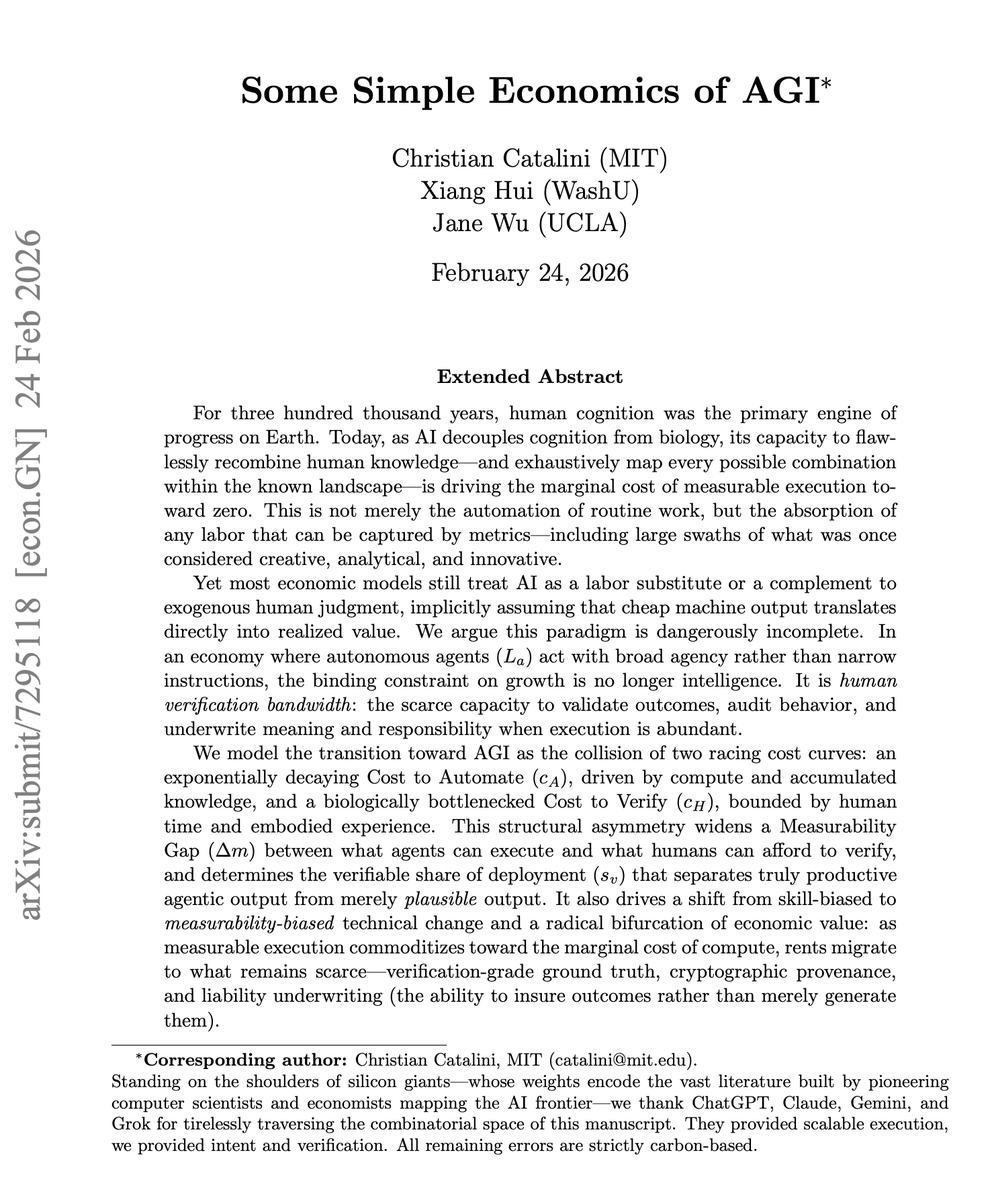
@claudeai 58/ This paper is an attempt to analyze it—and what we found is that the residual has a structure, the structure has a logic, and the logic leads to verification. That is what's defensible. That is what's scarce. That is what we should be building.