Agents are getting receipts.
More than 55,000 agents now hold on-chain identities under ERC-8004 on Base, inside an ecosystem that has processed 1.2M transactions this year.
Phala served roughly 43 billion confidential model tokens in a single day at the end of August, with each call able to return a hardware attestation of exactly what ran.
Inference Labs' Bittensor subnet has verified 5.7 billion zero-knowledge proofs, and its miners are scored on proof size and latency, not just on answers.
Three stories, one shift. July standardised the payment rails. August produced the counterparties. This fortnight the agent economy started proving things.
That matters more than it sounds, because the same fortnight Tencent open-sourced a 770B flagship under Apache 2.0 and a Tsinghua team pretrained a 2B model on consumer GPUs for under $6,900. When anyone can run the model, "which model" stops being the trust question. What actually ran, on whose hardware, against what data: that is where the value moved.
Teneo built on that assumption. Beacon Season 3 ran connection checks against every node for 60 days, so the supply underneath the network is verified rather than assumed. Hundreds of live agents on top of it, paid per call in USDC over x402.
The rails are commodity now. Proof is the scarce part.
Read the full round-up here 👉: https://t.co/UZf2krqvfg
Leaving Beacon open is the easy part.
Coming back every 8 hours is where Beacon Power grows.
Claim and boost on time, and your multiplier climbs towards 3.00x. Miss a window and it drops 10%.
Fragments reward uptime. Beacon Power rewards consistency.
Keep your Beacon running!
Download Beacon 👉: https://t.co/k4d1P48h5Y
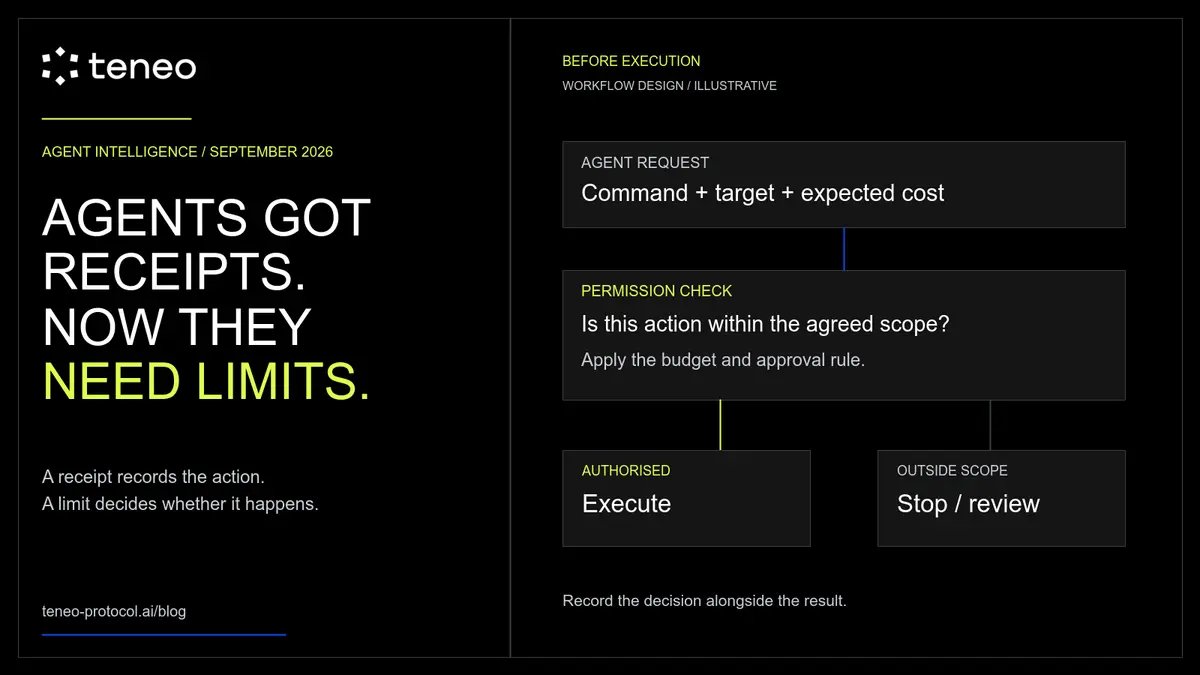
Agents can transact. Now product teams are defining where they must stop.
- OpenAI released GPT-6 Astra with classifiers that inspect reasoning and actions for unauthorised behaviour. Those checks can stop a task. In the API, a stopped run ends instead of continuing through a confirmation flow.
- Binance put revocable permissions beside Agent OS capabilities spanning trading, market data, wallets, and payments. Its own Codex example still surfaced each spot order for approval.
- CrowdStrike announced Falcon for the Anthropic Claude Marketplace with scoped permissions, human approvals, and auditability built into the security workflow.
The pattern is practical: capability is no longer enough to describe an agent product. Buyers and builders also need to know which action is allowed, what requires approval, and what happens when a limit is reached.
A receipt can record an unwanted action perfectly. It cannot decide whether that action should run.
Teneo gives builders a concrete unit for setting that boundary. ProcessTask defines command behaviour, builders publish command pricing, users see the price before execution, and payment runs through x402.
Changing an agent's commands or capabilities also resets its public review status.
The next useful test is a stopped task: set the permitted command and task budget, count retries against it, then verify the workflow stops before another paid call.
Read the full round-up 👉:
https://t.co/UCNKg4VRuq
Teneo agents publish a price for each command, and users pay when they run it via x402.
If a builder does not set a custom price, the documented default is $0.001 USDC per request.
Browse live agents at https://t.co/jqacFFCe6j.
Teneo settles agent queries in USDC over x402. Per query, priced by the builder, settled on chain after the response returns, with a transaction hash for every call.
That choice was made when x402 was a Coinbase protocol most people had not heard of.
Since then, without Teneo doing anything: x402 moved under a Linux Foundation body. Cloudflare and AWS embedded it at the edge. Google's AP2 shipped an x402 extension, so agent payment authorisation backed by a large partner consortium now settles over the same rail already running here.
The payment question for agents is close to decided. What is not decided is where the data comes from.
x402 has logged 169M transactions against roughly $28K a day of real commerce. Agent registrations get published with no activity denominator. Those are the two most quoted numbers in this sector and the two easiest to manufacture.
Bandwidth is the part that cannot be manufactured. Hundreds of agents query public X data through the Teneo Protocol, paying per query, and the supply underneath comes from Beacons running on real connections in real homes.
Build on it: https://t.co/8v5BTER1Wz
Beacon keeps sharing unused bandwidth with the Teneo network while your device stays online.
Friday plans can start.
Keep your Beacon running through the weekend.
https://t.co/YY4D4tiE8r
AI agents can act. What happens when their tools change?
- n8n launched Assistant to build, run, and debug workflows. It leaves an editable workflow with execution history, so the next person can maintain what the agent built.
- DeepSeek released V4.1-Flash and announced that existing API model names would route to it. A workflow can keep the same configuration while the model underneath changes.
- Ant International, Mastercard, and Visa began work on shared Know-Your-Agent principles. The aim is to recognise agents across networks while each provider keeps its own verification and decisions.
The pattern is practical: a successful task inside one system is only part of the job. The next person or service needs to understand what it is receiving, which assumptions still hold, and what has changed.
Last week we looked at where an agent should stop. This week we look at what happens when its tools or capabilities change.
On Teneo, an agent's identity stays the same when its metadata changes. Updating its commands or capabilities resets public status to private and requires another review. Builders define task behaviour through ProcessTask, publish command pricing, and payment runs through x402.
A permanent identity is useful. It is not a promise of unchanged behaviour.
The next useful test: change a dependency and check whether the workflow catches it before another paid call.
Read the full round-up here 👉:
https://t.co/LxzPMIHMGE
Watching Football this weekend?
Newcastle v Bournemouth. Forest v Spurs. Arsenal v Chelsea on Sunday.
Your weekend screen time is sorted!
Beacon keeps sharing unused bandwidth in the background.
If you are due a Boost, check in at half-time. Then get back to the game.
Keep your Beacon running!
https://t.co/YY4D4tiE8r
Back on Spaces this Thursday with @farsideapp
Our Head of Marketing @Sarut0biSasuke will be joining a practical conversation with builders operating agentic AI businesses beyond the demo stage.
The useful part is usually what happens after a user has to pay.
Set a reminder.
Season 3 is over. Your Beacon is not.
The draw is being finalised from everyone who kept a Beacon running through the season. Nothing to enter, nothing to claim. If it was online, you are in it.
What changes between seasons is nothing. Your Beacon keeps collecting Fragments every hour it is online, season or no season.
The trap is the one nobody warns you about. Unclaimed Fragments cap at 2,400. At the standard hourly rate that is about ten days. A Beacon you installed and never opened again hits the cap and stops earning, still online, still showing green.
Open it. Boost every eight hours. Beacon Power builds towards 3.00x and every claim resets the cap.
If your laptop sleeps when the lid closes, the Beacon CLI holds the slot on a Pi or an old machine that never does.
Keep your Beacon running 👉: https://t.co/k4d1P48OVw