Robert Wadlow was the tallest human ever accurately measured, standing at a staggering 8 ft 11 in (2.72 m), and he was still growing when his life ended due to a fatal infection caused by a wound on his leg.
Had he lived longer, he would have approached the heights attributed to the Anakim in the Bible and the Quinametzin giants of Aztec tradition. Interestingly, he had red hair, much like the alleged giant described in stories about Kandahar, Afghanistan.
He died in 1940 at the age of 22 and was a Master Mason in the Grand Lodge of Illinois.
Here he stands next to his 5.11ft tall father. Was this the result of a Nephilim bloodline, or simply what mainstream science explains as an abnormally high level of human growth hormone (HGH)?
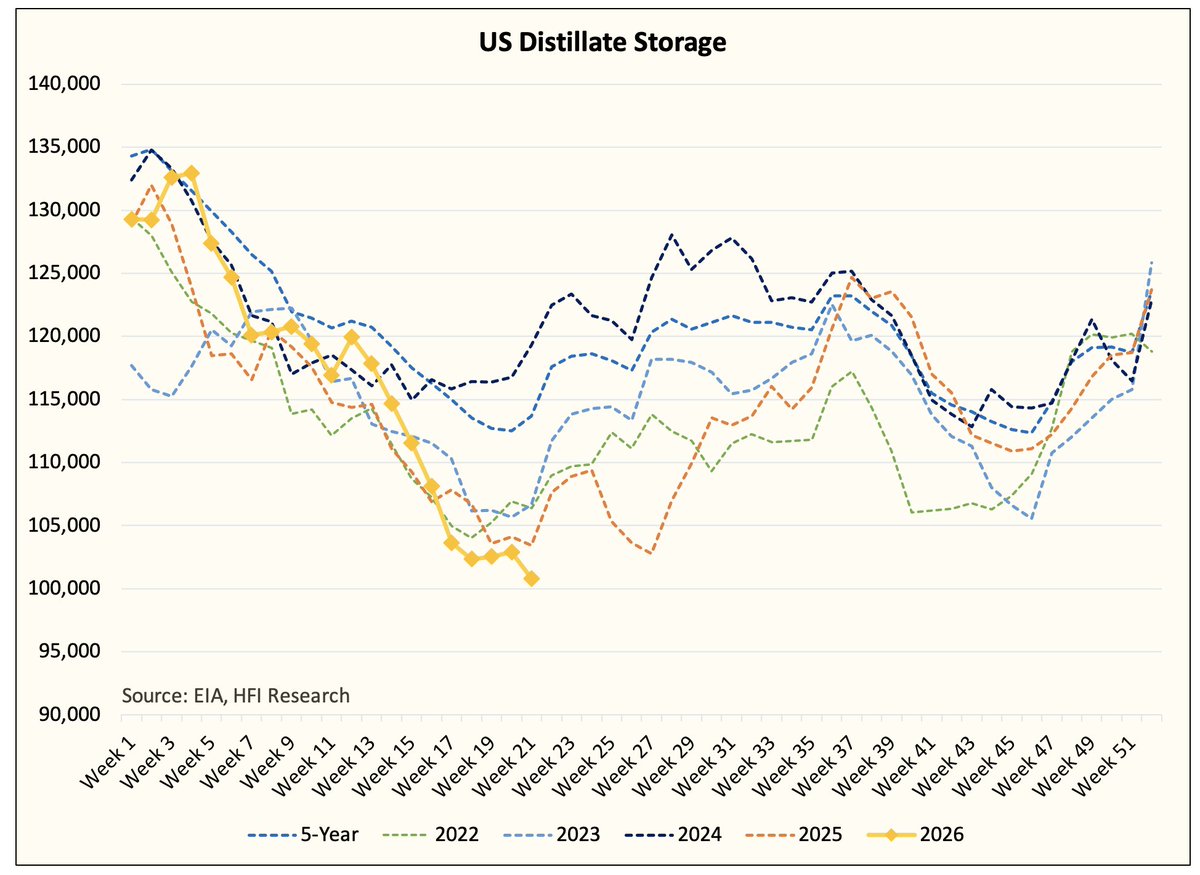
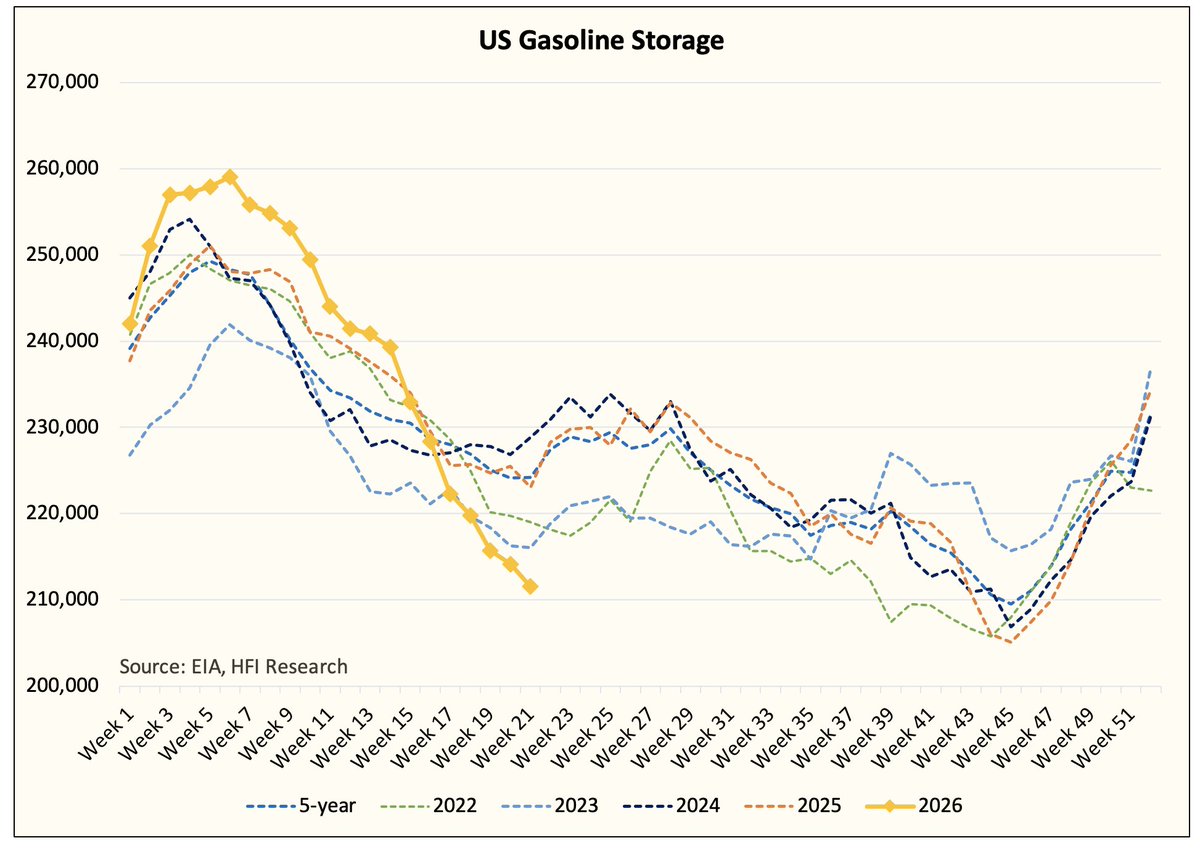
We are ~9 million bbls away from hitting a storage level that's the equivalent of living paycheck to paycheck for gasoline and distillate.
Once we get there, even a minor disruption (any sort of outage) will result in gasoline lines at gas stations.
I guess we are really doing this.
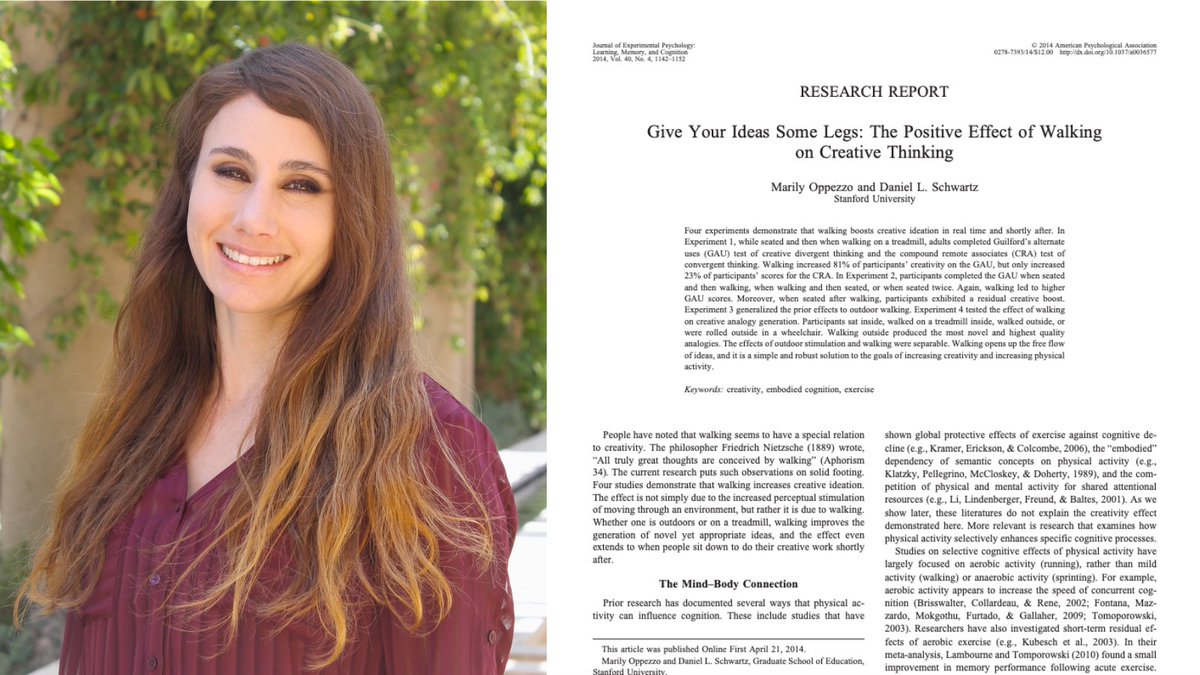
A Stanford psychologist spent 4 years proving that the simple act of walking generates 60% more creative ideas than sitting, and the experiment she designed to kill every alternative explanation is one of the most decisive findings in modern psychology.
Her name is Marily Oppezzo.
She got the idea for the study while walking with her advisor at Stanford to discuss her thesis topic, and the paper she eventually published in the Journal of Experimental Psychology in 2014 is sharp enough that it should have ended the seated meeting on the day it came out.
She ran 4 experiments on 176 people. Same person tested twice. Once sitting, once walking. The creativity tasks were the standard ones psychologists have used for decades to measure how good a brain is at generating novel useful ideas.
The result was almost too clean to publish.
81% of participants in the first experiment produced more creative ideas while walking than while sitting. In the second experiment, 88%. In the third, 100%. Every single person walked into a more creative version of themselves.
On average, people generated 60% more novel useful ideas the moment their legs started moving.
The skeptical question is the obvious one. Maybe it was the fresh air. Maybe it was the scenery passing by. Maybe it was the change of environment doing the work, not the walking itself.
Oppezzo killed every one of those explanations with one experimental decision.
She put people on a treadmill facing a blank wall. No scenery. No fresh air. No environmental change. Just legs moving in place while staring at white drywall. The 60% boost held.
Then she ran the experiment that closed the case completely. She took participants outside in two conditions. Half of them walked through a Stanford courtyard. The other half were pushed through the exact same courtyard in a wheelchair. Same outdoor stimulation. Same scenery passing at the same speed. The only difference was whether the legs were moving.
The walkers produced dramatically more novel high-quality ideas than the wheelchair group. The outdoors did almost nothing on its own. The walking did everything.
This is the part of the study that hit hardest when I read it the first time.
She also tested the opposite kind of thinking. Convergent thinking. The kind where there is one right answer and you have to narrow down to it.
Word puzzles where 3 words share a hidden fourth word that connects them. The seated participants did slightly better on these. Walkers got slightly worse.
Walking is not a general intelligence enhancer. It does one specific thing. It opens up the divergent search inside your brain. The part that generates options. The part that produces unexpected connections. The part that takes a problem and finds five ways into it instead of one.
When you need to converge on the single right answer, sit down. When you need to find the answer in the first place, get up.
The mechanism is now well understood. Walking selectively activates what neuroscientists call the default mode network, the system inside your brain that runs when you are not consciously focused on anything. The DMN is where mind-wandering happens. Where memories cross-reference each other. Where ideas that have been sitting in separate folders inside your head finally bump into each other.
When you sit at a desk and force yourself to concentrate, you suppress the DMN. When you walk at a natural pace, the executive part of your brain gets just busy enough handling the walking that the DMN comes online and starts doing the work that focus was blocking.
The most useful finding in the entire paper is the one almost nobody quotes.
The boost did not turn off the moment people stopped walking. Participants who walked first and then sat back down stayed elevated. Their next round of seated creativity work was still significantly better than people who had been sitting the whole time. The rest lingered for at least several minutes after the legs stopped moving.
You do not need to do creative work while walking. You need to walk before the creative work. The brain holds the state.
The history of this is the part that should haunt anyone who still does meetings in chairs.
Charles Darwin built a gravel loop behind his house in Kent called the Sandwalk and walked it 3 times a day for the rest of his life. The theory of evolution was developed one lap at a time on that path.
Nietzsche walked up to 10 hours a day during the years he wrote his most important books and openly said the work was conceived on his feet.
Beethoven composed for the morning and walked for 5 hours every afternoon with a pencil in his pocket for when something landed.
Kahneman said the best thinking of his Nobel Prize-winning career happened on leisurely walks with Amos Tversky. Steve Jobs refused to take important conversations sitting down. He held them on foot.
Every one of them was using the system Oppezzo would not measure until 2014. They just did not know what to call it.
The question worth sitting with is the one almost nobody asks.
Every meeting you have ever attended sitting around a table was a meeting held at a fraction of the brain power that was actually available to the people in the room. Every brainstorm that got stuck inside a conference room. Every problem you tried to solve at a desk and gave up on. Every idea you could not quite get to.
The intervention is the easiest one in modern science. No supplement. No app. No subscription. No training program. Just a pair of legs and 15 minutes.
The Stanford lab proved it. The philosophers knew it. The neuroscience explains it.
And almost everyone reading this is still trying to think their way out of problems sitting completely still.
OIL SIEGE ON BRICS: Nth SUMMARY
Here I explain why USgov is NOT interested in agreement with Iran but playing for time ⏳, as the OIL SIEGE pushes BRICS over the economic cliff.
The key point is that IT MUST BE SLOW, like slow cooking a frog, otherwise frog will escape, just like Japan attacked in 1941, under identical circumstances because US' OIL SIEGE was in your face obvious.
"Agreements, deals, cease fires" all play into the grand strategy of Pentagon for destroying the rise of BRICS by energy austerity.
Attached is also proof that I predicted all of this 3 years ago. I could predict it precisely because OIL SIEGE is the ONLY method for the US to deal with BRICS and US was never going to let things evolve freely.
China, OBVIOUSLY, did not see it coming; 1.4 billions of people did not see it coming. Otherwise, they would have a solution by now & they don't.
China's crude imports just collapsed from 12,000 kbd to 6,500 kbd.
The oil shock hasn't happened yet because China hasn't come back to buy.
Chinese refiners stepped back.
High prices, weak margins, no incentive to buy.
But inventories are now drawing down faster than run cuts. The buffer is shrinking.
When state refiners return to market and they will they won't be topping up.
They'll be restocking from depleted tanks while Hormuz is still disrupted.
image source: Muyu Xu
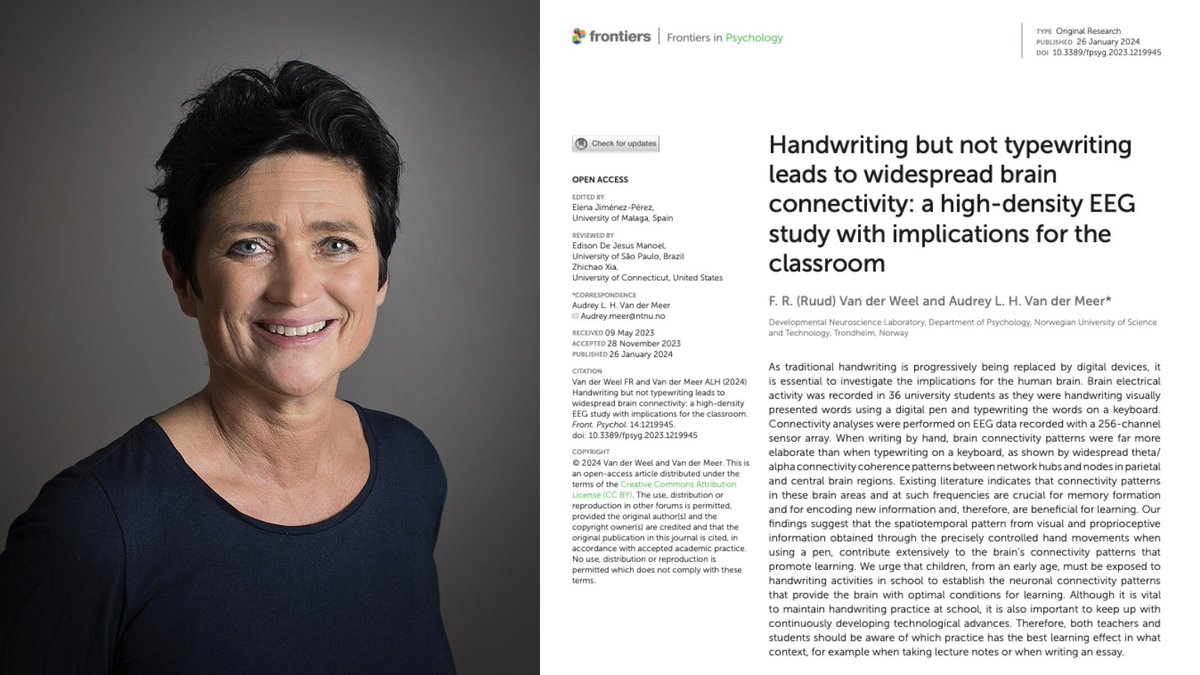
A Norwegian neuroscientist spent 20 years proving that the act of writing by hand changes the human brain in ways typing physically cannot, and almost nobody outside her field has read the paper.
Her name is Audrey van der Meer.
She runs a brain research lab in Trondheim, and the paper that closed the argument was published in 2024 in a journal called Frontiers in Psychology. The finding is brutal enough that it should have changed every classroom on Earth.
The experiment was simple. She recruited 36 university students and put each one in a cap with 256 sensors pressed against their scalp to record brain activity. Words flashed on a screen one at a time.
Sometimes the students wrote the word by hand on a touchscreen using a digital pen, and sometimes they typed the same word on a keyboard. Every neural response was recorded for the full five seconds the word stayed on screen.
Then her team looked at the part of the data most researchers had ignored for years, which is how different parts of the brain were communicating with each other during the task.
When the students wrote by hand, the brain lit up everywhere at once.
The regions responsible for memory, sensory integration, and the encoding of new information were all firing together in a coordinated pattern that spread across the entire cortex. The whole network was awake and connected.
When the same students typed the same word, that pattern collapsed almost completely.
Most of the brain went quiet, and the connections between regions that had been alive seconds earlier were nowhere to be found on the EEG.
Same word, same brain, same person, and two completely different neurological events.
The reason turned out to be something nobody had really paid attention to before her work. Writing by hand is not one motion but a sequence of thousands of tiny micro-movements coordinated with your eyes in real time, where each letter is a different shape that requires the brain to solve a slightly different spatial problem.
Your fingers, wrist, vision, and the parts of your brain that track position in space are all working together to produce one letter, then the next, then the next.
Typing throws all of that away. Every key on a keyboard requires the exact same finger motion regardless of which letter you are pressing, which means the brain has almost nothing to integrate and almost no problem to solve.
Van der Meer said it plainly in her interviews.
Pressing the same key with the same finger over and over does not stimulate the brain in any meaningful way, and she pointed out something that should scare every parent who handed their kid an iPad.
Children who learn to read and write on tablets often cannot tell letters like b and d apart, because they have never physically felt with their bodies what it takes to actually produce those letters on a page.
A decade before her, two researchers at Princeton ran the same fight using a completely different method and ended up at the same answer. Pam Mueller and Daniel Oppenheimer tested 327 students across three experiments, where half took notes on laptops with the internet disabled and half took notes by hand, before testing everyone on what they actually understood from the lectures they had watched.
The handwriting group won by a wide margin on every question that required real understanding rather than surface recall.
The reason was hiding in the transcripts of what the two groups had actually written down.
The laptop students typed almost word for word, capturing more total content but processing almost none of it as they went, while the handwriting students physically could not write fast enough to transcribe a lecture in real time, which forced them to listen carefully, decide what actually mattered, and put it in their own words on the page.
That single act of choosing what to keep was the learning itself, and the keyboard had quietly skipped the choosing and skipped the learning along with it.
Two studies. Two countries. Same answer.
Handwriting makes the brain work. Typing lets it coast.
Every note you have ever typed instead of written went into your brain through a thinner pipe. Every meeting, every book highlight, every idea you captured on your phone instead of on paper was processed at half depth.
You did not forget those things because your memory is bad. You forgot them because typing never woke the part of the brain that would have made them stick.
The fix is the thing your grandmother already knew.
Pick up a pen. Write the thing down. The slower road is the faster one.
Bond markets are flashing red.
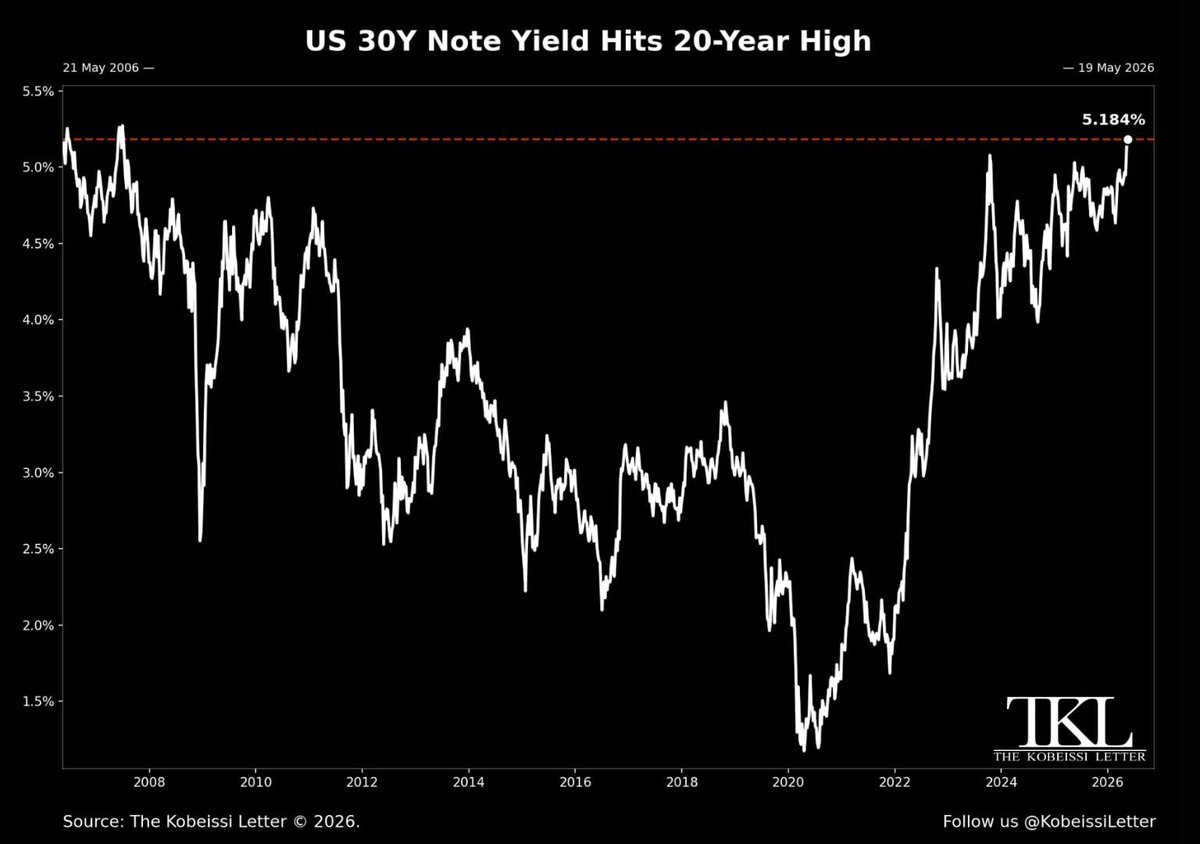
Today, the US 30Y Note Yield officially hit its highest level since July 2007, at 5.19%.
This will soon become Americans’ biggest problem, yet the vast majority do not even know it is happening.
What is happening? Let us explain.
(a thread)
CHINA's oil imports collapse in May:
6 mbpd or 50% less oil going to China in May.
At this rate, if they do not change anything, they have enough oil reserves to last until about 2027-Q2 (1600/6/30=9 months)
But as oil becomes scarce, not all exporters may sell their oil for money, either waiting for much higher prices or to protect their own population or other countries may come in to grab faster or more expensively (Black Market) and seeing oil reserves dwindle fast, China will have to cut their industrial production within 2026. Large but weak Global South economies will start collapsing much before; no buyers for China's overproduced goods that is not critical for survival.
If China goes into this "stand by, energy saver" mode, their export economy will collapse; asymmetrically US can wait on this siege for ever! Just sailing the Arabian seas, cooking barbecue & switching war ships every few months.
The only way to counter this OIL SIEGE is for China to attack US Navy near the Persian Gulf, which is exactly 🎯 what Japan did in 1941 under exactly the same circumstances 🎯.
Do not call it Black Swan please.
With fertilizer, this planet feeds 8.5 billion people.
Without it, we can feed around 2 billion.
We have just disrupted 30% of global fertilizer supply through the Strait of Hormuz. And people are still talking about this as if it is an oil story.
It is not an oil story. It is a food story. And the numbers do not care about politics.
Watch the full breakdown: https://t.co/uoO29ao98F
#FoodSecurity #Fertilizer #StraitOfHormuz #GlobalFoodCrisis #SteveKeen #Economics
THE PERFECT SIEGE:
The last perfect siege was in 1453 when Ottomans conquered Constantinople, which was considered impossible to capture for 1000 years prior to that.
I consider GREAT OIL SIEGE of 2026, involving 70% of global oil resources, the best in history so far, superior to 1453 (unless senile crap messes it up):
1) It is a GLOBAL SIEGE.
2) Unlike Byzantians, nobody is attacking back... Not Iranians, not EU, not China, not India, not nobody. SIEGE is UNCONTESTED.
3) US mainland remain unreachable by the enemies.
4) US finances remain undisturbed, not only because US issues global money but also investors smelling global collapse are rushing to US financial markets.
5) It remains an open secret, as in only few people have figured it out. People simply cannot get themselves to believe in the grand scope of things.
6) Iran willingly destroyed GCC oil & gas resources, tightening the effect of the siege drastically.
When I write about the long-run consequences of population decline, I’ve noticed that most people cannot grasp what a total fertility rate (TFR) of 1.1 means. Many of my readers look at 1.1 and treat it as not that different from 2.1. This is the wrong way to think about it: TFRs are like interest rates; they compound over time.
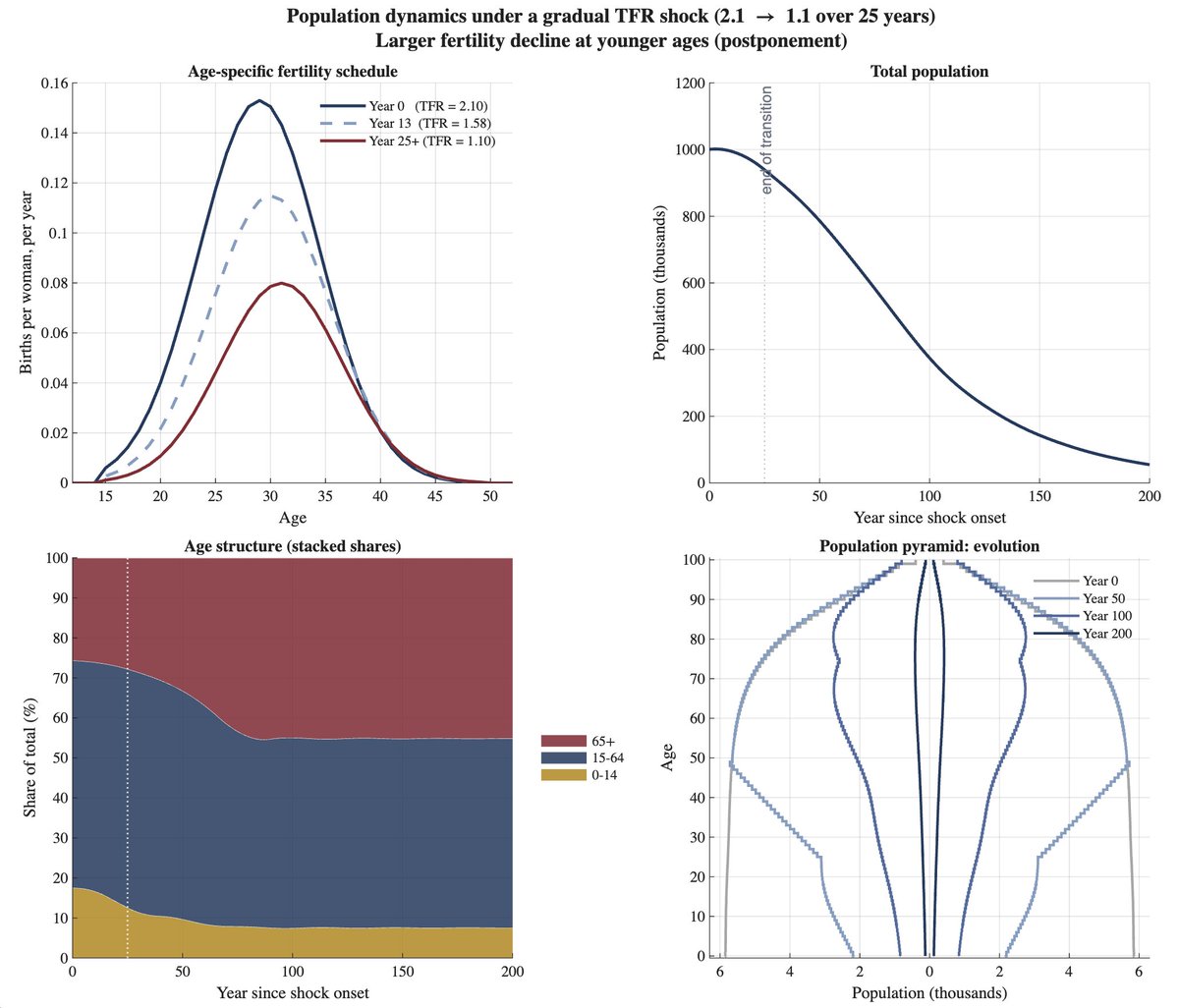
To make the point, I ran the following simulation. I built the population structure of a country with 1 million inhabitants, a TFR of 2.1 (just at replacement level), and a life expectancy of 85 (with realistic survival rates). Thus, this country has a stationary population over time.
I then hit this country with a reduction in the TFR from 2.1 to 1.1. The reduction, which takes 25 years to complete, is similar in size and duration to what we’ve seen in many advanced and middle-income economies. It is also concentrated among younger women, with fertility postponed to later years. I plot the initial, middle, and final TFR in the top-left panel of the figure.
I then simulate the next 200 years of this population. By the year 200, the original 1 million has fallen to 54,900, a 95.5% reduction. The top-right panel illustrates this evolution. This is not a minor adjustment: it means closing 95 of every 100 universities, hospitals, and shops. Since the population is likely to concentrate in a few remaining cities, nearly the whole country becomes a population desert.
The bottom two panels show the population structure and pyramids. The population stabilizes at a median age of 61 and an old-age dependency ratio of 95.21%.
You might argue that TFR is unlikely to remain at 1.1 for so long because higher-fertility subgroups (e.g., the highly religious) would grow as a share of the population. Fair enough. But I am not offering this simulation as a forecast. I am illustrating how, at current rates, countries of 50 million people (roughly South Korea or Spain) would become countries of 2.75 million, ignoring immigration.
These are the issues for the next century.
CALM BEFORE THE GREAT GLOBAL DEPRESSION:
This is a real chess game now; the next move, or lack of it, is really important.
Let's take a look at strategies of the main players:
1) US STRATEGY is about imposing OIL SIEGE on Global South & in particular on China. US controls North American continent oil (exerts unpleasant pressure on Canada & Mexico), Venezuela, has curtailed Russian O&G via Ukraine war + CIA attacks on shipments, and now put almost entire Middle East oil under siege, except for 7 mbpd running through pipeline across Saudis.
That is close to 70% of global oil currently under control of the US military might & US-BigOil, from land, sea and air.
Trump is bitching this or that, but his power declines every passing week in the polls & he will mostly likely lose midterm elections, now less than 6 months away.
DeepState (Pentagon + CIA + DC Think Tanks) will have full control over global affairs after the midterms & will no longer have to deal with Trump's unexpected urges. Vietnam war lasted across 5 presidents.
Given the OIL SIEGE, US has no incentive to make war; wars consume ammunitions, which are scarce now.
That is all to say US will simply WAIT on choke hold.
2) ISREAL STRATEGY was to reduce the influence of Iran in their region. Iran is far away and is operating through proxies. Iran is now isolated and Israel is expanding freely in Levant.
Israel has no incentive for re-igniting war with Iran and will WAIT.
3) IRAN has this strange obsession with Israel for regional dominance and with US about global dominance. They fought extremely well in this war, but if there is no war, their influence is rather limited. If nobody is attacking, they usually do not attack. If they attack GCC, Saudis in particular, yes, then US can wipe out their oil facilities in a day. Iran has been hit really good &there is much destruction there.
Iran will most probably wait, while seeking help from China and Russia in some form.
4) RUSSIA is no longer powerful. The long slow 4.5 years of war with Ukraine, incredible fighters, has weakened them to the brink. CIA is destroying their O&G facilities & shipment every day. It is unclear how much help they are getting from China, who are probably looking to grab some of land back from Russia, which Stalin grabbed during WW2.
The only importance of Russia today is that they are the only other major producer of O&G apart from everything else that US is trying to gab and they command vast lands full of resources.
Poland & Germany, perhaps Finland & Estonia are preparing for war with Russia, when it is time.
5) EU is weak in terms of energy & military. They have decided not to resort to military power in the aftermath of WW1 & WW2. They are no longer playing to be a power in global geopolitics. As long as they have enough energy, they will simply wait passively.
6) CHINA is the only player which has a critical decision to make, because they are playing for global leadership and a new system, on the basis of their industrial production & trade. They have been 100% silent so far.
If they chose to go turtle, the world goes into depression and their overproduction & export model will disappear within a year, so will their entire economy.
If they chose to act, there is no smart move evident. They have no allies for the past 5000 years. They have no military move that I can see. They can certainly get into a situation of war with some neighbors, which US is waiting for to turn them into Russia.
China may simply dwindle down, fade away, just like Japan did post 1990 economic crash, under the pressure of collapsing economics, indecision, collapse of global economic model.
This is precisely why the US is being so forceful imo. Somebody in DC has thought things over...
CONCLUSION: Great Global Depression is next under OIL SIEGE.
I really see no way around it.
It is too far out to speculate on what happens during and across the Great Global Depression. During 1930s, it took almost 10 years for the depression to transition to full-scale WW2.
Given global aging demographics, 10 years is a long time. We know from Japan that large depressions have demographic impacts (young cannot find jobs and cannot form families, leading to lost generations and rapid aging of the population).
WW2 was in many ways the continuation of WW1 and caused massive capital destruction, at the end of which a new system & global order was established, at least for the West. During the 20th century, global population grew 5x, mainly due to the discovery of the Haber-Bosch nitrate fertilizer system. Such a population increase is no longer possible due to the immense chemical pollution in the water, food & all other products.
There are also collapses after which no new global order was established; Bronze Age collapse (due to lack of timber) and Rome collapse (due to debt to center of usury) led to 1000 years of dark ages, when almost all knowledge was lost and people lived in poverty and disease.
So I do not agree with people who think that a new system will be established soon, collapse of the present system is way overdue etc. They simply do not know what they are saying; there is piles of trouble and unknown chunks of time (decades or centuries) between now & a "new system".
Iran is an intermediate target. The ultimate target is China. Bombing the Chinese railway connection is the continuation of the British strategy a century & a bit ago, to prevent Germany from building its Berlin-Baghdad-Basra railway, under construction in the years 1905-1910 onwards... Considered a lethal threat to UK dominance via the seas. Indeed a key reason why Britain wanted to make war on Germany (& hence started WW1).
China is the new Germany, peacefully focusing on innovation & economic prosperity, building up a trade surplus & hence being considered a deadly threat to the powers that want to subjugate & dominate, the powers that want to destroy everything excellent & good.
1/ The world is very rapidly running out of refined fuel due to the Strait of Hormuz blockade, according to a new Goldman Sachs report, with only 45 days' worth of stockpiles of jet fuel, naphtha, and LPG remaining. Rationing, surcharges, and mass cancellations are forecast. ⬇️
DEFLATIONARY ECONOMIC COLLAPSE:
Global fertility rates R in all industrial economies are 1 < R < 1.5.
This is with plentiful energy & food.
Food austerity imposed the SIEGE of the Middle East means that the globe can only support 1B instead of 8B people.
When?
In one generation, by 2050, global population will halve.
It is a serious situation (I do not expect Xtards to get it though).
HISTORY IS THE BEST GUIDE:
Constantinople, capital of Byzantium, which outlasted Rome by 1000 years, was the most heavily fortified & crowded & economically VALUABLE city in the middle ages.
THE SIEGE put on by Ottomans in 1453 is IDENTICAL to the SIEGE put on by Americans on the premier O&G region in the world in 2026.
The region will come out of this SIEGED completely changed. The only aspect I feel confident is that Iran will survive, because they always did. Entire GCC, all created by western powers, post WW1 post Ottomans, are looking at a very uncertain future, imo...
@John4you22@OMApproach It’s not my opinion, it’s what was derived from data that this man paid for and received from his scientist friends at places that measure what is happening.
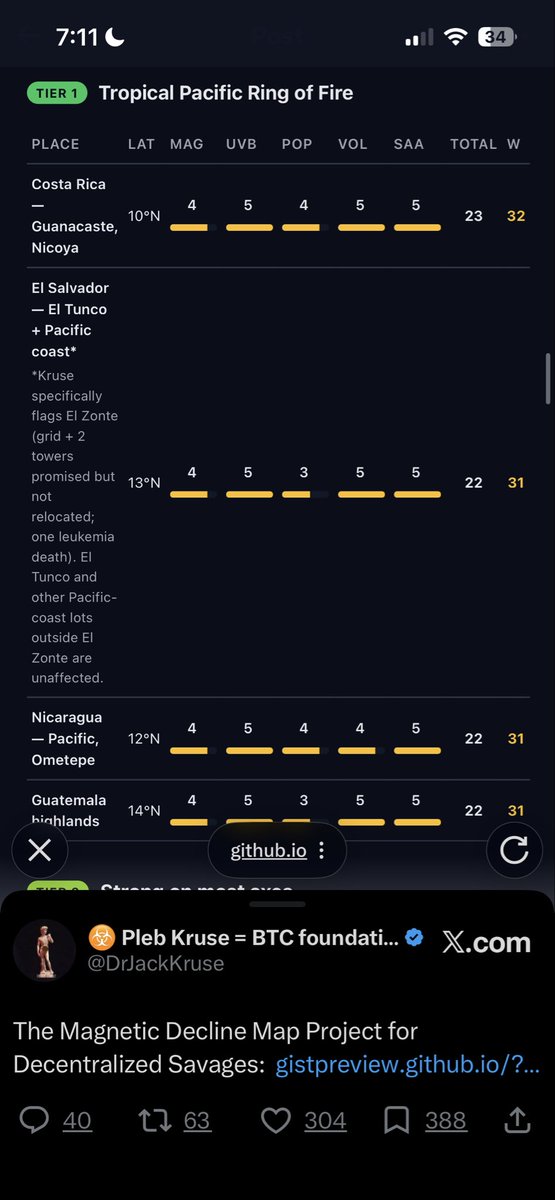
So far, Dr. Jack Kruse and former Bush administration official Catherine Austin Fitts have revealed that the elite are concerned about increased cosmic radiation. One attributes it to the weakening of the magnetic field, while the other points to an upcoming Grand Solar Minimum.
I’ve been talking about this for years. The current geomagnetic excursion causes the magnetic field to weaken, and we are also due to enter another Grand Solar Minimum. This will be the first since the rise of modern technology. In addition, we are due for another Bond Event.
So far, I have revealed two safer locations, as both Jack Kruse and the Area 51 caller on Art Bell have said that there are safer places on Earth. The elite have major projects in one of these locations, which is a hot topic right now and has shown a strong magnetic anomaly in the past, particularly during the Bronze Age collapse. The other place is also very famous and has been mentioned by a certain powerful figure.
Read my two posts by subscribing to my X account or Patreon. I will reveal more places, but they will not be public due to ongoing issues with the algorithm and heavy throttling.