@BGleas I am a Professional Email Marketer and Web designer.I can help you with email designs, email campaigns, email automation/workflow, web designs and many more.I have worked with various top notch CRM platforms and Two major CMS platforms.kindly message to further discuss on this.
Before Tinubu :
• $1 = N460
• 1 liter of fuel = N197
• 1 kg of gas = N570
• 1 crate of eggs = N2,500
• 1 bag of pure water = N150
• 1 bag of rice = N35,000
• 1 loaf of bread = N500
• 1 kWh electricity (average household tariff) ≈ N60
Tinubu 3 years in office:
• $1 = N1,400
• 1 liter of fuel = N1300
• 1 kg of gas = N1,200
• 1 crate of eggs = N6,000
• 1 bag of pure water = N400
• 1 bag of rice = N85,000+
• 1 loaf of bread = N1,200+
• 1 kWh electricity (Band A tariff areas) ≈ N200+
No light and fuel , and you’ll will still vote them in 2027, respectfully you’re a fool if you vote for this foolish government.
Source - @boye4christ2006
@AskMichaelTaiwo@MtScholarships I’m applying again for the @MtScholarships GRE voucher 🙏🏽
Last year (ID: 543598) and this year (ID: 445156), I gave it my best but couldn’t win. Yet, I refuse to give up on my dream of graduate studies. 🌍✨
@yabaleftonline These are stuffs that our university graduates should be producing for fun, with govt funding and support.
Including, phone cords and accessories
Plastic products like eleganza
Toothpicks
Automobile spare parts
Wires and cables
Chemicals products
Home appliances
Crude machines
@Nig_Farmer Invest it in Stambic IBTC money mutual fund account and be collecting 60k monthly. 3m is too small to start a good business in Nigeria. With this struggling economy, the whole money will evaporate.
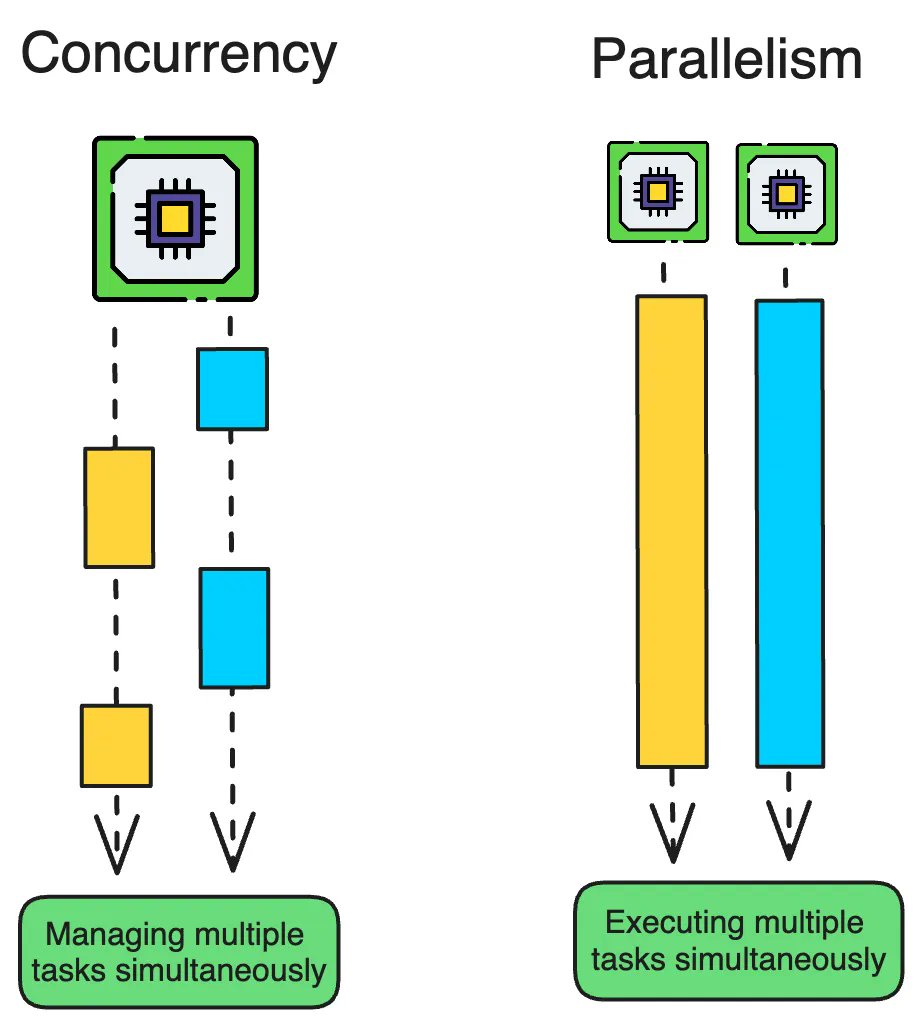
Concurrency vs Parallelism - They are NOT the same.
𝐂𝐨𝐧𝐜𝐮𝐫𝐫𝐞𝐧𝐜𝐲:
Concurrency means an application is making progress on more than one task at the same time.
While a single CPU can work on only one task at a time, it achieves concurrency by rapidly switching between tasks.
Example: Playing music while writing code – the CPU alternates between these tasks so quickly, it feels simultaneous.
The primary goal of concurrency is to maximize CPU utilization by minimizing idle time.
𝐏𝐚𝐫𝐚𝐥𝐥𝐞𝐥𝐢𝐬𝐦:
Parallelism means executing multiple tasks at the same time.
To achieve parallelism, tasks are divided into smaller, independent subtasks and processed simultaneously across multiple CPUs, cores, or GPUs.
Example: Training deep learning models by dividing datasets into smaller batches and processing each batch simultaneously across multiple GPUs or CPU cores.
The goal of parallelism is to boost performance by executing tasks in parallel.
Want to dive deeper into these concepts? I've covered this in detail with examples and code in my latest article: https://t.co/DWmMDNjSnp
Subscribe for more such articles every week.
YOU DO NOT HAVE TO GO TO AMERICA OR UK. They are not even top 10 countries to live in. It is just PR and English language convenience.
Explore others. This obsession is why the visa fee will even go up. It is basic economics.
JavaScript for Everything:
JavaScript + React = Web Development
JavaScript + Three.js = 3D Visualization
JavaScript + Angular = Web Applications
JavaScript + Phaser = Game Development
JavaScript + Vue.js = Progressive Web Apps
JavaScript + TensorFlow.js = Machine Learning
JavaScript + Node.js = Server-Side Development
JavaScript + Electron = DesktopApp Development
JavaScript + React Native = MobileApp Development
JavaScript + D3.js = Data Manipulation&Visualisation.
Problem: You want to use Node with TypeScript.
Solutions:
tsc (compile, then run js via node)
ts-node
tsx
Bun
esbuild
swc
babel-node
vite-note
My favorites? Bun or tsx.
Both are fast, low/no config, and have watch mode built in.
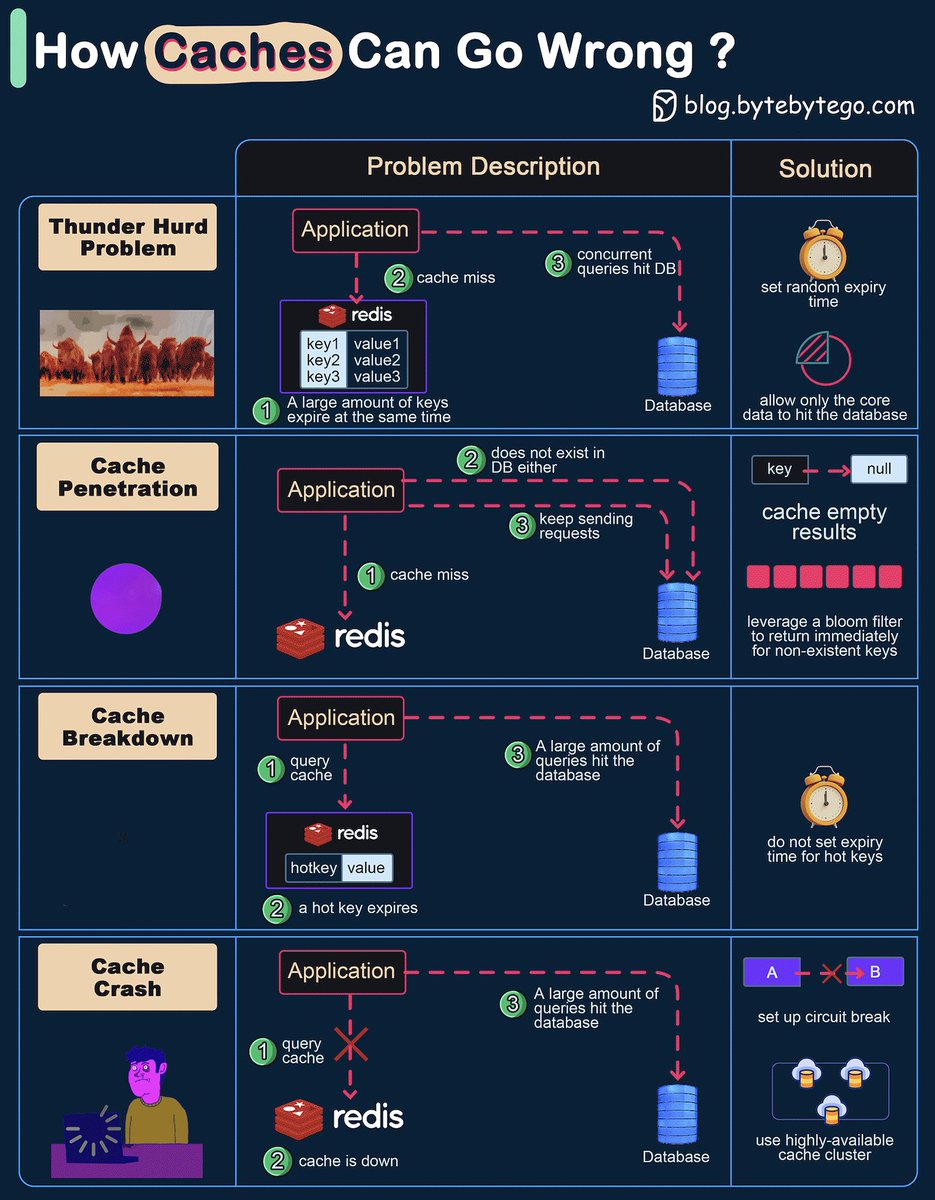
How can Cache Systems go wrong?
The diagram below shows 4 typical cases where caches can go wrong and their solutions.
1. Thunder herd problem
This happens when a large number of keys in the cache expire at the same time. Then the query requests directly hit the database, which overloads the database.
There are two ways to mitigate this issue: one is to avoid setting the same expiry time for the keys, adding a random number in the configuration; the other is to allow only the core business data to hit the database and prevent non-core data to access the database until the cache is back up.
2. Cache penetration
This happens when the key doesn’t exist in the cache or the database. The application cannot retrieve relevant data from the database to update the cache. This problem creates a lot of pressure on both the cache and the database.
To solve this, there are two suggestions. One is to cache a null value for non-existent keys, avoiding hitting the database. The other is to use a bloom filter to check the key existence first, and if the key doesn’t exist, we can avoid hitting the database.
3. Cache breakdown
This is similar to the thunder herd problem. It happens when a hot key expires. A large number of requests hit the database.
Since the hot keys take up 80% of the queries, we do not set an expiration time for them.
4. Cache crash
This happens when the cache is down and all the requests go to the database.
There are two ways to solve this problem. One is to set up a circuit breaker, and when the cache is down, the application services cannot visit the cache or the database. The other is to set up a cluster for the cache to improve cache availability.
Over to you: Have you met any of these issues in production?
--
Subscribe to our weekly newsletter to get a Free System Design PDF (158 pages): https://t.co/eVEdOFSYPY
@ZenithBank@ZenithBank what’s happening I opened an account and it’s not activated yet. It’s over 2 weeks now I can’t access my funds. I have lodged complaint on one of your branch.