Senior Research Officer at @MOJGovUK | Former ESRC Ph.D. Researcher at @UniKent investigating sexual assault at universities | Proud @CCCUPsychology alumnus
So happy to announce that, after three long years of studying, I passed my viva this afternoon!
A huge thanks to @AfroditiPina and @ProfGrahamTowl for being such supportive examiners, and to @tagannon1 for the many years of excellent supervision.
Now to write up some papers…
This week Times Higher covered a story about staff-student sexual harassment at the University of Kent. I wrote this comment piece giving some context on the issues raised.
https://t.co/Y1brkrdTVM
“We’re in a worse position now […] For a lot of us, if we had to go back & bring the complaint again, I’m not sure that we would”
Yet another HEI whose lack of transparency & obfuscation has only served to retraumatise survivors of sexual misconduct. C’mon @UniKent, do better!
Students accuse University of Kent of failing to protect them despite it upholding several complaints they made against a professor accused of sexual misconduct https://t.co/02rMppK63K via @TWilliamsTHE
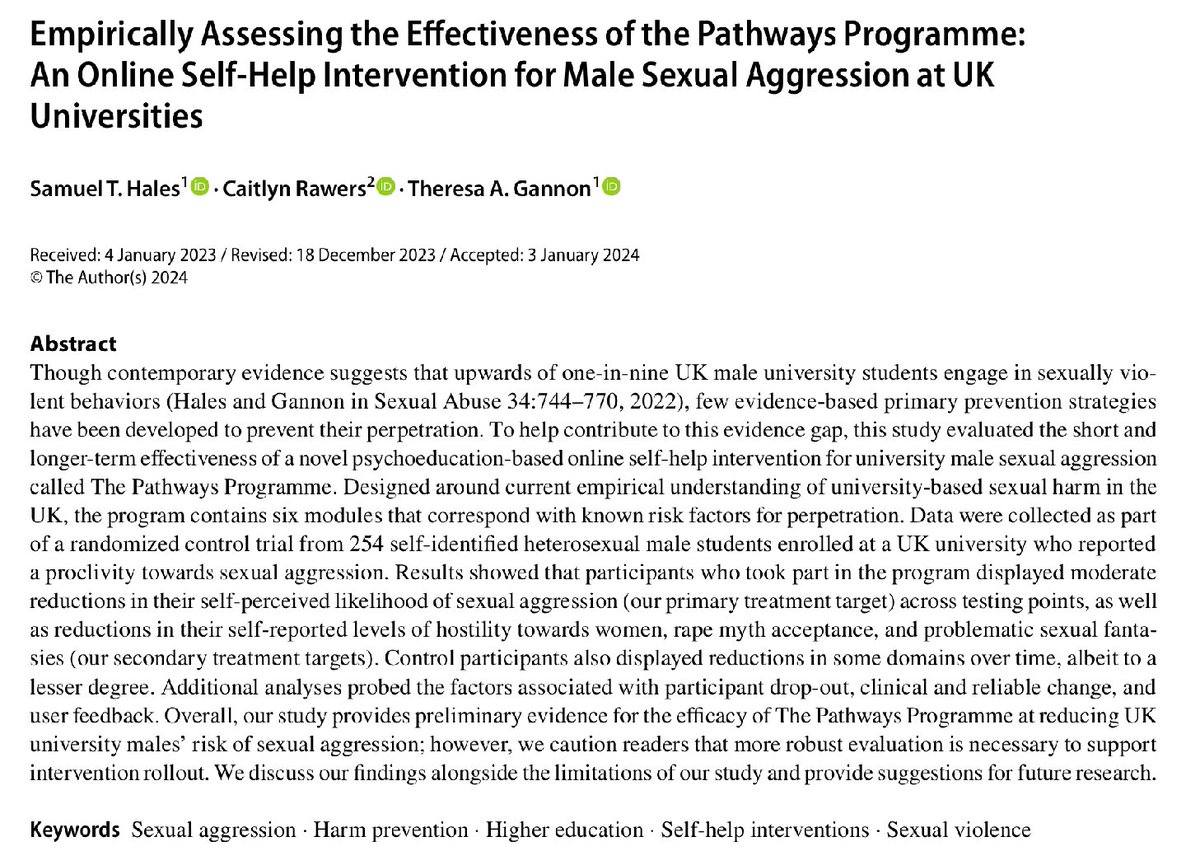
Online first in Archives of Sexual Behavior by Hales et al. (2024): Empirically Assessing the Effectiveness of the Pathways Programme: An Online Self-Help Intervention for Male Sexual Aggression at UK Universities
https://t.co/PquxiVScRy
@TheIASR@ZUCKERKJ
HOT OFF THE PRESS 🔥
A new RCT evaluation from @CaitlynRawers, @tagannon1, and I in @ArchSexBehav that reports on outcomes of the Pathways Programme – an evidence-based online psycho-education intervention for male sexual violence at UK universities.
https://t.co/AG4k9pcQlK
These early findings suggest that tailored self-help-style psycho-education interventions could be useful tools for UK universities in their fight against sexual violence. This is great news given that online programmes are easy to scale, cheap to run, and widely accessible
Results showed that the intervention group displayed larger reductions in all four outcomes than the control group, who only showed minor shifts over time. This suggests that participating in the programme helped lower the risk of sexual violence perpetration amongst our sample
NEW CAMPAIGN ALERT!
We’ve been working with @_clarissajd and The Misconduct Disclosure Scheme on a resource to help stop passing known staff perpetrators moving between HEIs.
TL:DR Get your uni to sign up to help combat ‘pass the perpetrator’
https://t.co/wetgM45QNZ
Much needed new study shines a light on the rates of sexual and domestic violence at UK universities over the past 20 years
The takeaway message: SV and DV occur at alarming rates in UK higher education and have wide reaching impacts for students, staff, and academia more widely
Check out our piece in @Wonkhe on our experiences in collaborating across intitutions & garnering institutional support for SV research - always a pleasure to work with the dream team @ngoziad@SusanLagdon & @ProfArmour@AntiBullyingCen
https://t.co/7CjcU3lqmS
New review looking at rates of USEs in HEIs across the UK, Ireland, and US – the first of its kind! Great work by @Megs__Reynolds and colleagues, as always #GBVinHE
📢 Excited to share that my systematic review examining prevalence rates of unwanted sexual experiences and its associations on uni students in the US, UK and Ireland is published! Worked on this paper w/ @ngoziad@SusanLagdon@aineaventin@ProfArmour 1/?
https://t.co/7WsWSGtuej
@Megs__Reynolds@anna_bull_@ActiveConsent @L_Burke2 @PMacneela @WFFlackJR @ProfGrahamTowl @clarissajdh @EByrnes_DCU @DarraghMcCashin @GerrardPoppy Very interesting indeed, great work all! We found similar issues when reviewing perpetration rates (i.e., inconsistencies in how SV is measured and defined, over-reliance on the SES) so clearly these are sector-wide!
Thanks for the tag, Megan!
@DrAlanUnderwood Hi Alan. There were various sub-analyses conducted, including some that looked at the impact of programme completion, participants’ suitability for the programme (as set out in the treatment manuals), and programme integrity on outcomes. Results are set out in the linked reports.
Colleagues and I at the @MoJGovUK published this week an impact evaluation of @HMPPS’ flagship accredited offending behaviour programme (OBP), the Thinking Skills Programme (TSP). We focused on two outcomes: reoffending and prison misconduct (via adjudications) [1/5]