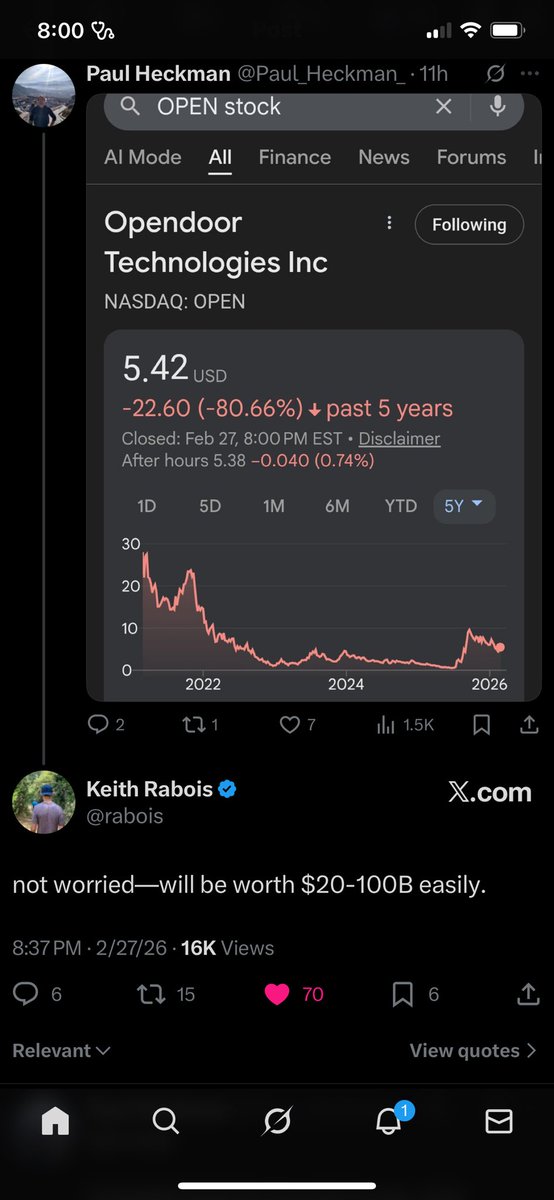
Why $OPEN keeps moving higher despite the short report
$OPEN (Opendoor Technologies) climbed nearly 10% even after a short report questioned the company’s path to profitability. For now, investors appear to be focusing more on the company’s long-term strategy than its current challenges.
The biggest change is Opendoor 2.0.
In the past, Opendoor made money by buying homes, holding them, and selling them later. That worked when the housing market was strong, but it also meant the company carried a lot of risk. If home prices fell or homes took longer to sell, Opendoor could lose money while paying financing costs.
Think of it like owning thousands of cars waiting to be sold. If demand suddenly slows, you’re stuck with expensive inventory that keeps costing money every day.
Opendoor 2.0 is trying to change that.
Instead of relying as much on owning homes, the company wants to become more of a technology platform that uses AI to price homes more accurately, shorten holding periods, and reduce inventory risk.
AI can analyze millions of data points—including local home prices, neighborhood demand, mortgage rates, school districts, renovation costs, and recent sales—to estimate a home’s value much faster than traditional methods. If its pricing becomes more accurate, Opendoor can avoid overpaying for homes and improve profit margins.
The long-term opportunity goes beyond buying and selling homes.
Think about Amazon. It started by selling books but eventually became a platform offering payments, advertising, cloud services, and logistics.
Opendoor could follow a similar path. If more buyers and sellers use its platform, the company could eventually expand into mortgages, title services, insurance, renovations, moving services, and other real estate products, creating multiple revenue streams instead of relying only on home sales.
Of course, the risks remain.
The short report argues that the company is still losing money, stock-based compensation is high, and the current housing market remains challenging. It also questions whether the new business model can consistently generate profits.
The bigger picture is that Opendoor is trying to transform from a house flipper into a real estate technology platform. If management successfully reduces inventory risk while growing higher-margin services, the business could become much more scalable over time. But if the housing market stays weak or the new strategy doesn’t improve profitability, investors may continue to question its valuation.
Today we're launching a new Opendoor app on iOS
You can browse homes, see prices and home details, book a tour in a few taps, and manage everything in one place
Try it out and let me know what else you'd like to see us build into the app
Q1 Financial Open House, streaming on X, YouTube, or Robinhood today at 2pm PT.
Wait til you hear what our lifecycle lead did (along with the other good stuff) https://t.co/UzpSEFqfdf
Escrow & Closing is to Opendoor what AWS was to Amazon. The infra we use to run our business. It is great. We want it to power what others are building.
Today, Opendoor acquired Doma’s escrow services to make home closing faster, cheaper and more certain. For everyone.
https://t.co/PmYiTdIVuL
Opendoor is getting attention for offering mortgage rates that look "below market" and I want to talk about it. This isn't some magic trick. It's actually pretty basic. Here's how we do it:
Opendoor mortgage rates aren't marked up. The end.
See, when people talk about "market rates" for mortgages, they telling you about the rates they see online from their lender, or from Mortgage News Daily, or some other source. Remember: those rates include 350 basis points of markup on average, based on self-reported data to the Mortgage Bankers Association.
350 basis points is not nothing.
As a rough rule of thumb, every 100 basis points markup raises a consumer's mortgage rate by 0.25 percentage points. So, let's all acknowledge that "market rates" in mortgage reflect 350 basis points of markup, which raises a customer's mortgage rate by roughly 0.875.
Opendoor changed that. Our mortgage rates are what happens when you take that markup out. It's like what E*TRADE did for stocks. In the 1980s, the market price of a stock was whatever its price was plus whatever your broker charged. It's why every broker had a different price. Today, the price of a stock is the same everywhere.
So if Opendoor's mortgage rates look "below market" to you, they're actually not. This is just the first time you're seeing mortgage rates without a massive markup.
More here: https://t.co/2aCXeVfFn8