Sunyani was amazing with the #BoysLivesMatter school tour! A big thank you to all the radio stations that welcomed me and gave me the platform to engage with their audiences. ❤️
Next stop, Kumasi for Rapperholic! 🙌🏾
Thank God for everything. The journey continues!
#PolishTillYouShine
We laughed, we got real, we made a toast to bigger things ahead 🍾
@sarkodie, like you've never heard him before. Full episode drops tonight at 6pm.
Subscribe and don’t miss it: https://t.co/GTSEC1xcuA
1. Is Ghana out of the fiscal woods yet?
2. The exchange rate, inflation, policy rate, government borrowing costs, all seem to be pointing the right way.
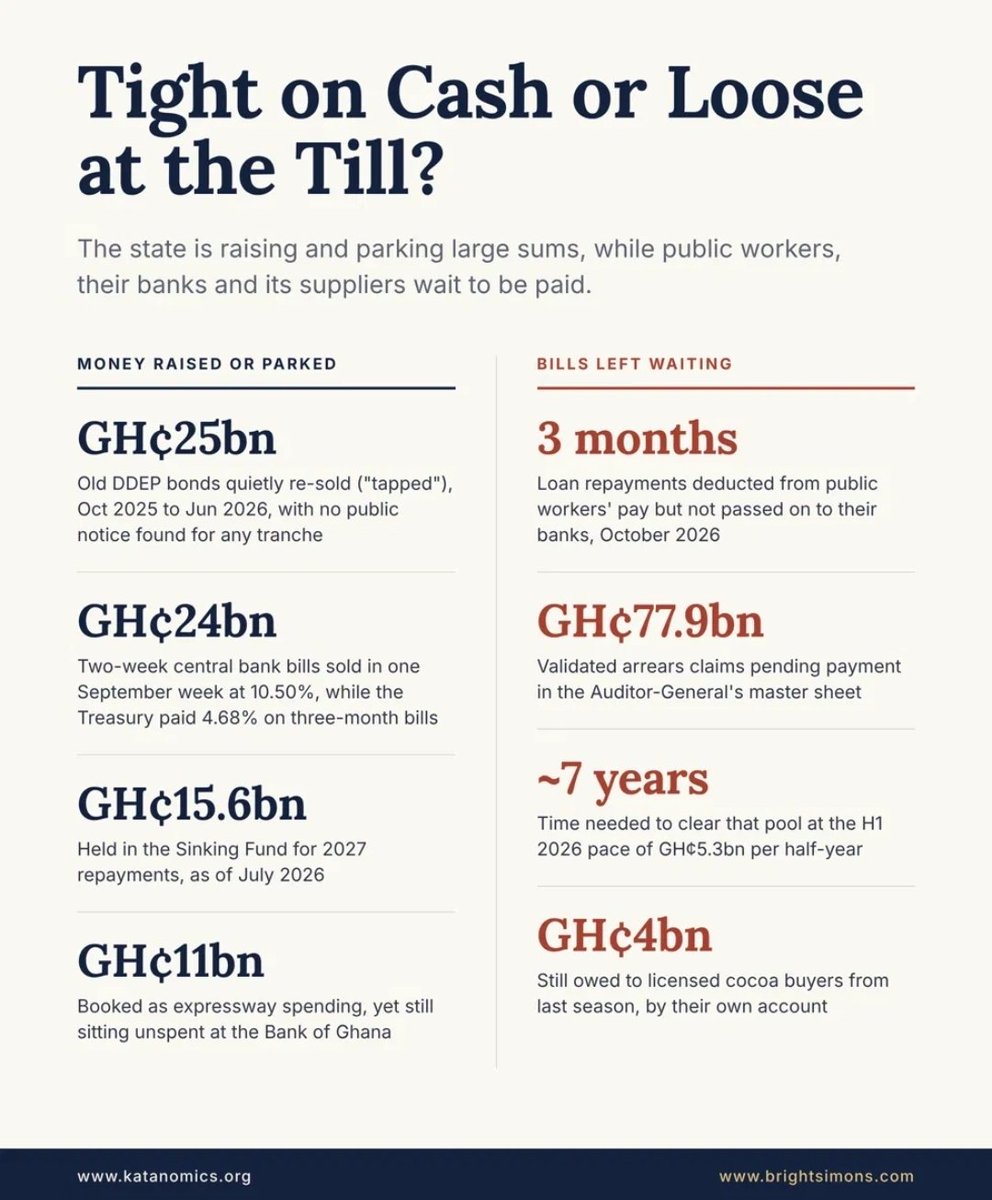
3. Yet, banks are threatening to block new loans to government workers because the controller/accountant-general deducts loan payments from pay and holds on to them rather than remit to the banks.
4. Public sector workers feel hard done by.
5. Contractors, licensed cocoa buyers, and the "coalition of unpaid nurses" and "unpaid teachers from colleges of education" have been protesting for much of 2025 and 2026 about months-old ARREARS.
6. Howzat?
7. Is there a cashflow problem or not?
8. One answer sounds like "fiscal austerity". Government has more fiscal leeway than ever, they say, but it is being extremely prudent so that the country doesn't skid off the fiscal rails.
9. Finance Ministry mandarins talk about massive restraint on the debt markets, for instance.
10. Well, analysts are pointing to a pattern that suggests that this neat story isn't that simple.
11. We all remember DDEP. Most of us by way of trauma. After the government declared itself bankrupt in 2022, its long-term bonds were restructured.
12. For most casual observers of the fiscal scene, the pain of DDEP has led to government having to rely on short-term treasury bills and a recent bond issuance wasn't too encouraging.
13. The truth, like I hinted, is more complicated. Between October 2025 and June 2026, the government issued about GH¢32.9 billion of domestic bonds. That is almost $3 billion.
14. Yet, only GH¢2.7bn (~$240 million), i.e. the lackluster showcase seven-year bond in April, went through the publicised sale.
15. Roughly GH¢25bn (~$2.2 billion) came from "taps" of the old restructured bonds, i.e. the DDEP bonds. There was no public individual notice for these issuances that the average investor would have seen. Another GH¢5bn went straight to the Bank of Ghana.
16. The Finance Ministry's bulletin calls the April sale the first issuance since the 2023 debt exchange, yet its tables show about GH¢22bn having been issued quietly in the preceding six months by "tapping" (i.e. reopening and selling) the old bonds and pacifying the Bank of Ghana with a "recapitalisation" bond.
17. Priced at the market yields of the time, the taps cost about 14.2 per cent (model-inferred), against 12.5 and 12.0 per cent on the advertised deals. That is to say those investors who got approached to buy got a better deal than those who bought into the more open and transparent April deal. Or the taps were placed nearer face value and someone else absorbed the loss. How to know?
18. The state took on roughly GH¢25bn of debt for about GH¢20bn in cash, a gap of around GH¢5bn, plus GH¢1.9 - 2.4bn in extra interest over the bonds' life. These are inferred estimates.
19. Of course, parallel pricing of state/public debt is now becoming familiar in Ghana. On 25 September, the Treasury paid 4.68 per cent on three-month bills, while the central bank paid 10.50 per cent on two-week bills a few days later. That week, the central bank borrowed about GH¢24bn and the Treasury about GH¢2.9bn.
20. The central bank's interest bill on these operations doubled to GH¢16.73bn in 2025. That GH¢8.1bn rise almost cancels the GH¢8.8bn of "savings" the Treasury claimed from its acclaimed "tight management" of fiscal policy.
21. Basically, similar to the effect we pointed out in 2024 when the government started issuing undercover bonds and selling on juicier terms to a select few investors, ordinary savers forced to rely on treasury bills are earning far less than rich institutions with access to these mouth-watering government debt products.
22. Howzat?
It gives me great pleasure to share this new ODI talk. In the video, I introduce the "triad of distractions" around AI safety, inequity, and employment concerns.
I argue that because all the current emphasis is on super-intelligent models going rogue, a strategic blindspot has grown around the possibly more dangerous phenomenon of "hazardous integrations".
1. We propose the "nkonsonkonson" model (from the ideography of Akan Adinkra) to re-center "integrations" as the "one ring" among the three dimensions of digital power (data, algorithms, and integrations) to rule them all.
2. AI costing is poorly understood, leading to a mischaracterisation of the technology's "productivity profile," and thus, very likely, its employment impact.
3. And, finally, the "equity" questions surrounding AI usually underweight the "civilisational" character of the fast-exploding new tech, and thus also the issue of "cultural intelligence."
Video in thread.
**STORMS DO NOT CANCEL PURPOSE.**
UT taught me valuable lessons about business, resilience, and leadership. Today, through PKALF, I use those lessons to develop the next generation of leaders.
Sometimes, life redirects us towards a greater purpose.
#TheUTStory#BouncingForward
Africa’s “own” credit rating agency (AfCRA) launched on October 7th. It has sparked something of a celebratory mood.
There were fierce debates ahead of its setup. But now that it has joined the stable of the continental institutions, debate must give way to constructive analysis about how to make it better.
Some facts:
1. AfCRA is not yet fully operational. It is currently 100% owned by Plus94 (co-founded by Sifiso Falala), and US$15m is being sought to build out the agency.
2. Plus94 is a market surveys company.
3. Sifiso Falala and other Plus94 principals own most of and control Sovereign Africa Ratings (SAR), which is where the rating capacity actually sits.
4. AfCRA is thus "essentially" the rebranding of a South African ratings company called Sovereign Africa Ratings (SAR).
5. The $15m is needed to build the operating platform, obtain licenses in multiple African markets, hire analytical talent, develop methodology, acquire data, build technology, and fund working capital.
6. A Mauritius “parent company” has now been set up to buy 51% of the former SAR. This Mauritius “parent company” must conclude various “post-incorporation” actions and raise the money. Only then does AfCRA become truly operational (see attached).
7. AfCRA says it operates under a Mauritian global business licence, but has yet to publish an actual credit-rating licence number.
8. $15 million is unlikely to be able to create a full pan-African presence (one of the criticisms of the international rating agencies has been their apparent lack of sufficient presence on the ground.)
9. AfCRA’s prospectus proposes a US$7.5 million pre-money value and a US$22.5 million post-money value. New investors contribute US$15 million for 66.67% of the Mauritius parent, while Plus94 retains 33.33% (worth $7.5m).
10. However, the pass-through interest that investors get in the former SAR by investing in the Mauritius parent would be 34%.
11. The prospectus concedes that the new group would be pre-scale, and has not yet demonstrated recurring-revenue potential.
12. SAR’s disclosed rating revenue was under $90,000, all from the government of Zanzibar, in its last financial disclosure. It has four known rating analysts.
13. SAR obviously has no pan-African presence. An assessment of some of its reports on Ghana, Kenya, Uganda, and Egypt showed limited exposure, including getting the inflation numbers wrong, and policy rates confused, for Ghana.
14. The preliminary business plan was reported to be focused on winning mandates to rate domestic debt, hardly the terrain of the “international bias” that earlier campaigns focused on.
15. Both SAR and AfCRA have one thing going for them, though: an AU brand association and endorsement.
16. For market acceptance, and the ability to positively influence Africa’s cost of capital (AfCRA’s declared objective), however, those advantages are clearly insufficient.
17. It goes without saying that AfCRA has a massive amount of work ahead.
18. One key challenge is that recognition is needed from European and American regulators for its ratings to matter to some of the big global investors. Looks like going to the same "biased quarters" for help?
19. We hope for the best.
20. PS: detailed report of concerns raised ahead of launch is in the thread.
The National Vaccine Institute has disclosed to Parliament's Public Accounts Committee that it spent GH¢13 million on training, seminars, and conferences in 2025.
This follows an Auditor-General's Report showing the Institute's financial position shifted from a GH¢36 million profit to a GH¢21 million loss.
PAC Chairperson Abena Osei-Asare has directed the Ministry of Health to investigate the expenditure.
#3NewsGH #TV3GH