Across the world lie monuments older than recorded history.
Pyramids. Sphinx. Megaliths. Forgotten cities.
Some believe they hide the greatest secret in human history.
"The Hall of Records"
#AncientMysteries#LostCivilizations
The Sayhuite Stone — Peru.
A massive granite monolith covered with hundreds of carvings.
Terraces.
Channels.
Pools.
Stairways.
An entire miniature landscape carved into a single stone.
Water can still flow through many of its channels today.
Some researchers believe it may have been a hydraulic model.
Others see a symbolic map of a sacred landscape.
Whatever its purpose, the level of detail is astonishing.
A whole world...
carved into rock.
#AncientMysteries #LostCivilizations
The Sayhuite Stone — Peru.
A massive granite monolith covered with hundreds of carvings.
Terraces.
Channels.
Pools.
Stairways.
An entire miniature landscape carved into a single stone.
Water can still flow through many of its channels today.
Some researchers believe it may have been a hydraulic model.
Others see a symbolic map of a sacred landscape.
Whatever its purpose, the level of detail is astonishing.
A whole world...
carved into rock.
#AncientMysteries #LostCivilizations
Beautifully said. Perhaps that is why so many of these ancient sites continue to fascinate us. They are not merely monuments, but lessons carved into stone—teaching through geometry, symbolism, astronomy, and scale. Whether their purpose was practical, spiritual, or both, they seem designed to make us think, observe, and question our place in the world. Thousands of years later, the lesson is still working.
The Unfinished Obelisk — Egypt.
Still anchored to the granite bedrock at Aswan.
More than 40 meters long.
Estimated weight:
over 1,100 tons.
The largest stone the ancient Egyptians are known to have attempted to carve.
A single block of granite.
Not assembled.
Not stacked.
One stone.
The crack running along its length ended the project before completion.
Had it survived, it would likely have become the largest obelisk ever erected.
Even unfinished, it remains one of the most extraordinary engineering projects of the ancient world.
#AncientEgypt #AncientMysteries
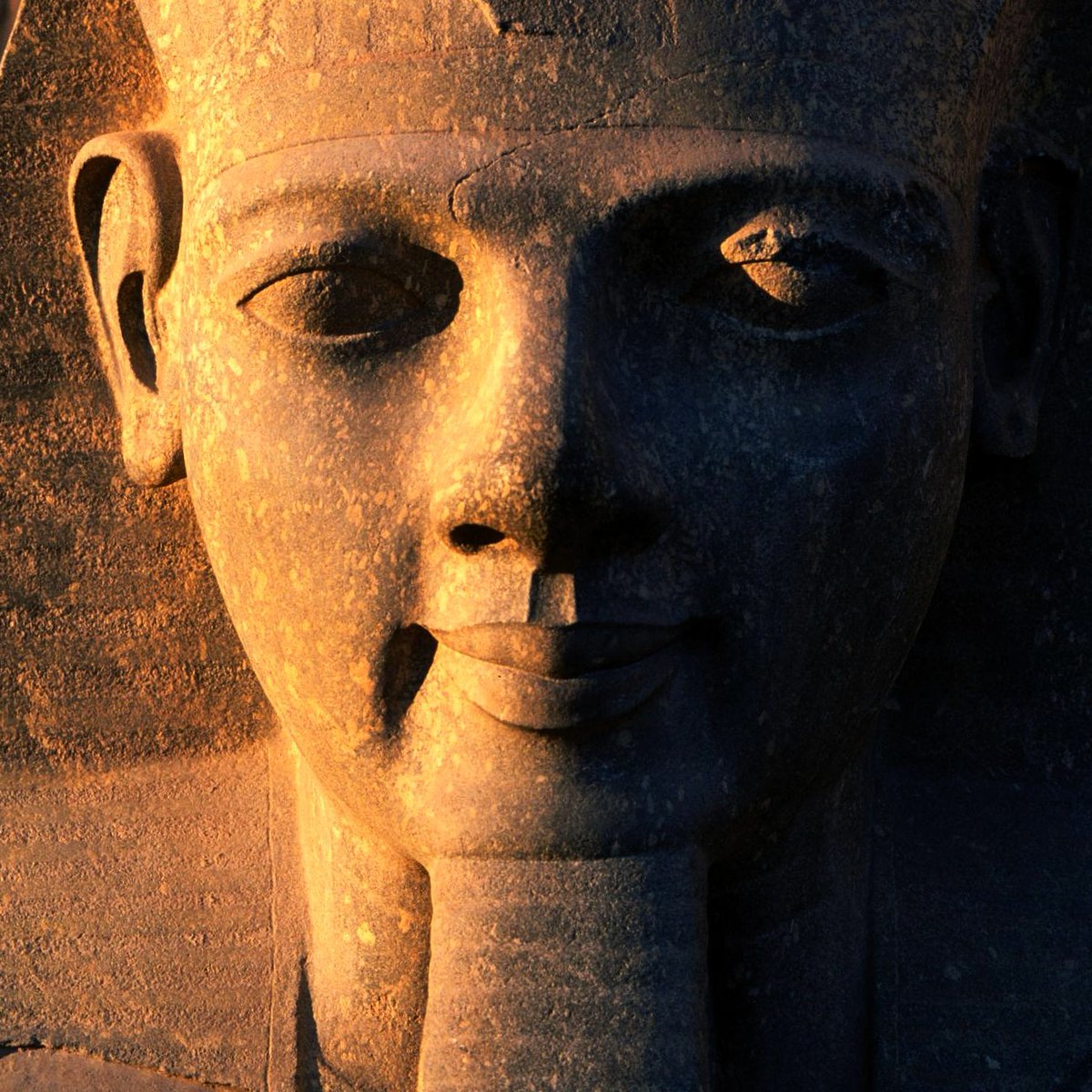
Luxor Temple — Egypt.
One of the colossal granite statues of Ramesses II is said to be so symmetrical that if you mirror one half of the face...
it almost perfectly recreates the other.
Over 3,000 years old, and carved from hard granite.
Yet displaying a level of precision that still impresses modern observers.
So perfectly symmetrical to appear inhuman...
almost alien.
The ancient Egyptians associated symmetry with Ma’at — order, harmony, balance, and cosmic perfection.
What are we looking at here?
#AncientEgypt #AncientMysteries
If the symmetry demonstration is accurate, it raises an interesting question:
How did Egyptian sculptors verify such precision on a monument of this scale?
The Tower of Jericho — West Bank.
One of the oldest surviving monumental structures on Earth.
Built around 8,000 BC, it was already ancient when the pyramids were built.
And when Göbekli Tepe was still standing...
this tower may have been among the very few large stone structures visible anywhere in the world.
Constructed by a society that had not yet invented metal or writing.
Yet, at over 8 meters tall, it demonstrates remarkable engineering and organizational skill.
Some researchers even believe it may have had astronomical significance.
Together with the remains of the Taş Tepeler culture in Turkey, the Tower of Jericho suggests that humanity possessed far more advanced capabilities than we often give our ancestors credit for.
Perhaps too advanced for mere hunter-gatherers to have seemingly developed such skills and knowledge out of nowhere?
#AncientMysteries #LostCivilizations
@Associatio8486 Interesting, thanks. I once watched a documentary that hypothised it was built as an observation post for the night sky and stars, which I findfascinating. As you say, either way, it is outstanding.
@MarcoPrinzi1 Yes.
But hunter-gatherers were not really supposed to possess organized labor, engineering expertise, and monumental architecture on this scale.
Yet here we are.
@MarcoPrinzi1 Perhaps the most intriguing line in the entire King List:
"After kingship descended from heaven..."
Not emerged.
Not developed.
Descended.
What if the ancients were telling the truth?
Across the world, civilizations separated by oceans and millennia recorded the same astonishing claim:
That history began long before recorded history.
Not with ordinary kings...
but with divine rulers, demi-gods, and ancient dynasties stretching thousands — sometimes tens of thousands — of years into the past.
Egypt.
Mesopotamia.
India.
Different cultures.
Strangely similar stories.
Coincidence?
🧵👇
#AncientMysteries #LostCivilizations
@MarcoPrinzi1 The Puranas do not describe history as a straight line.
They describe vast cycles of civilization, destruction, and renewal spanning immense periods of time.
@MarcoPrinzi1 The most controversial part of the Turin King List is not the pharaohs.
It is the rulers who come before them:
Gods.
Demi-gods.
The Followers of Horus (Shemsu Hor).
Egypt's own scribes recorded them as part of history.