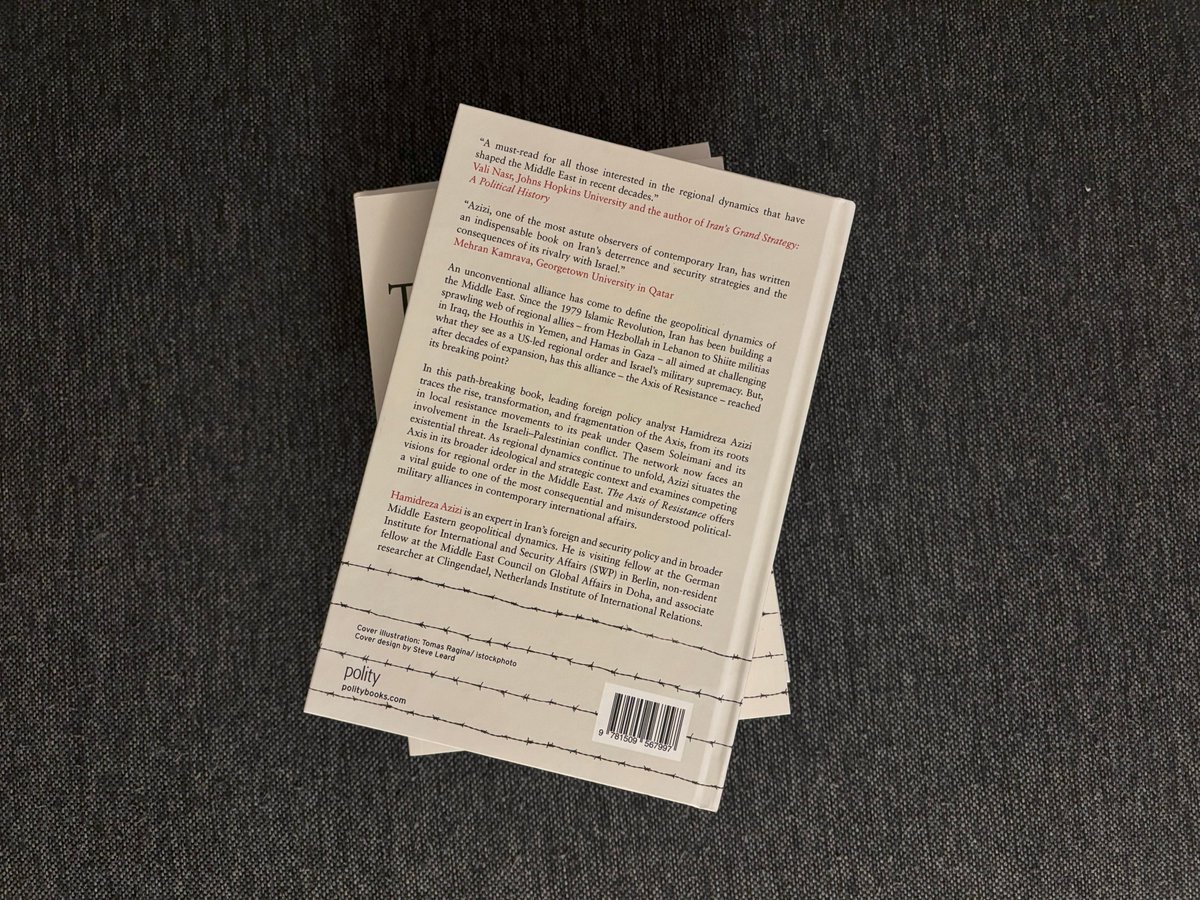
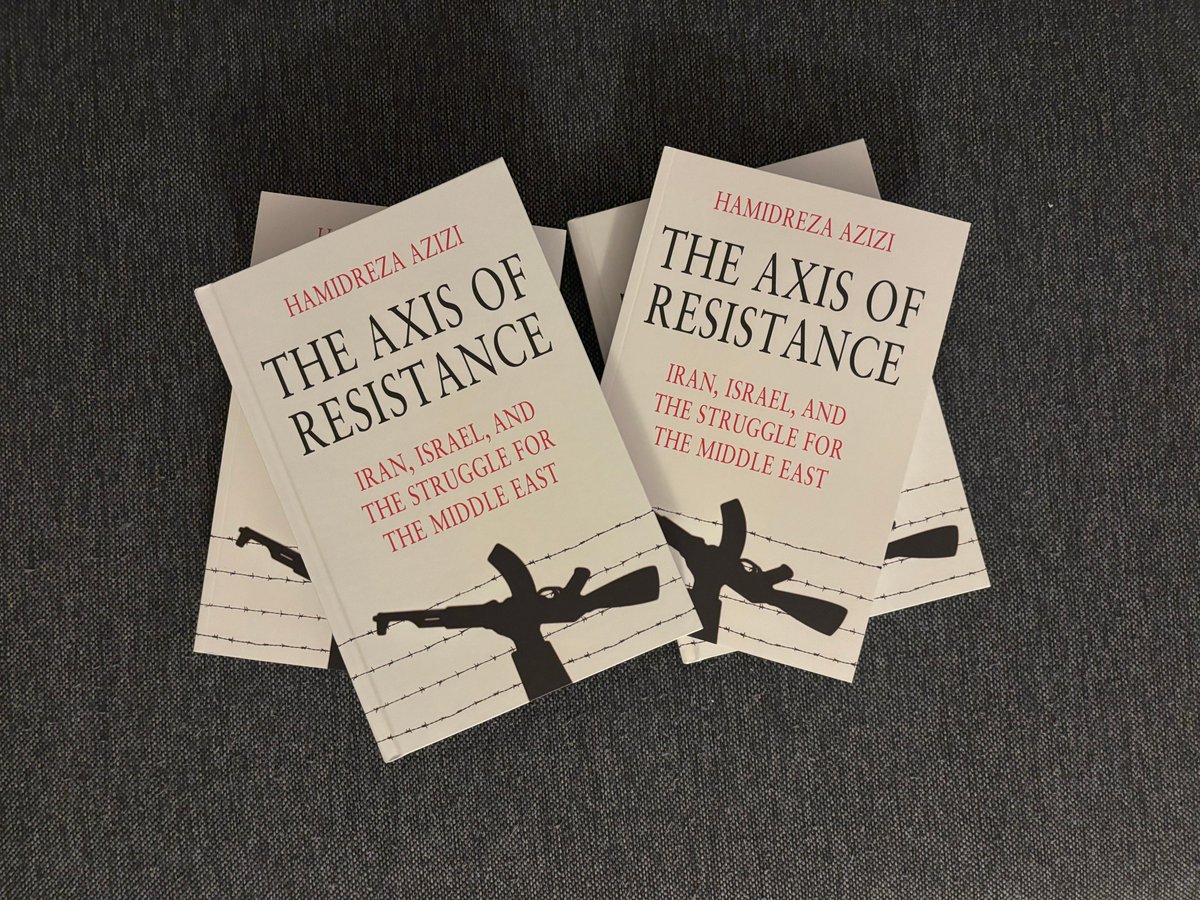
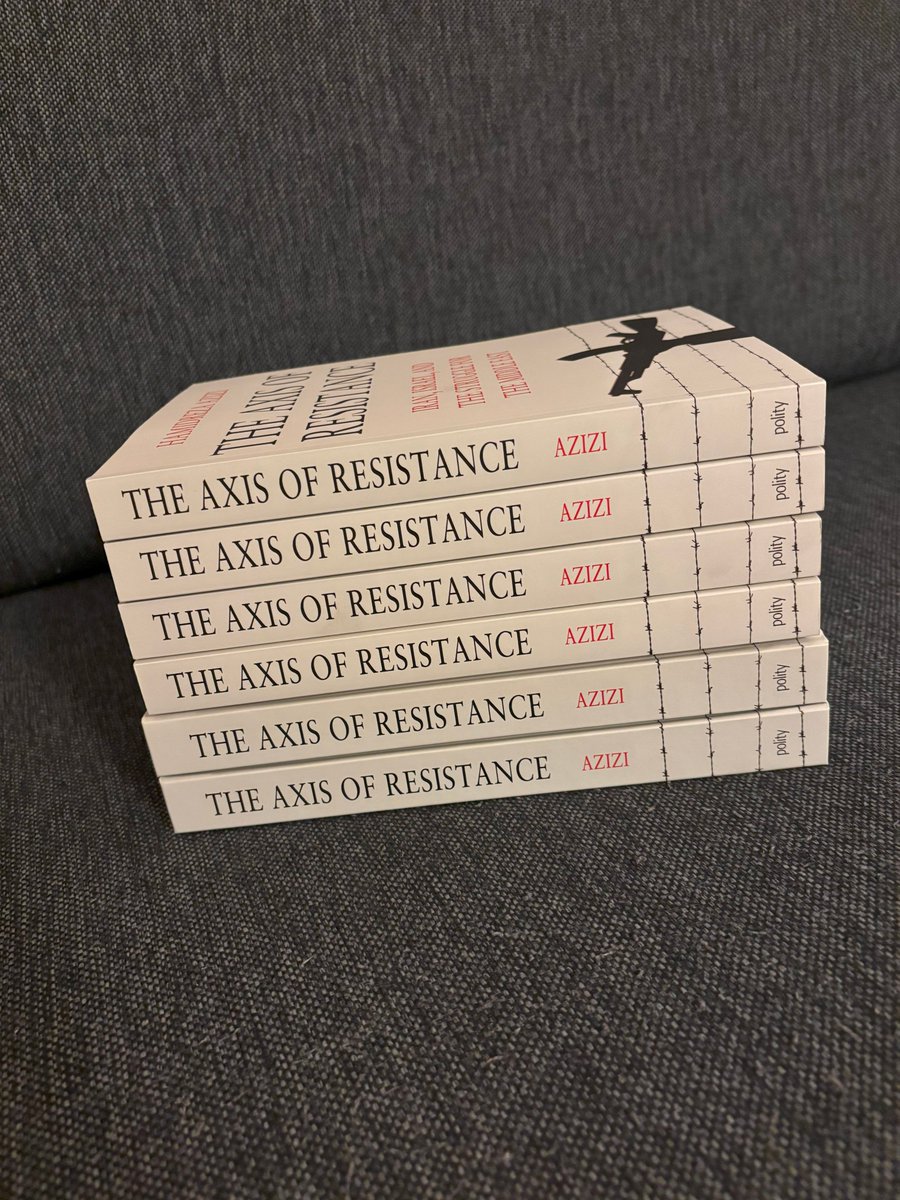
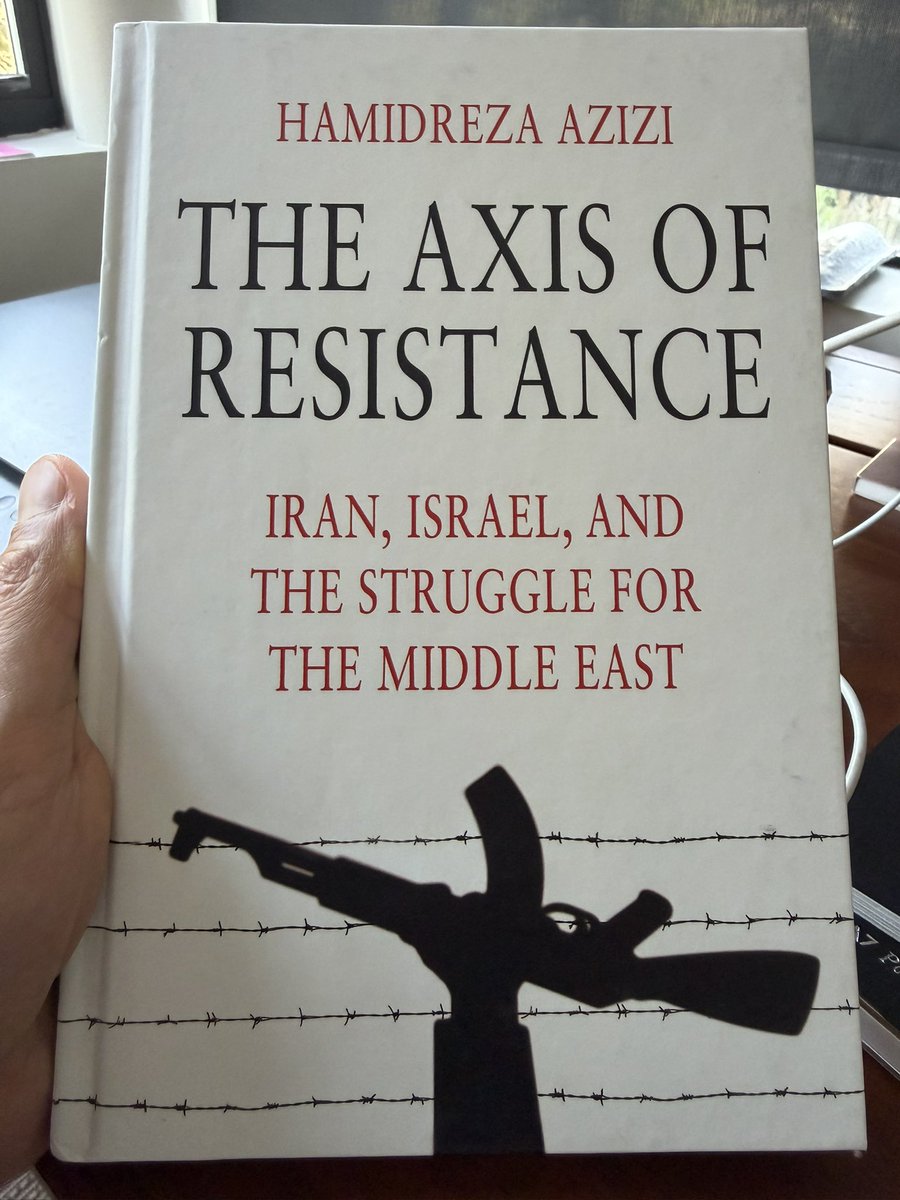
And finally… the author copies have arrived!
It’s a great feeling to hold the finished book after such a long process.
The Axis of Resistance: Iran, Israel and the Struggle for the Middle East
UK & EU: May 8 | US & North America: July 14
@politybooks
Some of the reactions to this analysis have been truly amazing. People want to hear what they like, not what they need to hear.
I was the one who wrote more than 2,500 words in March on how #Iran had rewritten its war strategy (https://t.co/0Hw3CJfYbV), and I now clearly see that it does not have an effective strategy for the current phase of the conflict. What worked during the 40-day war is not supposed to work today because the nature of the conflict has changed.
Two more points:
1. Iran not having a coherent strategy does not automatically mean that Trump has one. Both sides are essentially resorting to the same tactics, hoping they will produce a different outcome. The U.S.'s main advantage remains its air superiority, given Iran's almost complete lack of effective air defense.
2. If you think I am being biased, you would be surprised to hear and read what military analysts in Iran – including, and especially, pro-government experts – are saying about the shortcomings of their own strategy.
In any case, my job is not to please anyone. It is to point out unpleasant facts to those who are willing to hear them.
A few thoughts on the latest escalation:
During the 40-day war, #Iran had a clear targeting strategy, and each set of targets served a specific purpose. In the first stage, Iran targeted U.S. radar and early-warning systems at bases across the region. The aim was to enable longer-range strikes against Israel later. At the same time, Iran targeted those U.S. bases that could be used for a potential ground operation against Iran, including bases in Kuwait, Al-Harir in Iraq, as well as some bases in the UAE that could be used for operations against Iranian islands. At the same time, attacks on energy infrastructure in the region were intended to maximize economic pain.
This time, however, despite the effective resumption of war, Iran continues to target U.S. bases (in Kuwait and Bahrain) that have already been attacked several times. This may partly reflect efforts to strike new installations deployed by the United States at those bases. But when judged against current U.S. objectives, these attacks do not appear particularly helpful to Iran.
During the previous round of war, the U.S. had a broader set of objectives, including regime change, a potential ground operation to sieze HEU stockpile, and the targeting of Iran’s missile capabilities. In this round, however, the U.S. is focused on weakening Iran’s ability to threaten the Strait of Hormuz, and it is carrying out strikes toward that objective every night.
These operations rely primarily on capabilities that the United States already has in the region, as well as on the reimposition of the naval blockade, which depends on U.S. warships and naval forces. Iranian attacks therefore do not appear to be deterring the United States from continuing its strikes.
Therefore, it appears that Iran’s only strategy at this moment is to keep the Strait closed for as long as possible while the United States continues drawing down its strategic oil reserves, until the impact on the global oil market and the U.S. economy becomes irreversible. Iran hopes that this would push Trump to reconsider his position. Of course, this is a risky bet at a time when Iran remains under constant and heavy attack.
Reports from #Iran indicate that, over the past couple of days, attacks on different areas in Sistan and Baluchestan Province in southeastern Iran have increased.
That region is important for two reasons. On the one hand, it is where Chabahar is located, which is Iran’s only oceanic port and provides the country with maritime access beyond the Persian Gulf and the Strait of Hormuz.
On the other hand, given the region’s ethnic and religious composition and the history of insurgent groups operating there, there are concerns that the attacks in Sistan and Baluchestan may be aimed at creating conditions for the rise and advance of Balochi insurgents and increasing pressure on the Islamic Republic.
In this context, there was an attack on the night of July 14 against the headquarters of Brigade 388 in Bampur, Sistan and Baluchestan, in which several soldiers were killed and dozens were injured. This is important because Brigade 388 is the third brigade of the 88th Armored Division of Sistan and Baluchestan, which is tasked with countering potential amphibious assaults.
As such, according to Iranian military analysts, the U.S. may also be preparing for a ground operation in southern Iran - especially since the USS Boxer Amphibious Ready Group is still in CENTCOM area of operation.
At the same time, analysts note that together with the two other brigades of the same division, Brigades 188 and 288, the Brigade 388 has also been involved in counterterrorism operations and in securing Iran’s eastern borders against armed insurgent groups.
Qalibaf has just delivered one of the most comprehensive statements of Iran's strategic thinking since the latest phase of the conflict began.
Few lines here:
- He argues that Iran neither seeks war nor fears it, but must always be prepared to fight while using diplomacy as an equally essential instrument of national security.
- He defends the closure of the Strait of Hormuz during the 40 day war, says it enabled Iran to secure an "Iranian arrangement" for the Strait later reflected in Article 5 of the MoU, warns that the United States is now trying to weaken that achievement through military pressure, and insists that Tehran has no reason to uphold any agreement from which it no longer benefits.
- He rejects any separation between military action and diplomacy, extends the same logic to sanctions, Lebanon, U.S. bases in the region and revenge for Khamenei's assassination, and calls for national unity while reaffirming that Iran's armed forces retain full freedom of action.
- From my point of view, the speech signals something more significant than a reaffirmation of Iran's traditional deterrence doctrine. Qalibaf is publicly describing a strategic framework in which military operations, negotiations, economic pressure and political messaging are no longer treated as separate tracks but as different phases of the same campaign.
- As emerged elsewhere, the battlefield is expected to shape diplomatic outcomes, while diplomacy is expected to preserve and legitimize the gains produced on the battlefield. I guess this is a more integrated conception of statecraft than the one Tehran articulated in previous years.
- The emphasis on the "Iranian arrangement" in the Strait of Hormuz is particularly revealing. It suggests that Tehran increasingly sees the post-war maritime order not as a temporary emergency measure but as a strategic reality that should survive the fighting itself.
- In this narrative, the MoU is valuable only insofar as it protects and institutionalizes that new balance of power. If Washington attempts to reverse it through military coercion or fails to implement its commitments, Iran reserves the right to abandon the agreement while continuing to defend what it now considers an established strategic achievement.
- That is a much broader message than simply threatening retaliation: it is an attempt to redefine the political terms on which any future negotiation with the United States will eventually take place.
#Iran
If the U.S. and Iran allow even this modest understanding to disappear, the next cease-fire will become merely the pause before the next battle — and war, rather than diplomacy, could well become the permanent condition. My latest for @NYTOpinion
https://t.co/eLQi0nWC03
Told @WSJ that the Iranians don't want to escalate to the point where escalation would get out of control, where Trump is out of options other than more extreme military options
https://t.co/od0w17FXem
Reports from #Iran indicate that, over the past couple of days, attacks on different areas in Sistan and Baluchestan Province in southeastern Iran have increased.
That region is important for two reasons. On the one hand, it is where Chabahar is located, which is Iran’s only oceanic port and provides the country with maritime access beyond the Persian Gulf and the Strait of Hormuz.
On the other hand, given the region’s ethnic and religious composition and the history of insurgent groups operating there, there are concerns that the attacks in Sistan and Baluchestan may be aimed at creating conditions for the rise and advance of Balochi insurgents and increasing pressure on the Islamic Republic.
In this context, there was an attack on the night of July 14 against the headquarters of Brigade 388 in Bampur, Sistan and Baluchestan, in which several soldiers were killed and dozens were injured. This is important because Brigade 388 is the third brigade of the 88th Armored Division of Sistan and Baluchestan, which is tasked with countering potential amphibious assaults.
As such, according to Iranian military analysts, the U.S. may also be preparing for a ground operation in southern Iran - especially since the USS Boxer Amphibious Ready Group is still in CENTCOM area of operation.
At the same time, analysts note that together with the two other brigades of the same division, Brigades 188 and 288, the Brigade 388 has also been involved in counterterrorism operations and in securing Iran’s eastern borders against armed insurgent groups.
NEW: Following the Israeli-US killing of key Iranian political and military leaders in February, questions have arisen over the leadership of the hardline current in Tehran (and to what extent it wields influence).
As Iran and the US resume fighting, those figures are coming to the fore—and many of them are familiar faces who were perhaps prematurely dismissed as relevant..
Yours truly debating friends and colleagues Sima Shine, @MBaharoon, and Nate Swanson, expertly moderated by @SanamVakil, at @ChathamHouse (London) July 13, 2026. Video: https://t.co/DrGaSEWvcg
The Iranian system seems to have reverted to being cautious, dithering, and risk-averse which underscores that Iran is still living under Khamenei Sr.'s shadow rather than undergoing a generational shift toward the Third Islamic Republic marked by Mojtaba's ascension.
The Sana’a–Tehran corridor was blocked, but the Saudi–Houthi front reopened
In doing so, the IRGC offered its most overt public backing of the Houthis to date.
My latest Horizon Brief examines the developments, who gained, what changed, escalation pathways, geopolitical calculus & what to watch next👇
Read: https://t.co/ZX0t2rTPEK
A few thoughts on the latest escalation:
During the 40-day war, #Iran had a clear targeting strategy, and each set of targets served a specific purpose. In the first stage, Iran targeted U.S. radar and early-warning systems at bases across the region. The aim was to enable longer-range strikes against Israel later. At the same time, Iran targeted those U.S. bases that could be used for a potential ground operation against Iran, including bases in Kuwait, Al-Harir in Iraq, as well as some bases in the UAE that could be used for operations against Iranian islands. At the same time, attacks on energy infrastructure in the region were intended to maximize economic pain.
This time, however, despite the effective resumption of war, Iran continues to target U.S. bases (in Kuwait and Bahrain) that have already been attacked several times. This may partly reflect efforts to strike new installations deployed by the United States at those bases. But when judged against current U.S. objectives, these attacks do not appear particularly helpful to Iran.
During the previous round of war, the U.S. had a broader set of objectives, including regime change, a potential ground operation to sieze HEU stockpile, and the targeting of Iran’s missile capabilities. In this round, however, the U.S. is focused on weakening Iran’s ability to threaten the Strait of Hormuz, and it is carrying out strikes toward that objective every night.
These operations rely primarily on capabilities that the United States already has in the region, as well as on the reimposition of the naval blockade, which depends on U.S. warships and naval forces. Iranian attacks therefore do not appear to be deterring the United States from continuing its strikes.
Therefore, it appears that Iran’s only strategy at this moment is to keep the Strait closed for as long as possible while the United States continues drawing down its strategic oil reserves, until the impact on the global oil market and the U.S. economy becomes irreversible. Iran hopes that this would push Trump to reconsider his position. Of course, this is a risky bet at a time when Iran remains under constant and heavy attack.
I still do not see the targeting of regional infrastructure as being on the cards, unless the United States pushes toward an infrastructure war. Bab al-Mandab, together with the Strait of Hormuz, could nevertheless increase the aggregate economic pain and support Iran’s broader strategy.
A few thoughts on the latest escalation:
During the 40-day war, #Iran had a clear targeting strategy, and each set of targets served a specific purpose. In the first stage, Iran targeted U.S. radar and early-warning systems at bases across the region. The aim was to enable longer-range strikes against Israel later. At the same time, Iran targeted those U.S. bases that could be used for a potential ground operation against Iran, including bases in Kuwait, Al-Harir in Iraq, as well as some bases in the UAE that could be used for operations against Iranian islands. At the same time, attacks on energy infrastructure in the region were intended to maximize economic pain.
This time, however, despite the effective resumption of war, Iran continues to target U.S. bases (in Kuwait and Bahrain) that have already been attacked several times. This may partly reflect efforts to strike new installations deployed by the United States at those bases. But when judged against current U.S. objectives, these attacks do not appear particularly helpful to Iran.
During the previous round of war, the U.S. had a broader set of objectives, including regime change, a potential ground operation to sieze HEU stockpile, and the targeting of Iran’s missile capabilities. In this round, however, the U.S. is focused on weakening Iran’s ability to threaten the Strait of Hormuz, and it is carrying out strikes toward that objective every night.
These operations rely primarily on capabilities that the United States already has in the region, as well as on the reimposition of the naval blockade, which depends on U.S. warships and naval forces. Iranian attacks therefore do not appear to be deterring the United States from continuing its strikes.
Therefore, it appears that Iran’s only strategy at this moment is to keep the Strait closed for as long as possible while the United States continues drawing down its strategic oil reserves, until the impact on the global oil market and the U.S. economy becomes irreversible. Iran hopes that this would push Trump to reconsider his position. Of course, this is a risky bet at a time when Iran remains under constant and heavy attack.
That’s true. But I think it is more about the lack of a suitable strategy than a lack of capability. In the previous round, existential anxiety drove them to take extreme measures. Now, fear of uncontrollable escalation is encouraging greater caution on issues such as striking the energy infrastructure of certain GCC states. Still, the Houthis and Bab el-Mandeb may emerge as a relatively low-risk, high-return asset.
The Axis of Resistance by @HamidRezaAz just arrived in the mail. Really looking forward to reading this — Azizi is one of the sharpest analysts writing on Iran and the region today, and this promises a rigorous look at Iran, Israel, and the struggle shaping the Middle East