I just released an interview with the researcher Betsy Sethathi where she discusses the fieldwork that led to her documenting a psilocybin containing mushroom tradition in Southern Africa, a fascinating discussion!
https://t.co/hGFdKmqnBS
The DEA continue their scheduling rampage with new efforts to prohibit 4-OH-DiPT, 5-MeO-AMT, 5-MeO-MiPT, 5-MeO-DET, and DiPT. The proposed rule will be officially published tomorrow. The fight begins again.
https://t.co/9EqguUvJil
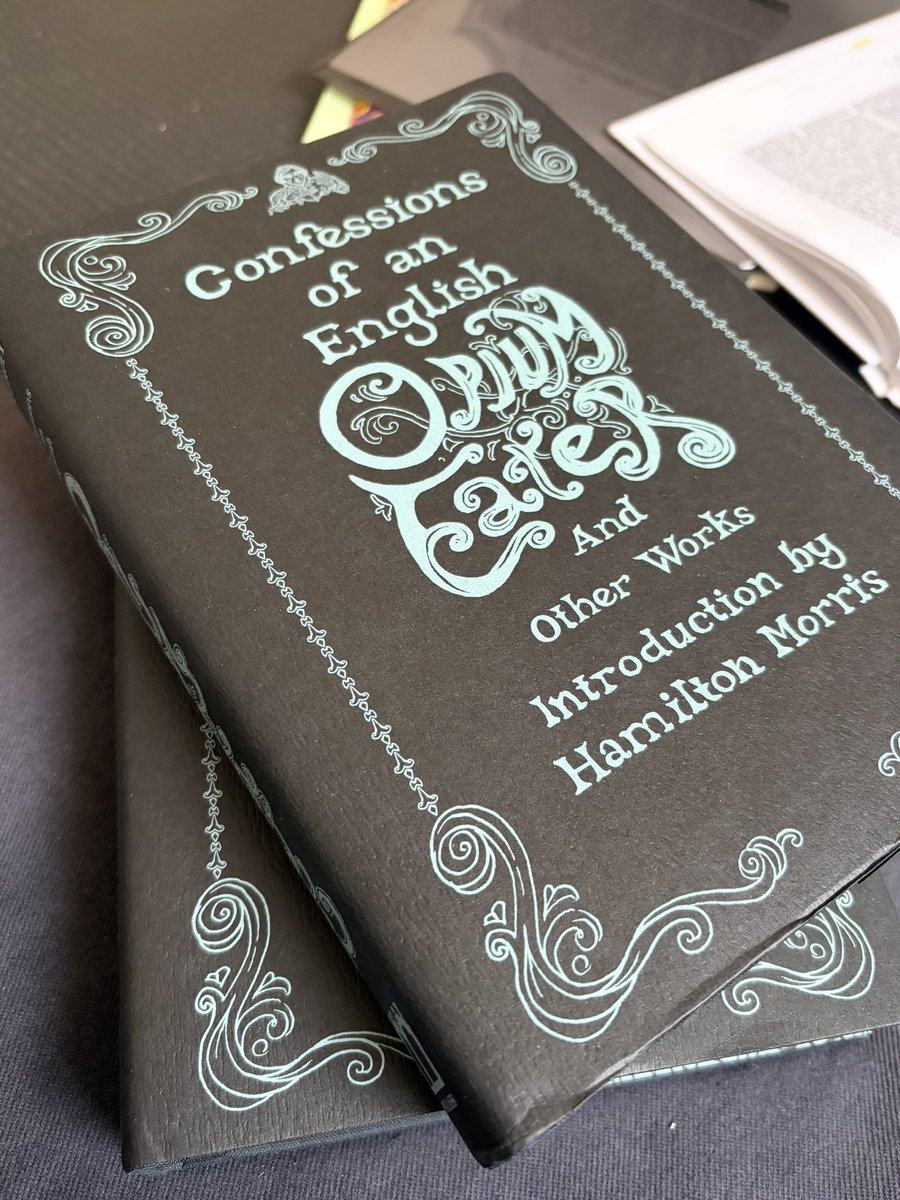
Many thanks to @GallowglassPB for copies of this beautiful hardback edition of De Quincy’s classic, introduced by @HamiltonMorris…
Highly recommended! Get yours at link in reply! 👽
I don't disagree with much of what you wrote, but it's still worth fighting for regulation. Prohibition hinders research and will likely endanger users, I want to fight for a different way of dealing with these problems. The market share remark doesn't strike me as ridiculous, there is a huge divide in the kratom community and I imagine many vendors didn't want to cross it.
Regardless of whether you like 7-OH, prohibiting it is likely to cause many preventable overdoses as dependent users lose their supply and switch to black market opioids. Please watch and share this video about the chemistry of 7-OH and write HHS to voice your opposition to prohibition.
https://t.co/BgBhPzVnpX
Seven months before his death in 2021, I interviewed the great Dr. Edward F. Domino about his experience administering the first dose of ketamine to a human being in 1964. You can listen to his story here:
https://t.co/7JNrhn2dgh
RIP Patrick Arnold, the legendary anabolic steroid chemist who created tetrahydrogestrinone aka "The Clear" and popularizer of the ring-open amphetamine-mimetic DMAA. You can listen to him discussing his research here: https://t.co/bkb8LufSHV
One of the reasonable points that Oliver made is that postmortem toxicology don't always test for kratom alkaloids and their metabolites, it should have been emphasized that the number of deaths attributed solely to 7-hydroxymitragynine is almost impossibly low. If this low number is a product of inadequate testing, more study needs to be done to estimate the incidence of 7-hydroxymitragynine-associated deaths relative to population exposure. Policy decisions need to be based on careful research that has yet to be done and effectively can't be done once these substances are prohibited.
@HamiltonMorris@LastWeekTonight@joerogan Hamilton, I’ve loved your reporting for like 15 yrs. from a non prohibition standpoint I’m curious what you think ought to be done ie how products like 7oh should be sold. There’s something perverse about the way they’re sold in shops w flavors like “blueberry razz”.
While approvingly discussing the fact that "some states are taking action" (i.e., banning) he admits that it is "complicated" and hedges by saying "full-on prohibition and criminalization just isn't great drug policy." Yet the episode is full of scaremongering and never once vocalizes true opposition to the prohibition of kratom or 7-hydroxymitragynine, instead saying "there has to be a harm reduction plan to go alongside any potential ban" which is borderline oxymoronic.
Surprisingly thoughtless reporting on "gas station drugs" from @LastWeekTonight. John Oliver clips me talking to @joerogan and instead of using the joke as an opportunity to suggest reasonable regulation and labeling requirements, tacitly approves of prohibition saying, nonsensically, that it must be accompanied by "harm reduction." What would that "harm reduction" be? Pharmaceutical opioid maintenance therapies, which Oliver has also criticized?
It's looks thoughtful to people who aren't thinking. He discusses bans throughout the episode uncritically, momentarily pays lip service to the idea that "full-on prohibition and criminalization just isn't great drug policy" then resumes scaremongering and says, "there has to be a harm reduction plan to go alongside any potential ban" without specifying what that harm reduction plan would be...because the answer is pharmaceutical opioid maintenance, which he has also repeatedly criticized.
In 2006, my friend Stephen Watt wrote a piece of computer code while high on ketamine that was used to extract credit card information from TJ Maxx and the rotisserie chicken purveyor Boston Market. For writing the code, he was sentenced to pay $170,000,000 in restitution. This is his story:
https://t.co/UrKUof7QaY
I tried to cure my OCD with mushrooms.
Filming The Mushroom Cure live in Boston April 10–11.
@HamiltonMorris joins after each show.
https://t.co/rFZ5vCHKHi