“We found a rental in #Hampstead, where we would take Ingrid - whom he loved as much or even more than I did, staring at her face for hours - ambling past sweet families on picnics or men “cottaging” in the brush, depending on the time of day.” Lena Dunham, Famesick, p382
“There must have been twenty people queuing up in Gail’s. The first branch opened nearby on #Hampstead High Street two decades ago and the locals seem to love it.” Alan Davies, White Male Stand-Up, p67
“She and Muriel set up home together in #Hampstead, Winifred hoping that her friend’s honeypot good looks would lure some of Gustav’s male friends, and that one of them would spare a look for her nether limbs and might even want to marry her.” Virginia Nicholson, Singled Out, p67
“He said I have the right look for a film he’s casting and he wants me to go to his place the day after tomorrow in West #Hampstead. That’s quite a posh area! Things are happening! WOOOO!!” Jess Robinson, Life is Rosi, p121
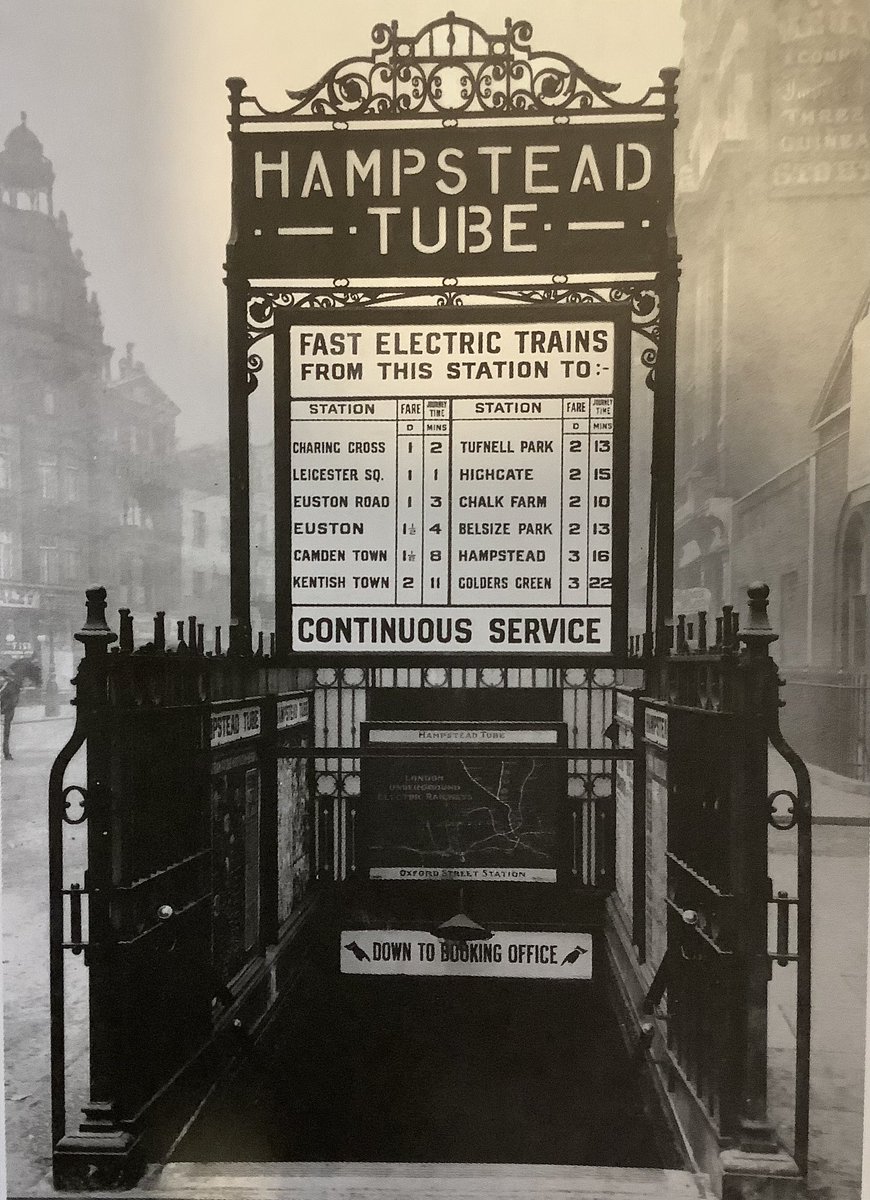
“1907 view of an entrance to the #Hampstead Tube at Oxford Street station (now Tottenham Court Road). The list of possible destinations is supplemented with journey times, fares, and an early network map on the railings.” Maxwell J Roberts, Underground Maps Unravelled, p10
“Sheldon Oaks was in #Hampstead, a wealthy part of North London; it’s pretty grounds bordering Hampstead Heath. This was the sort of place the rich came to die.” Fergus Craig, I’m Not the Only Murderer in my Retirement Home, p2
“Compared to what, though? He had in mind, I suppose, the unheard - but somehow heard-of - dialect of #Hampstead Highbrow, in which there was no chat or gossip, only earnest discussion of literature, philosophy, theatre, ideas and whatnot.” Geoff Dyer, Homework, p263
“Leicester Square Underground Station, Cranbourn Street, 1916: An interchange for the Piccadilly and Northern lines (then the #Hampstead Line). The corner houses the premises of Salmon & Gluckstein, tobacconists.” Philip Davies, Panoramas of Lost London, page 257
“He brought in Annabella Lwin as the group’s lead singer – a thirteen-year-old with no showbiz connections – after she was discovered singing along to the radio in a dry-cleaners in London’s West #Hampstead.” Justin Lewis, Into the Groove, p29
“Gentrification was coined by for the ‘invasion’ and displacement of working-class communities in London by the ‘gentry’ middle classes…fundamentally shifting the social character of places like #Hampstead, Islington and Paddington.” Richard Yeboah, From Hackney With Love, pxxi
“Master Lovett had been friendly with several gentlemen who had owned houses in this direction, particularly in the village of #Hampstead to the north of Primrose Hill, where the air was reputed to be especially pure.” Andrew Taylor, Ashes of London, p319
“At the start of 2024 I was walking on #Hampstead Heath - the wild bit on the hill above the swimming ponds where you can forget you are in a city at all - and I was listening to one of Glenn Campbell’s gospel albums, as I often do there.” Kate Mossman, Men of a Certain Age, p239
“The #Hampstead Tube (formerly the even-less-catchy Charing Cross, Euston and Hampstead Railway) would follow in 1907, which would eventually come to be called the Northern line.” Caroline Roope, The History of the London Underground Map, p49
“One summer evening, two sexegenarian writers, Hirst (a wealthy recluse), and Spooner (a down-at-heel poet), meet in a #Hampstead pub and continue their drinking into the night at Hirst’s stately house nearby.” Dylan Jones, 1975 - The Year the World Forgot, p95
“After an hour or more, an A&E doctor came to collect me. ‘As soon as I saw your name, I grabbed you,’ she said - which made me glad the hospital was in bookish #Hampstead.” Julian Barnes, Departure(s), p46
“R Travers Morgan was appointed to survey a possible North Cross motorway from Willesden, via #Hampstead and Dalston to Hackney Wick. The work was justified by the purported need to safeguard potential routes from competing development.” Wayne Asher, Rings Around London, p43
“Among the most innovative housing projects were Wells Coates’ Isokon flats (1933-34); Maxwell Fry’s Sun House (1936); and Erno Goldfinger’s 1-3 Willow Road (1939) in #Hampstead.” Arnold Schwartzman, London Art Deco, p128
“As a committed South Londoner, she had always felt rather scornful about places like West #Hampstead, but as she whizzed past sushi bars and a charming early twentieth-century fire station, she had to admit it seemed quite nice.” Charles Beaumont, A Spy at War, p133
“Kamran Ashraf, [falsely] convicted of theft from his post office in #Hampstead in January 2004 and imprisoned, told reporter Nick Wallis: ‘It means everything. It’s been 17 years, way too long, way too long.’” Richard Brooks, Post Mortem, p162