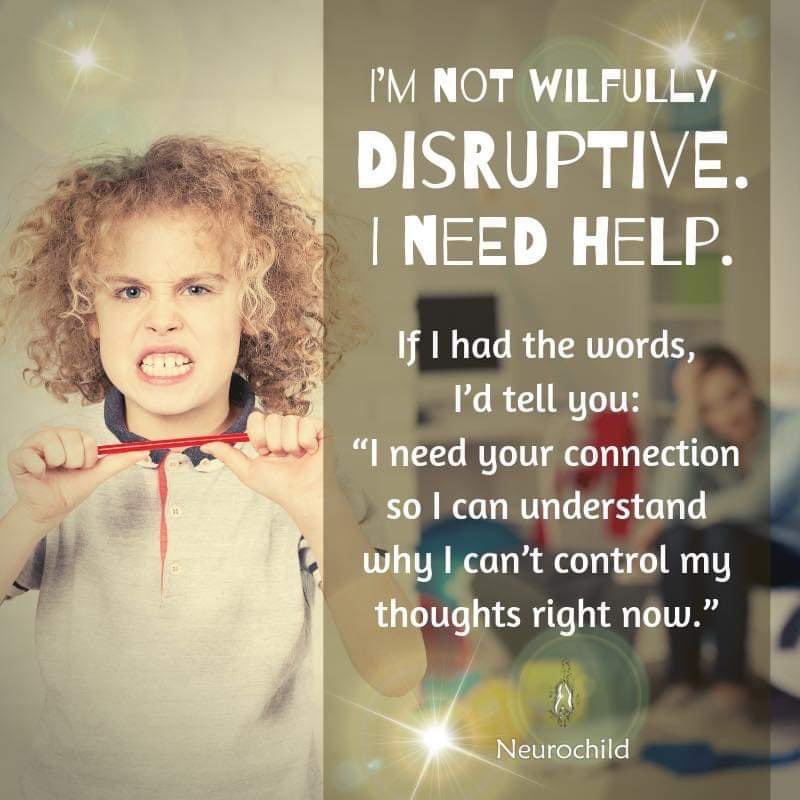
This is one the biggest barriers I experience when talking to professionals about considering shifts away from behaviouralist approaches to relational approaches.
A high percentage of behaviours that we see from our most traumatised young people is their unmet developmental needs.These needs are transmitted through behaviour. They are communicating how they feel psychologically & emotionality. Or what has happened to them.
🧠🌱
Here’s a hack to help teenage mental health.
Stop telling them that resilience means doing what adults want without complaining.
Resilience means different things in different situations. It can mean saying no, this is not right. It can mean standing up for yourself, or walking out. It can mean listening to your own reactions and acting accordingly. It can mean quitting, when you see that something isn’t worth the effort. It can be staying on when something is hard, because you see that something has worth and purpose.
Putting up with something because you’ve been told to do it isn’t resilience. Sticking at something because you don't feel you have the right to stop isn't resilience.
In the real world, that’s passivity.
Making your voice heard – even if that’s inconvenient for the adults around you – can be a resilient thing to do.
“Putting up with something because you’ve been told to do it isn’t resilience. Sticking at something because you don't feel you have the right to stop isn't resilience. In the real world, that’s passivity.” quoting @naomicfisher
@interveneFASD Very interested- Our adopted son has FASD (we think) as well as ACEs & attachment needs. experiencing sig diff in how son struggles with attachment& separation anxiety to other adoptees. E.G. seems to feel it more acutely& strategies advised do not give reassurance to our child
Don’t waste your time with Steve, he’s a lost cause!
This was what I was told when I asked about the student sitting alone at breakfast with his hood over his head and his head on the table minutes after the bell rang on the first day of school.
Statements like these have always made me want to get to know the student even more.
I wandered over to Steve’s table and asked if I could sit. Without looking up, he slid a chair out from the table. I took this as an invitation to sit.
I introduced myself as Dr. P the new principal. There was no reaction - I guess Steve wasn’t too impressed.
I just sat there quietly for a few minutes. Steve lifted his head up and asked if I had anything that I should be doing now. In my head, I thought that there was nothing more important than making a connection with Steve.
I responded by telling him that I was so new, I didn’t really know what I was supposed to be doing. I also let him know that I really didn’t know my way around the building very well yet and I was a bit concerned that I might get lost.
Steve said that he has been at this school since preschool and that he’d be willing to show me around. I accepted the offer and I let the front office and his teacher know that Steve and I would be on a tour.
I was very impressed with Steve’s tour. He literally knew every part of the building. It was also interesting that every staff person knew Steve (and shared a similar look when the two of us walked by).
When the tour was over, I spent a few minutes with Steve in my office learning about his likes (math, Pokémon cards and cheese pizza) and his dislikes (reading, writing and the school’s nachos).
I thanked him for the tour and asked if he would swing by my office at lunchtime. He agreed. I wished him a good morning and let him know that I looked forward to seeing him at lunch.
I put in an order for a cheese pizza to be delivered at his lunch period and let his teacher know to send him to my office at lunch.
I pulled Steve’s file. He had a long list of past interventions and strategies. They were all marked with language similar to ineffective, goal not achieved or too disruptive to evaluate. He also had a long list of detentions, lost recesses, and a couple of in school suspensions. There was no physical contact, property destruction or eloping listed. It appeared that the infractions were exclusively due to talking excessively, work refusal, and disrespect.
When Steve arrived at lunch, his whole face lit up at the sight (and smell) of a cheese pizza. I let him know that this was in return for a first class school building tour. My new friend Steve devoured half a pizza in under two minutes. He then asked if he could save a slice for his teacher.
I asked if he was interested in a newly created position in our building. He gave me a puzzled look. I let him know that it was as the senior tour coordinator for new students and guests. I let him know about the “compensation package” (a pizza lunch per month, a weekly pack of Pokémon cards, and other bonuses based on performance).
Together, we created a contract with a code of conduct for this prestigious position. We signed it and I had it notarized by our school secretary. He thanked me and said how excited he was. I contacted his parents and received their enthusiastic approval (and a sigh of relief that I wasn’t calling because of a behavior).
The next day I had Steve give our superintendent the tour. It went so well! The superintendent was very impressed (he even included this experience in his weekly report). Steve gave two more tours over the next week.
I checked in with his teacher and she said that he had been an exemplary student. Other staff in the building commented about his improving manners.
Over the school year, our pizza lunches & Pokémon “pay days” became something that I truly looked forward to.
Apparently, Steve wasn’t a “lost cause” after all!
Join the Maslow Before Bloom group:
https://t.co/i2rhBgHO8G
Recent research in UK schools found that 52% of young people identified school as having a negative impact on their mental health.
The authors of the paper, which include educational psychologists @SarSivers and @DrMaddi1, suggest that we need to stop locating the problem in young people, and start asking how we can create a school system which puts the psychological needs of young people first.
@SarSivers says "Our focus should be on how we engage and motivate children and young people to enjoy education & have a love for learning. It is time to create an education system which fits 21st century learners rather than try and make 21st century learners fit into the current system. It is time to be innovative."
This is why punishing parents and young people for attendance problems won't help. @UKLabour have it backwards. Attendance isn't the most pressing problem for education. The problem is, what is going on in our schools which makes so many young people distressed? Punishing them for poor attendance won't solve that.
https://t.co/SiLvPEJ3pB
‘We need an education system that aligns to young people’s needs rather than expects young people to align to the systems,’ our speaker Natalie Perera of the Education Policy Institute #breakthebarriers
When a child is struggling with school attendance, many of the strategies which adults employ can make things worse. Here are the three which I think do the most damage and which I often hear about in my therapy room.
1.Tell a child that school is critically important and that if they don’t attend they will never get an interesting job or lead a fulfilling life. Children believe us. If they can’t attend school, they think their whole life will be blighted. This leads to despair and hopelessness.
2.Make home less pleasant and don’t interact with children if they do not go to school in order that the child ‘chooses’ school. This leads to a breakdown in relationship between parents and children and children who are chronically under-stimulated and unhappy. I hear from parents who say that their children just sit on the stairs from 9-3 each day, staring into space.
3.Force them into school, no matter what their level of distress. People do this in the belief that children will learn through exposure that school isn’t as bad as they think and will become less anxious. Exposure doesn’t work if it is forced and you feel out of control, and anxiety is often a reaction not a reason. Children become sensitised to school and soon are highly anxious about everything to do with school, included reading, teachers and other children.
What’s the alternative? Find out what’s going wrong. What is it about this school for this child which isn’t working? Think about whether anything could change. Focus on building them up and do things they enjoy together. Give them opportunities to learn about things which interest them. Tell them stories of hope, and that you’ll help them learn and find their way to a fulfilling life.
For a happy child is more likely to be able to access education, however they do that. If you take away their happiness in order to force them into school, it is an empty victory.
All behaviour is communication - One of the Six Principles of Nurture. 💫
This infographic by WholeHearted School Counseling shows the hidden issues that children are experiencing that causes them to misbehave at school. It's vital that pupil's needs & #wellbeing are supported.
I really hope any school which awards ‘pen licences’ follow reasonable adjustments for children who may not be able to meet the expectations around this licence bc of their needs & or Disability #SEND#EducationUK#Schools#PenLicence
Trauma refers to a deeply distressing or disturbing experience that overwhelms an individual's ability to cope with the situation. There are various types of trauma that people may experience, including:
Physical trauma: This refers to any bodily injury that results from a traumatic event. Examples include broken bones, burns, cuts, and bruises.
Emotional trauma: Emotional trauma occurs when an individual experiences a deeply distressing or disturbing event that results in intense emotional pain. Examples include the death of a loved one, domestic violence, sexual assault, and childhood abuse.
Psychological trauma: Psychological trauma refers to the emotional and psychological impact of experiencing a traumatic event. This can lead to symptoms such as anxiety, depression, PTSD, and other mental health disorders.
Sexual trauma: Sexual trauma refers to any sexual abuse, assault, or harassment that an individual has experienced. This can include non-consensual sexual contact, sexual coercion, and sexual exploitation.
Developmental trauma: Developmental trauma refers to the impact of adverse experiences (ACES) during childhood, such as neglect, physical or emotional abuse, and abandonment. This can result in long-lasting emotional and psychological effects impacting an individual's ability to form healthy relationships and lead a fulfilling life.
It is important to note that trauma is subjective and can vary from person to person. What one person considers traumatic may not be traumatic for another. Additionally, the impact of trauma can vary depending on factors such as age, gender, culture, and individual resilience ❤️
If you find this helpful, please share it with your colleagues :)
As professionals working with children and families, we understand that behaviour is a form of communication. It allows individuals to express their needs, desires, and emotions. However, it is essential to recognise that there is often more to behaviour than what meets the eye. Beneath the surface lies attachment, the gravitational force that pulls us towards one another to survive. This attachment is embedded in our nervous systems and can manifest in our behaviours.
When we only address observable behaviours, it is like placing a plaster on an open wound that requires significant attention. Instead, we must dig deeper to understand what lies beneath these behaviours. Our bodies often communicate our underlying emotions and sensations without conscious thought or effort.
As Professionals, we must pay attention to our bodies and the communication indicators of the family we work with. (this isn't easy) By reflecting on our own nervous system states when confronted with dysregulated behaviours, we can meet the pedson in a state of regulation. This approach helps create a more relational, preventative, and brain-aligned discipline practice.
To achieve this, we can ask ourselves the following questions:
•What am I communicating to the person through my behaviour, gestures, face, posture, and tone?
•Have I checked in with my own nervous system and how it is responding to theother persons behaviour?
•Am I being authentic? Am I in touch with my gut feelings and checking in with myself regularly?
•Which family trigger me the most, and why?
•Do I respond to each person's behaviour in the same way?
•Which family do I redirect most often, and what behaviours do they exhibit?
•What behaviours do I expect to see, and how do I react when they don't occur?
•Which behaviours push my buttons the most?
•At what time of day do I feel the most calm and happy? What is happening during that time?
•At what time of day do I feel most dysregulated?
•What is my definition of calm and connected?
•Which family do I feel closest to, and why?
By exploring these questions, we can better understand our own nervous systems and how we respond to the behaviours of others. This approach helps us create a more effective and compassionate discipline practice that considers the underlying emotions and needs of those we are trying to help :)
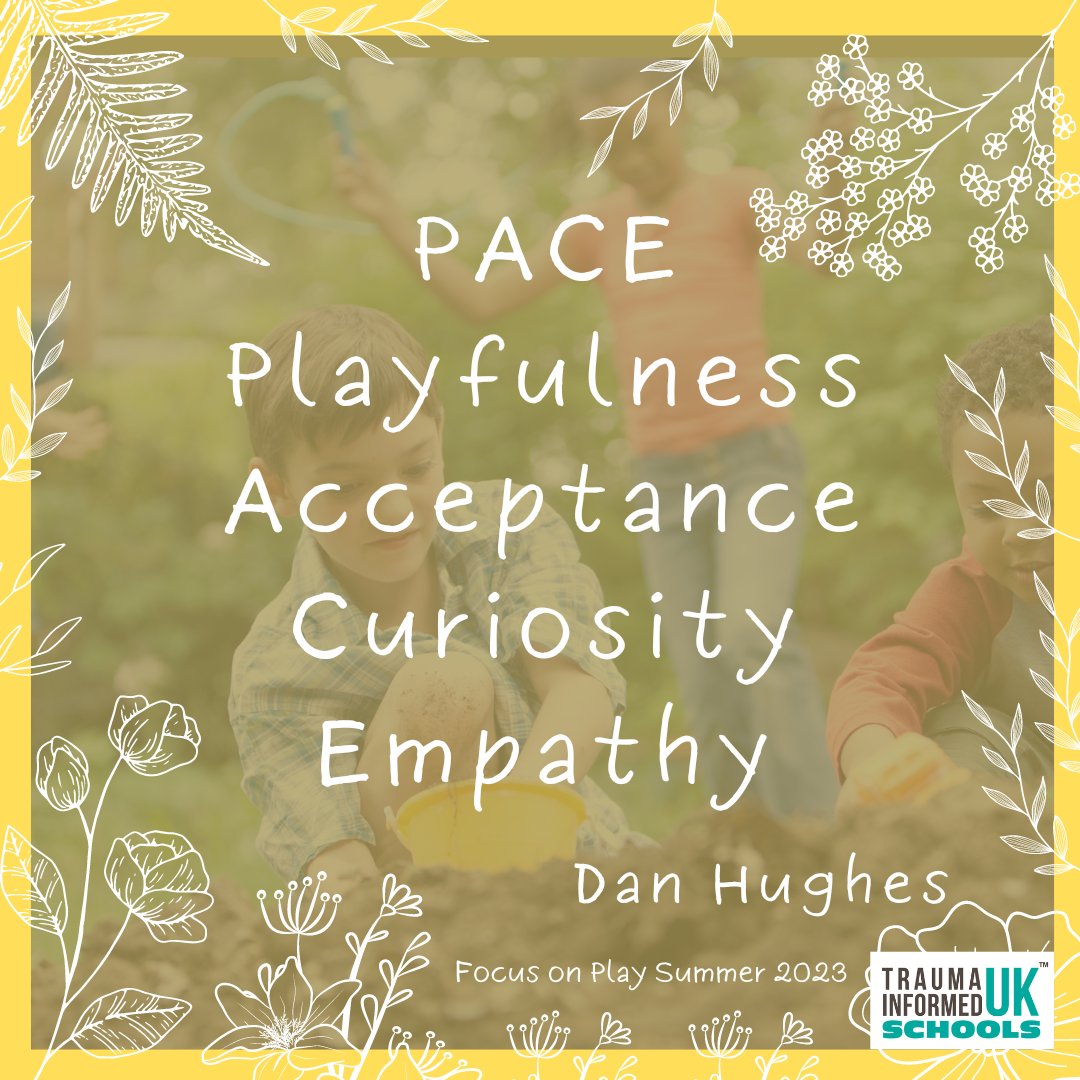
'Playfulness, Acceptance, Curiosity and Empathy (PACE) is a way of thinking, feeling, communicating and behaving that aims to make the child feel safe. Dan Hughes looks at what is meant by PACE... read more here https://t.co/TeFSyUrEZI
#TraumaInformedTheory#TISUK