Thrilled to be one of the 4 Voice Hack Night finalists with Surgical Triage!
I built a voice-first AI workflow that handles emergency hand surgery transfer requests, patient details, images, and next steps in one conversation. As a hand & microsurgeon, I look forward to having this agent available one day!
Huge thanks to @OpenAIDevs and @cerebral_valley
Vote for Surgical Triage → https://t.co/Tb7Lf7qrA3
What’s one way voice AI could transform your clinical workflow?
@cerebral_valley 🩺 Surgical Triage
A voice-first workflow for triage: transfer requests, patient details, images, and next steps in one place.
https://t.co/OVqQ5kI9rI
@jxnlco@thsottiaux I've been trying to squeeze out every last token before I lose my 200x abundance, but I didn't think I was pushing it that hard! Good to know I'm not the only one.
Any chance we can get an extension on the 6/5 cutoff for the 10x boost?? 😂
Did something happen with Codex usage limits? I went from ~80% weekly usage a couple hours ago to 0%. I'm on a 20x plan with the 10x boost from the 5/5 event.
@jxnlco@thsottiaux
@MaziyarPanahi It's amazing how low key they and their documentation are about promoting it! Such a powerful unlock to let users bring their own tokens!
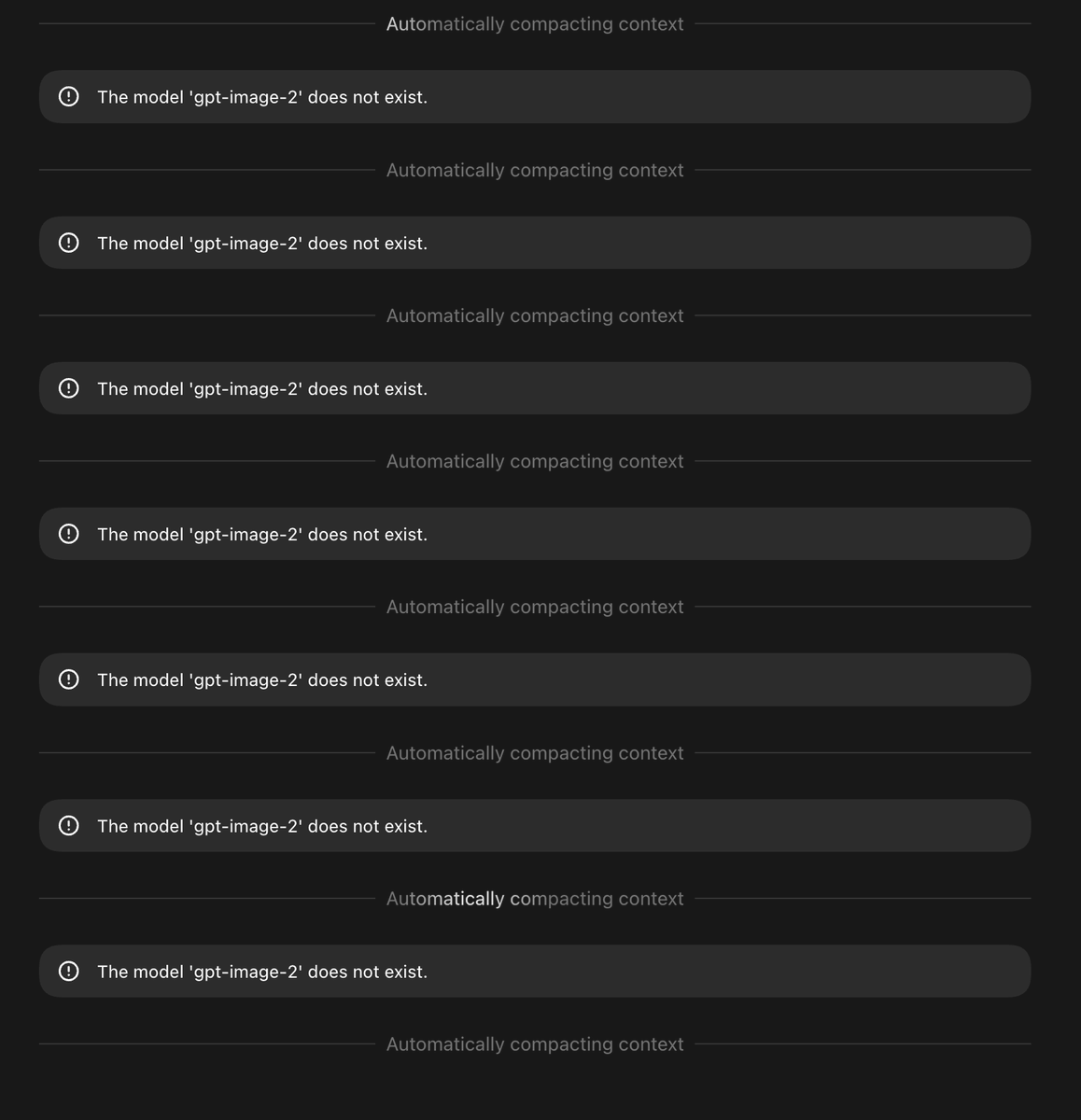
Is there a bug in the latest Codex app release? I'm getting this 'gpt-image-2' error on numerous threads, none of which should have anything to do with images. This blocks the thread from progressing or doing anything else.
@thsottiaux@jxnlco
Is there a bug in the latest Codex app release? I'm getting this 'gpt-image-2' error on numerous threads, none of which should have anything to do with images. This blocks the thread from progressing or doing anything else.
@thsottiaux@jxnlco
Totally agree. The voice interaction is just the interface that fits an existing workflow. The unlock is the not only the structured packet but the ability to reason over it in real time at a latency acceptable for a voice interaction.
And not only does it fill the packet, but this tool ensures that it:
1) is accurate -- e.g. resolves discrepancies between the verbal description of the injury and the photo representation of the injury
2) fits my preferences -- dynamic calling of my custom skills library
(Thanks, @beknabdik. Good luck at YC!)
The future of voice starts with Chat.
Last week, we partnered with @OpenAI to bring builders together at OpenAI's SF HQ to showcase what's possible with the latest realtime voice models.
From AI companions and sales agents to translation and education tools, teams pushed the boundaries of voice-first experiences – with winners decided by a community vote.
Voice is becoming one of AI's most exciting frontiers.
What got built:
Not-roboticist hand surgeon here trying to better understand the robotics hand space...
I have a few observations. Curious if there are explanations:
Intrinsic muscle function
The demonstrated finger flexion at the beginning of the video is more of an intrinsic minus hand posturing where there is flexion through the IP joints with more limited composite flexion through the MP joints. Initiation of grasp in humans is typically a synergistic combination of MP joint flexion + IP joint extension before then flexing the IP joints around the object of interest. This is a complex coordination of movement facilitated by our intrinsic muscles.
Thumb palmar abduction and opposition
The thumb movement primarily demonstrated here is simply flexing/extending in the plane of the palm, which isn't a particularly functional motion. The more critical palmar abduction / opposition movement shown in the video is a one time movement to the flexed middle finger. I'd instead love to see the thumb opposing to the fingertip of each finger and then dragging the thumb down the length of each finger and into the palm.
Tenodesis effect
The repeated combined wrist flexion + finger flexion is an antagonistic movement in humans. Typically, we perform synergistic finger extension with wrist flexion. This is enabled by the tenodesis effect. I suspect in a robotic hand that it is easier to pull on palmar tendons to perform composite wrist flexion and finger flexion in a robotic hand, while achieving the more human-like synergistic motion I described is a more complex and coordinated activity.
Would love any explanation or discussion if there are good explanations for these missing functions. As I said, I'm trying to learn the space.
The primitives are there within the Codex app's requestUserInput tool, but I agree that I never see this exposed in Codex.
I've built a medical knowledge retrieval tool on top of the open source Codex app server with interactive question functionality so it's clearly possible.
Hoping @OpenAIDevs choose to more prominently surface this feature, as I REALLY like the equivalent AskUserQuestion tool in Claude Code and Claude's willingness to use it.
@fishbotics I’m a hand and microsurgeon in SF. If you’re working on robotic hands, would love to connect. I suspect there are human anatomy-inspired opportunities that aren’t yet being utilized.
Would love to hear his vision for Foundry Local as a platform for domain expert builders, not just enterprise developers.
On-prem inference could be a game changer for solo physician-builders like me trying to move from agentically coded prototypes to responsibly deployed tools in heavily regulated settings.
No performance gain on my eval. It kept promising one more great thing to try, but it never moved the needle. Each loop ended up being a minimal tweak, and nothing changed.
It was probably a skill issue with my goal prompting but….
I started over and:
1) used an orchestrator thread and told it to use the new codex feature to spin up child threads
2) hyped it up with language like “use first principles clinical reasoning”, “be high agency”, and “make bold decisions with conviction” (inspired by @conviction!!)
And within an hour, I got a 10 point gain on the eval (100 point scale).
I do suspect there’s some value with the orchestrator maintaining coherence, but that’s just vibes for now.
@TheOneAndArjun Thanks, Arjun! It’s empowering what these tools now enable. If you’re non-technical and have domain expertise in anything, try building something!!
@model_mechanic I’m a hand and microsurgeon in SF. If you’re working on robotic hands, would love to connect. I suspect there are human anatomy-inspired opportunities that aren’t yet being utilized.
This is incredible and already have found great use cases!!! However, there's a bug that's really breaking the workflow...
I've had several instances where a main orchestrator agent spawns another thread. However, the child thread never gets started and hangs at the prompt. The orchestrator doesn't realize the child thread is stuck. It continues to check on this hung thread, views it as ongoing, and won't kill it. I, of course, can manually insert myself, but the goal here is to remove myself as the bottleneck and let the model cook. Any chance this can be improved?
(As a related note, I have this issue with probably ~5% of the prompts I launch where I'll launch a prompt, but it's never picked up and just hangs without the job starting. I've updated, restarted, etc to no avail.)
@OpenAIDevs