Unison Scot & Scot Labour. Activist. Ex Trading Standards professional. Broadsword calling Danny Boy. Tweets personal, if you don't like then just scroll on...
Everywhere I go in Malawi, toilets are segregated by sex. Safe toilets for girls is a key element of safeguarding and helps keep girls in school. But don’t take my word for it. Single sex spaces for women and girls are a key component of development policy. https://t.co/Dpl86jSrs9
Woman of the Day WW1 ambulance driver Sadie Bonnell, born OTD in 1888 in Kew, Surrey, one of the first women to be awarded the Military Medal for “gallantry and conspicuous devotion to duty” for collecting wounded soldiers from a dressing station near the Western Front under heavy fire, close to a poison gas dump.
When war broke out in 1914, Sadie joined the First Aid Nursing Yeomanry founded in 1907 as an all-women mounted volunteer Corps and trained as ‘the connecting link between the fighting units and the hospitals.”
Members of FANY had to qualify in first aid, horsemanship, veterinary work, signalling and camp cookery. They were ready to go, but the War Office really wasn’t ready to accept the help of women. They preferred them to sit at home and knit. “No petticoats here.”
Ever tried stopping a woman when her mind is made up? Some applied to the Belgian and French armies and were accepted. Sadie joined the Canadian Army Service Corps as an ambulance driver and was posted to Normandy.
During the night of 18-19 May 1915, based in a large camp on the road to Arques in Normandy, she collected wounded men from a dressing station near Saint-Omer whilst under heavy German bombardment for five hours. The enemy's shells had set a nearby ammunition dump on fire and narrowly missed a poison gas dump nearby.
The men wounded in the bloodbath of the trenches were carried or escorted to the advanced dressing stations and from there, to field hospitals or Channel ports. Transported over poor roads and jolting railways, many died in agony en route but it was the only chance of survival they had.
Sadie returned again and again with Evelyn Brown, a Canadian volunteer, until every single one of the wounded had been collected.
She was awarded the Military Medal, one of the first women to achieve that honour, and was decorated by General Sir Herbert Plumer, commander of the British Second Army. The citation read: ‘For gallantry and conspicuous devotion to duty, when an ammunition dump had been set on fire by enemy bombs and the only available ambulance for the removal of wounded had been destroyed…she arrived with three ambulances and, despite the danger arising from various explosions, succeeded in removing all the wounded. Her conduct throughout was splendid.’
She showed great courage again during the East End Air Raid in 1916, driving an ambulance during some of the first air raids London experienced, and from 1919, she worked in hospitals as a volunteer. She was noted for her love of fast cars and only gave up driving when she turned 95.
Sadie died aged 105 on 2 September 1993.
The First Aid Nursing Yeomanry was later used as one of the two cover stories for the incredibly brave women who joined the Special Operations Executive during WW2.
“It wasn’t courage. I was there to do something useful. There was a job we had to get done.”
A magnificent letter from a magnificent woman.
“ Dear Mr Wright,
It must be terribly difficult having to share your name with the legendary and enormously popular disk jockey. My late husband, Sir Michael Caine, was not the actor, Nonetheless, Hollywood starlets might call saying they were in town.
Awkward all around.
I am a law maker. You would not expect me to pontificate on structural instability, hazardous materials or airborne toxins. I know nothing about accelerants, burn patterns or smoke staining. If I told the people, you represent how to deal with a fire I ought, rightly, be ignored.
What the blazes, then, do you think you are doing when trying to meddle with the adoption of the EHRC's latest Service Code? If no one else has told you already I am sorry to be the bearer of bad news, but you appear to have no idea what you are talking about. Did you think to run your nonsense past a lawyer? (If you did,hesitate to pay.)
The provision of changing and lavatorial facilities by an employer is governed by the Workplace (Health and Safety) Regulations 1992. Employers are required to provide separate facilities for males and females. There is no option to provide only mixed facilities. Mixed facilities are optional but sex-separated facilities are compulsory. That has been the case for 34 years. It has not changed because of a Supreme Court Judgment. You might not have understood it before, but you do not need EHRC Guidance to understand it now. Fire fighters must be provided with biologically separated sanitary and changing facilities. That will remain the case even if the EHRC Guidance is frustrated.
No "hard-won" rights have been rolled back. The rights you imagine (or, more likely, have been briefed about) have never existed. Rights do not accrue and acquire validity thanks to magical thinking or bad advice.
That which you frame as a call for employers and service providers to "go beyond minimum requirements" is, in fact, a demand that they break the law. I assume you had no idea that was the case. I can imagine you being keen to change laws with which you disagree, democratically, but I should be surprised were you to knowingly call for outright anarchy.
The laws governing access to legitimately sex-separated facilities have not changed for employers since 1992, and for service providers since 2010. If you were ignorant of them before you have no excuse now. If you do not like them you may seek, democratically, to change them.
Until then, I strongly encourage you to urge members to obey the law and stop posturing as though the law is something you might like it to be but is not.
Yours sincerely
Baroness Nicholson of Winterbourne
London
SW1A OPW”
A British scientist invented the single most valuable piece of technology in human history, then signed a document that legally guaranteed he would never make a cent from it, and he did it on purpose while every university around him was racing to patent everything they could.
His name is Tim Berners-Lee, and the invention was the World Wide Web (WWW).
Not the internet, which already existed as a way to connect computers, but the actual web of pages and links you are using to read this right now. HTML. HTTP. The URL. He built all three while working at CERN, a physics lab in Switzerland, between 1989 and 1991.
He wrote the first browser on a NeXT computer and stuck a label on it that said "DO NOT POWER IT DOWN" because if anyone unplugged it, the entire web would vanish.
Here is the part that should stop you cold.
CERN owned the invention. Under the rules of the time, the lab could have licensed it, charged a fee for every installation, and collected a royalty on every server that ever came online.
His colleague Robert Cailliau confirmed they actively discussed exactly this, because in the early 1990s patenting university inventions and squeezing money out of them was the standard move.
They could have charged for every search. Every upload. Every page load on Earth, forever.
Berners-Lee fought to give it away instead.
He pushed CERN to release the source code into the public domain with no patent and no fee of any kind. On April 30, 1993, two CERN directors signed a half-page document that relinquished all intellectual property rights to the World Wide Web. A few signatures on a single sheet of paper.
That was the moment nobody came to own the thing that now connects more than five billion people.
His reasoning was not sentimental. It was mechanical.
He understood something most inventors never grasp. The value of the web was not in the code. It was in the network. And a network only grows if everyone can join without asking permission.
The second you charge a toll, people route around you, and you end up with a hundred tiny incompatible webs instead of one universal one. He said it plainly years later.
If he had demanded fees, there would be no World Wide Web. There would be lots of small webs, and none of them would have mattered.
So the thing that made the web worth trillions is the exact same thing that guaranteed he would never personally capture any of it. Openness was not a sacrifice he made against the invention's success. Openness was the success. The free part was the product.
People who made far less consequential things became billionaires off the platform he built. He watched it happen and kept running a nonprofit standards body out of an office at MIT, setting the rules that keep the web working for everyone, paid like a normal professor.
When an interviewer once asked him why he never cashed in, he refused the premise of the question. He said that framing only makes sense if you measure a person's worth by their net worth. People are what they have done and what they stand for, not what sits in their bank account.
The man who could have owned a piece of every click ever made chose to own none of it, because he understood that the only way to give the world something this big was to make sure he could never take it back.
The most valuable thing ever built belongs to everyone, and that was the entire point.
Interesting - all reference to MacWhirter has been removed and replaced with "the columnist". Is she not happy to stand by what she wrote about us? We are named in her piece.
https://t.co/yBKG8a8C0p
There is no Woman of the Day today but if there was, suffragette and social worker May Billinghurst, born OTD in 1875 in Lewisham, would be a contender for using a modified tricycle painted in suffragette colours (she was crippled by polio) and recruiting more women while she wheeled herself round the exercise yard at HM Prison Holloway.
She had contracted polio as a child and used a tricycle wheelchair for most of her life. As a young woman, she took up social work assisting women at a workhouse in Greenwich, taught Sunday school, and volunteered for a temperance charity — then very much a women’s rights issue.
"My heart ached and I thought surely if women were consulted in the management of the state, happier and better conditions must exist for hard-working sweated lives such as these... It was gradually unfolded to me that the unequal laws which made women appear interior to men were the main cause of these evils. I found that the man-made laws of marriage, parentage and divorce placed women in every way in a condition of slavery - and were as harmful to men by giving them power to be tyrants."
Inspired by Millicent Fawcett and Emmeline Pankhurst, May was drawn early to militant tactics and joined the Women’s Social and Political Union in 1907. She started the Greenwich branch in 1910.
“I wondered how the public could ever be made to think about it. In the midst of the hopelessness of it all, Christabel Pankhurst sounded the war note of militancy and was imprisoned for her boldness, and the subject of votes for women was on every tongue."
When Prime Minister HH Asquith went back on his word by focussing on another bill rather than the promised Conciliation bill that would have granted women the vote, May took full part in the WSPU demonstration outside the House of Commons in November 1910, known as Black Friday.
“At first, the police threw me out of the machine onto the ground in a very brutal manner. Secondly, when on the machine again, they tried to push me along with my arms twisted behind me in a very painful position, with one of my fingers bent right back, which caused me great agony. Thirdly, they took me down a side road and left me in the middle of a hooligan crowd, first taking all the valves out of the wheels and pocketing them, so that I could not move the machine, and left me to the crowd of roughs, who, luckily, proved my friends.”
She knew how it would look: a helpless woman with obvious disability being treated quite callously, thus underlining the the brutal tactics of the police when dealing with women. In fairness, she gave no quarter. She was known to ram the police with her tricycle at a fast rate of knots to stop them arresting her sister suffragettes.
May was able to get closer to the House of Commons on in November 1911. This time, police had second thoughts about attacking her tricycle with its 'Votes for Women' banner and she was carried “shoulder high by four policemen in her little tricycle or wheel-cart that she propels with her arms. Amid immense cheering from the crowd she followed the rest into the police station."
During the window smashing campaign of March 1912, May hid a supply of stones under the rug covering her knees and smashed a window herself. She was sentenced to one month’s hard labour at HMP Holloway. She never did the hard labour. Holloway simply didn’t know what to do with her. May, on the other hand, made good use of her time there, recruiting other women prisoners on the exercise yard to join her in the fight for women’s suffrage.
Alice Ker, another imprisoned suffragette, said in a letter to her daughter: “Miss Billinghurst is here with her tricycle. She has irons on each leg, and can only walk with crutches, her tricycle works with handles. She drives it round the yard at exercise time. It is painted in the colours, with a placard, Votes for Women, on the back of it.”
Arrested again in December 1912, this time for damaging postboxes, May represented herself in court, and once again used the opportunity to promote the cause of votes for women, telling the all-male jury:
“This is a women’s war in which we hold human life dear and property cheap, and if one has to be sacrificed for the other, then we say let property be destroyed and human life be preserved. We are not hooligans seeking to destroy but we mean to wake the public mind from its apathy.”
She was sentenced to eight months imprisonment and forcefed.
“The government may further maim my crippled body by the torture of forcible feeding, as they are torturing weak women in prison today. They may even kill me in the process, for I am not strong, but they cannot take away my freedom of spirit or my determination to fight this good fight to the end.”
May was released early when her health declined but returned immediately to the fray. In May 1914, she chained herself to the gates of Buckingham Palace. The police responded by destroying her tricycle.
This indomitable woman died in 1953 at the age of 78, with full voting rights, her work done.
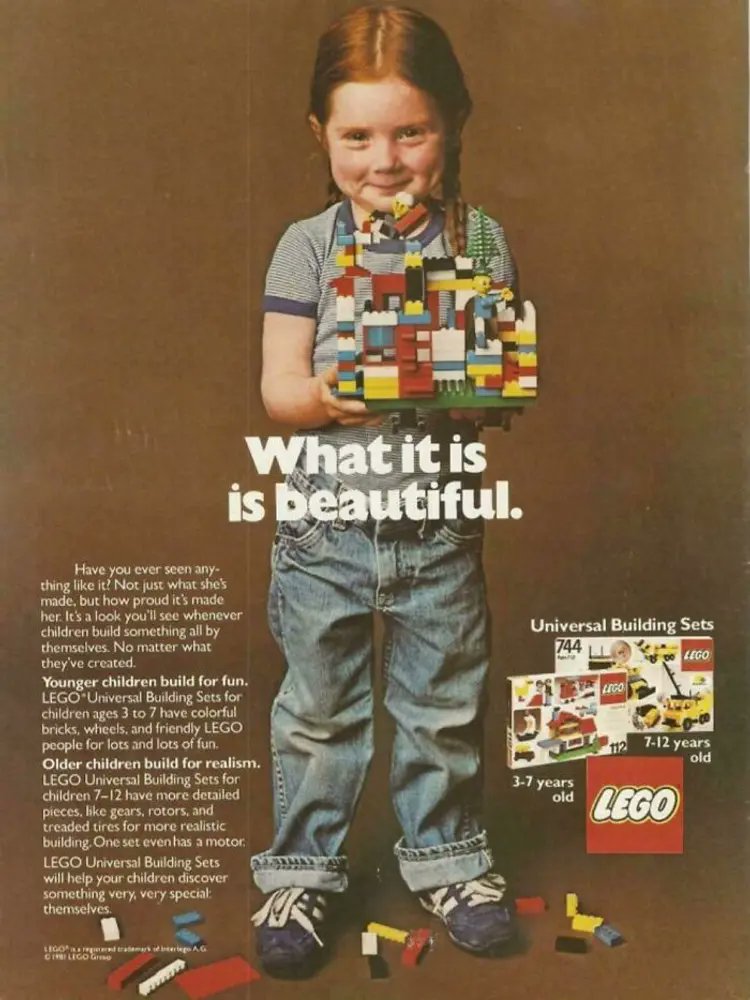
Una niña pelirroja con vaqueros, una construcción de LEGO en las manos y una sonrisa que no está posando para nadie. Esa imagen lleva más de cuarenta años siendo uno de los anuncios más citados de la historia de la publicidad.
Se llamaba Rachel Giordano. Tenía unos siete años cuando la fotografiaron para la campaña de 1981. El titular decía simplemente: What it is is beautiful. Lo que es, es hermoso. Sin mencionar si era niña o niño. Sin color rosa. Sin instrucciones sobre qué debía construir.
Lo que muchos recuerdan como un gesto revolucionario de LEGO en realidad era la continuación de algo que la empresa danesa llevaba haciendo desde los años 50: vender sus piezas como un juguete universal. Los sets se llamaban Universal Building Sets. La creatividad era el producto, no el género del comprador.
Lo interesante llegó después.
En los años siguientes, LEGO fue derivando hacia una segmentación por géneros cada vez más marcada. En 2012 lanzó LEGO Friends, una línea diseñada específicamente para niñas, con colores pastel, figuras femeninas estilizadas y sets de cafeterías, salones de belleza y boutiques. Las críticas fueron inmediatas.
Fue entonces cuando alguien rastreó a Rachel Giordano, la niña del anuncio de 1981. La encontraron: tenía 37 años y era médico. En una entrevista con Adweek en 2014 fue directa: en 1981 los LEGO eran universales y la creatividad del niño producía el mensaje. En 2014, era el juguete el que le decía al niño quién debía ser.
LEGO escuchó, al menos en parte. En 2021, en el 40 aniversario del anuncio original, la empresa lo recreó para el Día Internacional de la Mujer bajo el nombre Future Builders y se comprometió públicamente a eliminar los estereotipos de género de sus productos y campañas.
El anuncio de 1981 no era radical para su época. Se volvió radical cuando la industria fue en dirección contraria.
In 2016, Marc Carter from Devon, England, made a heartfelt plea for help when his autistic son Ben's favorite blue Tommee Tippee cup began falling apart.
Ben had been drinking exclusively from that same cup since he was around 2 years old.
Because of his strong attachment to it, switching to another cup was extremely difficult and had previously caused serious distress and dehydration concerns.
Marc shared Ben's story online, hoping to find replacement cups. What happened next was extraordinary.
The appeal went viral under the hashtag CupForBen, and people from around the world searched their homes, attics, and cupboards for matching cups.
Dozens were sent to the Carter family by strangers who wanted to help.
Then the original manufacturer, Tommee Tippee, stepped in. Although the cup had been out of production for years, the company searched through its archives, located the original mold, and arranged a special production run of 500 new cups just for Ben.
She is not being held responsible for her husband’s crimes. She is being called to account for her deliberate frustration of the legitimate scrutiny which might have revealed those crimes. The distinction should be perfectly intelligible to anyone except the disingenuous.
@JeremyVineOn5@mikeparry8@StormHuntley@alexisconran Hi, thank you for letting your caller insult our director without pushback. I can think of no reason for putting this clip online other than to further the offence.
I notice you haven't tried to get in touch with us.
I have tried, I really have but I can’t get my head round a by-election where the Labour candidate is standing in direct opposition to the Labour PM and supported by among others the deputy leader of the party. I have no love for Starmer, but this is making my head 🤯
Impressive advocacy from @MaeveHalligan. Universities are the sharp end of the tyrannical, vindictive, censorious dogma that passes for activism in her generation. Maeve, @theasewell05 & Serena Worley at @CUSocOfWomen stand up to it daily. Courageous & principled young women ✊
lIf you do anything today, watch @MaeveHalligan at the Cambridge Union. I genuinely think this was the first time many people in that room were confronted with the hard reality of the trans debate, rather than the slogans that usually surround it.
@BuckAngel was exceptional: calm, articulate, humane. Ultimate respect.
And then there was Helen Webberley. I remember once thinking the criticism directed at her by GC women was excessive, especially the claim she was ‘pure evil’. After hearing her speak, I no longer think that. She is totally insincere. I can deal with hard ideologues- they believe they are telling the truth; they are genuine, @HelenWebberley is different.
One audience member, a trans-identified male and former patient of hers, stood to speak during points of information. His account of how he had been treated was deeply disturbing.
Watch the full debate. It is worth your time.
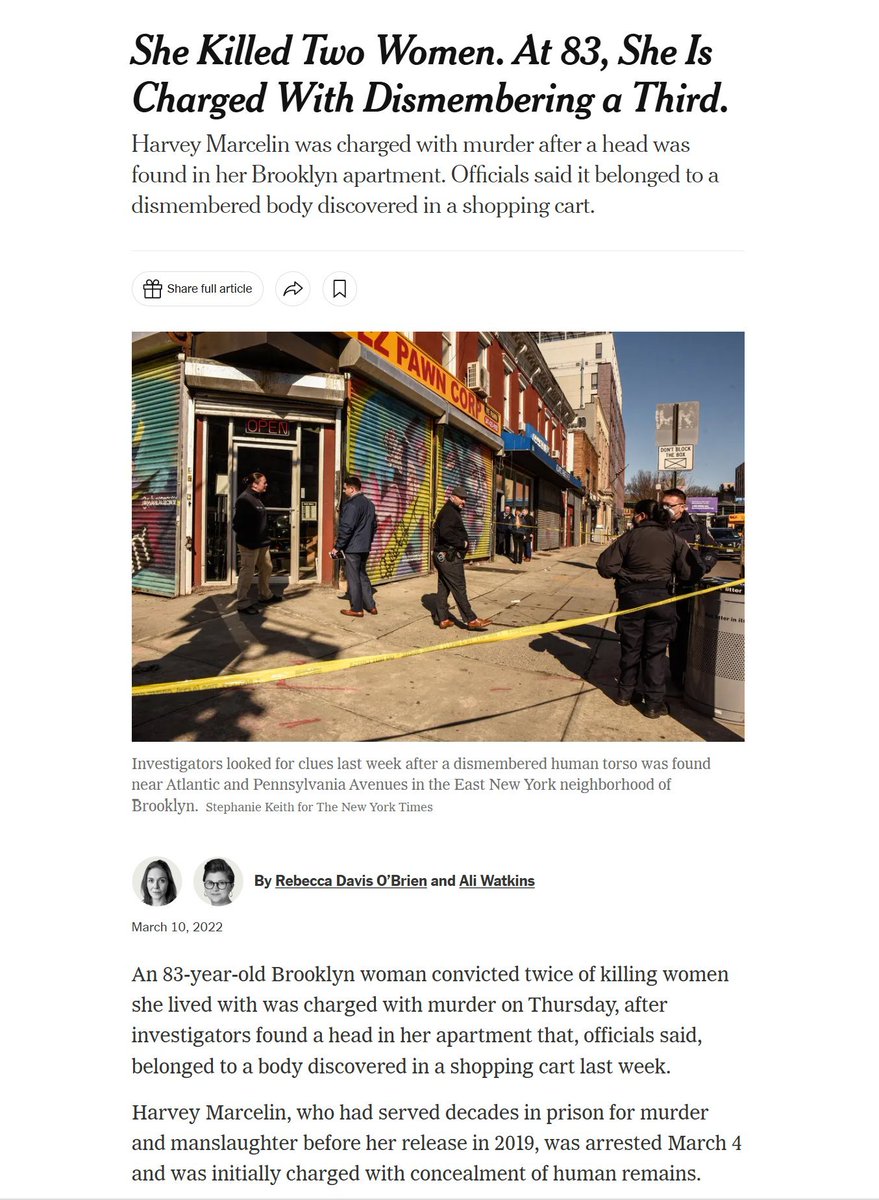
Harvey Marcelin is a male serial murderer of women. He has murdered three women over the course of his life. He is a man.
In 2022, the New York Times honored his gender identity by referring to him as "she" and "her," soon after he was arrested for beheading and dismembering the third woman of the three women he has murdered in his life.
Marcelin no longer calls himself a woman in 2026, so the New York Times now refers to him as "an elderly man."
Marcelin was always a man.
He was a man when he was born.
He was a man when he murdered his girlfriend in 1963. He was a man when he was released from prison in 1984. He was a man when he murdered another woman that lived with him in 1986.
He was a man when he began pretending to be a woman while in prison. He was a man because pretending to be something you are not does not make you into the thing you are pretending to be.
He was a man, and a serial murderer of women, in 2022 when he was granted access to a woman's shelter over the concerns of women who were terrified by the prospect of having to share living quarters with a male serial murderer of women.
He was a man whom an employee of the women's shelter tried to deny access to the shelter.
He was a man for whom the shelter overrode the judgment of that employee and punished her, in order to comply with New York City Human Rights Law, which forbids any woman from drawing a boundary between herself and any man who says that he is a woman, and grants a right to any man who says he is a woman to violate sex-based boundaries.
He was a man who had a "human right" that the state of New York protected to enter private spaces reserved for the protection of women.
He was a man when he beheaded and dismembered yet another woman weeks later.
He was a man when he appeared for trial two days ago acknowledging that he is now a man, a fact that was always true.
He was a man when the New York Times honored his gender identity in 2022 by calling him a woman.
He was a man when he said he was a woman. He was a man when he acknowledged the fact that he is a man.
When people with penises stop using their genitalia as weapons of sexual violence, we’ll stop being obsessed with keeping them out of places where we’re easy prey
We’ve talked about “Gabrielle” Darone, the trans-identifying man who joined a women’s support group for mothers who had experienced stillbirth after “simulating” one of his own. He got grieving women kicked out of this group for objecting to his behavior, which included asking women if he could “breast feed” their infants.
Would you believe that he wasn’t a one-off?
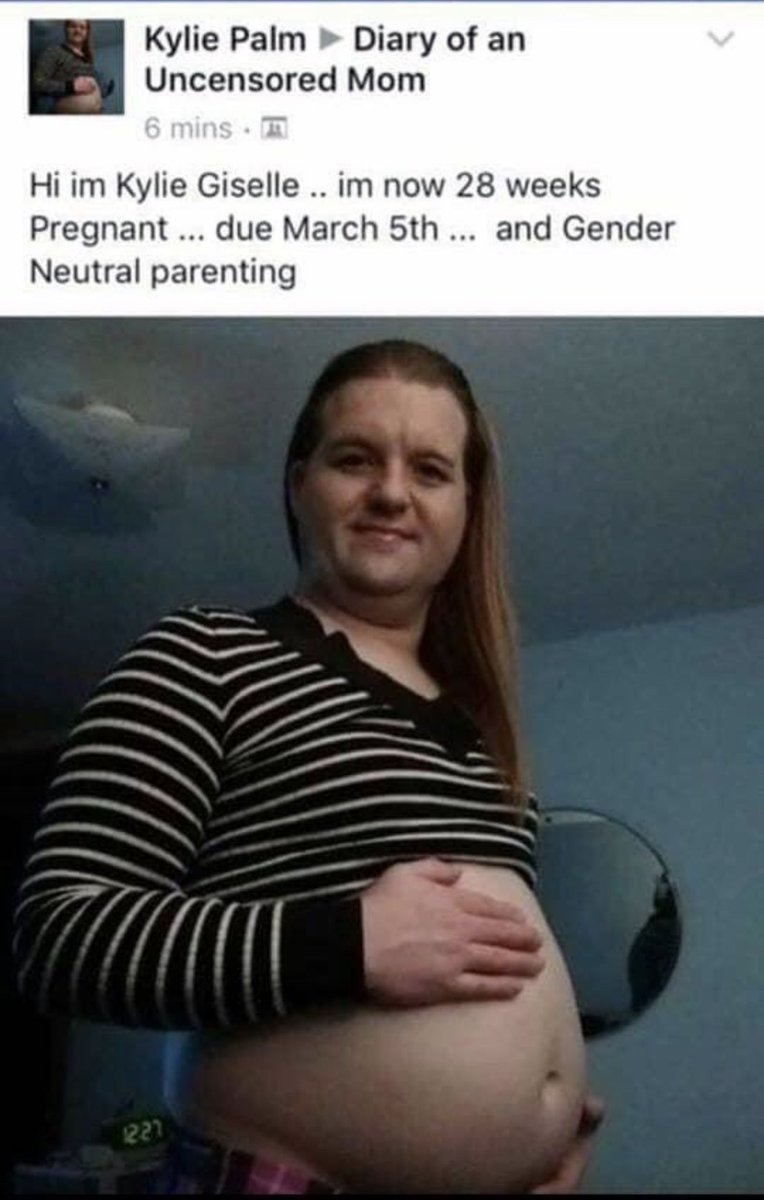
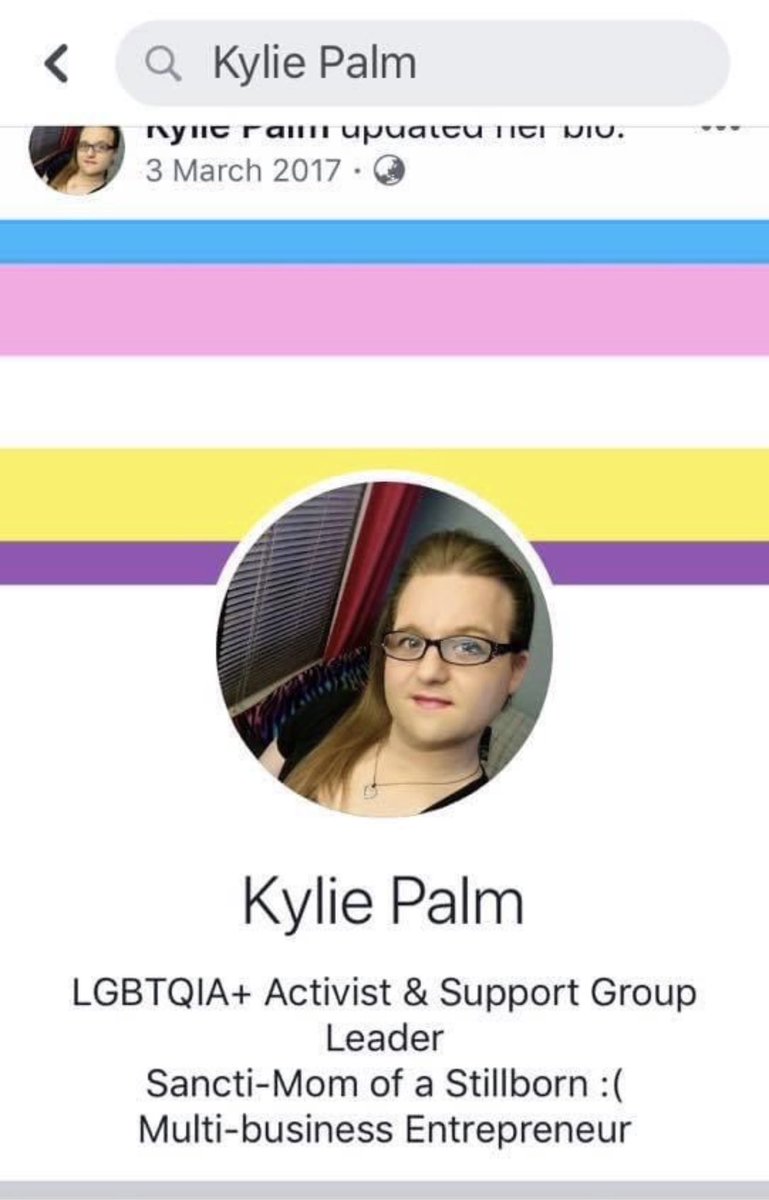
Meet “Kylie Palm,” another man who pretended to be pregnant and then faked a stillbirth. He even tried to raise money for a doll to “help him grieve” for his imaginary baby. Mr. Palm also joined a parental grief/stillbirth group, and he, too got women who had experienced the loss of an actual child kicked out of their own support group.
Now I’m wondering how many other men have done this in their fetishistic pursuit of women’s pain.