19 year old Japanese student built a trading bot with Claude Code in 2 days.
Used his iPad as a second monitor.
First night: $6,732 profit.
Starting capital: $68.
Total profit so far: $750,000.
[ 𝐍𝐨𝐭𝐞: 𝐅𝐨𝐥𝐥𝐨𝐰 𝐌𝐞 @quantumaix8 𝐅𝐨𝐫 𝐢𝐧𝐬𝐭𝐚𝐧𝐭𝐥𝐲 𝐚𝐮𝐭𝐨 𝐃𝐌]
Here's how it works👇
The bot scans over 50 markets simultaneously.
Syncs live BTC data from Binance every second.
Spots price errors before humans even notice.
The edge is pure speed + pattern recognition.
While traders stare at charts trying to predict the next move, his bot is already executing on mispricing across dozens of markets.
No guessing.
No emotions.
No hesitation.
Just Claude Code logic finding gaps that close in seconds.
He built the entire system in 48 hours:
→ Claude Code handles the trading logic
→ Binance API feeds real-time BTC data
→ iPad displays multi-market monitoring
→ Executes trades when arbitrage windows open
The system runs 24/7.
Every price dislocation = profit opportunity.
Most people are still trading manually, refreshing charts, second-guessing entries.
Meanwhile this 19 year old engineering student turned $68 into $750K by letting Claude Code do what humans can't: process 50 markets instantly and execute without fear.
Why are people still trading manually?
I'm giving away the exact Claude Code setup for free.
24 hours only.
To get it:
1️⃣ Comment " OPUS "
2️⃣ Like and Repost
3️⃣ Follow @quantumaix8 so I can send it via DM.
I'll DM you the complete setup.
A 19-year-old Japanese student built a trading bot with Claude Code in 2 days.
Used his iPad as a second monitor.
First night: $6,732 profit.
Starting capital: $68.
Total profit so far: $750,000.
Here's how it works:
The bot scans over 50 markets simultaneously.
Syncs live BTC data from Binance every second.
Spots price errors before humans even notice.
The edge is pure speed + pattern recognition.
While traders stare at charts trying to predict the next move, his bot is already executing on mispricing across dozens of markets.
No guessing.
No emotions.
No hesitation.
Just Claude Code logic finding gaps that close in seconds.
He built the entire system in 48 hours:
→ Claude Code handles the trading logic
→ Binance API feeds real-time BTC data
→ iPad displays multi-market monitoring
→ Executes trades when arbitrage windows open
The system runs 24/7.
Every price dislocation = profit opportunity.
Most people are still trading manually, refreshing charts, second-guessing entries.
Meanwhile this 19-year-old engineering student turned $68 into $750K by letting Claude Code do what humans can't: process 50 markets instantly and execute without fear.
Why are people still trading manually?
💡I'm giving away the exact Claude Code setup for free.
24 hours only.
To get it: 👇
1️⃣ Comment "Claude"
2️⃣ Like Comment and Repost
Follow @techluisenzo
I'll DM you the complete setup.
The MemeBitcoin account transfer request page is now open, following our earlier update on support for users affected by X account suspensions.
Please submit an appeal to X first. If your suspension is lifted, you can continue logging in with your original X account. If your account remains suspended, sign in to the request page with a new X account, enter your original account details, and sign with the wallet you provided during registration.
Requests will be reviewed in the order received. If approved, the points, game progress, and emblems from your existing MemeBitcoin account will be transferred to your new X account. Accounts found to have used bots or engaged in abuse are not eligible for support.
This process does not lift your X account suspension. We will never ask for your password, private key, or seed phrase. Never share these with anyone.
👉 Submit a request: https://t.co/Bzq4KiaOhc
@Playnance_ Transaction completed but USDC not received yet please check
Transaction hash is
0x5f119bff0bef091050f23cde049785e41dbe6e482dd277c5b98cff0bd298de6d
Today I call upon the blockchain industry to calmly begin planning for "bunker mode". My personal recommendation is to set in motion a controlled mass migration of assets to fresh addresses, i.e. addresses whose pubkeys remain hidden behind a hash.
Holders, starting with large and sophisticated ones, should consider moving the bulk of their funds to addresses that have never signed a transaction. And when they do sign one, they should also move remaining funds to a new address (possibly generated from the same seed phrase).
Don't rush. While I believe there is cause for action a rushed migration would do more harm than good. Don't panic either. Moving assets to protected addresses is a simple, preventative step which does not require new cryptography or new wallets.
IMO it is now reasonable to brace for the possibility that ECDSA breaks before qday, in the worst case in months not years. By "break" I mean fast private key recovery (e.g. in one week) on available hardware (e.g. a large GPU cluster).
Recent days have been humbling for human mathematical intuition. Long-held, unquestioned hypotheses have fallen. This includes the n log(n) bound for integer multiplication and the 3SUM conjecture. In hindsight, May's unexpected disproof of the Erdős unit distance conjecture was our warning shot.
Yesterday's OpenAI drop made it clear that mathematical superintelligence is upon us. They say there are weeks where decades happen. We are about to live through weeks where centuries of mathematical progress happen. Could our magic 64-byte ECDSA signatures be too good to be true? Was it just security through obscurity all this time?
Elliptic curves feel especially vulnerable to superintelligence. Curves carry rich structure, with room for fancy tricks like Schoof, Frobenius, pairings. (By contrast, hashes are designed to minimise algebraic structure.)
Separately, as Ewin Tang can attest, an efficient quantum algorithm sometimes foreshadows an efficient classical one. We should be open to the possibility of a classical counterpart to Shor that breaks elliptic curves and RSA at once.
Also noteworthy is the striking under-representation of cryptographic breakthroughs among the 722 mathematical results OpenAI published. I've witnessed first-hand the US government censoring academic quantum cryptanalysis results. Backroom interventionism is my base case.
I urge large, sophisticated actors to lead by example. Project11's "risq list" (bitcoin-risq-list.projecteleven[.]com) is a great tracker of exposed BTC pubkeys. Binance, Bitbank, Robinhood, Bitfinex, and Tether have an opportunity to harden their cold storage. Next month I'll address institutions in London in a live Q&A (forum.ethereuminstitutional[.]org/london-2026).
Again, please do not rush. Wallets holding under 50 BTC enjoy partial cover from "Satoshi's shield", i.e. his 20K exposed addresses that hold 50 BTC each. Load-bearing signers like oracles and L2 security councils should consider rotating ECDSA pubkeys with every signed message and/or multi-signing with a hash-based schemes like SPHINCS.
Exiting bunker mode safely will require post-AI cryptography. My inclination is to go all-in on hash-based cryptography and avoid structured mathematical assumptions entirely, whether from curves, lattices, or isogenies. A single battle-tested hash (e.g. from the SHA or BLAKE families) yields plausible post-AI security.
The Ethereum roadmap on strawmap[.]org fully embraces hash-based cryptography with end-to-end formal verification as a response to the quantum threat. Those timelines must now be revisited and accelerated in light of mathematical superintelligence. I'll be pushing for maximum defensive acceleration.
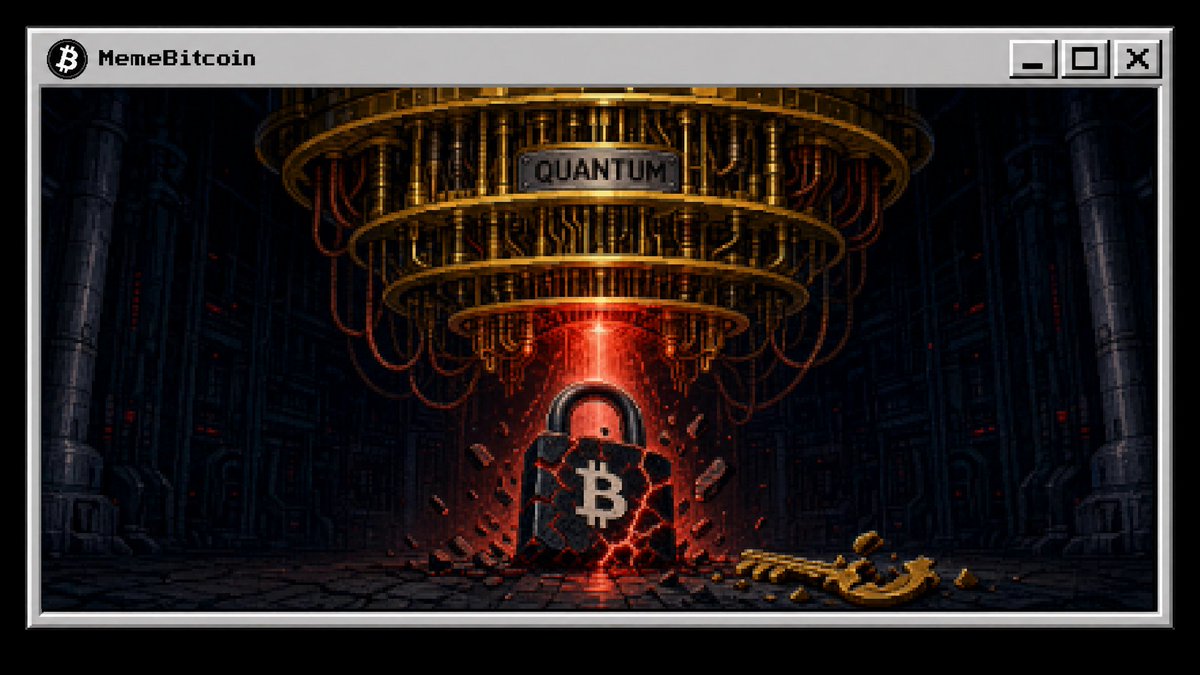
As we shared earlier, quantum computers cannot derive Bitcoin private keys today. But the computational resources required to make that possible are falling quickly.
In cryptography, "impossible" is not a law of nature. It is only a description of how much computation is required.
MemeBitcoin does not intend to leave this as a problem for the distant future. We are accelerating Crack participation so more of the community can take action now.
On September 29, a new Crack Event begins with a total reward pool of 1.096361 BTC.
Keep participating in Crack on MemeBitcoin as usual. You do not need to submit another BTC wallet address.
When the event begins, the Community Gauge will appear on the game screen. The Community Gauge does not decrease with every Crack. It decreases whenever an event winner is selected, reflecting the remaining reward amount.
Every Crack becomes part of a record built together by the community in the race toward 1,096,361 BTC.
If you receive the BTC Event Winner emblem, you have won. Your individual reward amount will be available when Claim opens. Each user can receive only one BTC Event Winner emblem.
The event ends when the remaining reward amount shown on the Community Gauge reaches zero. There is no fixed end date.
Detailed information about reward confirmation and the Claim process will be announced separately once everything is ready.
Crack.
Watch the remaining BTC fall.
Claim your share of 1.096361 BTC.
https://t.co/EYkXmHa5kS
※ Notice: The MemeBitcoin Portal, originally scheduled to open on September 28, has been postponed while we prioritize the Crack Event. A new Portal launch date will be announced through our official channels.
Quantum computing still feels like science fiction to most people in crypto.
But the research is moving faster than many realize.
Earlier this year, Google Quantum AI published new research on Shor's algorithm and secp256k1, the elliptic curve used by Bitcoin.
Under the hardware and error rate assumptions used in the research, the estimated number of physical qubits required for this type of attack fell to roughly one-twentieth of previous estimates.
That does not mean a quantum computer can derive Bitcoin private keys today.
But it does mean that a future quantum computer capable of threatening Bitcoin cryptography may require significantly fewer resources than researchers previously estimated.
And the work is continuing. Researchers are still finding ways to make the algorithms and quantum circuits involved more efficient.
The progress in quantum computing appears to be moving faster than the conversation around it in crypto.
Most crypto users still see quantum risk as something far in the future.
Something to think about later.
But how far away is "later"?
Crypto has a Fear and Greed Index to measure how the market feels every day.
Maybe one day we will need a way to measure quantum risk too.
At MemeBitcoin, Crack has never been symbolic.
Every Crack generates a real candidate private key and checks whether it matches the target associated with Satoshi.
With today's computing, the probability of finding the correct key is effectively zero.
But "impossible" in cryptography is not a law of nature.
It is a statement about how much computation is required.
And that is exactly what advances in quantum computing are beginning to challenge.
For now, the mathematics still holds.
For now, those coins remain untouched.
For now.
An estimated 1,096,361 BTC, held in wallets widely associated with Satoshi, has remained untouched since Bitcoin's earliest days.
We have been cracking toward it, one key at a time.
Soon, there will be another reason to Crack.
This is content from Justin Drake’s remarks on quantum computing progress from almost four months ago.
The 1,096,361 problem is approaching silently, it is not a distant-future problem, but a practical one.