Jensen Huang deserves due process, not mob justice. He is literally the reason we have an AI revolution and why US leads the AI race.
Read the Stand with Jensen letter and consider adding your name. #standwithjensen#bringjensenback https://t.co/FU2zi2Aocd
@WSJ@WSJopinion You sort of set him up, didn’t you, by creating the impression that senior government officials anonymously provided information about spying, when in fact the info came from a lobbyist at a competing AI company?
Many years ago, while researching a paper on U.S. monetary policy, I read the testimony before Congress of several extremely prominent economists during the 1960s and 1970s.
I was somewhat saddened to discover that they did not follow standard stabilization principles. When the economy was weak, they recommended expansionary fiscal and monetary policy (the right advice in that scenario). But when the economy was booming, they never supported contractionary fiscal and monetary policy (also the right advice in that situation) because they did not want to “kill the expansion.”
No, sorry. If you want to manage aggregate demand (and I believe we should), you need to understand that this is a balancing act and, even more importantly, that fiscal policy has to be sustainable. Keynes himself was extremely clear about this. Gösta Rehn (1913–1996) and Rudolf Meidner (1914–2005) were even clearer: the government should run a surplus on average to have enough fiscal space to respond to large shocks (wars, financial crises, etc.). It is precisely because we care about those most vulnerable in society that you want to run a surplus. The cries against “austerity” are nearly always a mix of demagoguery and irresponsibility.
I suspect that many of those who defend Keynes most ardently in the public debate are the ones who least appreciate how good an economist he was.
I was Bill’s junior colleague for seven years at Yale Economics. Bill was always sharp and curious, and most importantly, so kind and supportive. RIP, Bill. https://t.co/pDJDDTYfZF
New research shows that cities in China whose mayors compete more closely for promotion do less business with each other. Local SOE investment aligns with the political interests of mayors. When mayors don’t compete, the effect disappears. Read the brief: https://t.co/BiN2RnkEst
Dear President Kornbluth and Chairman Gorenberg,
Yesterday, as I am sure you are aware, a Boston jury unanimously found that @MIT professor Kristin Knouse defamed David Sabatini, falsely accused him of rape and sexual harassment, and tortuously interfered with his contractual arrangements including his tenure at MIT.
MIT and its tenure review committee relied on Professor Knouse’s statements when it took away David’s tenure and terminated him.
MIT's policies explicitly prohibit harassment, retaliation, and fabrication of claims. Falsely accusing a colleague of rape and sexual harassment and pushing for his termination under false pretenses are clearly violations of MIT policy.
In light of the unanimous findings of the jury after five years of discovery, many legal motions and countermotions by both parties, and a three-week trial in Suffolk County Superior Court in Boston:
Is MIT going to take away Knouse’s tenure and terminate her?
If not, why not?
Is MIT going to restore David’s tenure, and apologize for firing him?
If not, why not?
In light of what has transpired in this grave miscarriage of justice, MIT has the opportunity and the obligation to right a serious wrong here.
At a minimum, the public deserves transparency into what actions MIT is taking in this case as taxpayers are major funders of MIT.
Sincerely,
Bill Ackman
📢 ‼️New SCCEI China Brief‼️ 📢
In China, competition for promotion among local officials exacerbates misallocation and fragments China’s domestic market. Read the brief: https://t.co/BiN2Rnk6CV
The narrative is blame China and trade, and it’s mostly wrong. The general point is that areas relatively more exposed to negative demand shocks saw more job losses and had a hard time adjusting or did not adjust at all. The China Shock lit is based on a clever way to identify a particular type of negative demand shock (import competition). It only shows areas more exposed lost more jobs relative to less exposed regions. It cannot credibly produce a general equilibrium total job loss number. What we learned is adjustment to those shocks is hard. What politicians heard is only China Shock bad, must reverse China Shock. It’s a rhetorical question but there were 2 million manufacturing jobs lost during Great Recession, what are doing about that? It appears to be, almost nothing, because there is no clever ID strategy.
Reposting a WSJ op-ed with Jim Heckman on the “China Shock” study published in May 2025. Academic economists used to be more carefully qualifying their research findings. https://t.co/midKtQgtG3
@JesusFerna7026 It is important to account for the heterogeneity in fertility rates among subgroups. Are there subgroups with fertility rate substantially above replacement. Such groups, if any, will be the protection against the converging to 0 logic. It is natural selection in action.
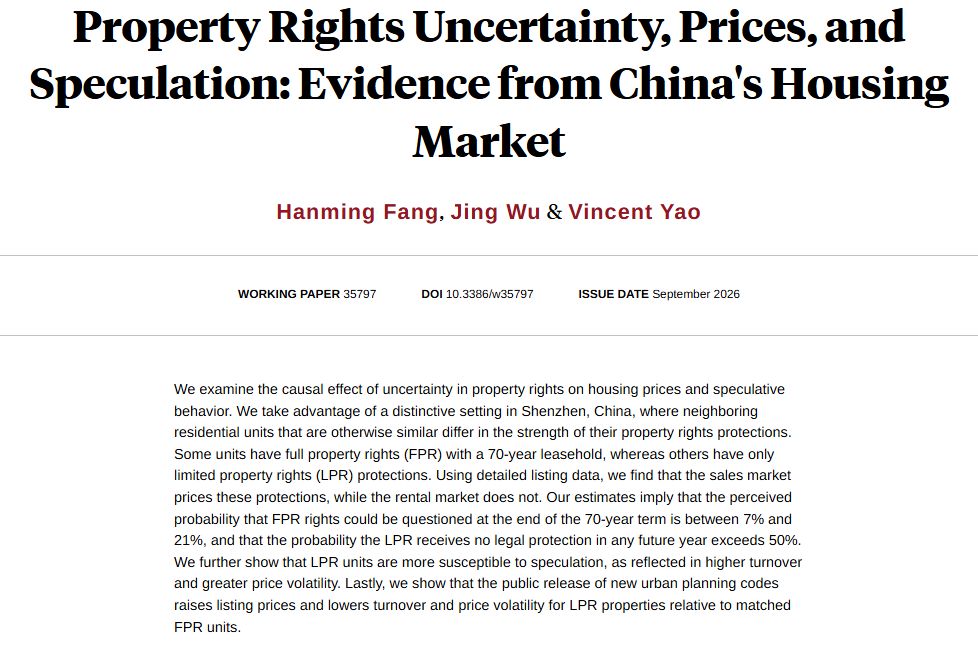
Market sales price in property rights uncertainty but rental rates do not; limited property rights houses show more price volatility and turnovers-signs of more speculation-relative to matched full property rights houses.
Studying how property rights uncertainty affects prices and speculative activities in the housing markets using a natural comparison of full and limited property houses in Shenzhen, from @HanmingF, Jing Wu, and Vincent Yao https://t.co/qpNgCu2FBv
Studying how property rights uncertainty affects prices and speculative activities in the housing markets using a natural comparison of full and limited property houses in Shenzhen, from @HanmingF, Jing Wu, and Vincent Yao https://t.co/qpNgCu2FBv
Asset privatization as intergenerational redistribution instrument has the automatic stabilizer property, while pension based redistribution faces downward rigidity when growth slows down and population ages…
Subsidized access to appreciating public assets in rapidly growing economies can serve as a powerful instrument for intergenerational redistribution, from Kaiji Chen, @HanmingF, and Yang Tang https://t.co/oaPzur63vU
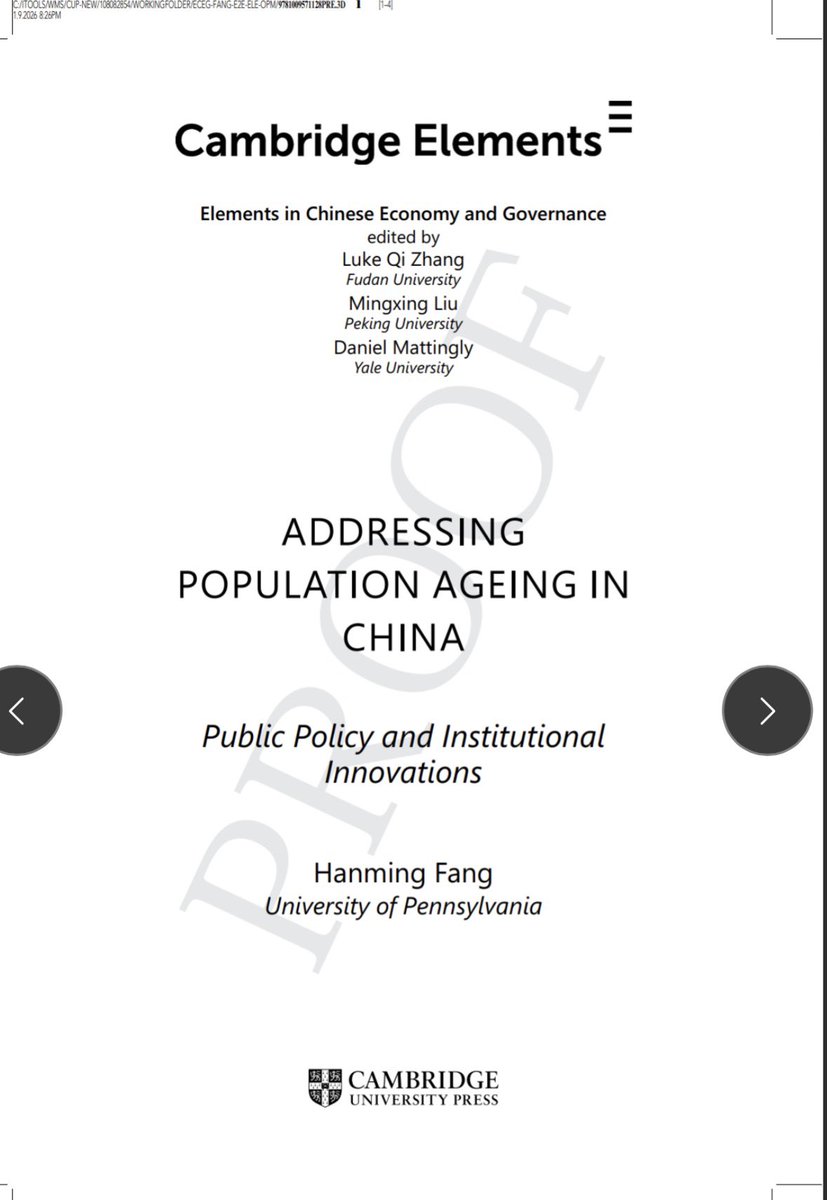
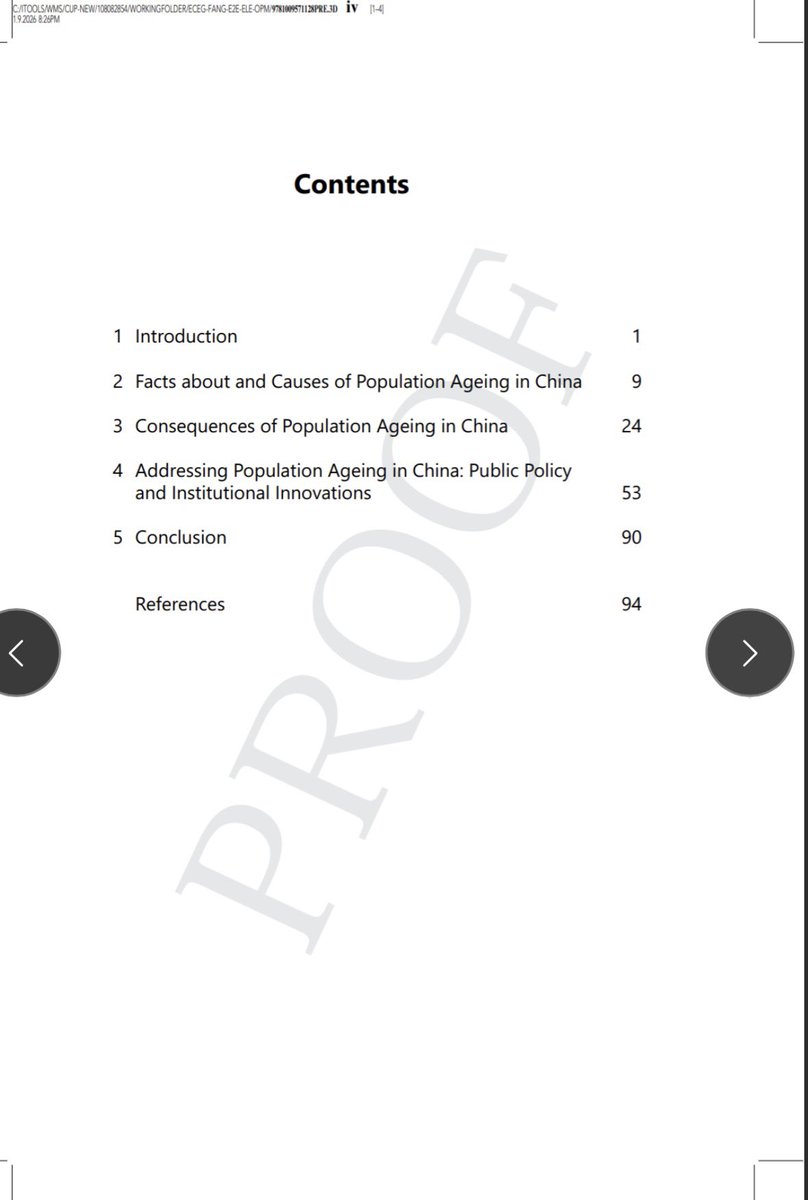
Pleased to receive the proofs for my forthcoming Cambridge Element titled “Addressing Population Ageing in China: Public Policy and Institutional Innovations”. It summarizes my understanding of the Chinese ageing issues and possible solutions. Links will be posted here later here
Why it is so important to get to the bottom of how this tragedy could have happened in such a great university… Besides Keynes, Cambridge economics was the intellectual home for Alfred Marshall, AC Pigou, Frank Ramsey, Joan Robinson, Frank Hahn, James Meade, Sen, Dasgupta, etc.
The University of Cambridge can boast 126 Nobel Prizes. That’s more than any other university in the world except Harvard, and it does it on an endowment that is one twentieth the endowment of Harvard. In the Nobel ranking, Cambridge beats MIT, Chicago, Columbia, Oxford, and Yale (in that order). Cambridge, the university of Newton, Hawking, Russell, Wittgenstein, Moore, Keynes, Crick, Sanger, Kendrew, Perutz, Rutherford, Chadwick, Turing, Maxwell, Brenner, the list goes on and on, Cambridge is beyond question one of the very greatest universities in the world. The list of immense distinction continues to the present day. It is tragic, and deeply unfair, that the reputation of this truly great university should suffer at the hands one unfortunate anomaly, the Department of Education.
I agree with every word you say. I have to say that, on my just concluded sabbatical at Cambridge, I met amazing first rate scholars in evolutionary ecology, in climate science, in dense material physics, in Chinese history, etc. What just transpired is shocking to me.
I strongly believe that knowledge is fundamental to running a society. We need economists who understand monetary policy in central banks. We need researchers who have studied history, strategy, and military affairs to help steer national defense. We need doctors and public health experts to design effective responses to epidemics.
But the public needs sound reasons to let these experts shape their future. Once that trust evaporates, we are all worse off. Unfortunately, the Jason Arday scandal is the perfect example of how these experts, and the institutions they run, are destroying that trust.
I do not find Arday’s tales extraordinary. Throughout history, there are thousands of examples of people spinning fantastic tales about their lives. He is just one more name on a long list of confidence men.
What is extraordinary is the massive institutional failure at every level. Liverpool John Moores University granting a degree for a Ph.D. dissertation that did not survive even basic scrutiny (including a grammatical mistake in its title). Cambridge University appointing him (full) professor at an unusually early academic age (eight years after his dissertation; in academia, this is what matters, not your biological age) and with a scholarly record that was rather thin. Hilary Cremin (@hilarycremin), head of the Faculty of Education, telling the world on television that Arday was “the best in the world in terms of the research that you do.” The BBC broadcasting segments about Arday, a most unusual decision for an academic appointment. Simon & Schuster paying him a large advance for his memoirs on the basis of a book proposal that defied common sense. And Amazon promoting his book, still this very morning, as an editor’s pick.
If I were a regular person, say someone driving a truck in the Midlands or working at a small shop in Sussex, how could I trust the universities any longer? How could I trust the BBC and the media? How could I trust the publishing industry? How could I trust Amazon’s editor’s picks?
Then, should we be surprised if the farmer or the shop owner votes for someone selling snake oil? Or if they refuse to listen to the case for policies that cost them in the short run but benefit them in the long run, such as the transition to net zero emissions? Or if they read books written by charlatans? Or if they deny basic scientific findings?
The universities, the media, the publishing industry, Amazon, and many of our other core knowledge institutions have a serious problem. Their response is to close ranks and avoid a serious discussion. No, sorry, this will not do.
The Jason Arday scandal should be a moment of reckoning. Unfortunately, I am afraid it will not be.