@Anirudh50919300@bmss_official 2/2 When they are too close to each other, it should be possible to separate them by Ion Mobility Mass spectrometry as they will have different conformations/masses/charges/sizes/shapes
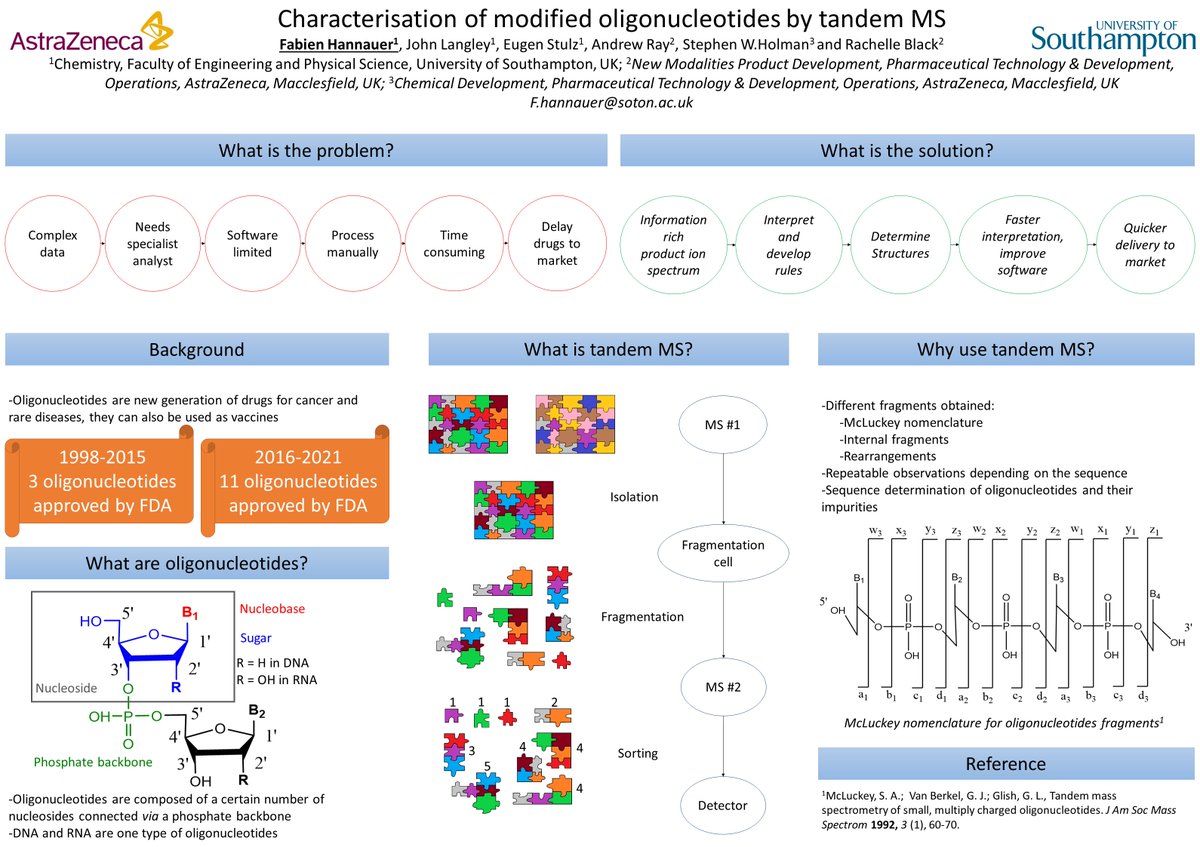
I am happy to share my first #RSCPoster which is an introduction to my project on the characterisation of therapeutic oligonucleotides by tandem MS. Happy to answer any questions #RSCAnalytical
@Anirudh50919300@bmss_official 1/2 Thank you, that is a good question. In general, they can have very close m/z which can be separated by high resolution.
@SCancho The fragmentation technique used is collision induced dissociation (CID) which is the most commonly used in tandem MS and for oligonucleotides. Other fragmentation techniques can be used in complementary of CID as they will give different types of fragments.
My research focuses on the use of Supercritical Fluid Chromatography-Mass Spectrometry (SFC-MS) for analysis of pesticides. Here is some background to my project and some reasons why you should consider SFC for your method development! #RSCPoster#RSCAnalytical
@DrG34185295 Thank you, at the moment I do not know, but it should be possible to apply it for modified oligo.
Depending on the modifications, different types of fragments should be observable.
@SCancho At the moment, the different software used to process the data are limited that is why new observations are necessary which could be used in new software.
Using AI could help but it is out of my area.
Excited to share my #RSCPoster today, exploring the issue of fuel delivery system blockages and how a combination of different chromatography and mass spectrometry techniques can help understand why these blockages occur! #RSCAnalytical