Excited to see WPSS being recognized as one of the top 10% most-viewed papers published by Wiley in 2023! Many thanks to my mentor Dr. Choupan’s continuous support!!!
🎉 Congrats to @JeiranC's current PhD student, @HaoyuLan, on his new achievement for his WPSS PVS segmentation work. Haoyu's work was recognized among the top 10% of most-viewed papers published by Wiley in 2023! 👏
Check out the paper here: https://t.co/MMU5WbzxeW
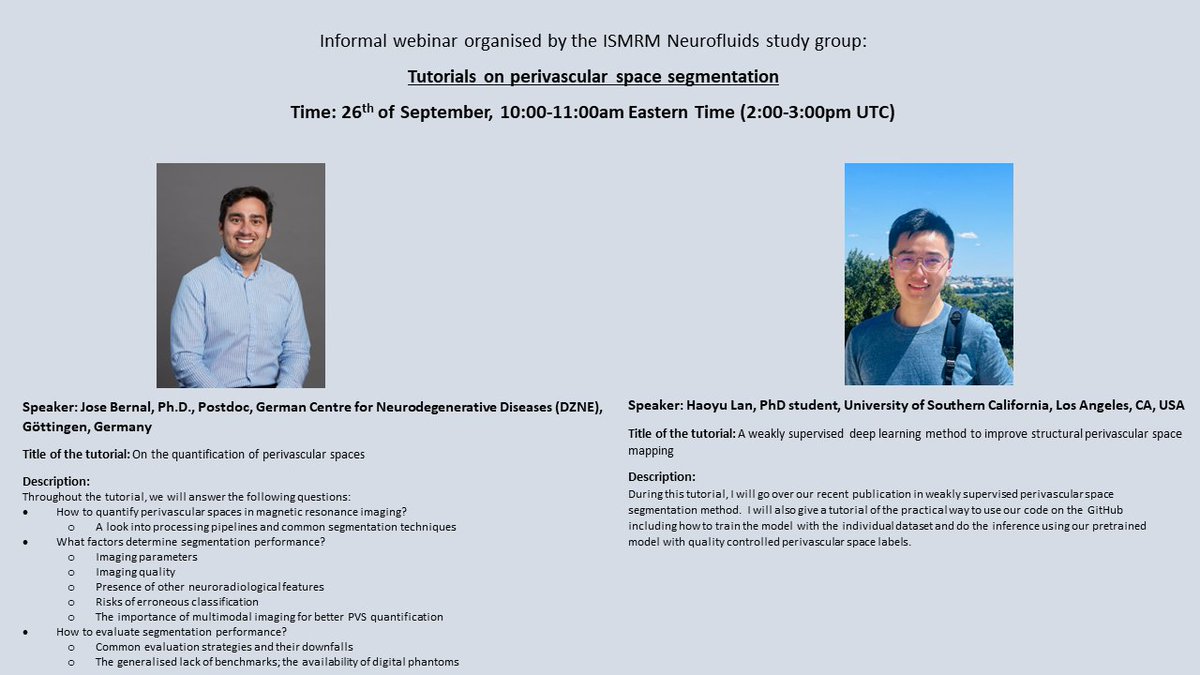
The ISMRM Neurofluids SG would like to invite you to attend our first informal webinar (26th Sept) on perivascular space segmentation methods!🧠
During these informal webinars we aim to provide more practical tutorials and stimulate discussions.
Everyone is welcome to attend!
We are thrilled and honored to have received this award from Andrew and the editorial teams of NeuroImage: Clinical at #OHBM2023. Thanks to all my coauthors,@fsepehrband & Kymry; this achievement wouldn’t have been possible without you. Thank you all!✌️😊
@USCLONI@OHBM@eic_nic
📢Thrilled to announce the source code of our PVS segmentation model WPSS is publicly available! WPSS is a weakly supervised data-driven convolutional neural network model focusing on segmenting PVS in #MRI images. Learn more 👉 https://t.co/QmaHiyUsQm
Congrats @JeiranC@HaoyuLan
Check out at @midl_conference Frequency Structural MRI Signal conditioned MRA Synthesis with Denoising Diffusion probabilistic Model" by @HaoyuLan! This work proposes a method using DDPM to synthesize MRA from T1w MRI enabling non-invasive vasculature visualization. #ChatGPT
I'm excited about Segment Anything released from FAIR today. It tackles an old problem (find objects in images) at large scale: trained on 11M images and 1B objects.
This is a new Foundation Model for Computer Vision - it recognizes any object in any context.
I'm speechless.
Not peer-reviewed yet but a submitted paper.
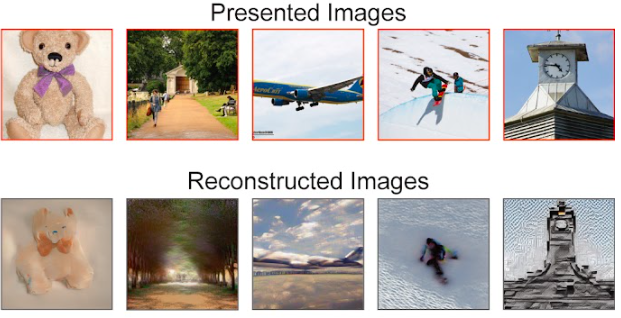
The 'presented images' were shown to a group of humans. The 'reconstructed images' were the result of an fMRI output to Stable Diffusion.
In other words, #stablediffusion literally read people's minds.
Source 👇
// Stable Diffusion, Explained //
You've seen the Stable Diffusion AI art all over Twitter.
But how does Stable Diffusion _work_?
A thread explaining diffusion models, latent space representations, and context injection:
1/15
Curious about “Imaging perivascular space structure and function using brain MRI”? Check out our latest paper published in @Neuroimage https://t.co/9uDgOgWqV0
1. This article covers ...
[REST IN NEXT COMMENTS]
How to network at a conference?
Many students will be attending their first-ever *in-person* conference this year. How exciting! 🤩
Some tips on making the best of attending a conference. 🧵
1/ People study medial entorhinal cortex (MEC) because of its key role in navigation and memory.
In our new paper we build neural network models that explain the full diversity of neural responses in MEC.
To appear as a #NeurIPS2021 Spotlight!
Tweetprint below 👇🧠
1/ I'm often confronted with skepticism that neural network models of the brain are intelligible, or that they're even proper models at all, considering how "different they look" from real brains.
We are thrilled to announce the #ICLR2021 Outstanding Paper Awards! Out of 860 excellent papers, the award committee identified 8 that are especially noteworthy:
https://t.co/zvHwJFrkld
Congratulations to the authors!!
@shakir_za@iatitov@aliceoh@NailaMurray@katjahofmann
Future AI systems will learn as people do — without relying on labeled data sets. Today we’re detailing SEER, a breakthrough in self-supervised #computervision, and open-sourcing VISSL, the library we used to build it. Learn more:
https://t.co/CBg6ZkiqFU
We've found that our latest vision model, CLIP, contains neurons that connect images, drawings and text about related concepts. https://t.co/zV6N4yvYcG