🚨 New paper 🚨
"Indirect Credit Supply: How Bank Lending to Private Credit Shapes Monetary Policy Transmission" joint with Young Soo Jang and @JessieJiaxuWang .
https://t.co/DJj2e0OplM
Many thanks to the University of Florida's finance group for inviting me to present in their fall seminar series. The feedback on my paper was extremely helpful, and special thanks to @CortesGustavoS for showing me around beautiful Gainesville !
https://t.co/fo3VUuNBhw
New paper:
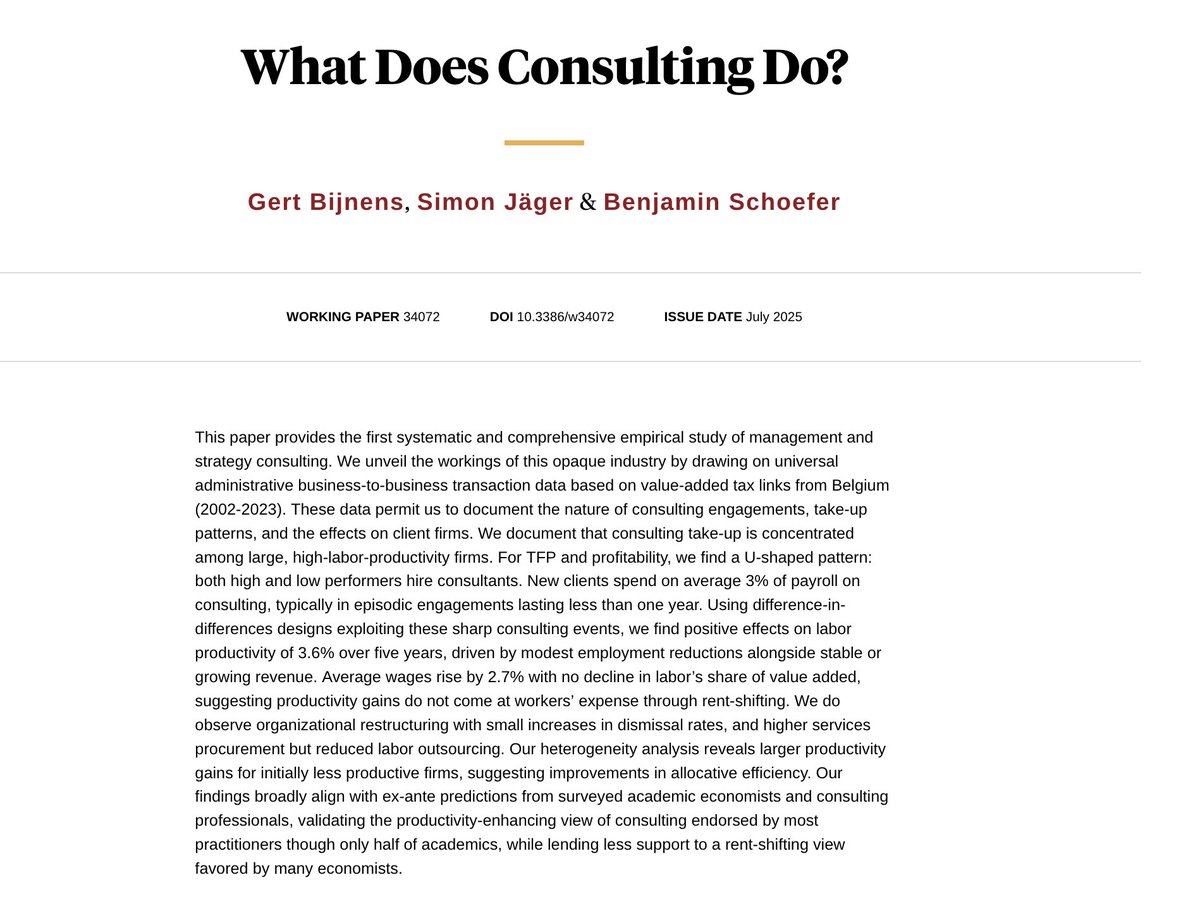
"What Does Consulting Do?"
w/ Gert Bijnens, @simon_jaeger
Consulting is a storied but opaque industry.
Our VAT-based B2B data permit the 1st comprehensive study:
Which firms buy consulting?
What happens when they do?
https://t.co/o0znxOUz7O
https://t.co/wVFNyRv8cp
Highly recommended!
"Attention to the Macroeconomy" by Sebastian Link, Andreas Peichl, Oliver Pfäuti, Christopher Roth, and Johannes Wohlfart
"...attention to the macroeconomy responds strongly to shocks; more attentive respondents adjust their inflation expectations more frequently during the shock, are more confident in their beliefs, and hold smaller misperceptions about realized inflation. However, at odds with goal-optimality of attention, more attentive agents’ expectations about future inflation deviate more strongly from expert benchmarks."
https://t.co/HO1aBTQuj9
By the way, Oliver Pfäuti is a graduate of the Master’s program in International and Monetary Economics (MIME). Highly recommended! https://t.co/KcAD71dYND
🚨 Reminder -- Today is the final day to submit your papers for the 38th Mitsui Finance Symposium: New Frontiers in Financial Intermediation.
Please submit your paper here:
https://t.co/lnxRbE3Ra8
During tightening, banks charge private credit lenders relatively higher rates compared to other borrowers with comparable levels of credit risk. Private credit lenders in turn pass this higher cost to firms.
🚨 New paper 🚨
"Indirect Credit Supply: How Bank Lending to Private Credit Shapes Monetary Policy Transmission" joint with Young Soo Jang and @JessieJiaxuWang .
https://t.co/DJj2e0OplM
We highlight a novel quantity-price tradeoff: bank lending to private credit funds mitigates the credit supply contraction during monetary tightening but amplifies monetary policy transmission by raising borrowing costs.
@ymschindler Very nice paper ! Do you know what share of these firms receive venture capital funding, and how that differs by treated/untreated or those that survive/fails? My guess would be it would be significant since many of these look like startups and your 5 states include California.
Submissions to the FRA went live on July 1. You can submit your paper here (deadline Aug 31).
https://t.co/YMKtkQcJkH
As with last year, we're delighted to partner with @J_Fin_Economics with a dual submission. Full details here:
https://t.co/lr31BhnUsz
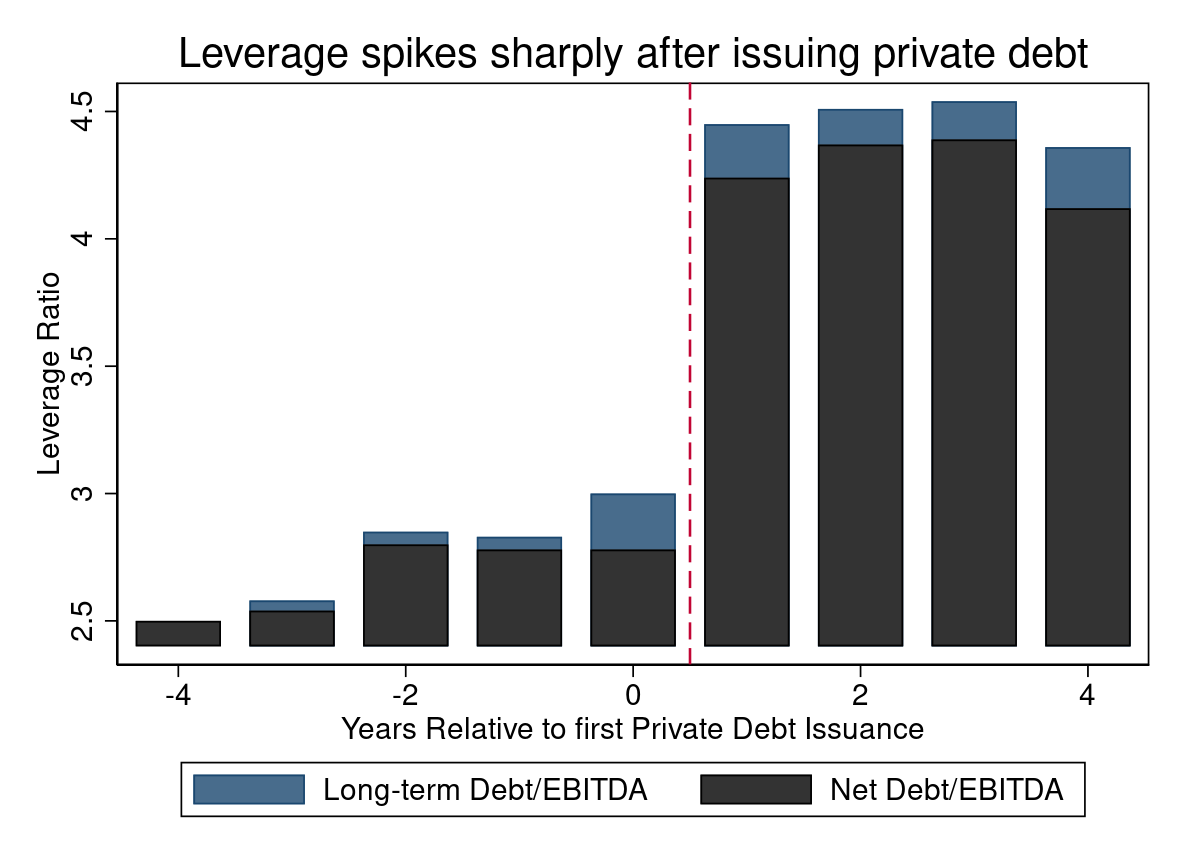
🚨New paper: Private Debt versus Bank Debt in Corporate Borrowing, joint with Irina Stefanescu and Simon Mayer. We study how firms choose between bank debt and private debt, and how the rise of private debt affects bank lending. https://t.co/0aIiHX0zuw