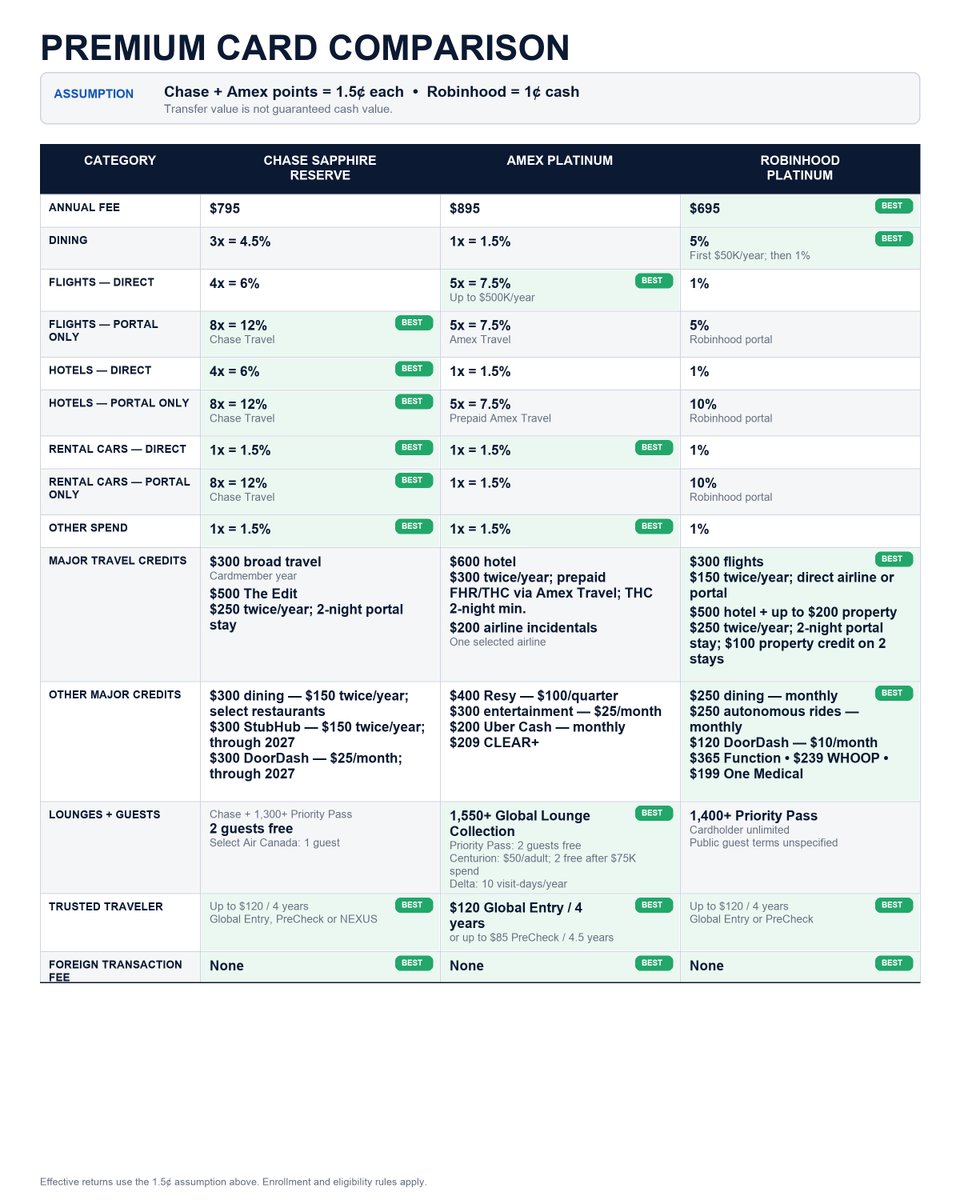
Robinhood launched the Platinum Card, a direct competitor to the Chase Sapphire Reserve and Amex Plat, but built for a younger, more tech-forward customer, with benefits I'd actually use that easily cover for the $695 annual fee.
They have improved it significantly from what they announced a few months ago, and could be a great card for you.
but... I won’t be getting it, and will instead be sticking to my existing stack:
Chase Sapphire Reserve for Travel and Dining (4.5%+)
United Quest Card for United (Even if you don't use the card it pays for itself if you are a frequent flyer because you get more miles just for having the card)
Amazon Prime Visa - 5% on Amazon/WholeFoods
Robinhood Gold card for 3% cash back on everything else
That being said, the Platinum is a very competitive card. Highlights:
• 27g platinum-plated card (a negative for me! I want a lighter card tbh)
• 5% cash back on dining (up to $50k spend/year- this is the best differentiating feature)
• 5% on flights booked through Robinhood
• 10% on hotels and rental cars booked through Robinhood
• Up to $1,000/year in travel credits ($300 flights plus up to $700 on premium hotels, spread across semiannual credits)
• Function Health ($365), WHOOP ($239) and One Medical ($199) included - if you use these 3 it pays for itself!
• Priority Pass lounges, concierge, no foreign transaction fees and Global Entry/TSA PreCheck credit (all table stakes for premium cards)
• Robinhood Gold included ($50)
I think most people in my demographic can easily justify the $695 annual fee, you'll easily get >$1000 of value from the card before you spend anything. I also like that it's straight cash back instead of points, although it's fairly easy to get 1.5c of value from Amex and CSR points.
2 main reasons I don't want to upgrade from Gold to Platinum:
1) They only allow one credit card per account, and the Robinhood Gold makes more sense for me
I already have the Robinhood Gold Card, which is a fantastic flat 3% cash back card. Upgrading would mean giving up unlimited 3% cash back on almost everything and dropping to 1% outside dining and portal travel. If I could keep both cards, I would get the platinum because the benefits easily cover the annual fee for me.
2) The travel portal sucks - you only earn 5% on flights and 10% on hotels when booking through their portal.
I just looked up a hotel I recently booked on Booking for $972. It costs $1,496 in the Robinhood portal. Even after 10% cash back, I'd still be paying hundreds more. Also the UX on the portal leaves a lot to be desired.
Flight portals are also a pain when plans change, so I always prefer booking directly with airlines.
If you're choosing between this card and the Chase Sapphire Reserve, I think it's a legitimate competitor and probably the better fit for a lot of younger professionals.
If you already have the Robinhood Gold Card, though, I'd keep it. The loss of 3% everywhere outweighs the Platinum's incremental benefits for me.
$HOOD LAUNCHES PLATINUM CARD
$695 PER YEAR
- 27g platinum-plated, ie "annoyingly heavy"
- 5% back on dining + flights
- 10% on hotels + rental cars
- Up to $1,000/yr in Travel credits
- WHOOP Peak, Function Health & One Medical memberships included
- Priority Pass lounges, concierge, no FX fees + Global Entry/TSA PreCheck credit
- Robinhood Gold included
- and much more!
The school seats, the fight for everything will slowly become easier. Slowly the number of young people will reduce the age pyramid will become bigger at the top.
Somewhere around 2075, there will be no Gen X and almost all of millennials will be gone. Around the same time total births will be half of what was achieved in 2025
A lot of people make this mistake. They forget that 1984 had higher number of births in India than in 2024
In fact, 1985 had higher number of births than 2005. The current Gen Z is outnumbered by millennials
Dress for the job you want, not the one you have.
You will rarely see me without a suit,
or at the very least, a jacket,
even on Fridays.
Perhaps it’s an occupational habit, but I’ve always believed that every professional is a walking résumé. Before you say a single word, people have already formed an impression of your attention to detail, discipline, and respect for the occasion.
Recently, I met a mid-level Indian professional over lunch. He was in a temporary role and wanted to introduce his founder’s business to me. I arrived in my usual suit. The founder, a Romanian gentleman, was smartly dressed in a jacket. The professional arrived in an untucked linen shirt, worn-out shoes, and spent much of the meeting chewing gum.
Was his competence affected by what he wore? Of course not. But first impressions matter. If you don’t make an effort for a meeting that could influence your career, it inevitably raises questions about how seriously you approach other professional responsibilities.
This isn’t about wearing expensive clothes or designer labels. It’s about showing respect, for yourself, for the people you’re meeting, and for the opportunity in front of you.
One thing I’ve consistently admired in many professionals from countries such as Japan, South Korea, and China is the emphasis they place on presenting themselves professionally. Language barriers may exist, but preparation, discipline, and presentation often speak just as loudly.
Yes, exceptional talent can overcome almost anything. There are brilliant entrepreneurs, engineers, and scientists who break every convention. But for the overwhelming majority of us, professionalism is judged on the complete package: competence, character, communication, and presentation.
My advice to young professionals is simple: work hard, keep learning, and never underestimate the power of looking like someone who takes both themselves and their work seriously
The world is deeply unfair.
Some of the most talented people I know are stuck in dead end desk jobs while some of the snarkiest narcissistic tyrannical workhorses are in positions of great power.
This has always greatly saddened me.
After a lot of analysis, I think there are 5 reasons this happens:
1. Refusal to believe / fear of failure. Loss of belief that where there is a will (to enact change), there is a way e.g. “I am just a cog in the wheel. If I say something, no one will listen.” or “if I do this, I will upset somebody”
2. Lack of purpose. You don’t really understand what you’re fighting for and what you believe in. You fight for inconsequential, often selfish, goals. e.g “Will doing this get me a promotion? Should I completely change everything to do this other project cause it will get me a promotion?”
3. Lack of self awareness. I will stand up to this thing I believe in and they will listen to me. e.g intern saying: “why doesn’t the ceo like my view on company strategy?”
4. Refusal to play. The failure to acknowledge that your worldview is only as powerful as your ability to influence others of your worldview OR a complete repudiation of the will to interact with those who don’t share your worldview e.g. “these guys just do what they want. They won’t listen to me. what will happen if I do this?”
5. Refusal to strategize or concede. The unwillingness to play and win a side quest that will ostensibly further your vote because you find the interim goal pointless. Or the inability to concede a battle to fight the war. e.g. “this direction is wrong. I need to fight it (even though it’s a small issue)”
Almost everyone who is bitter or feels stuck in their career boils down to one of these 5 failure modes 1, 2 and 3 are the most common. Many suffer consequences of 2-5 and end up in 1. I’ve personally seen some of my sharpest friends land up in 1 because they just don’t believe they can win.
One privileged part of my job is getting to interact with people who are willing to, against all odds, believe in something heretical, know why it’s important, know what needs to be done to make it real, do it, and make side quests to get it done. I think it applies to everyone doing anything.
Your parents are suffering from untreated financial trauma.
Indian parents will sit on ₹5 crores of real estate and fixed deposits yet still walk in 40°C heat and fight a street vendor to save ₹15 on tomatoes. They proudly call this middle class values.
It is not. It is a poverty mindset they are absolutely terrified to outgrow.
They built a life optimizing for survival because of the circumstances at that time and now expect you to inherit that as a badge of honor. When they see you paying delivery charges or booking Urban Company, they don't get angry because you are wasting just money. They get angry because your convenience makes their decades of unnecessary suffering look completely pointless.
They forgot one brutal reality: they are not the permanent owners of their wealth. They are simply temporary custodians of it.
They spent their turn hoarding money out of a deeply ingrained fear of going broke. But that era is over. Now the time to use that money is yours. And that’s exactly how this works.
You are not disrespecting their legacy by valuing an hour of your time over ₹15 bus travel. You are actually fulfilling the purpose of the wealth they built. They have won in life.
You cannot inherit generational wealth if you are forced to inherit the trauma of poverty along with it.
Stop romanticizing their struggle, step into your role and unapologetically play your turn.
NRI making money and returning back to spend their last 30yrs is something that will be a major trend in 2030s and 2040s.
Expect gated societies targeted at such people soon.
India will get a lot of forex and a lot of well paying jobs to take care of people who are worth north of $10 million
Major U.S. airlines that have announced @Starlink WiFi adoption:
• Southwest
• United
• American
• Frontier
• Alaska
• Hawaiian
U.S. airlines that haven't:
• Delta
• Jet Blue
Capitalism creates a wealthy society where even people with no skills enjoy higher quality of life than such people in any other society.
Capitalism does not make everyone wealthy. But it creates an environment where even zero skill people get a better life. People cribbing about capitalism should do a world tour to understand how lucky they are just by being in America.
People don't become billionaire by earning.
People become billionaire by creating an amazing company that offers superior product and services. They have billionaire status because they own shares of the company.
When you talk of taxing wealth, you are implying taking away their ownership. That's wrong.
I am not a Crypto believer. I think all this Bitcoin is a Ponzi scheme. Well, who cares what I think?
But here's something that seems to make some sense - Stablecoin.
A stablecoin is a type of cryptocurrency designed to have a fixed value that is tied to another asset—most commonly the US Dollar ($1.00). It acts as a bridge between traditional banking and digital asset banking. I still don't get the need but I understand the mechanics.
For every 1 digital token issued, the company holds $1.00 in a bank account or US Treasury bill. If you want to redeem your token, the issuer burns the digital coin and hands you a physical dollar.
Where it wins?
Sending money across borders via traditional wire transfers is notoriously slow and expensive. A stablecoin can move millions of dollars globally in seconds for pennies.
This will form the basis for Decentralized Finance.
The company well positioned in Stablecoin Business: Circle.
It has received a final regulatory approval from the U.S. Office of the Comptroller of the Currency to establish a national trust bank
Everyone says AI will take away our jobs.
Let’s run that argument to its logical conclusion.
Assume it’s 2050.
AGI exists.
AI can do almost every knowledge task.
75% of today’s jobs disappear.
Companies replace most of their workforce with AI.
Now ask one simple question:
Who is buying what those companies produce?
If 75% of working-age people no longer earn salaries, and you add children and retirees to the equation, who provides the purchasing power that keeps the economy alive?
Businesses don’t exist to produce products. They exist to sell them.
And sales require customers with income.
This is why the long-term challenge of AI is not just technological, it’s economic. Productivity without purchasing power creates a contradiction. Economists have long recognized that mass production ultimately depends on mass consumption.
So the real question isn’t whether AI can replace workers.
It’s whether society can create a new economic model in which people still have enough income to remain customers.
Without demand, even the most advanced AI has no market to serve.
The Story of 2026:
Big AI Capex spending by Alphabet Inc., Amazon, Meta and Microsoft Corp
The winners are the companies executing these capex orders
Foxconn, now Hon Hai's sales for the June quarter rose almost 40% to $79 billion 😲
The US-Iran war spiked Oil prices and pushed customers towards EVs. So, all the European hate against Tesla has disappeared.
According to the European Automobile Manufacturers' Association (ACEA), Tesla sales surged 77% during the first five months of the year.
Tesla's global sales shot up 25% in the second quarter.
The company posted deliveries of more than 480,000 in the three months to the end of June, up from a little over 384,000 during the same period in 2025